CHAPTER 2: The Theater of Compliance
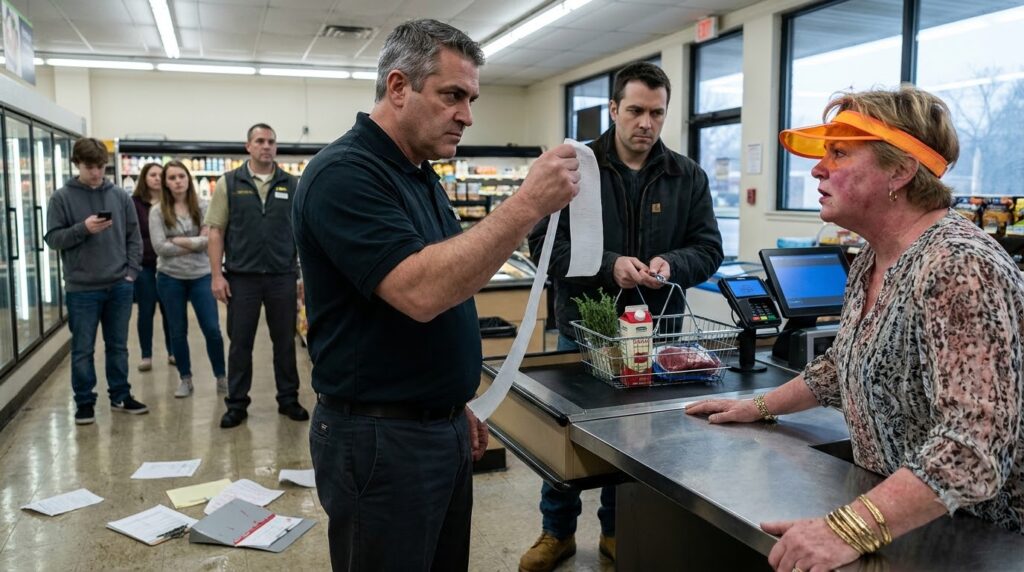
The metal frame of the register counter gave a faint, rhythmic shudder under Brenda’s palm. Her bracelets—dense, overlapping bands of hollow gold—slid down her forearm with a dry, metallic rattle as she hammered the clipboard’s corner against the stainless steel divider. The sound was engineered to irritate, a persistent metronome meant to fracture Julian’s patience before the scanner could read a single barcode.
“I won’t tell you twice, kid,” Brenda said, lowering her register-shaming tone into a conspiratorial purr directed at the growing arc of onlookers behind them. Her visor caught the overhead glare, casting a greenish shadow across her cheekbones where heavy powder settled into fine lines. “This lane is under temporary district lockdown. Section four-B of the charter. Community allotment priority overrides standard consumer transactions during emergency food-drive windows.”
The young cashier, whose name badge read Toby in crooked black letters, looked like he wanted to dissolve into the rubber conveyor belt. His fingers hovered over the plastic keypad, trembling against the yellow CANCEL button. “Ms. Gable, I… I don’t see any district override code on the terminal interface. My supervisor didn’t log a restriction for aisle four.”
“Your supervisor is currently stocking the dairy vault and hasn’t checked his tablet,” Brenda snapped, her chin lifting with defensive rigidity. She reached across the gap, her red-tipped fingernails tapping an aggressive rhythm against the laminated roster clipped to her board. “Look right here. Handwritten addendum. Initialed by three board members. We are clearing out discounted protein cuts for the pavilion harvest supper tonight. That flank steak and the cream—those aren’t retail items. Those are earmarked provisions.”
Julian did not move. He kept his weight planted squarely on his heels, his hands resting lightly on the edge of the counter. Through the gap between Brenda’s shoulder and the register monitor, he caught a sideways glimpse of the clipboard’s reverse side. The cardboard was warped from moisture, and someone—using a thick, unyielding red marker—had scrawled a series of cancelled account numbers and frantic tally marks across the back of the official sheet. The numbers were erratic, ending in heavy, aggressive slashes that cut deep into the gray pulp. It wasn’t an official district roster. It was a ledger of desperation.
“You’ve misread the zoning boundaries again, Brenda,” Julian said, his voice dropping into the steady cadence he used when correcting an apprentice over a misheated pan. “The community pavilion sits three hundred yards west of the property line. This is a commercial establishment governed by state retail code, not your kitchen committee.”
A sharp intake of breath rippled through the queue behind them. A man in a stained contractor’s vest shifted his weight, his heavy tool belt clanking against his knee. “Wait a minute,” the contractor muttered, craning his neck to look past Brenda’s neon visor. “Didn’t she try that same stunt over at the hardware supply depot last Tuesday? Claimed the clearance lumber was set aside for a community tool shed.”
Brenda spun on her heel, her gold bangles colliding with a vicious chime. “Mr. Henderson, this is an internal administrative matter. If you understood the scope of our neighborhood liabilities—”
“I understand my time costs seventy-five bucks an hour, lady,” Henderson interrupted, stepping closer with a low, gravelly rumble. “And your ‘administrative matter’ is blocking the only lane with a working card reader.”
The micro-tension in the aisle spiked, thickening the air with the smell of damp wool and ozone from the cooling units. Brenda’s face darkened, the mottled flush spreading down her neck beneath the collar of her patterned blouse. She realized she was losing the rhythm of the room. Her performative authority—so effective when backed by empty hallways or quiet neighborhood curbs—was buckling under the simple, mundane friction of working people waiting to pay for milk and bread.
Instead of retreating, she doubled down, her fingers digging so viciously into the cardboard clipboard that the paper tore at the metal clip. “If you sabotage this collection,” she hissed, leaning in so close Julian could smell the artificial mint of her breath, “I will ensure every supplier within a ten-mile radius flags your barn deliveries as non-compliant biological hazards. You think you’re isolated out there in your pasture, Julian? You have no idea how many signatures it takes to starve a property out.”
Julian held her gaze, his expression unchanging, though a muscle feathered briefly along his jawline. He saw the frantic pulse beating at the base of her throat—the unmistakable rhythm of someone who had spent too much money she didn’t have to maintain a facade she couldn’t afford.
Before he could answer, a heavy, deliberate pair of boots began squeaking against the linoleum from the front office corridor, each step carrying the distinct, unhurried weight of authority.