
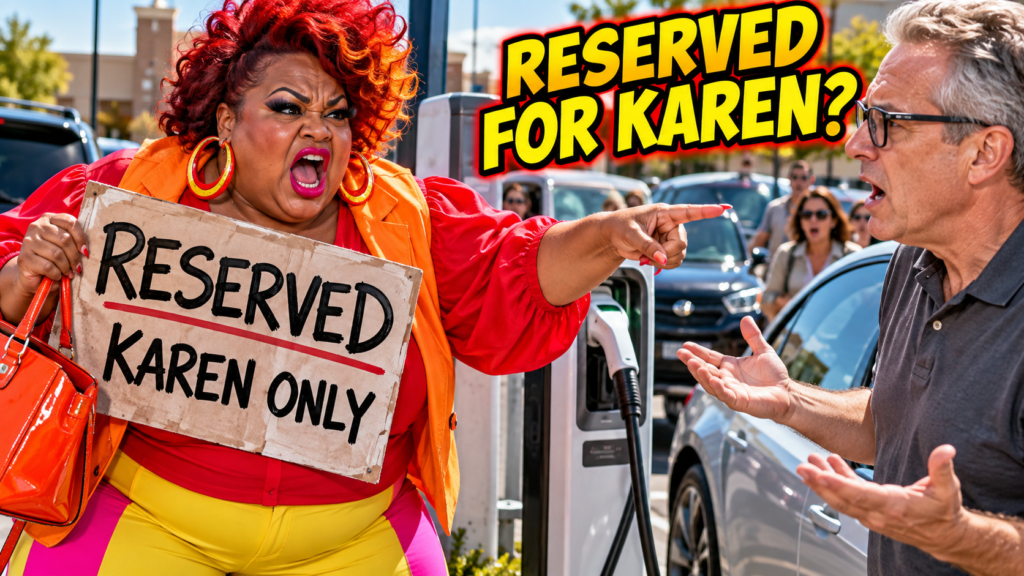
Chapter 4: The Evidence Behind the Cardboard
The next morning, Elaine reviewed the security footage.
She discovered that Karen had arrived nearly forty minutes before Daniel.
But the footage also showed something else.
Karen had not been waiting in her car.
She had parked her black EV several spaces away, walked to the charger, and placed the first sign there.
Then she returned to her vehicle.
Twenty minutes later, another customer approached.
Karen came back.
She stopped that driver too.
The same thing happened again.
And again.
She had been holding the charger without using it.
Elaine saved the footage.
Marcus also checked the delivery area.
The discarded cardboard boxes were supposed to be broken down and placed in a recycling container. Karen had entered the area earlier that afternoon and removed several pieces.
Nothing about the cardboard itself was valuable.
What mattered was what Karen had done with it.
She had turned ordinary trash into a fake symbol of authority.
The property manager decided the incident needed to be documented formally.
Not because the cardboard sign was important.
Because the behavior had created a pattern.
Daniel was contacted and asked to provide a statement.
He almost declined.
He had no interest in becoming part of a neighborhood dispute.
But then he remembered the woman behind him in the EV line.
She had been driving an older electric SUV.
Her charging level had been dangerously low.
She had eventually left without charging because she could not wait any longer.
That changed Daniel’s mind.
He provided his statement.
So did two other drivers.
Karen was furious when she learned that.
She sent an email to the property office claiming that she was being targeted and humiliated.
She argued that she had spent money at the shopping center for years.
She demanded that the signs be returned immediately.
Elaine answered with a simple request:
Come to the management office the following afternoon.
Bring the original signs.
And bring the receipt showing when she had supposedly reserved the charger.
Karen arrived carrying both signs.
She had no receipt.
Instead, she brought a folder filled with shopping receipts.
She placed them on Elaine’s desk one by one.
Groceries.
Clothing.
Restaurant bills.
Beauty products.
Dozens of purchases.
“I am a loyal customer,” Karen said.
Elaine looked at the receipts.
“I don’t doubt that.”
“Then I deserve consideration.”
“You deserve the same consideration as every other customer.”
Karen’s face tightened.
For once, she had no immediate answer.
Then Elaine slid one photograph across the desk.
It showed the elderly woman who had left without charging.
Her car’s battery warning was visible on the dashboard.
Karen stared at it.
And something in her expression changed.
Not guilt.
Not yet.
Something closer to discomfort.








