
Chapter 1: The Five-Dollar Halloween
“STOP! FIVE DOLLARS PER KID—PAY UP OR TURN AROUND!”
The shout cut through the Halloween laughter before most people even noticed where it had come from.
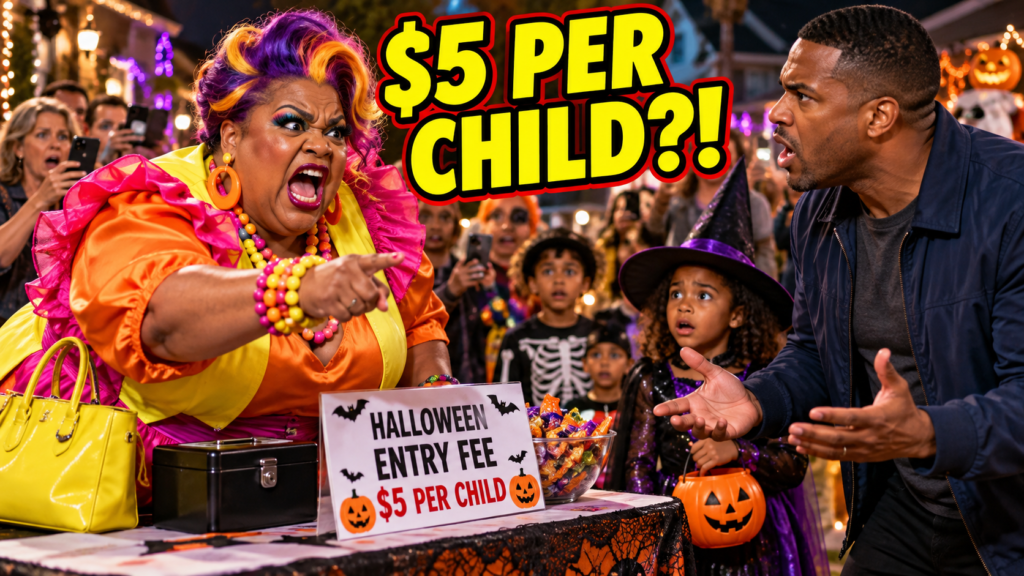
At the edge of the decorated suburban street, Karen stood behind a folding table as if she were running an official checkpoint. Her enormous lemon-yellow handbag hung from one shoulder. Her purple-and-orange hair looked almost fluorescent beneath the porch lights. In front of her sat a clear plastic candy bowl, a small cash box, and a handwritten sign in thick black letters:
HALLOWEEN ENTRY FEE — $5 PER CHILD
A father named Marcus Reed stopped so abruptly that his young daughter nearly bumped into him.
He looked at the sign.
Then at Karen.
Then back at the sign.
“You’re charging children to walk through their own neighborhood?”
Karen’s expression hardened.
“I’m controlling this event,” she snapped. “Security, lighting, crowd management. Somebody has to pay for it.”
Marcus glanced down the street.
There were no barricades. No official event booth. No security personnel. No printed notice from the homeowners association. Just decorated houses, families carrying candy buckets, and Karen’s folding table blocking part of the sidewalk.
Behind Marcus, several other parents had stopped.
Phones began appearing.
Karen noticed.
“Put those phones away,” she demanded.
That only made more people raise them.
Marcus stepped slightly in front of the children.
“You don’t own this street,” he said.
Karen slapped her palm against the table.
“Then take your kids somewhere else!”
For a moment, nobody moved.
Then an older woman named Evelyn Parker, who had lived on the street for more than thirty years, walked slowly out of her driveway carrying a folder.
She did not shout.
She did not argue.
She simply held up a printed flyer.
“The neighborhood Halloween walk is free,” Evelyn said quietly. “It always has been.”
Karen turned toward her.
“That flyer is outdated.”
Evelyn looked at the date.
“It was printed three days ago.”
The crowd murmured.
Karen reached for the paper, but Evelyn pulled it back.
Then she opened the folder.
Inside was something else.
A copy of the neighborhood event notice, complete with the community association’s official letterhead.
At the bottom was a sentence Karen had apparently overlooked.
No resident may collect money from participants or represent themselves as an event organizer without written authorization.
Marcus read it aloud.
The mood on the street changed.
Karen’s face tightened.
But instead of backing away, she grabbed the cash box.
“Fine,” she said. “You want to make this official?”
She lifted the box and carried it toward her house.
“Then we’re going to talk about who actually paid for this neighborhood.”
She disappeared behind her front door with the cash box in her hand.
Marcus watched her go.
Nobody noticed that Evelyn was still staring at the table.
There was a second sign underneath the Halloween fee notice.
It had been covered by the first.
And it contained a name.
Karen’s.








