CHAPTER 4: The Hearing
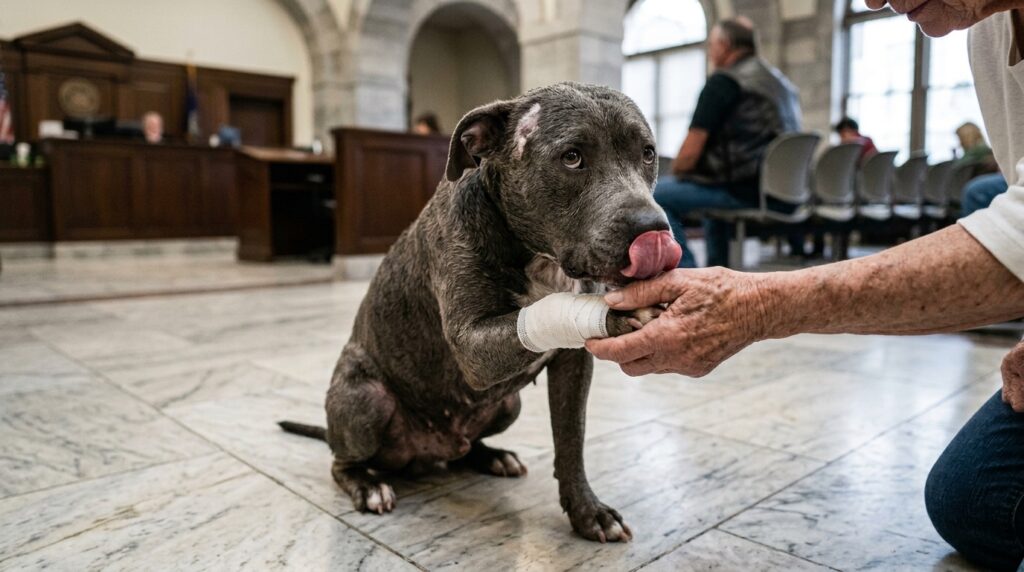
The marble hallways of the county courthouse felt cold and hollow, a far cry from the warm, oil-scented air of our clubhouse. Every click of our dress shoes echoed like a gavel strike. I walked with my hand resting on Leo’s shoulder, while Sarge walked on a short, tight lead between us. He was a different dog today—groomed, bandaged, and wearing a leather harness Specs had found that looked more “service dog” and less “junk-yard guardian.” Still, people stepped aside as we passed, their eyes lingering on the jagged scar over his ear.
Julian Sterling was already there, flanked by two lawyers who looked like they’d been carved out of ice. He didn’t look at Leo; he looked at Sarge with a smirk that told me he expected a victory. He knew that one wrong move—one growl, one bared tooth—and the “menace” label would stick forever.
Judge Miller peered over her spectacles as we took our seats. She didn’t look impressed by the row of bikers in the gallery, all of whom had tucked their long hair back and put on their cleanest shirts. “This is an unorthodox request,” she began, her voice like dry parchment. “The petitioner claims this animal is a vital therapeutic necessity. The respondent claims the animal is a danger to the child and the public. Before I rule on guardianship, I want to see this dog’s temperament myself.”
The evaluator, a stern woman named Dr. Aris, stepped into the center of the courtroom. She carried a series of “stressors”—a heavy umbrella, a recording of high-pitched sirens, and a mechanical cat that moved with an uncanny jerkiness. This was the moment. If Sarge’s rough past or his injuries triggered an aggressive response, the case was over.
Sarge felt the floor—slick and foreign beneath his sensitive paws. He could sense the thick, heavy layer of anxiety radiating off Jax and the boy. The room was full of strangers who smelled of sharp chemicals and old paper, but there was one scent that acted as a focal point: the cold, arrogant smell of the man in the wool coat. Sarge’s hackles wanted to rise. He felt the old, primal urge to circle the boy and push the strangers back. But he also felt the weight of Jax’s hand on the leash—not a pull of command, but a steadying touch that signaled trust. Sarge lowered his head, his tail giving a single, tentative sweep against the marble.
Dr. Aris approached. She suddenly popped the umbrella open just inches from Sarge’s face. The room gasped. Sarge flinched, his body tensing into a spring, but he didn’t snap. He simply stepped closer to Leo’s chair, tucking his head under the boy’s hand. Next came the mechanical toy, whirring and clattering toward him. Sarge watched it with a curious tilt of his head, then looked up at Judge Miller as if to ask why the humans were playing with such strange things.
“He’s not reacting,” Julian Sterling hissed loudly to his counsel. “The dog is clearly sedated!”
“He’s not sedated, Mr. Sterling,” Specs said, standing up. “He’s loved. There’s a difference.”
The final test was the hardest. Dr. Aris reached down to firmly grab Sarge’s injured paw—the one still wrapped in gauze from his five-mile trek. I felt my heart hammer against my ribs. Sarge let out a tiny, sharp whimper of pain, but instead of baring his teeth, he turned and licked the evaluator’s hand. It was a gesture of submission and gentleness that silenced the entire courtroom.
Judge Miller leaned forward, her expression softening for the first time. “It seems the ‘monster’ has better manners than many humans I’ve had in this court.”
Just as the tide seemed to turn, Sterling’s lead attorney stood up, holding a thick folder. “A charming display, Your Honor. But it doesn’t change the fact that the boy’s mother was a fugitive from her own family, or that these men are members of an organization with a criminal history. We have a deposition from a neighbor claiming the dog was involved in a violent altercation only two months ago.”
My blood ran cold. It was a lie, or at least a twisted version of the truth, but in a courtroom, a well-placed lie can be as lethal as a bullet. I looked at Specs, but for the first time, our lawyer looked worried. He was scrambling through his papers, looking for a rebuttal we didn’t have.
Next up in Chapter 5: The final verdict. Specs plays his last card—the mother’s secret trust conditions—as the judge decides if a boy and his dog belong in a mansion or a clubhouse sidecar.