
CHAPTER 2: CONCRETE INVENTORY
The diesel tremor came up through the soles of Marcus’s work boots, vibrating through his shins before the truck even cleared the turn at Elm Street.
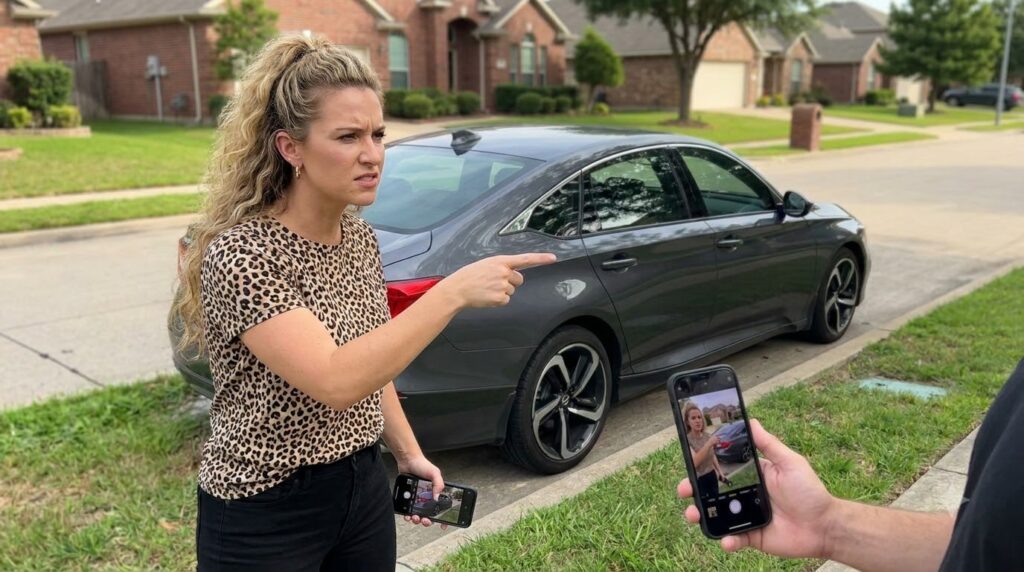
Brenda didn’t flinch. Her jaw remained set, her eyes fixed on the black screen of Marcus’s phone as if she could burn through the glass with sheer force of will. But her index finger dropped an inch, the sharp vector of her pointing stance slackening just enough for Marcus to catch the faint, twitching pulse in her neck.
“He’s coming,” she said, her voice dropping beneath the approaching engine roar. “You want to stand on your little square of dirt? Stand there. See how long your phone stays in one piece.”
Marcus didn’t move his boots. The asphalt beneath him radiated an oppressive ninety-four degrees, the heat softening the tar seams near the curb line. Right at the corner of his driveway apron rested a jagged, oil-stained brick fragment—one of three Brenda had nudged onto his property line over the past four weeks to mark where she believed her visitor lane began. He had left the brick where it landed, letting the red dust crumble into the dry crabgrass, waiting for the day the line would have to be drawn in something harder than baked clay.
The harassment hadn’t started with screaming in the street. It had started six months ago, three weeks after Brenda signed the lease on the faded yellow ranch house across the way.
First came the orange safety cones—two battered, sun-bleached plastic pylons she dragged onto the public curb every morning at six, reserving thirty feet of municipal roadway for a vehicle that wasn’t there. When Marcus gently kicked one aside to park his work truck after a late drain-pipe installation on the south side, he found a index card wedged under his driver-side wiper the next morning: PRIVATE TENANT SPACE. DO NOT PARK AGAIN OR TOWING WILL ENSUE. No signature. Just heavy, blue-ink block letters pressed hard enough to score the paper.
Then came the subtle physical interventions. A handful of coarse roofing nails scattered behind his rear tires. A bucket of soapy dirty water dumped over his hood while he was inside eating dinner. A steady, dripping line of motor oil spilled along his passenger door—never enough to call the county code enforcement officer, just enough to leave a slick, iridescent stain on the hot pavement that smelled of burnt iron every time the sun hit the curb.
Marcus had quietly documented all of it. In a green spiral notebook resting on his kitchen counter, he had logged twenty-seven separate incidents: dates, weather conditions, time of day, and precise measurements from his property pin to her makeshift barriers. He hadn’t called the police. On Maple Street, calling the county before you had your proof laid out in straight lines was just an invitation for a deputy to tell two tired grown adults to shake hands and act like neighbors.
The heavy truck cleared the corner. It was a black, lifted three-quarter-ton pickup with an aftermarket exhaust pipe that spat a thin plume of gray soot against the white painted fence of the corner lot. It didn’t slow down as it approached Marcus’s sedan; it accelerated, the engine whining high and tight before the driver slammed on the brakes.
The truck skidded to a halt six inches from the sedan’s rear bumper, its front grill towering over the low trunk line of Marcus’s dark gray car like a wall of chrome and black plastic.
The driver’s side door swung open before the engine died.
Chad Miller stepped out onto the asphalt. He was broad-shouldered, wearing a gray sleeveless shirt stained with grease at the ribs, his arms thick with the weathered density of a man who worked iron or poured concrete for a living. He didn’t look at Brenda. He didn’t look at the houses on either side of the street. His eyes locked directly onto Marcus standing on the concrete apron, taking in the canvas work vest, the dusty boots, and the smartphone held steady at chest level.
“What’s the problem here, Brenda?” Chad’s voice was low, gravelly, carrying the flat certainty of a man used to settling disputes with his chest before he used his mouth.
“He won’t move the car,” Brenda said, stepping back toward the truck’s fender, her tone shifting instantly from raw aggression to targeted vindication. “He’s filming me, Chad. He’s been standing on his driveway filming me for ten minutes, telling me I don’t have any right to the street.”
Chad didn’t ask for clarification. He didn’t look at the sedan’s position relative to the curb or check for a yellow line. He walked straight into the five-foot gap between the truck and Marcus’s driver-side door, his heavy boots crunching hard on the loose gravel accumulated near the gutter.
“Turn the phone off, buddy,” Chad said, stopping three feet from Marcus’s chest. The heat coming off the truck’s radiator washed between them, thick with the smell of unburnt gasoline and hot belt rubber. “We’re going to talk like men, or we’re going to have a real quick problem.”
Marcus didn’t lower the screen an inch. “The phone stays on, Chad. And the car stays parked.”
Chad reached into his back pocket, his thick fingers pulling out a folded piece of yellow lined paper, stained with grease along its creases. He didn’t hand it over; he slapped it flat against the hood of Marcus’s sedan with the palm of his hand, the dull thud echoing off the brick facade behind them.
“Read that,” Chad snapped, pointing a thick thumb at the faded ink. “That’s signed by the property owner. Exclusive curb access for Unit A. You’re parked in leased space, pal.”
Marcus glanced down at the paper without lowering the camera lens. The handwriting was jagged, written in black sharpie, bearing the name of an absentee landlord who lived two counties away. But right at the bottom edge of the paper, stamped in faint red ink, was a municipal seal Marcus recognized instantly from his work on county drainage easements.








