
The Line We Draw on Sun-Baked Asphalt and Broken Concrete Rules
CHAPTER 1: THE WEIGHT OF PARALLEL LINES
“That car is in our space, move it before this becomes a problem!”
The words hit the hot hood of the dark gray sedan like thrown gravel.
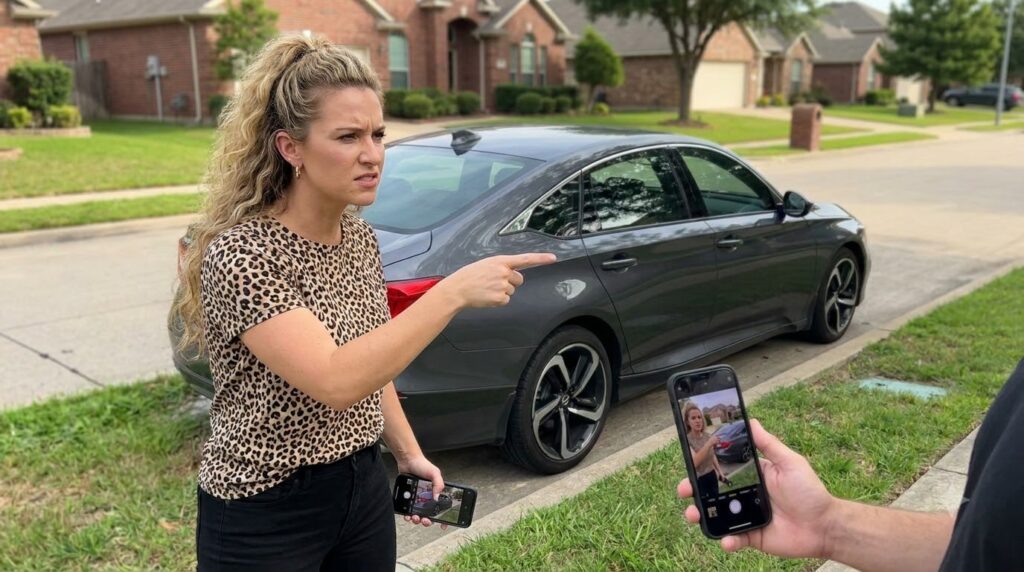
Marcus Vance didn’t take his hand off the driver’s door handle. The metal was still radiating the three-o’clock sun, heavy and dull against his palm. Through the heat-blur rising off the asphalt, Brenda Lawson stood three feet into the roadway lane, her work boots planted wide on the concrete seam where municipal property met private dirt. Her leopard-print top caught the hard afternoon light, and her high blonde ponytail didn’t move an inch in the stagnant suburban air.
“You do not own the curb,” Marcus said. His voice lacked heat, raspy from a twelve-hour shift hauling gravel on the bypass. “This is still a public street.”
“Look at me!” She stepped closer, her jaw locked tight around small gold hoop earrings that glinted as she jerked her chin toward her driveway. In her lower hand, a black smartphone was gripped like a slab of iron, its screen dark, its edges worn. “My boyfriend gets home tonight. Keep laughing and see what happens then!”
Marcus reached into his canvas work vest, pulled out his own phone, and tapped the screen once. The camera lens flared in the sun as he brought it to chest height, steadying his elbows against his ribs. He didn’t raise his voice. He didn’t step off the concrete apron of his driveway.
“I am not moving it,” Marcus said quietly, watching her image align inside the small glass frame. “This street is public.”
Behind her, the neighborhood was dissolving into the quiet freeze of a hot summer afternoon. Across the street, the steady, rhythmic scrape of Mr. Henderson’s push-mower choked out and died. Down on the corner, a porch swing creaked once on rusted chains before stopping altogether. The street had no breeze, only the smell of baking asphalt, dry grass, and the faint, bitter tang of exhaust lingering near the sedan’s bumper.
Brenda didn’t retreat. She leaned forward, the shadows of the overhead power lines cutting across her face, her eyes narrowed into dark slits as she stared straight into the dark glass of his phone lens.
“You think a camera makes you safe, Vance?” she hissed, her voice dropping into a tight, grating rasps that barely carried past the sedan’s side mirror. “You think you’re the first smart guy on this block?”
Marcus didn’t answer. He kept his eyes fixed on her knuckles—white where she gripped her phone, rigid with a quiet, furious certainty that the space beneath his tires belonged to her by right of noise and anger.
Then, two blocks south, the deep, guttural rumble of a modified V8 engine turned the corner, its exhaust note vibrating straight through the soles of Marcus’s boots.

CHAPTER 2: CONCRETE INVENTORY
The diesel tremor came up through the soles of Marcus’s work boots, vibrating through his shins before the truck even cleared the turn at Elm Street.
Brenda didn’t flinch. Her jaw remained set, her eyes fixed on the black screen of Marcus’s phone as if she could burn through the glass with sheer force of will. But her index finger dropped an inch, the sharp vector of her pointing stance slackening just enough for Marcus to catch the faint, twitching pulse in her neck.
“He’s coming,” she said, her voice dropping beneath the approaching engine roar. “You want to stand on your little square of dirt? Stand there. See how long your phone stays in one piece.”
Marcus didn’t move his boots. The asphalt beneath him radiated an oppressive ninety-four degrees, the heat softening the tar seams near the curb line. Right at the corner of his driveway apron rested a jagged, oil-stained brick fragment—one of three Brenda had nudged onto his property line over the past four weeks to mark where she believed her visitor lane began. He had left the brick where it landed, letting the red dust crumble into the dry crabgrass, waiting for the day the line would have to be drawn in something harder than baked clay.
The harassment hadn’t started with screaming in the street. It had started six months ago, three weeks after Brenda signed the lease on the faded yellow ranch house across the way.
First came the orange safety cones—two battered, sun-bleached plastic pylons she dragged onto the public curb every morning at six, reserving thirty feet of municipal roadway for a vehicle that wasn’t there. When Marcus gently kicked one aside to park his work truck after a late drain-pipe installation on the south side, he found a index card wedged under his driver-side wiper the next morning: PRIVATE TENANT SPACE. DO NOT PARK AGAIN OR TOWING WILL ENSUE. No signature. Just heavy, blue-ink block letters pressed hard enough to score the paper.
Then came the subtle physical interventions. A handful of coarse roofing nails scattered behind his rear tires. A bucket of soapy dirty water dumped over his hood while he was inside eating dinner. A steady, dripping line of motor oil spilled along his passenger door—never enough to call the county code enforcement officer, just enough to leave a slick, iridescent stain on the hot pavement that smelled of burnt iron every time the sun hit the curb.
Marcus had quietly documented all of it. In a green spiral notebook resting on his kitchen counter, he had logged twenty-seven separate incidents: dates, weather conditions, time of day, and precise measurements from his property pin to her makeshift barriers. He hadn’t called the police. On Maple Street, calling the county before you had your proof laid out in straight lines was just an invitation for a deputy to tell two tired grown adults to shake hands and act like neighbors.
The heavy truck cleared the corner. It was a black, lifted three-quarter-ton pickup with an aftermarket exhaust pipe that spat a thin plume of gray soot against the white painted fence of the corner lot. It didn’t slow down as it approached Marcus’s sedan; it accelerated, the engine whining high and tight before the driver slammed on the brakes.
The truck skidded to a halt six inches from the sedan’s rear bumper, its front grill towering over the low trunk line of Marcus’s dark gray car like a wall of chrome and black plastic.
The driver’s side door swung open before the engine died.
Chad Miller stepped out onto the asphalt. He was broad-shouldered, wearing a gray sleeveless shirt stained with grease at the ribs, his arms thick with the weathered density of a man who worked iron or poured concrete for a living. He didn’t look at Brenda. He didn’t look at the houses on either side of the street. His eyes locked directly onto Marcus standing on the concrete apron, taking in the canvas work vest, the dusty boots, and the smartphone held steady at chest level.
“What’s the problem here, Brenda?” Chad’s voice was low, gravelly, carrying the flat certainty of a man used to settling disputes with his chest before he used his mouth.
“He won’t move the car,” Brenda said, stepping back toward the truck’s fender, her tone shifting instantly from raw aggression to targeted vindication. “He’s filming me, Chad. He’s been standing on his driveway filming me for ten minutes, telling me I don’t have any right to the street.”
Chad didn’t ask for clarification. He didn’t look at the sedan’s position relative to the curb or check for a yellow line. He walked straight into the five-foot gap between the truck and Marcus’s driver-side door, his heavy boots crunching hard on the loose gravel accumulated near the gutter.
“Turn the phone off, buddy,” Chad said, stopping three feet from Marcus’s chest. The heat coming off the truck’s radiator washed between them, thick with the smell of unburnt gasoline and hot belt rubber. “We’re going to talk like men, or we’re going to have a real quick problem.”
Marcus didn’t lower the screen an inch. “The phone stays on, Chad. And the car stays parked.”
Chad reached into his back pocket, his thick fingers pulling out a folded piece of yellow lined paper, stained with grease along its creases. He didn’t hand it over; he slapped it flat against the hood of Marcus’s sedan with the palm of his hand, the dull thud echoing off the brick facade behind them.
“Read that,” Chad snapped, pointing a thick thumb at the faded ink. “That’s signed by the property owner. Exclusive curb access for Unit A. You’re parked in leased space, pal.”
Marcus glanced down at the paper without lowering the camera lens. The handwriting was jagged, written in black sharpie, bearing the name of an absentee landlord who lived two counties away. But right at the bottom edge of the paper, stamped in faint red ink, was a municipal seal Marcus recognized instantly from his work on county drainage easements.
CHAPTER 3: THE PAPER BARRIER
The yellow paper slapped against the sedan’s sun-baked hood with a flat, dry crack.
Marcus didn’t flinch, nor did he lower the phone. The lens adjusted instantly to the close range, capturing the oil smudges along the paper’s folded edges and Chad’s heavy, calloused hand still pinning it against the dark gray paint. Heat radiated off the metal hood, warming the paper until the faint smell of motor oil and stale wood pulp rose between them.
“Look at it,” Chad commanded, his knuckles turning pale as he pressed harder against the hood. “That’s black ink. That’s Mr. Vance—no relation to you, I take it—signing over exclusive access to the sixty feet of curb adjoining Lot 14-B. We pay an extra hundred and fifty a month for that paper. That makes this space ours. You’re trespassing on a leased right-of-way.”
Marcus focused his eyes past Chad’s thick thumb. The handwriting was loose, arrogant, scrawled with a thick-tipped marker: Unit A retains sole vehicular staging and curb priority along front boundary. But near the bottom right, half-obscured by a grease smudge, sat that faint, circular red ink mark. It wasn’t a landlord’s personal notary. It was a municipal recording office stamp, dated May 11, 1974, with a docket filing code running along the arc: EASEMENT-PUBLIC-UTIL-SEC-4.
Chad saw Marcus’s gaze anchor on the bottom corner. He immediately shifted his hand, sliding his palm down to cover the red ink.
“Don’t worry about the county stamp, pal,” Chad sneered, leaning his body weight forward until his belt buckle clinked against the sedan’s headlight assembly. “That just means it was recorded with the lease at the township office. It’s binding. You park here again, or you keep standing there playing director with your little phone, and I don’t just tow the car—I file a civil lien against your property for interference with a commercial tenancy.”
Brenda stepped up to Chad’s shoulder, her leopard-print top brushing his sleeve. Her jaw had lost its nervous tremor; the paper seemed to give her a concrete floor to stand on. “Show him the signature, Chad. Show him who owns this street.”
Marcus didn’t argue the signature. He didn’t debate Mr. Vance’s authority or the hundred and fifty dollars she claimed to pay every month. He knew how absentee landlords operated in this county—promising tenants the world, selling them air, and letting them fight the neighbors over boundaries that didn’t exist on any county tax map.
Instead, Marcus shifted his footing by two inches, resting the heel of his work boot against the concrete apron of his own driveway.
“A landlord can lease you his roof, Chad. He can lease you his grass,” Marcus said, his voice flat, gravelly, and unhurried. “He can’t lease you what he conveyed to the county fifty years ago to get his sewer line hooked up.”
Chad’s eyes narrowed. The muscle along his jawline twitched once, hard. “What the hell are you talking about?”
“Read the red stamp under your thumb,” Marcus said. “Or don’t. Keep your hand right there. The camera’s got it in high-def.”
Brenda glanced at Chad, her confident posture wavering for a fraction of a second as she caught the subtle change in her boyfriend’s stance. “Chad? What is he talking about? What stamp?”
“He’s blowing smoke,” Chad muttered, but he didn’t lift his hand. He kept his palm pressed flat against the yellow paper, his shoulders tensing as he looked around the quiet street.
The silence on Maple Street was no longer passive; it was dense and expectant. Across the asphalt, Mrs. Gable had come out onto her porch, holding a brass watering can that hung forgotten in her hand, her eyes locked on the three of them standing over the sedan’s hood. Two houses down, young Miller had stopped wiping down his windshield, his blue rag dangling at his side as he watched the standoff.
Chad felt the weight of those eyes. He was a big man used to muscle solving small problems before they became legal ones, but muscle on a open suburban street under a noon sun was a clumsy tool. He took a half-step closer to Marcus, trying to use his height to cut off the phone’s angle, crowding Marcus’s chest until the smell of stale coffee and tobacco on his breath filled the small gap between them.
“Listen to me very carefully, Vance,” Chad growled, dropping his voice into a dangerous, low rumble meant only for the two of them. “I don’t care about fifty-year-old paper. I care about what happens when I tell you to move your vehicle. You take the keys out of your pocket, you climb in that car, and you put it in your own damn driveway before I decide to move it with my hitch.”
“If your truck touches my bumper,” Marcus replied quietly, looking straight past the edge of the phone into Chad’s bloodshot eyes, “that’s not a parking dispute anymore. That’s felony property damage on video.”
Chad’s hand tightened into a fist right on top of the yellow agreement, crumpling the paper against the hot enamel of the hood. For a long, motionless three seconds, neither man breathed. The heat off the pavement shimmered between them, trapping the smell of hot rubber and dry earth.
Then, from three blocks away toward the avenue, the distinct, rising wail of a municipal police siren broke through the humid air.
CHAPTER 4: THE DECOY CLAIM
The distant siren’s tone pitched higher as it bounced off the brick gables at the top of Maple Street.
Chad’s hand jerked on top of the hood. His fingers twitched, crumbling the corner of the yellow paper further into the hot enamel, but he didn’t pull back completely. Instead, his jaw flexed, his eyes darting toward the intersection before returning to Marcus’s phone lens with a hardened, desperate calculation.
“You called them,” Chad spat, his chest heaving against his sleeveless shirt.
“Ten minutes ago,” Marcus said. His voice remained a flat line, his elbows locked against his ribs. “When Brenda stepped off her porch and blocked my bumper.”
“You think they’re going to care about your little camera?” Brenda interjected, her voice rising to cut through the hum of heat and the growing siren tone. She reached into her black handbag, her nails clicking frantically against a leather seam until she yanked out a faded white envelope stamped with a blue corporate logo. She thrust it directly between Chad and Marcus, right into the camera’s focus. “Show him the rest of it, Chad! Show him what we signed last week!”
Chad snatched the envelope from her, his heavy thumb tearing the top flap open in one rough motion. He yanked out a folded carbon-copy document, bright yellow and smelling faintly of chemicals and old adhesive. He held it flat over the first paper, pinning both against the hood with a heavy forearm.
“This is the master lease rider,” Chad growled, tapping a thick index finger against the bold type at the header. “Read it, Vance. Exclusive Right of First Refusal for Exterior Access and Encroachment Zone. Signed by Mr. Vance himself, witnessed by his managing agent. We paid two thousand dollars up front to secure sole possessory rights to the entire curb frontage of Lot 14-B. That includes the asphalt under your tires. The landlord legally transferred his possessory easement to us.”
Marcus adjusted his thumb on the smartphone screen, zooming in two notches. The document was detailed, rigid, and filled with dense legalese. It explicitly claimed that the property owner had assigned all private parking privileges along the street boundary directly to Unit A, granting them the contractual right to tow non-registered vehicles at the car owner’s expense. To anyone without a background in county civil records, it looked ironclad. It was a concrete wall built out of legal jargon, designed specifically to intimidate anyone who dared park a work truck on the block.
This was the weapon Brenda and Chad had been leaning on for six months. This was why the orange cones felt legitimate to them; this was why they felt entitled to threaten, block, and harass every neighbor who pulled up to the curb. They believed they had bought the street.
“You see that?” Chad demanded, his face inches from the lens. “That’s a binding civil contract. You’re standing on my leased space, holding a camera like a trespasser. When the deputy gets here, I’m handing him this rider and pressing charges for unlawful interference.”
Marcus stared at the bold signature of the landlord at the bottom of the sheet. For six months, Brenda had ruled the curb based on the weight of that yellow carbon copy.
“He took your two thousand dollars,” Marcus said softly, his voice cutting clean through the rising whine of the police engine turning onto Maple Street.
Chad’s eyes flared. “What?”
“The landlord,” Marcus continued, lowering his phone by three inches so his eyes locked directly onto Chad’s. “He took your cash and sold you a right he didn’t own. He signed a piece of paper transferring a public roadway to you, knowing damn well he gave that exact dirt away fifty years ago so the county would run his water line.”
Brenda’s hand froze against her bag. “That’s… that’s a lie. Mr. Vance is a licensed property manager!”
“He’s an absentee owner in a county where he thinks nobody checks the clerk’s vault,” Marcus replied.
The white-and-blue patrol cruiser rounded the corner, its roof lights flashing silently against the sun-baked brick chimneys of Maple Street.
CHAPTER 5: THE WATCHING BLOCK
The silent strobe of red and blue light cut through the afternoon haze, sweeping across the red brick facades of Maple Street like a rhythmic pulse.
The patrol cruiser slowed to a crawl, its tires crunching heavily on the loose gravel accumulated near the gutter line. The driver-side window rolled down three inches, exposing the dark frame of Officer Miller’s sunglasses and the grey-streaked hair beneath his crushed cloth cap. He didn’t turn on his siren horn. He didn’t jump out with his hand on his holster. He let the idling hum of the patrol engine fill the narrow street while his eyes took in the geometry of the confrontation: Chad’s lifted truck blocking the travel lane, Chad’s broad frame crowding the hood of the dark gray sedan, Brenda clutching her handbag by the rear fender, and Marcus standing motionless on his driveway apron with a phone raised at chest height.
“Nobody move,” Chad muttered through gritted teeth, his eyes fixed on the cruiser’s hood badge. He grabbed the yellow papers off the hood, folding them twice with frantic, jerky motions, and stuffed them into his back pocket. “I’ll handle the deputy, Brenda. You keep quiet.”
Marcus didn’t lower his screen. He pivoted on his heel by two inches, keeping both Chad and the approaching squad car inside his camera frame.
Across the street, the neighborhood had completely shed its quiet anonymity. Mr. Henderson had walked all the way to his front fence, leaning his forearms against the top rail, his faded mesh cap pulled low over his eyes. Down on the corner, Mrs. Gable set her brass watering can on the bottom step and walked out to the edge of her lawn, joining two guys from the roofing crew who had stopped loading their ladder rack down at Lot 18. Everyone was watching. Six months of subtle intimidation, blocked delivery vans, and midnight screaming matches had boiled down to a ten-foot stretch of asphalt in front of Marcus’s garage.
The cruiser door swung open with a heavy mechanical click.
Officer Miller stepped out into the ninety-degree heat, his heavy leather duty belt creaking as he adjusted his stance on the pavement. He didn’t walk straight toward Chad. He walked to the center of the roadway, looking first at the sedan’s tires—parked six inches flush against the concrete curb—and then at Chad’s black pickup, which sat angled across the double yellow line with its nose resting inches from Marcus’s rear bumper.
“Alright,” Miller said, his voice flat, dry, and thoroughly unimpressed by the heat or the tension. “Who called it in?”
“I did,” Marcus said, stepping forward just enough to show his work boots were planted firmly on his own property line. “Ten minutes ago.”
“He’s filming people, Officer!” Brenda yelled, breaking her promise to Chad instantly as she took three fast steps toward the cruiser’s headlight. She pointed her finger directly at Marcus’s chest, her blonde half-ponytail shaking with intense agitation. “He’s been standing on his driveway harassing me while I was trying to leave! He parked his car in our private space and refused to move when I asked him nicely!”
Miller didn’t look at Brenda’s finger. He turned his head slowly toward Chad. “Is this your truck blocking the travel lane, son?”
Chad straightened his shoulders, puffing his chest out to its full width as he tried to dominate the space between the cruiser and the sedan. “Officer, we have a civil lease agreement for this curb. I was attempting to enforce a lawful parking restriction under a signed master tenant rider. This guy here park his personal vehicle in our designated zone and started recording my girlfriend when she tried to notify him.”
Miller took off his sunglasses, tucking one arm of the frame into his shirt pocket. He looked at the sedan’s license plate, then at Marcus’s work vest. “You live here, Vance?”
“Four years,” Marcus replied. “House 112. The car is registered to this address. I parked it along the curb at two-fifteen after my shift.”
“And you,” Miller said, turning his gaze back to Chad. “Where’s your vehicle registered?”
Chad hesitated for half a second. “We rent Unit A across the street. The landlord gave us exclusive rights to—”
“I didn’t ask about your landlord,” Miller interrupted, his tone dropping an octave into a cold, bureaucratic register that signaled he had heard this exact speech a hundred times on county calls. “I asked where the truck is registered.”
“County line,” Chad muttered, his jaw tightening. “It’s a work vehicle.”
“Right.” Miller reached into his pocket and pulled out a small black notepad. “So what I have right now is a legally registered vehicle parked flush along a residential curb, and a commercial truck parked diagonally across an active lane of traffic blocking a driveway apron.”
Brenda’s face flushed a deep, mottled red under the bright afternoon sun. “That’s not fair! We have paper! Chad, show him the paper!”
Chad reached into his back pocket with a heavy, reluctant hand, pulling out the crumpled yellow carbon copy. He held it out toward the officer, his posture still rigid, still attempting to demand authority rather than request help. “Look at the signature. Mr. Vance owns the entire frontage of Lot 14-B. He leased us the curb.”
Officer Miller didn’t take the paper immediately. He looked at the grease smudges, the crumpled corners, and then his eyes drifted down to the faint red municipal stamp visible near the bottom crease. A slow, thin smile touched the corner of his mouth—not a friendly smile, but the tired expression of a county cop who recognized a disaster waiting to happen.
“You paid money for this?” Miller asked softly.
“Two thousand dollars,” Brenda blurted out, her voice cracking with a sudden, sharp edge of desperation. “Two thousand dollars up front for sole access!”
Miller finally took the paper, holding it up against the blinding sun glare coming off his cruiser’s windshield. He didn’t read the landlord’s handwriting. He traced his thumb along the curved red ink of the municipal seal at the bottom edge.
“Well,” Miller said, looking over the top of the paper straight into Chad’s eyes. “Mr. Vance took your money, alright. But he didn’t sell you a parking spot. He sold you a lawsuit.”
CHAPTER 6: THE RUSTED THREAT
“A lawsuit?” Brenda’s voice cracked into a thin, breathless pitch that cut clean through the idling rumble of the police cruiser. She took two fast steps toward Officer Miller, her heels clicking against the heat-softened asphalt, her hands twitching near her handbag strap. “What are you talking about? We have a contract! That’s Mr. Vance’s signature!”
Officer Miller didn’t raise his voice. He unfolded the yellow carbon paper completely, holding it by the corners so the afternoon sun shone straight through the thin wood pulp, illuminating the grease smudges and the faint, circular red stamp near the bottom edge.
“Mr. Vance owns the dirt under your rental house, ma’am,” Miller said, his thumb tapping the red ink mark. “He doesn’t own the asphalt under this sedan. Back in 1974, the township took a twelve-foot public utility easement along this whole side of Maple Street. That means from the center line of the road to three feet inside Marcus’s lawn, the municipal government holds exclusive right-of-way. Your landlord couldn’t lease you this curb any more than he could lease you the county courthouse.”
Chad’s chest expanded, his grease-stained sleeveless shirt stretching tight across his ribs as he stepped off the sedan’s bumper, towering over Miller’s right shoulder. “Now hold on a minute, Officer. We paid good money for this rider. If the landlord signed it, that gives us possessory privilege until a court says otherwise. This guy’s vehicle is obstructing our access!”
“Your access to what, son?” Miller turned his head slowly, his grey-streaked eyebrows rising over the dark frame of his sunglasses. “Your driveway is wide open over there across the road. You’re parked diagonally across an active traffic lane, blocking a taxpayer’s driveway apron, threatening a resident on his own property, and trying to enforce a fake lease on a public street.”
“I didn’t threaten anybody!” Chad barked, his face darkening into a deep, congested purple as he pointed a thick finger at Marcus. “I told him to move his damn car! He’s been standing there filming my girlfriend with his phone, stirring up trouble on the block!”
Marcus didn’t step back. He lowered his smartphone three inches, resting the bottom corner against his chest vest, but the camera lens remained pointed straight at Chad’s face.
“He told me his boyfriend was coming home to fix the problem,” Marcus said, his voice flat, steady, and loud enough for Mr. Henderson to hear clear across the street. “And when Chad pulled up, he told me to turn the camera off or we’d have a ‘real quick problem.’ I have every second of it saved on cloud backup.”
Officer Miller looked from Marcus’s steady hands back to Chad’s clenched fists. The officer’s posture shifted. The casual, slack stance of a county cop handling a minor neighborhood dispute instantly vanished, replaced by the rigid, mechanical weight of an officer preparing to execute a physical arrest. He reached down with his right hand, resting his palm flat over the snapped leather strap of his sidearm holster.
“Step back toward your truck, Chad,” Miller commanded, his voice dropping into a cold, dangerous register that echoed off the brick facades. “Right now.”
Chad froze. For two agonizing seconds, his boots remained planted on the hot pavement, his muscles tense, his eyes darting from Miller’s hand on the holster to the watching neighbors lined along the fences. Behind him, Brenda gasped, her hands flying up to cover her mouth as she realized the entire street was witnessing the collapse of her authority.
“Chad, please…” Brenda whimpered, her voice losing every trace of its earlier venom. “Just… just step back.”
Chad took a slow, heavy step backward, his boots dragging through the loose gravel in the gutter. But as he reached his truck’s driver-side door, he slammed his open palm against the black sheet metal with a thunderous BANG that made Mrs. Gable flinch on her porch three houses down.
“This isn’t over, Vance!” Chad roared, his eyes wild as he glared past the officer straight at Marcus. “You think you’re smart with your little camera and your county maps? You still gotta live on this block! You still gotta park your truck somewhere at night!”
Officer Miller pulled a pair of steel handcuffs from his utility belt with a sharp, metallic CLINK. “That’s a verbal threat of retaliation in the presence of an officer, son. Turn around and put your hands on the truck hood. Do it now, or you’re going to the county lockup in the back of my cruiser.”
CHAPTER 7: THE EVIDENCE OF THE ROAD
The cold, double-click of the steel handcuffs echoed off the hot hood of the black pickup.
Chad’s heavy shoulders twitched, his thick neck muscles corded under his grease-stained collar. For one razor-thin fraction of a second, his weight rocked back onto his heels, his boots grinding into the loose pavement grit as if he meant to turn into the officer.
Miller didn’t flinch. His hand stayed flat on his holster strap, his thumb flicking the leather retention snap open with a crisp pop.
“Don’t do it, Chad,” Miller warned softly, his voice cutting through the heat like a cold blade. “You’re six inches away from turning a municipal ordinance dispute into a felony obstruction charge on county camera. Put your hands flat on that hood.”
Brenda let out a ragged, strangled gasp. She stumbled backward, her heels catching on the concrete curb seam, her hands wildly clutching her black leather handbag as if it were a life raft. “Chad! Chad, stop! Just put your hands down!”
The fight went out of Chad’s spine in a slow, deflating shudder. He slammed both his calloused palms flat against the sun-baked sheet metal of his truck hood, his head hanging low between his thick shoulders.
“I didn’t touch him,” Chad muttered into the hot paint, his breath fogging the black finish. “I didn’t lay a finger on his car.”
“You made a direct verbal threat of retaliation in front of a uniformed officer,” Miller said, stepping up behind him. He didn’t ratchet the steel cuffs over Chad’s wrists, but he held the open jaw of the cuff against Chad’s right wrist, holding him pinned against the vehicle by sheer presence. “And you’re currently blocking a public roadway with an unregistered commercial vehicle.”
Miller turned his head toward Marcus, his sunglasses reflecting the harsh sunlight and the motionless dark gray sedan. “Vance. Is your phone still recording?”
“Still recording,” Marcus said, keeping his grip steady. The canvas vest was heavy across his shoulders, soaked through with sweat, but his hands didn’t tremble. “Cloud server’s syncing in real-time.”
“Good,” Miller said. He reached down with his free hand, unclipped his field binder from his belt, and tossed it flat onto the sedan’s hood right next to Brenda’s crumpled yellow carbon agreement. “Because here’s what’s going to happen right now on Maple Street. I am writing two citations.”
Brenda stepped forward, her blonde half-ponytail disheveled, her voice trembling with a mixture of rage and terror. “Citations? For what? We’re the ones who pay rent here!”
“Citation one,” Miller said, taking out his pen and tapping the top form. “Improper parking and obstruction of a public right-of-way, issued to the owner of this black pickup truck. The truck moves in five minutes, or the county tow rig takes it off the asphalt at your expense.”
Chad’s head jerked up, his teeth gritted. “Five minutes? The hitch is locked!”
“Then you better find the key real quick, son,” Miller snapped without looking at him. “Citation two is a formal municipal notice of easement violation, issued to the legal property owner of Lot 14-B—your landlord, Mr. Vance. It cites him for illegally attempting to lease dedicated public right-of-way land deeded to the township under Ordinance 1974-B.”
Officer Miller unclipped the yellow carbon paper Chad had pressed against Marcus’s car earlier and slid it into his field binder behind a blue official filing receipt.
“This paper isn’t a lease,” Miller continued, looking straight at Brenda. “It’s evidence of fraud by an absentee landlord. If you two have a problem with where you park your cars, you take this yellow paper and you take your landlord to civil court. But if I catch either of you setting one foot, one orange cone, or one tire on Marcus’s driveway apron, or threatening anyone on this curb again, you won’t be getting a piece of paper. You’ll be sitting in the back of my cruiser on a criminal harassment charge.”
A deep, collective exhalation seemed to pass through the entire block. Across the road, Mr. Henderson took off his mesh cap and wiped his brow, a faint nod of satisfaction passing between him and the two roofers down on Lot 18. Mrs. Gable picked up her brass watering can and slowly walked back up her front steps, the tension that had gripped Maple Street for six months evaporating into the hot August air.
Brenda stood motionless on the concrete, her face pale, her lips trembling as she looked around at the dozen watching neighbors. The invisible territory she had carved out with screaming, orange cones, and fake legal threats had vanished under two minutes of cold municipal reality.
“Move the truck, Chad,” Miller said, stepping back and snapping his handcuffs back into his leather case. “Now.”
Chad pulled his hands off the hood, his knuckles red from the hot metal. He didn’t look at Marcus. He didn’t look at Brenda. He yanked his truck door open, pulled his heavy frame inside, and slammed the door hard enough to rattle the side mirror.
Marcus slowly lowered his smartphone, pressing the red button on the screen to stop the recording. The screen went black, reflecting his own tired, grease-stained face, the work vest heavy against his chest, and the clear, open road behind him.
CHAPTER 8: THE LINE ON MAPLE STREET
The silence that settled over Maple Street was absolute.
It wasn’t the artificial quiet of a street holding its breath, but the heavy, unburdened stillness of a summer afternoon returning to its natural rhythm. The black pickup’s diesel engine roared to life with a violent, coughing shudder, spitting a single cloud of dark exhaust against the curb before Chad threw the transmission into reverse. The tires squealed once against the sun-softened asphalt as he backed out into the intersection, turned hard, and accelerated away toward the avenue without looking back.
Brenda stood alone on the sidewalk for five seconds. Her high blonde half-ponytail was disheveled, a few loose strands clinging to her damp forehead. She held her black handbag tight against her ribs, her leopard-print top slightly crooked. She didn’t look across at Marcus. She didn’t look at Officer Miller, who was calmly sliding his field binder into the door pocket of his cruiser. With her head bowed and her jaw locked in a silent, burning flush of public defeat, she turned on her heel and walked up the front steps of Unit A, the screen door slamming shut behind her with a sharp, hollow clack.
Officer Miller stepped over to the driver-side window of his patrol car. He rested his forearm on the door frame, looking over at Marcus, who remained standing on the concrete apron of his driveway.
“You got what you needed on that video, Vance?” Miller asked, his voice low and casual once more.
Marcus slipped his phone into the front pocket of his canvas work vest. The metal casing was still warm against his chest. “Every second of it. It’s backed up to two separate drives.”
Miller nodded once, a slow, approving tilt of his chin. “Good. Keep it saved. I’ll log the citation report with the municipal clerk before four o’clock. If their landlord calls you trying to bluff about tenant rights or property damage, tell him to look up County Map 1974-B, Page 42. He knows what he signed back when the township ran the main water line down this block. He tried to rent out land he gave away fifty years ago, and now he gets to explain that to a magistrate.”
“Thanks, Officer,” Marcus said.
“Have a good evening, Marcus. Keep your car where it is.” Miller climbed into the cruiser, pulled the door shut, and let the white-and-blue sedan roll slowly down the street, its roof lights dark as it vanished around the corner of Elm.
Across the street, the neighborhood began to move again. Mr. Henderson picked up his push-mower handle, gave the pull-cord a firm yank, and resumed his steady, rhythmic pass along his front lawn. Mrs. Gable gave Marcus a small, silent nod from her porch swing before picking up her gardening shears. Down on Lot 18, the two roofers went back to sliding aluminum ladders onto their truck rack, their loud laughter echoing softly through the warm air.
Marcus didn’t move right away. He stood on the edge of his driveway apron, feeling the heat rising off the pavement through the soles of his work boots.
He walked over to the corner of his lawn where the three oil-stained brick fragments lay scattered in the dry crabgrass—the makeshift markers Brenda had nudged onto his boundary line weeks ago. He bent down, picked them up one by one, and tossed them into his recycling bin near the garage door.
Then he walked over to his dark gray sedan. The metal hood was cool now, the shadow of the house stretching long and dark across the driveway. He ran his hand along the clean, dust-draped paint of the driver’s door, feeling the solid, unyielding frame beneath his fingers. He checked the tires—flush against the concrete curb, perfectly legal, sitting right on top of the municipal easement that belonged to everyone and no one.
There were no orange cones in the street. There were no handwritten notes under the wipers. There was only the open, sun-baked asphalt, the quiet hum of a lawnmower down the block, and the clear, undisturbed line of the road extending all the way to the horizon.
Marcus unlocked his front door, stepped inside the cool silence of his house, and let the heavy oak door click shut behind him.







