
CHAPTER 2: THE ENFORCER ON THE MARBLE FLOOR
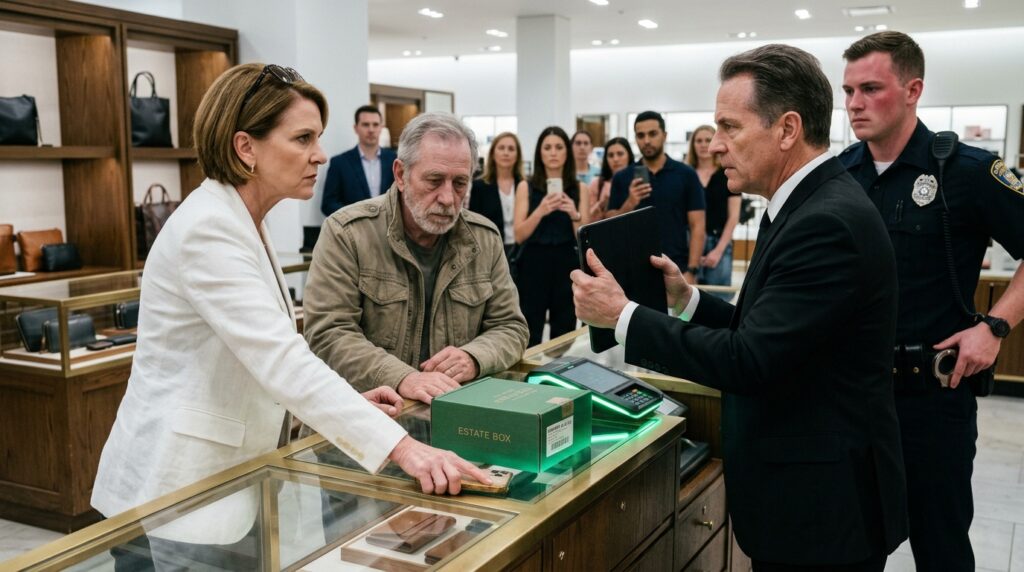
“Step back from the counter, sir,” Victoria Vance said, her smartphone held at chest height, its matte-black lens tracking Marcus’s steady hands. Her voice had the dry, rhythmic clip of a gavel hitting soft pine. “Elena, do not scan that voucher. If the system is lagging, it’s because the security firewall has already caught the discrepancy in his profile.”
Marcus didn’t alter his stance. His boots remained anchored against the limestone floor, his heels dead weight that refused to shift for her posture. He could hear the low, wet thud of the air-conditioning intake vents inside the pillar behind him—a rhythmic vibration that felt like a machine running on stripped gears. The marble under his palms was cold, filmed with a thin residue of daily chemical polish that left a gray grit against his skin.
“The terminal is updating its routing tables, ma’am,” Marcus said. His voice was flat, dry as old lime. He didn’t look at her screen. He looked at the edge of the brass rail where a tiny, rusted rivet had begun to work its way out of the grain. “It takes forty seconds for the legacy servers to register an executive pickup. I suggest you lower the lens before the metadata logs your device into the store’s active tracking loop.”
“I know exactly what the loop registers,” she retorted, her finger tapping the glass screen with a sharp, plastic snap. “My husband ran the code audit for the county infrastructure bonds. We know how people like you utilize obsolete employee overrides during the shift changes. Elena, look at the tag on that box. Is there a regional allocation stamp, or is it marked for salvage redistribution?”
Elena froze, her small, pale hands caught on the reinforced paper tape of the green box. Her silver name tag clicked against the brass button of her vest as her breath caught. “It’s… it’s a high-tier registry hold, Mrs. Vance. The system pulled it from the master vault in Chicago. It’s not on the floor ledger.”
Marcus watched the girl’s fingers. He saw the slight tremor in her thumb, the way her grip on the box shifted away from Victoria’s side of the counter. It was the standard defensive posture of a floor associate caught between two layers of pressure they didn’t have the institutional grade to understand. He had written the manual on employee protection protocols in ninety-eight; he knew that if she blinked twice, she was going to drop the inventory to avoid the confrontation.
“Elena,” Marcus said, his tone dropping into the quiet, heavy register he used for factory compliance checks. “The box stays on Counter Two. Do not return it to the slide. The transaction hold currently showing on your terminal isn’t an invalid code. It’s a standard system-generated audit protocol for legacy loyalty allocations. Let the timer clear.”
“It’s an unauthorized possession,” Victoria said, stepping closer until the scent of her citrus perfume cut through the lavender wax, sharp and chemical like floor stripper. She lifted her voice, letting the edge of it travel across the rows of glass display cases toward the glass-enclosed entrance forty yards away. “Officer! We have an active asset dispute at the leather counter. The individual is refusing to vacate the register space after a failed authorization.”
From the edge of his field of vision, Marcus heard the heavy, rubber-soled thud of municipal boots turning onto the marble. Officer Davies was twenty-eight, his navy uniform stiff from industrial laundry starch, his utility belt creaking with the weight of oil-blackened iron handcuffs and a heavy radio unit. His face was flushed from the noon heat near the street doors, his eyes shifting from Victoria’s sharp white blazer to Marcus’s stained canvas jacket.
“What’s the problem here?” Davies asked, his hand resting automatically on the square plastic casing of his radio. The leather of his belt holster made a dry, rasping sound against his shirt as he adjusted his weight.
“This man is attempting to clear a waitlisted luxury item using an unverified account signature,” Victoria said, her phone still recording, her arm extended like a iron rod. “The floor associate has already flagged the ledger hold. He’s obstructing the checkout lane and using corporate threats to bypass physical identity verification.”
Marcus turned his head slowly, his eyes meeting the young officer’s gaze. He saw the split-second calculation Davies was making—the visual inventory of his faded green sleeves, his calloused palms, the lack of a designer label on his chest. It was the same calculation every field officer made when they were dropped into an environment where the clothing was expected to match the currency.
“Officer,” Marcus said, keeping his hands open and visible against the polished wood of the register desk. “The ledger isn’t broken. It’s waiting for the secondary authentication loop. If you look at the serial block on Counter Two, you’ll see the terminal is currently running an internal compliance check. The transaction isn’t mine alone. It belongs to an estate registry that predates this entire branch.”
“He’s spinning a narrative, Officer,” Victoria said, her voice rising as two shoppers from the silk aisle stopped to watch, their faces blank and pale under the high LED lights. “Check his identification. He doesn’t have an active residential profile in this district. He’s a transient using old corporate credentials to exploit the system.”
Davies stepped between them, his boots leaving two dull gray smudges on the white limestone. He looked down at the terminal screen, where a small amber light had begun to pulse near the base of the keyway. “Sir,” the officer said, his voice dropping into the flat, transactional cadence of a state authority figure. “Take your hands off the counter and step away from the box. We’re going to verify the ledger status in the office behind the main floor.”
Marcus didn’t move his fingers. He felt the cold iron of the brass rail through his skin, stable and real against the sudden drift of the room. The amber light wasn’t an error code. He knew the specific frequency of that pulse; it was the legacy signal for an un-vaulted routing protocol, a message sent from an obsolete server that had been buried in the corporate basement before Davies had even learned to wear a badge. The decoy secret was about to click into place on the ledger screen, but the true reality—the thing Arthur had hidden in the code from his hospice bed—was still ticking in the dark behind the keys.








