CHAPTER 4: The Window at the End
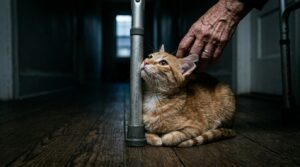
The hallway of Shady Oaks felt like a place where time went to hold its breath. Everything was muted—the colors, the voices, even the light. As I carried the plastic crate, I felt like I was smuggling something vital and illicit into a desert. Pie didn’t yowl. He didn’t claw at the gate. He just sat there, his one notched ear pressed against the plastic mesh, listening to the rhythmic squeak of a nearby med-cart.
We reached the door to 212. Elias stopped, his hand hovering over the handle. “He doesn’t know you’re coming,” he whispered. “He’s… he’s been very quiet lately. The doctors call it ‘failure to thrive.’ I just call it a broken heart.”
I stepped into the room. It was small, but filled with the sharp, bright glare of a New England afternoon. An old man, thinner than a winter reed, sat in a high-backed chair by the window. He was staring out at the trees, his hands resting motionless on a plaid blanket. He looked like he was waiting for a bus that had already passed him by.
I set the carrier down on the linoleum floor. The click of the latch felt as loud as a gunshot in the still room.
Pie stepped out of the carrier. He didn’t run. He didn’t investigate the strange medical equipment or the smell of disinfectant. He stood in the center of the room, his white-rimmed eyes scanning the space until they landed on the man in the chair.
Pie’s nostrils flared, drawing in the stale air. Underneath the smell of medicine and starch, there was a chemical signature he knew in his marrow—the scent of the hands that had fed him for seventeen years, the specific pheromones of the person he had been trained to protect. His body, usually stiff with the indignity of age, suddenly found a fluid, purposeful grace. He felt the familiar vibration of the man’s shallow breathing. He didn’t need a name; he knew the shape of the soul in that chair.
The old man didn’t turn around at first. “Elias?” he croaked. “Is that you?”
“It’s someone else, Grandpa,” Elias said, his voice cracking. “And a friend.”
Pie walked across the floor, his paws making no sound on the tiles. He reached the chair and did something I hadn’t seen him do at my house. He didn’t lean. He stood on his hind legs, his front paws catching the edge of the old man’s knee, and let out a long, rattling purr that sounded like a motor being brought back to life.
The man, whose name I learned was Henry, looked down. His jaw dropped, and for a second, I thought the shock might be too much. His hands, gnarled by arthritis and time, began to shake violently as they reached out.
“Professor?” Henry whispered.
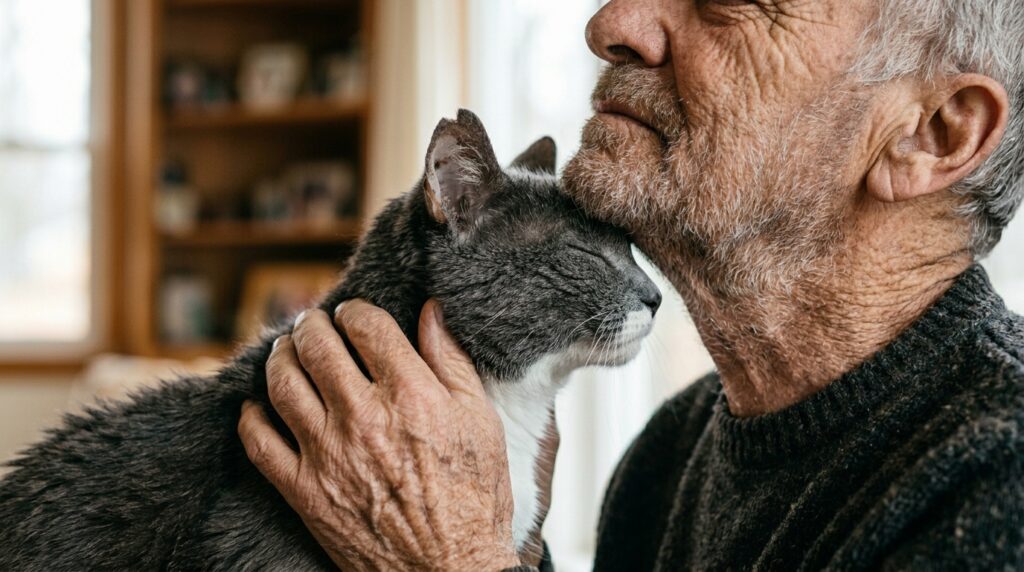
Pie didn’t wait for an invitation. With a soft, careful hop that looked like it cost him every ounce of his remaining strength, he landed on Henry’s lap. He didn’t circle. He didn’t settle. He walked right up to Henry’s chest and leaned his forehead against the man’s chin, mirroring exactly what he had done to me on that first day at the shelter.
“Oh, you good boy,” Henry sobbed, burying his face in the sun-faded tuxedo fur. “You good, good boy. I thought I left you. I thought I’d lost you in the dark.”
I stood by the door with Elias, feeling like an intruder in a sanctuary. I saw the way Henry’s hands finally stopped shaking as they stroked the Professor’s notched ear. I saw the way Pie’s eyes closed, his whole body sinking into the plaid blanket as if he had finally found the only anchor that mattered.
They sat like that for a long time. There was no need for explanations about “running out of room” or internet debates. There was just a man and a cat, two survivors of a world that moves too fast, finding a moment of stillness together.
Henry looked up at me, his eyes wet but clear. “You’re the one?” he asked.
I nodded. “I’m Arthur. He’s been keeping me company.”
Henry smiled, a fragile, beautiful thing. “He’s a teacher, you know. He teaches you how to stay when everyone else wants to leave. Thank you for staying, Arthur.”
As the nurse came in to tell us the visit was over, Pie didn’t fight when I had to pick him up. But as I placed him back in the carrier, he looked back at Henry and gave one short, sharp tap against the plastic gate.
Henry laughed through his tears. “I know, Professor. I’ll take my pills. I promise.”
Next up in Chapter 5: The final chapter. As the season turns, Arthur prepares for the inevitable goodbye, realizing that Pie didn’t just need a place to die—he needed a place to finish his story.