Chapter 6: A Wedding Worth Remembering
The second ceremony took place on a clear autumn afternoon.
The Chicago skyline stretched across the horizon, and a gentle breeze moved through the ornamental trees.
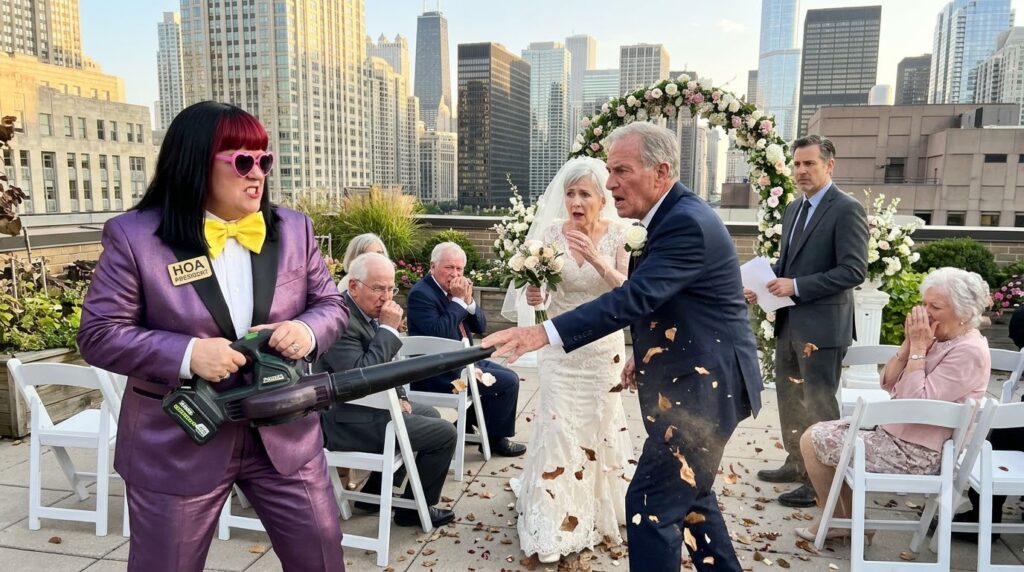
There were no leaf blowers.
No angry announcements.
No arguments about reservations.
The rooftop had been carefully cleaned, and the white folding chairs were arranged in neat rows. Fresh flowers decorated the arch, while small glass vases filled with white roses stood along the aisle.
Margaret arrived wearing her ivory wedding dress again.
The lace sleeves had been carefully repaired, and the outer skirt had been professionally cleaned. Her pearl necklace rested against her collarbone, and her silver-blonde curls framed her smiling face.
Walter waited beneath the arch in his navy suit.
His white rose boutonniere was fresh.
Helen Brooks sat in the front row, holding a small package of tissues. Frank Sullivan sat beside her, looking unusually emotional for a man who had spent most of his professional life reviewing financial statements.
Ethan stood near the entrance, making sure the arrangements were ready.
Daniel had also received an invitation.
He had never intended to become part of the couple’s wedding story, but he had been so disturbed by what happened that he wanted to see them have the day they had originally paid for.
He arrived carrying a small gift and a handwritten note wishing them happiness.
The ceremony was simple.
Walter and Margaret exchanged their vows as the afternoon sunlight fell across the rooftop.
There were no elaborate speeches.
No expensive performances.
Just two people who had found love again when they least expected it.
When Walter placed the ring on Margaret’s finger, she smiled through her tears.
This time, nobody was trying to drive them away.
The guests applauded, and Walter kissed his bride beneath the white floral arch.
Later, the residents gathered around the tables for cake and coffee.
The conversation gradually shifted from the terrible first wedding day to happier memories. Some guests joked about how much better the weather had been without a certain HOA president operating heavy machinery.
Even Margaret laughed.
She admitted that she had spent weeks wondering whether she would ever feel comfortable returning to the terrace.
But standing there now, surrounded by friends, she realized that the place had not belonged to Karen.
It belonged to the residents who lived in the building.
It belonged to the families who gathered there, the neighbors who celebrated birthdays, and the people who wanted to enjoy their home without worrying that someone might use authority to take it away.
Walter raised his coffee cup.
He thanked everyone who had stood beside them when things went wrong.
He thanked Ethan for preserving the records, Frank for insisting on transparency, Linda for conducting a fair review, and Daniel for refusing to ignore what he had witnessed.
Most of all, he thanked Margaret.
He said that their first wedding day had taught him something he would never forget.
A beautiful ceremony could be ruined in minutes.
But the people who stood beside you when things went wrong were worth far more than any decoration, venue, or reservation.
The guests applauded again.
Across the building, Karen remained absent from the celebration.
She had been invited through the standard community notice, but she chose not to attend.
Perhaps she couldn’t bear to see the same rooftop where her plan had failed.
Perhaps she simply didn’t want to face the residents who now knew what she had done.
Whatever the reason, the terrace was peaceful without her.
The new board later published the results of its audit and the changes to the reservation system. Residents received clearer financial reports, standardized booking confirmations, and written protections against unauthorized changes.
The association also established a small volunteer committee to help older residents and families reserve shared facilities.
The goal was simple: no one should have to fight an HOA president to celebrate an important moment in their own community.
As the sun began to set, Walter and Margaret stood together beside the railing.
The skyline glowed in the distance.
Margaret leaned her head against her husband’s shoulder, holding the bouquet of white roses.
The wedding that Karen had tried to destroy had finally become everything they wanted it to be.
And the woman who once believed that money gave her the right to decide who belonged had lost the very authority she had abused.
In the end, the rooftop didn’t need a more powerful HOA president.
It needed a community that understood one simple truth:
A home is not a kingdom, and the people entrusted with managing it are not its rulers.
They are there to serve the people who live beneath its roof.