Chapter 7: The Price of Standing Up
The lawsuit changed everything.
Daniel had expected to defend his home against improper HOA enforcement.
He had not expected to become a defendant in a business defamation case.
The complaint claimed that his statements had caused reputational harm to Whitmore Residential Partners.
It accused him of spreading unsupported allegations about the company’s relationship with the HOA consultant.
The amount of damages requested was far beyond anything Daniel could comfortably pay.
For the first time, he felt genuine fear.
He had retirement savings.
He had a paid-off house.
He had enough money to live modestly and help Ethan with college.
But he did not have unlimited resources for litigation.
Rachel found him sitting at the kitchen table late that evening.
The complaint lay open beside his untouched dinner.
She sat across from him.
Daniel admitted that he was considering a settlement.
Not because he believed Margaret was right.
Because he was tired.
He had spent years caring for Ellen during her illness.
He had endured the grief that followed.
He had worked hard to build a peaceful retirement.
Now, at sixty-three, he faced the possibility of spending years in court.
Rachel listened.
Then she reminded him that settling was a decision he could make, but it needed to be based on sound legal advice rather than fear.
The next morning, Patricia reviewed the complaint.
She explained that the case would turn on what Daniel had actually said, whether the statements were factual or opinion, and what evidence supported them.
She also discussed possible defenses and whether the lawsuit could be challenged under applicable state law.
She made no promises.
But she was clear about one point.
Daniel had been careful at the meeting.
He had described his own experience, quoted Margaret’s words, and requested an investigation.
He had not publicly accused Richard Whitmore of a crime.
The documentary evidence also gave the dispute a substantial factual foundation.
Patricia prepared a response.
Meanwhile, another development changed the situation.
A local reporter named Caroline Hayes contacted Daniel.
Caroline was fifty-four and had covered municipal affairs, consumer disputes, and housing issues for nearly twenty years.
She had heard about the HOA meeting from a resident.
She wanted to know whether the controversy reflected a broader pattern.
Daniel initially refused an interview.
He had no interest in seeing his face on television.
But Caroline explained that she was investigating the financial relationship between Community Renewal Advisory Services and Whitmore Residential Partners.
She had obtained public business records showing overlapping officers and addresses.
She had also identified several property purchases involving Whitmore Residential Partners in Brookstone Estates.
The company had acquired four homes in eighteen months.
Three had previously received significant HOA enforcement notices.
That fact alone did not prove wrongdoing.
But it raised questions.
Caroline had contacted Richard Whitmore for comment.
He denied that his company had improperly influenced HOA enforcement.
He maintained that all purchases were voluntary and that the business offered homeowners a convenient alternative to traditional sales.
Margaret also denied wrongdoing.
She described the controversy as a campaign by dissatisfied residents opposed to reasonable community standards.
Caroline published her article on Friday.
It was careful, detailed, and heavily documented.
It included statements from Daniel, Helen, Susan, Leonard, and the Whitmores.
It described the disputed penalties, the consultant contract, the property acquisitions, and the unresolved questions about board authorization.
Within hours, residents from neighboring communities began contacting the newspaper.
Some reported similar experiences with aggressive HOA enforcement.
Others defended the importance of maintaining neighborhood standards.
The article sparked debate far beyond Brookstone Estates.
Daniel disliked the attention.
But he was relieved that the issue was finally being discussed in terms of documents and accountability rather than personalities.
Then the story reached the Millers.
Mrs. Miller called Daniel on Sunday afternoon.
She had read the article.
For months, she and her husband had told themselves that selling their home was simply a difficult but necessary decision.
Now she wondered whether they had been pressured.
She asked Daniel for Patricia’s contact information.
Daniel gave it to her.
Before hanging up, Mrs. Miller said something that stayed with him.
She told him that leaving Brookstone Estates had felt like abandoning part of her life.
She had tried to make peace with it.
But she still dreamed about her old kitchen.
The yellow curtains.
The view of the maple tree.
The place where her husband had measured their children’s heights against the pantry doorframe.
Daniel stood quietly by his own kitchen window after the call.
He understood.
A home could be sold.
But the life lived inside it could not be replaced.
That evening, Ethan joined him in the garage.
The motorcycle was almost ready for its first long ride.
They had planned to take it along the country roads north of town once the weather improved.
Ethan asked whether the lawsuit meant they might have to sell the house.
Daniel looked at his grandson.
He wanted to offer certainty.
Instead, he offered the truth.
He explained that they were facing a serious dispute, but they had evidence, legal help, and people willing to speak honestly.
They would handle one step at a time.
Ethan nodded.
Then he showed Daniel something on his phone.
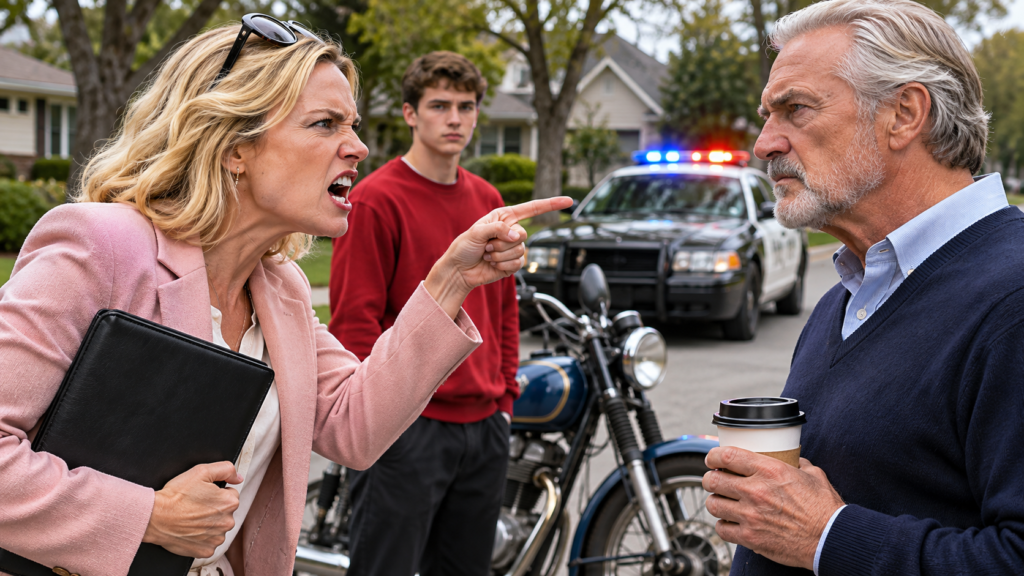
He had recorded the original confrontation from beside the motorcycle.
Daniel knew about the recording.
But he had never watched the entire clip.
Ethan played it.
Margaret’s voice filled the garage.
“I decide who belongs in this neighborhood!”
Then came the moment after the officer intervened.
Margaret had turned toward Richard’s SUV, believing the argument was over.
But Ethan’s camera was still recording.
The audio captured Margaret speaking into her phone.
Her voice was lower now.
Less theatrical.
More calculating.
She said Daniel was becoming a problem.
Then she added that Richard needed to move faster on the Mercer property.
Daniel stared at the screen.
He had been so focused on the public confrontation that he had missed what happened afterward.
Ethan looked at him.
“Grandpa, why would her husband need to move faster on our house?”
Daniel didn’t answer.
He was already reaching for Patricia’s number.