CHAPTER 6: THE ABSTRACT FRONTIER
The diesel whine of the approaching city enforcement truck didn’t roar onto Elmwood Avenue; it slowed to a low, heavy mechanical throb as its broad orange bumper crossed the intersection. High-intensity amber strobes on its cab cut the afternoon shadows into precise, repeating blocks of light, bouncing off the brick walls of number forty-two and turning the green manicured lawns into an unstable canvas of pulsing orange.
Elena did not remove her palms from the blue-tinted map duplicate. She stood perfectly loose, her spine still locked against the silver B-pillar of her sedan, her chest drawing slow, deliberate breaths that registered the sharp, cold smell of fresh tar and diesel exhaust. The geometric trap had closed. The private war over three hundred square feet of public asphalt had dissolved under the heavy, administrative weight of yellow steel and city badges.
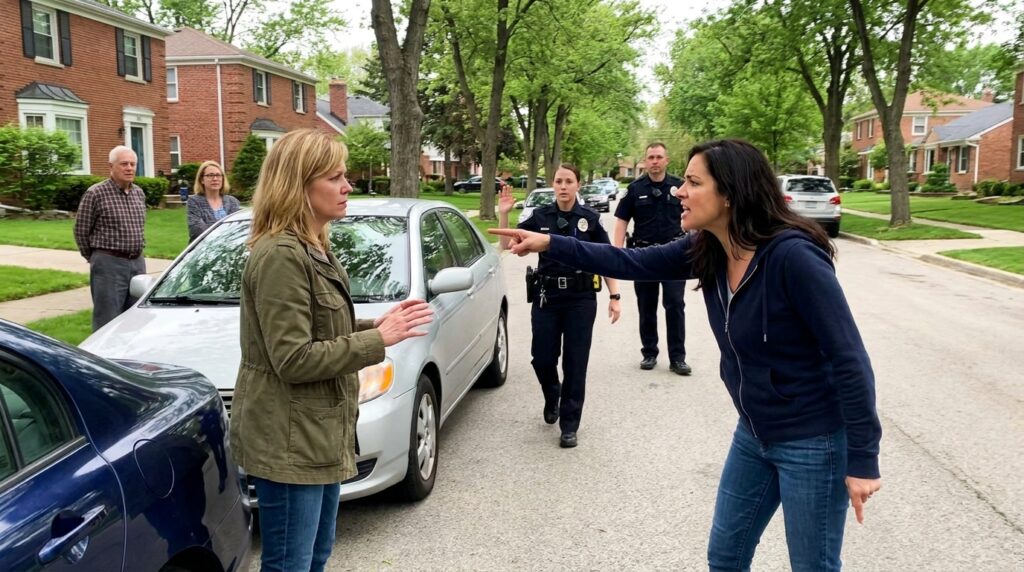
Victoria remained on the grass strip, her posture frozen in a strange, half-bent tilt, her dark sneakers buried up to the rubber seams in the soft, over-watered turf. She didn’t reach for her fallen clipboard. Her eyes were fixed on the side panel of the city truck, where the white-and-blue municipal emblem—Department of Building Inspection and Safety—shone under the flashing amber light. Her lips moved, dry and pale, but no sound came out to fill the gap between the vehicles. The sharp, lecturing authority that had driven her down her driveway for eighty-four days had been completely ground down by the unyielding machinery of the city ledger.
A man in a heavy fluorescent vest climbed down from the truck’s cab, a steel-tipped measuring tape dangling from his leather belt with a heavy, metallic clink. He didn’t look at Victoria, and he didn’t look at Elena. He walked straight to the long, serpentine fissure filled with fresh patch material, his boots making a hard, rhythmic slapping noise against the concrete gutter.
“Twelve,” the city worker said, nodding once toward Officer Miller as he drew a heavy digital level from his side pocket and laid it flat across the asphalt seam. “We’ve got the internal telemetry reports up on the terminal now. The trunk line is bowing under the structural load of the retaining wall at forty-two. The entire right-of-way is dropping five millimeters a week.”
Miller didn’t check her pad. She stood with her arms loose, her gloved hands resting near her leather duty belt, her focused gaze tracking the tiny red laser line projecting from the worker’s level onto the lower stone tier of Victoria’s porch. “Is the perimeter secure for civilian transit?”
“Negative,” the worker replied, his thumb clicking the tape measure locked against the curb. “The soil displacement under the driveway pad has cleared out the sub-base entirely. We’re posting an immediate structural red-tag for the frontage. No vehicles over fifteen hundred pounds within twenty feet of this curb line. That means the driveway itself is quarantined until the main line is excavated.”
A low, collective murmur passed through the crowd of neighbors gathered down the block. The older man in the dark plaid shirt stepped off his porch railing, taking three short steps toward the curb before the backup officer raised a flat, black-gloved palm to check his advance. The neighborhood watchers didn’t speak, but their silent, heavy eyes shifted from the city truck to Victoria, tracking the sudden, complete collapse of the block’s most pristine property.
Victoria’s hands came up, her fingers clawing at the thick cotton fabric of her navy zip hoodie, her face turning an unnatural, dead-white color under the flashing amber strobe lights. “You can’t quarantine my driveway,” she whispered, her voice cracking, losing all its performative edge, sliding into a thin, desperate plea that was instantly swallowed by the idle of the diesel engine. “I have code compliance certificates from the construction phase. The builder certified the foundation line.”
“The builder lied to clear the zoning grid, ma’am,” Elena said, her voice dropping into the quiet space with a flat, transactional finality that ended the argument before Victoria could build a new defense. Elena picked up her blue map, folding the thick, blue-tinted sheets once, twice, until the technical coordinates of Trunk Line 4-East were hidden back inside the pocket of her olive jacket. “You knew the certificates were unverified when you found the structural ledger last year. That’s why you forged the parking variance paper. You thought if you could keep my car off the asphalt, the ground wouldn’t drop fast enough to trigger a city inspection before you listed the house for sale.”
Victoria didn’t deny it. She didn’t scream, and she didn’t lift her hand to jab her finger into the air again. She simply stood on the edge of her grass, her shadow stretching long and fractured across the broken concrete of her driveway pad, her dark curls shaking as she watched the city worker begin to plant three heavy, interlocking steel barriers across the mouth of her garage access lane. The orange plastic cones she had used to weaponize the public street were tossed aside into the weeds, replaced by the heavy, official barricades of a municipal hazard zone.
Officer Miller stepped back onto the sidewalk, her boots making a clean, sharp sound on the concrete as she handed Elena’s identification cards back across the line. “You’re cleared to move your vehicle down the block past forty-six, ma’am,” Miller said, her delivery clinical, empty of personal bias, but completely final. “The curb clearance lane is officially under city restriction.”
Elena took the cards, sliding them flat into her leather wallet without looking down. She felt the heavy brass zipper of her field jacket cold against her throat, a solid, unyielding boundary that she pulled all the way to the top seam. She didn’t look at Victoria’s face as she climbed back into the driver’s seat of the silver sedan. She turned the key, the V6 engine turning over with a steady, rhythmic thrum that broke the lingering quiet of the cul-de-sac.
As she pulled away from the curb, her rearview mirror caught the final layout of number forty-two: Victoria standing entirely alone on her over-watered lawn, the flashing amber lights of the city rig casting repeating, rhythmic blocks of orange across her empty driveway, while the neighbors she had spent years trying to intimidate watched her house sink into the quiet, forgotten clay of the public easement.