
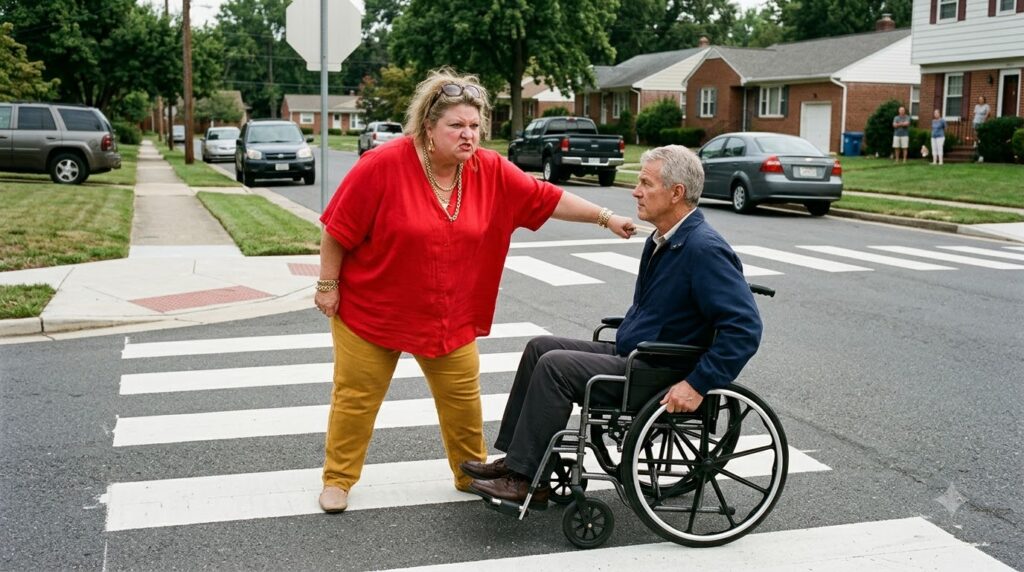
Chapter 2: The Spot She Was Guarding
The man reached the opposite curb and stopped beside the ramp.
His name was Daniel Mercer.
He had lived in the neighborhood for almost twelve years, long enough to know which sidewalks were cracked, which driveways flooded after rain, and which crosswalk signals sometimes took too long to change.
He had also learned that most people were willing to make room.
Most.
Daniel turned his wheelchair around.
The woman in red was still standing in the crosswalk.
She was breathing harder now.
Her name, he would later learn, was Patricia Bell.
At the moment, she was simply the stranger who had nearly forced him to reverse into traffic because she wanted him to “wait his turn.”
Daniel watched her for several seconds.
Then he noticed the object she had been watching all along.
A large black SUV was parked along the curb on the opposite side of the street.
Its hazard lights were blinking.
The driver’s seat was empty.
Patricia glanced toward it again.
A younger woman approached from the corner carrying a paper grocery bag.
“Patty?” she called.
Patricia immediately raised one hand.
“Over here.”
The younger woman looked at the SUV.
Then she looked at Daniel.
Then back at Patricia.
Daniel’s suspicion grew.
He rolled closer, keeping a respectful distance.
“Is that why you were blocking the crosswalk?”
Patricia stiffened.
“I told you. I was waiting for someone.”
The younger woman looked embarrassed.
“Mom, you didn’t have to stand in the crosswalk.”
Patricia shot her a look.
“Stay out of this, Rachel.”
That one sentence changed the atmosphere.
Daniel realized the younger woman was her daughter.
Rachel put the grocery bag down.
“Mom, just move the car.”
Patricia folded her arms.
“I wasn’t moving it.”
“It’s blocking the curb ramp.”
“It isn’t blocking anything.”
Rachel looked at the ramp.
It clearly was.
The SUV’s rear end extended close enough to make the accessible route awkward to navigate.
Daniel slowly rolled toward it.
Patricia stepped in front of him again.
“No.”
Daniel stopped.
“No what?”
“You don’t need to go over there.”
Rachel’s face tightened.
“Mom.”
Daniel looked from mother to daughter.
“What is happening?”
Rachel hesitated.
Patricia answered for her.
“Nothing is happening.”
But Rachel looked at Daniel with an expression that suggested otherwise.
She finally picked up the grocery bag.
“My mom thinks that parking space belongs to her.”
Patricia’s face flushed.
“It has always been my spot.”
Daniel glanced at the curb.
There was no reserved sign.
No painted designation.
No private marking.
Just an ordinary public parking space beside the sidewalk.
Daniel understood.
Patricia hadn’t been guarding the crosswalk.
She had been guarding the parking space.
And when Daniel happened to cross at the exact moment she was waiting for her daughter to bring something to the SUV, Patricia had decided that his wheelchair was the easiest thing to make disappear.
Daniel could have argued.
Instead, he pointed toward the curb ramp.
“People need that.”
Rachel lowered her eyes.
“I know.”
Patricia shook her head.
“You people always make everything complicated.”
Daniel’s jaw tightened.
But he kept his voice calm.
“I’m not asking for special treatment.”
He looked at the ramp.
“I’m asking you not to block the only way I can get home.”
Rachel went silent.
Patricia stared at him.
And for the first time, her daughter seemed to understand that this was no longer about a parking spot.
It was about what happened when one person’s convenience became another person’s barrier.








