
Chapter 1: “Wait Your Turn”
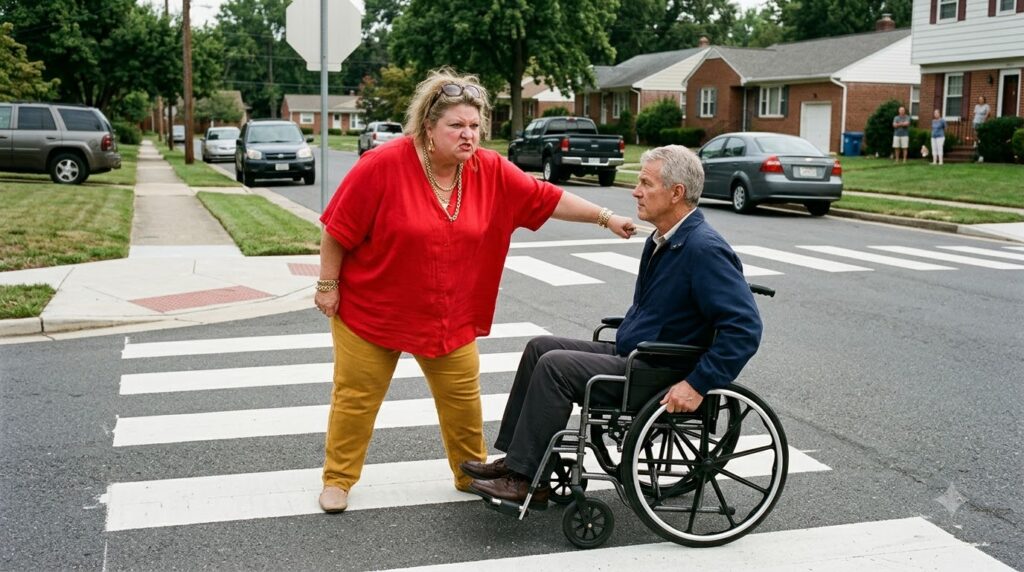
The wheelchair was already halfway across the painted crosswalk when the woman in the red blouse stepped directly into its path.
The man behind the chair squeezed the hand rims hard.
The tires squeaked against the painted pavement, and the chair stopped less than a foot from her.
She did not move.
Instead, she spread both arms as if she had every right to occupy the middle of the crossing.
She was in her late fifties, heavyset, dressed in a bright red blouse and mustard-yellow pants. Oversized sunglasses sat on top of her messy blonde hair, and thick gold jewelry flashed at her wrists whenever she moved.
The man in the wheelchair was in his early sixties. His gray hair was neatly trimmed, and his navy jacket was zipped against the cool evening air. His hands remained on the wheels.
For a moment, neither spoke.
Then the woman gave a short, contemptuous laugh.
“Wait your turn.”
The man’s eyebrows tightened.
“You’re standing in the crosswalk to stop me?”
“I’m waiting for someone,” she replied. “You can go around.”
He looked at the sidewalk behind her, then at the narrow curb ramp beside the crossing.
There was nowhere reasonable to go around without leaving the marked path and navigating a rough strip of grass.
“I’m already crossing,” he said.
The woman stepped backward.
But instead of clearing the path, she stepped farther into the remaining portion of the crosswalk.
Her palm dropped sharply, ordering him to stop.
“I said I’m waiting for someone.”
The man stared at her.
“Then why are you standing here?”
Her smile disappeared.
She took one deliberate step toward him.
That was when he noticed something strange.
She wasn’t merely waiting.
She was watching the street.
Not the sidewalk.
Not him.
The street.
As if she were guarding a particular spot.
He shifted his wheelchair slightly toward an opening on the right.
The woman immediately shifted with him.
He moved left.
She moved left.
He stopped.
She stopped.
The exchange became almost absurdly precise.
She was following him like a person guarding a doorway.
Finally, the man looked directly into her eyes.
“What are you trying to stop me from reaching?”
The woman opened her mouth.
For the first time, she hesitated.
Behind them, a couple walking their dog had slowed down.
An older man standing near a mailbox looked over.
The woman noticed them.
Her expression changed.
The smugness remained, but something underneath it had begun to crack.
“Don’t act like I’m the one causing a problem,” she snapped.
The wheelchair user didn’t answer.
He simply turned his chair toward the narrow opening she had left.
His wheels rolled forward.
The woman spun around.
She tried to close the gap again.
But the chair was already moving.
And now several people were watching.
The man crossed more than half the street before she hurried toward the opposite side of the crosswalk.
She was still trying to block him.
But for the first time, she was no longer standing in control of the crossing.
She was chasing the space he needed.
And that raised a question nobody had asked yet:
Why was she so determined to keep one particular wheelchair user from reaching the other side?








