
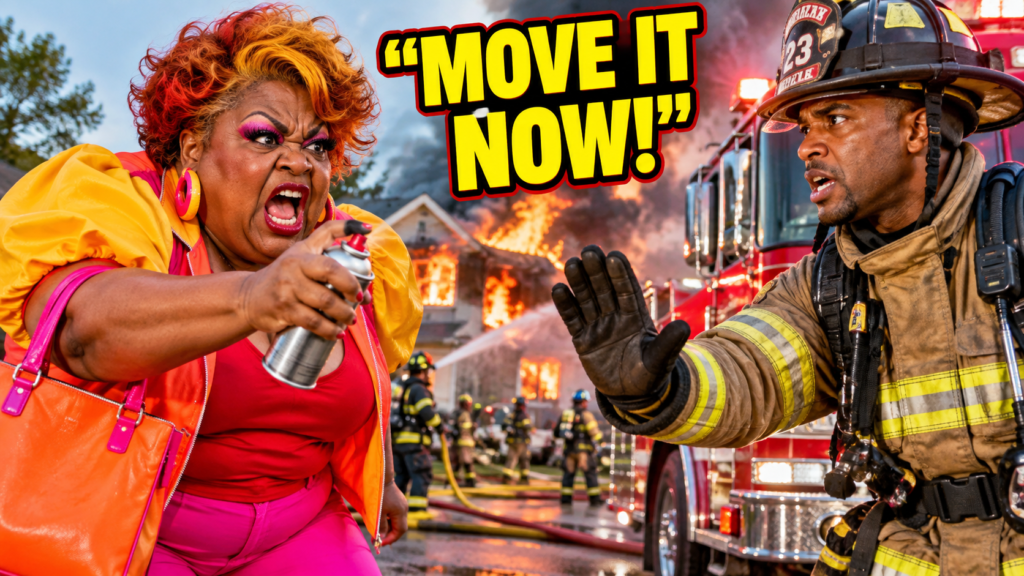
Chapter 2: The Photograph
By morning, Karen had convinced herself that the previous night had been a personal insult.
She stood in her kitchen, still wearing the same furious expression she had carried onto the porch.
Her driveway had been blocked.
Her property had been used.
Nobody had asked permission.
To Karen, those three facts settled everything.
She called the fire station.
Then she called the city.
Then she called the homeowners association.
Each conversation ended differently, but the message was essentially the same: emergency responders could temporarily use private access when necessary to protect life and property.
Karen hated the answer.
So she demanded the photograph.
Later that afternoon, Daniel met her outside the station.
He didn’t seem angry.
That almost irritated her more.
He handed her a copy.
Karen looked down.
The photograph had been taken from the fire engine just before the crew advanced their hose line.
Her driveway appeared in the foreground.
Beyond it, smoke covered the street.
And near the burning house stood an elderly man.
Her neighbor, Harold Bennett.
Karen knew Harold.
He was seventy-eight and lived alone after his wife died.
In the photograph, Harold was not standing safely in the street.
He was trapped beside the burning house, trying to reach the side gate.
Karen stared at the image.
Daniel pointed to the driveway.
“This was our only clear route for the ladder crew.”
Karen swallowed.
She still wanted to argue.
“But you could have moved the truck later.”
“We did.”
“When?”
“After we got Harold out.”
Karen looked back at the photograph.
Daniel continued.
“His bedroom was on the second floor. He had tried to get downstairs, but smoke filled the hallway.”
Karen’s fingers tightened around the paper.
She remembered seeing Harold earlier that evening.
She remembered him waving from the porch.
She had been too angry about the fire engine to think about why he wasn’t already with the other neighbors.
Daniel lowered his voice.
“We were told he might still be inside.”
Karen looked toward the station doors.
For the first time, she had nothing to say.
But Daniel wasn’t finished.
“There was another problem.”
He showed her a second photograph.
This one showed a narrow strip of pavement beside Karen’s driveway.
A vehicle had been parked there earlier that evening.
Karen recognized it immediately.
Her own SUV.
She had left it partly across the curb while unloading groceries.
It had narrowed the only alternate access route.
Karen stared at the image.
“You moved my SUV?”
“We had to.”
“You had no right.”
Daniel paused.
“We didn’t move it.”
Karen looked confused.
“Then who did?”
“The first engine crew couldn’t reach it. So a neighbor backed it out of the way.”
Karen slowly turned.
Across the street, Harold’s daughter, Melissa, was standing near the damaged house.
She had arrived after the fire.
She looked directly at Karen.
Neither woman spoke.
Then Melissa walked over.
“My father told me something this morning,” she said.
Karen braced herself.
“He said you were the person who complained about the fire truck.”
Karen’s chin lifted.
“I was protecting my property.”
Melissa looked toward the blackened remains of her father’s home.
Then she looked back at Karen.
“He also said you were the first person he saw when he came outside.”
Karen blinked.
Melissa’s voice softened.
“He said you were yelling about your driveway while he was standing there coughing.”
Karen’s face changed.
She had remembered the argument.
She had not remembered Harold.
And that was harder to live with.








