
Chapter 6: The Apology
Walter was sitting on his front porch when Karen arrived.
His cane rested against the chair.
A newspaper lay unopened beside him.
Karen stood at the bottom of the steps, suddenly uncertain.
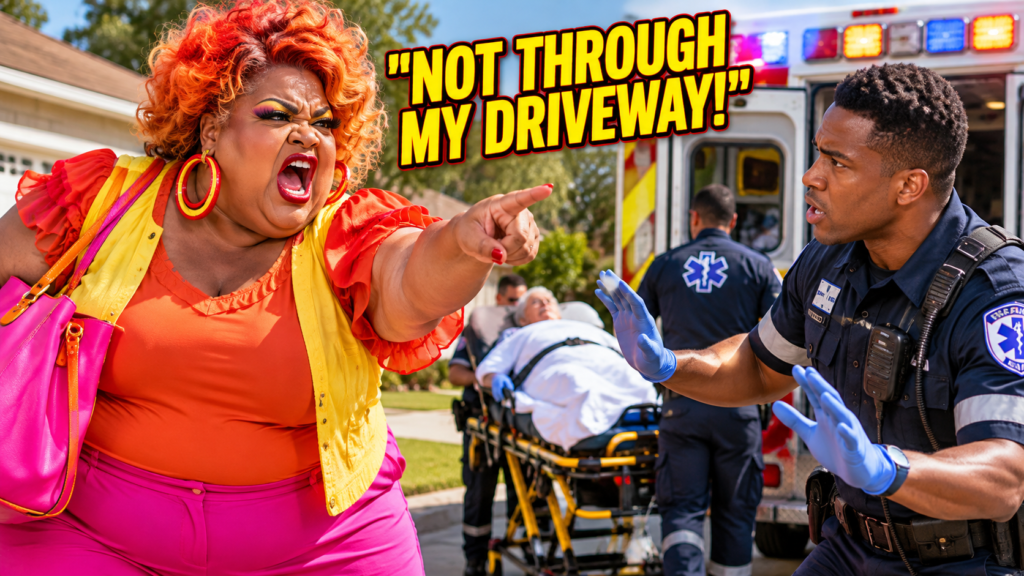
She had confronted paramedics without hesitation.
She had argued with inspectors.
She had defended her driveway like a fortress.
But standing in front of Walter felt different.
“I owe you an apology,” she said.
Walter looked at her.
“For what?”
Karen almost laughed.
“For the ambulance.”
Walter nodded.
“You were scared.”
Karen shook her head.
“No. I was angry.”
She took a breath.
“I thought everyone was taking something from me. My driveway. My privacy. My home.”
Walter listened.
“And I forgot that sometimes people need what we have for a few minutes.”
Walter looked toward her house.
“You removed the gate?”
“Yes.”
“And the planters?”
“Moved.”
He smiled.
Karen sat on the step.
For several minutes, neither spoke.
Then Walter said something that surprised her.
“You know what I remember about that day?”
Karen looked at him.
“You were standing there in those ridiculous pink pants.”
Karen stared.
Then, unexpectedly, she laughed.
It was the first time either of them had laughed together in years.
Walter smiled.
“And you looked terrified.”
“I was furious.”
“Sometimes they look the same.”
Karen lowered her eyes.
That sentence stayed with her.
Not because it excused what she had done.
It didn’t.
But because it gave her a way forward.
A week later, Karen attended the neighborhood association meeting.
She expected people to criticize her.
Some did.
Others simply listened.
Karen stood and explained that she had misunderstood what emergency access meant.
She didn’t make excuses.
She didn’t blame the paramedics.
She didn’t claim she had been treated unfairly.
Instead, she proposed something practical.
A clearly marked emergency-access area beside the neighborhood driveways.
A volunteer list for elderly residents who might need help during emergencies.
And a simple rule:
When the sirens arrive, everyone makes room.
The proposal passed.
But Karen’s biggest change happened at home.
She left the gate open.
Not unlocked.
Open.
And for the first time in years, the driveway no longer felt like a boundary.
It felt like part of the neighborhood.








