Chapter 2: The Video Everyone Saw
By dinner, the video had spread beyond the handful of residents Karen had originally intended to reach.
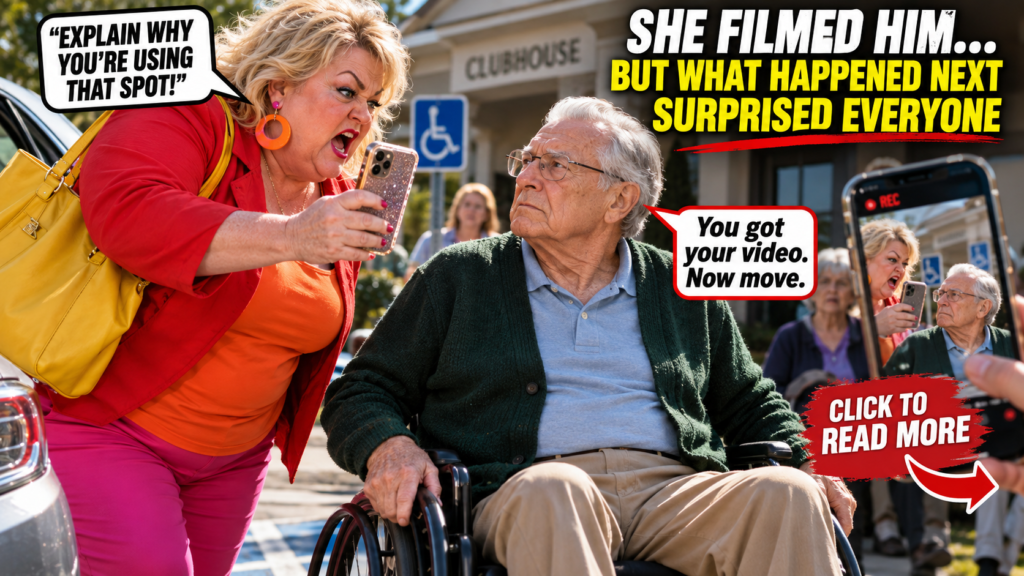
Karen’s caption claimed Daniel had become “aggressive” when she questioned his use of the accessible parking space.
She did not mention that she had stood in front of his wheelchair.
She did not mention that she had filmed him before he had even left his vehicle.
And she certainly did not include the moment when Daniel calmly asked her to move.
Daniel learned about the post from his daughter, Emily.
She called that evening.
“Dad, are you okay?”
Daniel was sitting at his kitchen table, a bowl of soup cooling in front of him.
“I’m fine.”
“Someone sent me the video.”
Daniel closed his eyes.
He hated the idea of his face being passed around by strangers.
Not because he had done anything wrong.
Because he had spent most of his life believing that private moments should remain private.
After his wife Margaret died three years earlier, Daniel had become especially protective of his independence. He still drove. He still attended the clubhouse’s morning coffee group. He still maintained the small garden behind his house.
The wheelchair had changed how he moved through the world.
It had never changed who he was.
Emily wanted him to respond publicly.
Daniel refused.
“Let people watch it,” he said. “The truth doesn’t need me shouting over it.”
The next morning, the homeowners association manager, Linda Brooks, called Daniel.
She had seen the video.
But she had also received three complaints.
Not against Daniel.
Against Karen.
Linda explained that the community had received concerns about filming residents without permission, blocking accessible routes, and publicly accusing residents of violating parking rules.
There was another issue.
Karen had filed a formal complaint claiming Daniel had intimidated her.
Linda needed Daniel’s statement.
Daniel agreed to provide one.
He wrote down exactly what happened, without exaggeration.
No insults.
No accusations about Karen’s character.
Just times, actions, and facts.
At the bottom, he wrote:
“I don’t want Karen punished. I want residents with disabilities to be able to use the spaces provided for them without being publicly humiliated.”
Linda read the statement twice.
Then she noticed something attached to the complaint.
A photograph.
Karen had taken it herself.
It showed Daniel’s accessible parking placard hanging from the rearview mirror.
She had accidentally included the very evidence that proved he had been legally using the space.
But that wasn’t the only thing Linda noticed.
The photograph had been taken before Karen began recording the confrontation.
Which meant Karen had known the placard was there.
Linda printed the photograph and placed it inside the case file.
The next HOA meeting was now scheduled for Friday.
Karen had requested to speak.
And she planned to bring the video.