
CHAPTER 3: THE DECOY COVENANT
The dark blue patrol car didn’t roll onto the grass. It stopped two feet short of Mark Vance’s gravel driveway extension, its front tires aligned perfectly with the concrete curb edge. The engine didn’t idle; the driver cut the ignition immediately, leaving the hot metal ticking in the ninety-five-degree air.
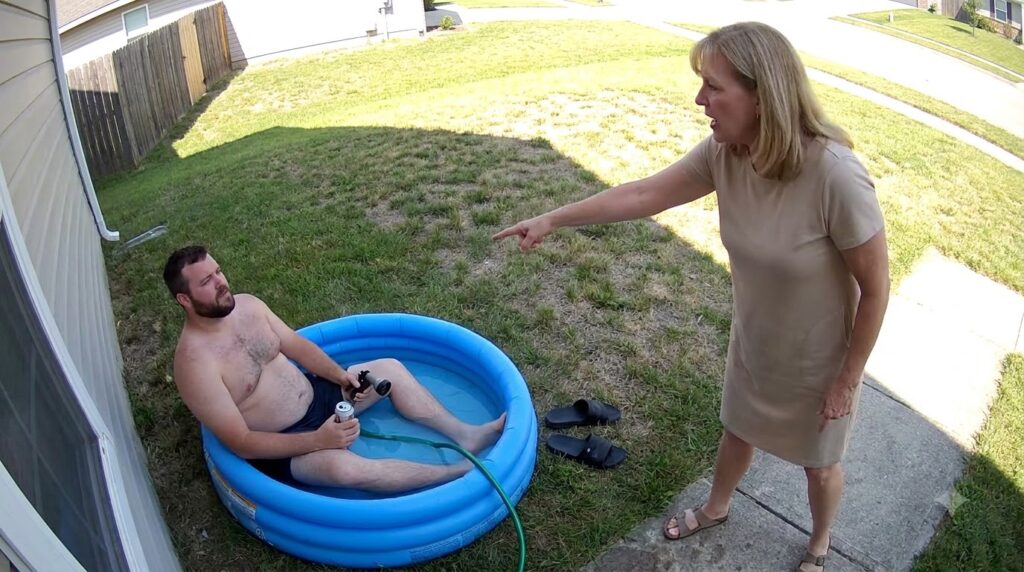
Mark didn’t get out of the pool. He reached down, gripped the brass nozzle with his right hand, and laid the hose flat across his lap, its black spray tip pointed straight at the grass line. With his left hand, he lifted the waterproof accordion folder off the shade of the porch step and slid out his two laminated sheets.
Deputy Miller stepped out of the vehicle, his boots making a dry, crunching sound on the hot asphalt. He didn’t unholster his sidearm or touch his belt clips, but his eyes swept the yard in a single, three-second sweep: the soaked beige dress clinging to Evelyn Higgins, the cold silver can resting in two inches of blue plastic water, and the quiet line of neighbors sitting motionless on distant porches.
“Afternoon,” Deputy Miller said. His voice was flat, gravelly, and entirely stripped of urgency. He stopped on the public sidewalk, two inches on the street side of Mark’s buried iron property pin. “Got a call regarding a water disturbance and an unpermitted structure in the front setback.”
“He attacked me, Deputy!” Evelyn stepped up beside Miller, her soaked sandals squeaking loudly against her skin. She thrust the yellowed manila folder toward the officer’s chest. “He sprayed me with a high-pressure line when I attempted to deliver an official notice of non-compliance! I am the vice-president of the Oakridge Preservation Board, and this man is violating Clause 14B of our deeded aesthetic covenant!”
Deputy Miller didn’t take the folder immediately. He looked at Evelyn’s dripping hair, then down at the yellowed paper, then across the lawn at Mark.
“Clause 14B,” Mark said from the pool. He didn’t raise his voice. He held his laminated county survey map out in his left hand, the red official seal of the land recorder’s office catching the hard glare of the afternoon sun. “There is no active setback easement on this lot, Deputy. The county land survey completed in 2018 shows my deeded property line extends six inches past that concrete sidewalk edge. Mrs. Higgins walked six feet past my property pin, stepped into my personal space, and refused to leave after two verbal warnings.”
“He’s using outdated municipal maps!” Evelyn’s voice rose an octave, sharp and piercing against the heat. She yanked the white staple-bound petition out of the folder and held it two inches from Miller’s nose. “Look at this! Twenty-four registered homeowners on this block signed this petition three months ago, re-affirming the Preservation Board’s authority over all front yard setbacks! It’s a binding neighborhood agreement!”
Deputy Miller took the petition. He squinted against the sun, his thumb tracing the top staple near the corner.
Mark watched the deputy’s face. He knew what Miller was looking at because Mark was looking at the exact same detail from ten feet away: the top left corner of that signature sheet didn’t have one staple hole. It had three distinct, rectangular puncture marks where old staples had been yanked out with a flathead tool and re-bound.
“This covenant,” Deputy Miller said slowly, looking at the yellowed cover page, “refers to the Oakridge Homeowners Association, Inc.”
“Yes!” Evelyn declared, her shoulders squaring under her damp dress as she cast a triumphant look at Mark. “We hold jurisdiction over all setback visual standards!”
“Mrs. Higgins,” Miller said, his tone dropping into a quiet, measured cadence as he turned the yellowed page over. “This document was recorded with the county clerk in 1984. But the petition attached to it is dated April of this year. And the header on your petition doesn’t mention an association. It says ‘Oakridge Neighborhood Watch Committee’.”
Evelyn blinked, her rigid posture wavering for a fraction of a second. “It’s the same organization! We updated the title for administrative clarity during the last board review!”
“Administrative clarity doesn’t rewrite deeded covenants, ma’am,” Miller said flatly. He looked over at Mark. “Mr. Vance, do you have your survey?”
Mark didn’t get up. He reached out over the blue vinyl rim and handed the laminated sheet across the grass line. Miller took it, his eyes scanning the red-ink boundary lines, the buried iron pin markers, and the county recorder’s timestamp.
“Your property line covers this entire grass patch right up to the concrete,” Miller noted.
“It does,” Mark replied. “And the municipal code for temporary seasonal recreation units allows inflatable structures under eighteen inches without a permit. The water depth in that pool is seven inches.”
Evelyn’s face turned a darker shade of crimson, the wet fabric of her dress shivering as a gust of hot wind swept down Oakridge Avenue. “That petition gives the committee power to remove blighted items! We have twenty-four signatures!”
Miller flipped the petition sheet over, looking at the names. Then his thumb stopped on the third line. He stared at it for a long, silent moment before looking up at Evelyn.
“Mrs. Higgins,” Miller said quietly, “line three is signed by Arthur Pendelton.”
“Art signed it willingly!” Evelyn snapped. “He agrees that front yard pools ruin the street’s character!”
“Art Pendelton moved to an assisted living facility in Phoenix two years ago,” Miller said, his eyes locking onto hers with cold, professional scrutiny. “I know because I helped his son load the moving van. Who signed his name on this page three months ago?”
The air on the lawn seemed to freeze despite the heat. Across the street, Carl Rivera lowered his phone slightly, a slow, tight smile spreading across his face as he watched Evelyn’s jaw tighten.
Mark didn’t smile. His mind was already calculating the shift. The petition was a fake—a fabricated weapon constructed by Evelyn using old homeowner names to simulate legal authority she didn’t possess. That was the decoy secret she had been hiding in her yellowed folder to intimidate the block.
But as Deputy Miller handed the fake petition back to her, Mark’s phone buzzed again against the dry towel beside his hip. He glanced down at the screen.
The same unknown local number had sent a second text, accompanied by an attached PDF file icon: The petition is a distraction. Search the 2012 county tax dissolution records for Oakridge HOA. She’s been collecting cash dues for a non-existent entity for twelve years.
Mark’s chest tightened as the true scale of the shift hit him. The fake petition in her hands wasn’t just an overreach; it was a desperate cover-up to protect a decade-long financial fraud.








