
Chapter 4: What Deserved a Place
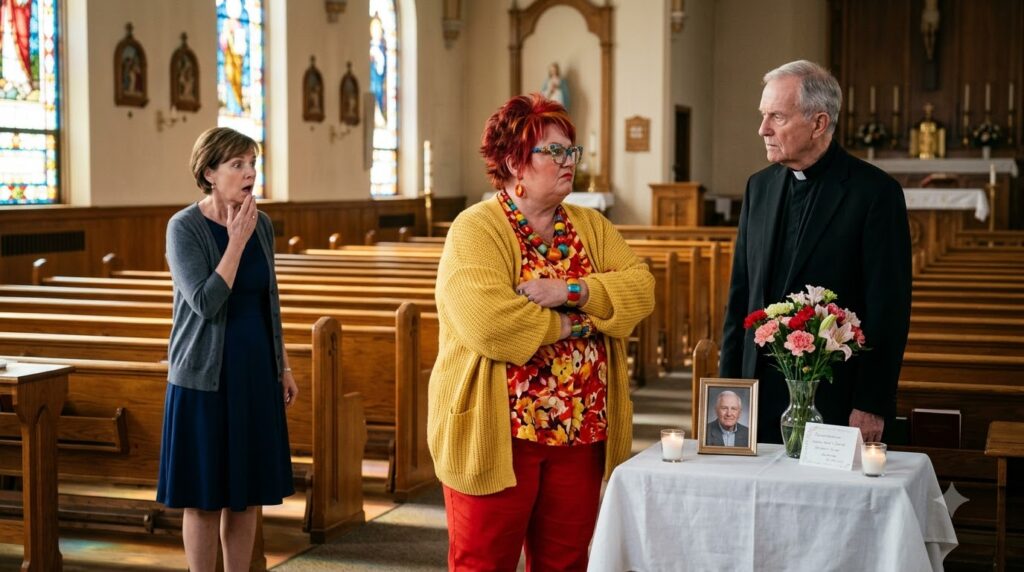
Marlene stood near the entrance while people quietly took their seats.
The memorial remained in place.
The cracked photograph rested safely away from the table, waiting to be repaired. The flowers were still arranged beneath the warm light from the stained-glass windows.
Nothing about the table had changed.
Marlene looked at it from across the sanctuary.
Father Thomas approached her, but he did not crowd her.
“You can still tell me you disagree with the placement,” he said.
“I do.”
“You can ask whether there is a better arrangement.”
“I know.”
“But you cannot decide that disagreement gives you permission to damage something.”
Marlene looked down.
“I was angry.”
“I know.”
She glanced toward the photograph.
“I shouldn’t have thrown it.”
“No.”
She swallowed.
That admission seemed to cost her.
After a moment, she walked toward the memorial.
Father Thomas watched carefully.
Marlene stopped several feet away.
She did not touch the table.
She did not touch the flowers.
She did not reach for the photograph.
Instead, she looked at the handwritten remembrance card.
The words were simple.
They were not about appearance.
They were not about ownership.
They were about someone being remembered.
Marlene stood there quietly.
Then she stepped aside, leaving the walkway completely open.
Father Thomas noticed the gesture but said nothing.
Marlene turned toward the other decoration near the entrance.
Her eyes rested on it for a moment.
Then she looked back at the memorial.
This time, she walked away without touching anything.
The church began to fill.
People moved through the aisle without difficulty.
The memorial remained exactly where it belonged—not because Marlene had been defeated in an argument, but because someone else’s grief did not need to surrender its place simply to satisfy her idea of order.
Father Thomas returned to the sanctuary.
Marlene took a seat among the congregation.
The damaged photograph would be repaired.
The memorial would remain.
And the boundary that should have been respected from the beginning was finally clear: being a member of the church gave Marlene a voice.
It did not give her ownership of everyone else’s sorrow.








