CHAPTER 1: The Line in the Asphalt
The smell of hot pine resin and scorched brake pads clung to the gravel shoulder, thick enough to taste. Julian Vance kept his pencil pressed against the grain of the rough-cut cedar plank, his thumb steady against the steel rule. He did not blink, nor did he shift his weight from the ball of his left foot.
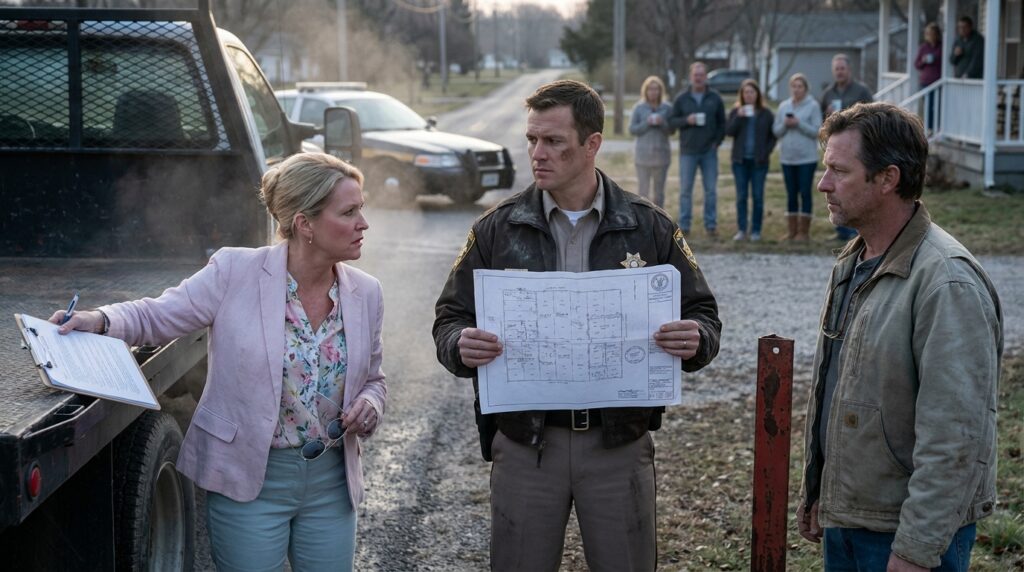
“I am telling you, Mr. Vance, for the third and final time,” Brenda said, her voice ratcheting up half an octave to carry over the thrumming diesel engine of the flatbed truck. She tapped the corner of her silver-rimmed sunglasses against her clipboard. “Commercial deliveries of this scale are strictly prohibited on community-maintained arteries without a Class-Four board permit. Shut the engine off, back that flatbed out to County Road 7, and do it before I call code enforcement.”
The delivery driver, a young man with a sweat-stained collar and a laminated manifest gripped in one hand, looked back and forth between Brenda’s pastel linen blouse and Julian’s motionless stance on the porch steps.
“Boss,” the driver called out, his voice tight with defensive hesitation. “Do I move or stay?”
Julian finally lowered the pencil. He took off his wire-frame glasses, hooked them into the neckline of his faded canvas jacket, and wiped his palms clean on his denim thighs. He moved with a deliberate, maddening slowness, deliberately refusing to match the frantic, predatory energy radiating from the woman blocking the path.
“Leave the truck right where it is, Ben,” Julian said, his voice flat, pitched just loud enough to cut through the exhaust.
Brenda’s mouth tightened into a pale, hard slash. Her fingers gripped the edges of her clipboard until her knuckles whitened under her manicured nails. “You think you can operate outside the rules just because your grandfather managed to squat on this acreage before the county had zoning maps, Julian? This is an organized community. We share the infrastructure. We share the standards. And people who refuse to pay their share do not get to carve private kingdoms out of public convenience.”
Julian stepped off the bottom timber of the porch, his boots crunching softly into the limestone grit. He could feel the eyes of half a dozen neighbors from across the cul-de-sac, their silhouettes dark and motionless behind lace curtains and glass storm doors, watching to see if the structure would hold or if Brenda’s manufactured gravity would pull everything down.
“You call it shared infrastructure, Brenda,” Julian said, closing the distance between them until he could smell the expensive floral perfume masking the sour edge of her panic. “The county map calls it parcel C441B. Unencumbered. Private.”
“A piece of paper from 1961 doesn’t override modern association bylaws,” she snapped, stepping directly into his personal space, her chin lifted. “Marcus Webb drew up the addendum himself. It’s logged. It’s binding. And if that timber hits the ground today, I am filing an immediate injunction that will freeze every nickel of your renovation budget before the sun goes down.”
Julian looked past her shoulder, noting the way her left eye twitched—a microscopic tremor of genuine desperation hidden beneath the gleaming lacquer of her authority. She wasn’t just enforcing aesthetics; she was running out of time, and she needed his compliance to patch a hole she couldn’t afford to show anyone.
“File whatever you like,” Julian murmured, turning his gaze back to the idling truck. “Just make sure you bring a better pen next time. Your last notice forgot to include the county clerk’s seal.”
He walked past her without waiting for her reply, leaving her standing alone in the centerline of the gravel road as the truck’s air brakes hissed twice in the rising heat.