
CHAPTER 2: THE RECONNAISSANCE LINE
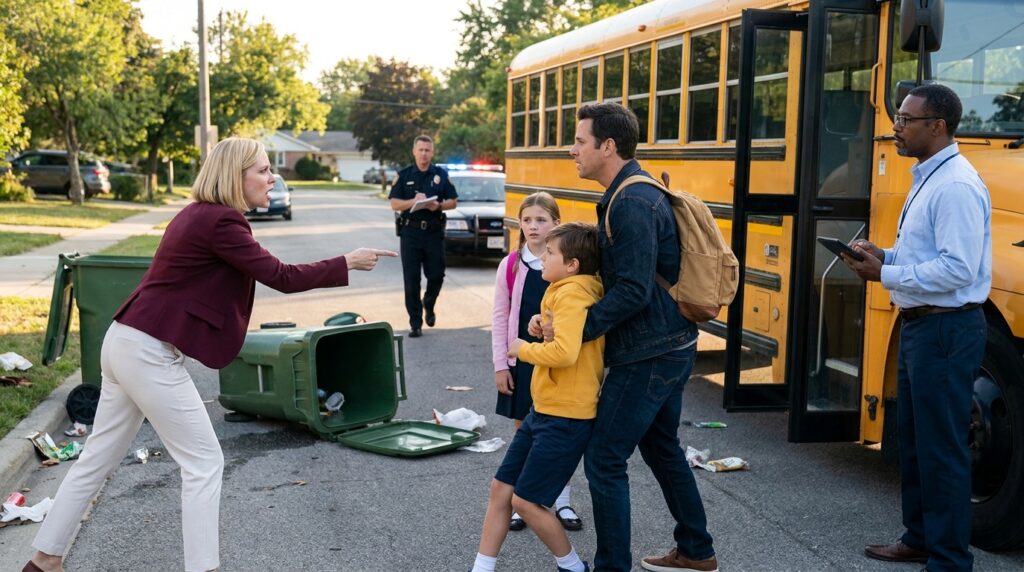
“The rules,” Evelyn said, her voice dropping into a register that was surgically precise and completely devoid of vibration, “are the only reason your porch has a structural permit, Mr. Vance.”
She didn’t lower the phone. The reflection of the streetlights, which had just flickered to life under the early evening sensor lock, cut a silver notch across the top edge of her device. Her white trousers remained inches away from the gray mush of the leaking milk cartons, but her posture had shifted. Her weight was balanced on the heels of her beige flats, a stance Marcus recognized from his four years in the logistics division at Fort Meade—the defensive lock of an auditor who knew the regulatory code by heart and had already filed the injunction before the target even noticed the discrepancy.
Marcus kept his hand flat against the yellow nylon of Leo’s hood. The boy’s ribs were small, rhythmic bellows beneath his palm, steadying as the immediate danger of the International Blue Bird’s chassis receded into a dull, hot diesel idle.
“The curb isn’t association property, Evelyn,” Marcus said. His voice was a flat slab of pine. He didn’t let his eyes wander to the windows of number forty-two, where the silhouette behind the horizontal blinds had just adjusted its angle by three degrees. “Check the county plat map. The public right-of-way extends eight feet from the asphalt centerline. Your bins were in the county lane.”
Evelyn’s mouth twitched, a micro-expression that lasted less than seventy milliseconds before the starched line of her jaw reclaimed its symmetry. “The association maintains the easement. If your son cannot respect the physical perimeter of the Crimson Lane stops, the board will vote on a safety variance. We’ve already logged the spatial violations from your driveway.”
Marcus didn’t answer. He was looking past the sharp edge of her blonde bob, toward the gray cedar utility pole that marked the boundary between their properties. The wood was old, creosoted, split by decades of mid-Atlantic frost. But three feet below the primary transformer bracket, there was an anomaly—a small, matte-black cylinder no larger than a standard hex bolt, its crystalline face oriented directly at the lockset of his front door. It wasn’t county equipment. The casing lacked the standard metallic asset tag of the regional grid authority. It was an unlisted lens, positioned to capture the exact entry and exit logs of his household.
The realization sat in his throat like cold iron, but his face didn’t register the hit. In a tactical calculation, information was only valuable if the opposing force believed it remained hidden.
“The bus is waiting, ma’am,” Arthur Miller’s voice cut through the humidity from the top step of the bus well. The driver hadn’t turned his head toward Evelyn; his glasses reflected the green and red indicators of his digital diagnostic dashboard, his light-blue shirt stiff under his navy sweater vest. His fingers remained wrapped around the mechanical handle of the door control, holding the platform open but refusing to step down into the municipal debris. “The schedule is timed to the minute. If we’re holding the lane for a civil dispute, I’m required to log the ignition pause with the central dispatch.”
“Log it,” Evelyn said without turning around. Her phone remained locked on Marcus’s forehead, her thumb hovering over the interface as if she were waiting for him to step past the scuffed white serial number on the split bin. “The township needs a record of the environment he’s creating. My husband has already forwarded the parking logs from last Tuesday to the zoning commission.”
Marcus shifted his weight, his scuffed leather work boots crunching softly on a fragment of dry gravel. He felt a small, hard object shift beneath the tread of his heel. He didn’t look down immediately. Instead, he allowed his gaze to track the long, sharp spear of a shadow cast by the overturned bin. The plastic container had split along its thermal seam, revealing its inner ribbing. Tucked into the unvandalized interior corner of the plastic wall, held in place by a strip of high-tack industrial filament tape, was a notched brass key. It wasn’t a standard house key; the barrel was cylindrical, machined for a high-security cabinet or a commercial data locker.
The bin hadn’t been placed here for garbage. It was a dead-drop location, positioned at the exact dead-zone between the three private security cameras lining the cul-de-sac.
“Leo,” Marcus murmured, his fingers tightening slightly on the boy’s shoulder. “Go to the steps. Don’t look at the lane.”
“The boy stays until the authority arrives,” Evelyn stepped forward, her burgundy sleeve cutting across Marcus’s field of vision, her proximity close enough that he could smell the dry-cleaning fluid on her collar. “You don’t get to clear the scene before the baseline is established.”
The air grew significantly colder as the sun dipped entirely behind the ridge line, leaving the street in a desaturated, zinc-colored twilight. From three blocks away, the low, undulating whine of a municipal siren began to rise, its frequency bouncing off the uniform vinyl siding of the houses like a rhythmic warning. Marcus remained planted, his posture low-centered, his internal monologue running the risk models with a cold, unemotional efficiency. Evelyn wasn’t moving her bins because she hated his truck or his lawn; she was guarding the physical site. Every second she held him here under the pretense of a public disturbance was another sixty seconds the dead-drop remained under her direct surveillance.
“I’m not clearing anything,” Marcus said, his eyes dropping back to the small black bolt on the utility pole. “The street is already recorded.”








