
CHAPTER 1: THE BARRICADE AT AISLE SEVEN
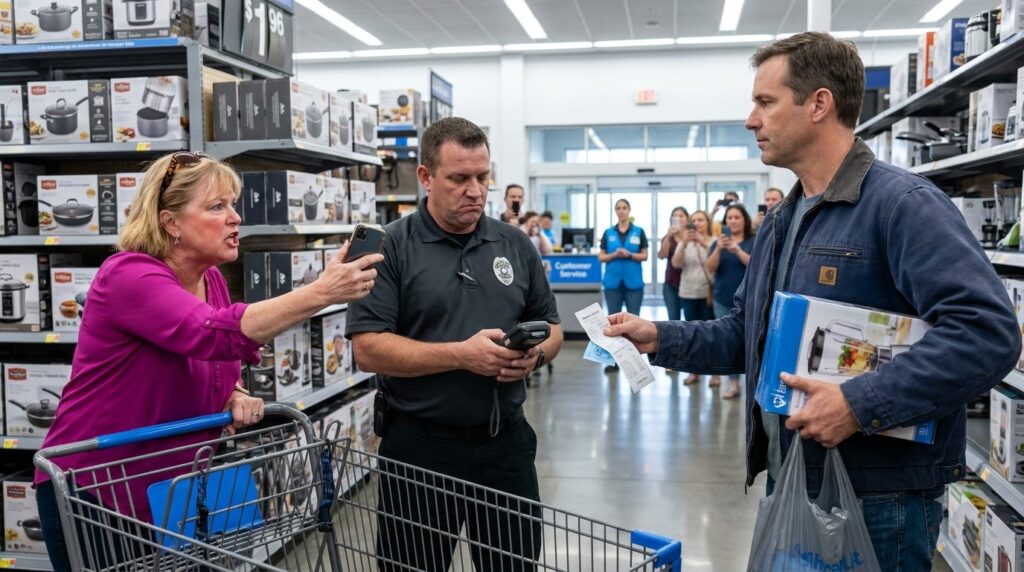
The steel wheel of the shopping cart didn’t roll; it ground sideways across the polished concrete, leaving a jagged gray rubber mark two inches from Marcus Vance’s work boots.
Marcus didn’t jump. Thirty years of adjusting diesel timing belts and listening to the high-pressure hiss of postal air brakes had trained his nerves to ignore sudden noise. He simply stopped, his right hand maintaining a firm, steady grip on the thick plastic handles of the store bag. Inside, the heavy box containing the commercial-grade blender settled with a dense, metallic thud.
“You aren’t taking another step toward those doors,” Brenda Hollister said. Her voice carried the harsh, grating frequency of an unlubricated pulley, cutting cleanly through the ambient hum of the store’s air handlers and the distant beep of scanning registers.
She stood behind the metal cart like a border guard at a checkpoint. Her bright magenta blouse was crisp, unwrinkled, and loud against the muted gray shelves of Home Goods. High on her crown, oversized tortoise-shell sunglasses caught the harsh glare of the overhead LED tubes, casting twin squares of white light over her forehead. In her right hand, her smartphone was already raised, its camera lens pointed squarely at the center of Marcus’s navy canvas jacket.
“Ma’am,” Marcus said. The word was low, flat, and worn smooth at the edges. “You’re blocking the main lane.”
“I am securing store property,” Brenda countered, her chin tilting upward as two shoppers pushing wire baskets slowed down five yards away. A young associate in a blue vest paused near an endcap display of cast-iron skillets, eyeing the standoff with hesitant eyes. “I saw you in the kitchen aisle. You picked up that hundred-and-fifty-dollar unit, walked right past the home department desk, and tucked yourself behind the display pillar. You think because this place is big, nobody’s paying attention?”
Marcus felt the familiar, dull pulse behind his temple—not anger, but the cold, heavy weight of an old routine. For fifty-eight years, his stoic posture, broad shoulders, and quiet habits had made him a target for people who mistook silence for guilt. He didn’t shift his stance. He didn’t reach for his wallet, nor did he attempt to push the cart aside. In the army, when an officer came looking for fault on the motor pool floor, you didn’t offer excuses; you stood by your work order and let the steel speak for itself.
“I paid at Register Four,” Marcus said softly.
“Register Four is a general checkout,” Brenda snapped, her manicured index finger tapping against the side of her phone casing. Her voice rose half an octave, deliberately pitched for the growing circle of onlookers. “High-ticket kitchen electronics are supposed to be ringed up at the specialty counter! You knew the cashier down front was backed up with groceries. You counted on her not checking the box!”
Behind her, near the customer service desk, a man in a dark charcoal polo shirt stepped out from behind the counter. A silver security badge gleamed against his chest, and a coiled black wire snaked up his neck into a clear earpiece. Asset Protection Controller David Owens had noticed the gathering crowd.
Brenda saw him coming and waved her left hand in a sharp, demanding arc. “David! Down here! I’ve got a runner held at the endcap!”
Marcus didn’t turn to look at the approaching officer. Instead, his thumb slid down inside the breast pocket of his work jacket, his calloused skin brushing against the thin, crisp edge of a thermal paper slip folded twice. But as his fingers adjusted around the paper, he felt something else wedged inside the fold—a small, blue-inked paper tab that hadn’t come from the cashier’s hand.








