CHAPTER 6: THE SILENCE AT THE BORDER
The rear door of the county cruiser clicked shut with a heavy, double-sealed latch, cutting off Evelyn’s frantic, muffled sobbing.
Through the tinted glass, Mark could see only the distorted silhouette of her silver hair pressed against the frame. Her shoulder twitching, her blue cardigan crumpled around her upper arms where the steel restraints bound her hands. The red-and-blue strobes swept across the dark glass in slow, rhythmic pulses, casting long violet shadows across the dry grass of Mark’s front lawn.
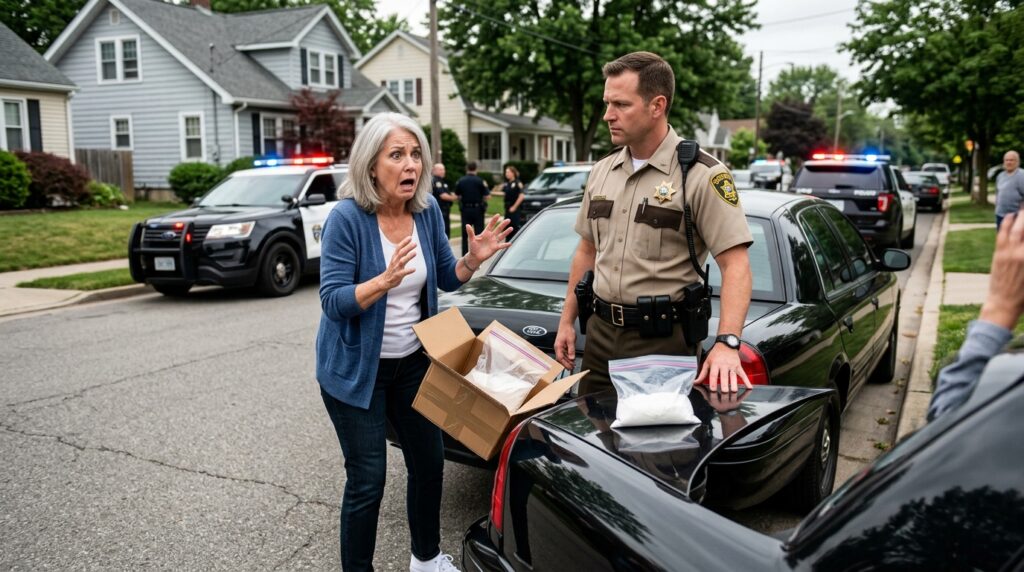
Deputy Miller stood beside the sedan’s trunk lid, his gloved hands carefully sealing the open cardboard flaps with yellow evidence tape. The sharp, tearing sound of the adhesive echoed down the street, loud in the sudden, dead quiet that had settled over the cul-de-sac.
“Narcotics team is two minutes out,” Miller said without turning around. He smoothed the yellow tape down over the cardboard seam with the heel of his palm. “They’ll process the car and the driveway apron. You’ll need to step back inside your home once they set the tape, Mark.”
“I’ll stay right here,” Mark said.
His voice didn’t carry anger. It carried the flat, unyielding weight of the concrete apron beneath his boots. He unclasped his left hand, opening his fingers to look at his brass house keys. The metal had cooled against his skin, no longer burning with the midday heat, the sharp teeth resting inert in his palm.
Across the avenue, the doors at Number 402 and Number 406 remained half-open. Neighbors stood on their porches—some holding cell phones at their chests, others simply staring in stunned, motionless silence. For eighteen months, those same neighbors had ducked into their garages whenever Evelyn’s clipboard appeared at the end of the block. They had paid the fifty-dollar fines for overgrown edging and unpainted shutters rather than face her shrill, administrative tribunal at the quarterly meetings.
Now, none of them spoke. The silence wasn’t triumphant; it was the heavy, exhausted air of a battlefield after the artillery stops.
Miller finished smoothing the tape, then straightened his spine. He reached into his shirt pocket, pulled out a small white card, and handed it across the three feet of neutral ground between the asphalt and the driveway.
“Case reference number,” Miller said. His gray eyes met Mark’s with a quiet, unvarnished respect. “State Investigator Vance will call you tomorrow for the formal deposition. You gave her room to dig her own ditch, Mark.”
Mark took the card, tucking it into his front shirt pocket next to his pen. “She dug it years ago, Deputy. She just didn’t realize who she was filling it for.”
“Her son’s silver pickup won’t make it past the county line,” Miller added, his tone clipped and matter-of-fact. “State police have the plate from the traffic camera at the avenue intersection. Scott set her up, but he left his own thumbprint on that green slip.”
Miller turned and walked back to his cruiser, his heavy boots crunching softly on the loose gravel along the gutter. He opened the driver’s door, climbed inside, and engaged the transmission. The tires rolled slowly over the asphalt, trailing behind the second unit as the two squad cars guided Evelyn away from the street she had spent a decade trying to control.
Mark didn’t watch the cruisers turn the corner. He turned his back on the avenue and walked three paces up his driveway to the exact spot where the box had landed an hour ago.
The concrete was bare. Only a small, square shadow remained where the sun hadn’t quite baked away the morning moisture beneath the cardboard.
Mark stood on his apron, his thumb tracing the smooth, worn brass of his front door key. For the first time in two years, the street felt wide, quiet, and completely his own. He slid the key into the deadbolt latch of his front door, turned the cylinder, and stepped inside, letting the door fall shut with a clean, solid click.