Chapter 2: Shadows Across the Asphalt
The patrol car’s red and blue lights divided the quiet street into alternating bands of color.
The officers had moved us away from the utility box while they began their initial inspection. I stood beside the rear of the cruiser, following instructions to keep my hands visible. The metal trunk pressed against my lower back, and the afternoon heat rose from the asphalt beneath my shoes.
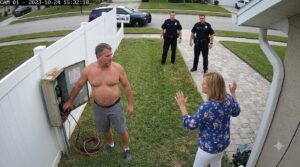
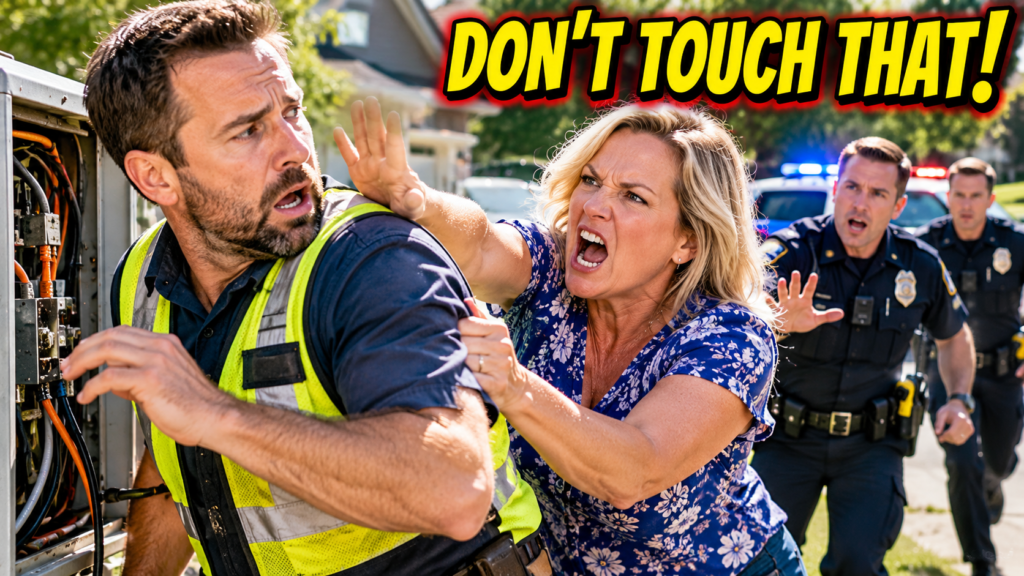
Across the short stretch of pavement, the woman in the blue floral top was speaking to the second officer.
She had regained her composure. Her shoulders were squared, and her voice had settled into a controlled, indignant tone.
“I live at forty-two twenty,” she repeated. “That service easement borders my property. He had no right to come over here, open that equipment, and start touching things.”
The officer listened without agreeing or disagreeing.
“I asked him what he was doing,” she continued. “He became hostile. Then he put his hands on me.”
I could hear every word.
“That isn’t what happened,” I called out.
The officer beside me raised a hand.
“Let me handle the questions, sir.”
I stopped speaking.
There was little to gain by trading accusations across the street. The officers needed to establish what had happened, and the equipment offered a way to test the claims being made.
My attention returned to the open box.
The second officer had put on protective gloves and was directing a flashlight into the housing. He was taking his time, examining the exposed connections rather than simply looking at the panel and closing it.
A faint clicking sound came from somewhere inside the enclosure.
It was rhythmic enough to draw attention, although I couldn’t identify its source from where I stood.
The woman glanced toward the box again.
She did it quickly, almost unconsciously, then returned her attention to the officer.
“There’s no reason to turn this into some major incident,” she said. “Call the utility company if you have questions. But I want him cited for assault.”
The officer beside me finally turned toward the equipment.
“Ma’am, we’ll address your complaint,” he said. “First, we need to understand what we’re looking at.”
“It’s a utility box.”
“I can see that.”
His tone remained neutral, but the exchange had changed. He was no longer allowing her to decide which part of the incident deserved attention.
The second officer called across the lawn.
“Come take a look at this.”
The officer beside me walked toward the fence, leaving enough distance between me and the woman to prevent another confrontation. I stayed by the cruiser, frustrated but unwilling to give her another opportunity to claim that I had threatened her.
From my position, I could see the second officer pointing toward a section behind the visible terminals.
He had found a connection that did not appear to belong with the ordinary equipment in the housing.
The nearer officer leaned in.
“What am I looking at?”
“There’s a separate feed running back toward the foundation,” his partner replied. “It doesn’t appear to be part of the normal metered connection.”
The woman went still.
It was a small change, but it was more revealing than another angry outburst would have been. Her hands, which had been moving as she explained her complaint, stopped at her sides.
The officer straightened and looked at her.
“Do you know anything about this additional connection?”
“No.”
The answer came too quickly.
“Nothing at all?”
“I told you. It’s standard utility equipment. If you don’t understand it, call the power company.”
The officer returned his attention to the housing.
“That’s what we’re going to do.”
I watched him inspect the connection again. The discovery did not establish who had installed it, who owned it, or why it was there. But it gave the officers a concrete reason to investigate something beyond the argument that had brought them to the property.
The woman seemed to understand that distinction.
Her complaint depended on keeping the focus on me. The additional feed made that strategy less effective with every passing minute.
She turned toward the officer standing beside the box.
“I want you to understand something,” she said. “He had no authorization to touch my equipment.”
The officer did not look up.
“Then we’ll need to establish whose equipment it is.”
For the first time, she had no immediate response.
I shifted my weight against the cruiser, watching the investigation develop. I knew what I had seen when I approached the box, but I also knew that suspicion was not proof. The officers would need to determine whether the connection was authorized and whether anyone had interfered with it.
That was why the condition of the housing mattered.
The officer directed his flashlight toward the recessed cavity again. His partner examined the wiring from another angle, taking care not to disturb the exposed components.
Then the nearer officer turned back toward the woman.
“Ma’am, I need you to remain here while we sort this out.”
Her jaw tightened.
“You can’t seriously be suggesting that I did something wrong.”
“I’m not making that determination yet.”
“Then why am I being treated like a suspect?”
“Because we found something that needs explaining.”
She stared at him, then looked across the street at me.
Her expression had lost the theatrical indignation she’d displayed when the officers first arrived. What remained was harder and more personal.
“You don’t know what you’re interfering with,” she said quietly.
I held her gaze.
“Neither do you, apparently, if you thought nobody would look inside.”
The officer beside her immediately told us both to stop talking to each other.
I obeyed.
The next step belonged to the officers and the utility personnel they would need to contact. Whatever the hidden connection meant, it could not be resolved through another argument in the street.
But one fact had already become clear: the box contained something that could not be explained simply by calling it standard equipment.
And until that discrepancy was resolved, neither the woman’s accusation nor my account could make the physical evidence disappear.