Chapter 6: The Price of Refusing to Apologize
Nearly a month passed before Karen finally agreed to discuss a resolution through an attorney.
By then, the fundraising platform had refunded the contributions collected through her disputed campaign.
The animal services complaint was closed.
The police investigation had documented the conflicting statements and preserved the available recordings.
Marcus’s attorney had also assembled evidence of the disruption to his employment, the time he had spent addressing the accusations, and the expenses he had incurred protecting his reputation.
Karen’s attorney requested a settlement meeting.
Marcus agreed.
He arrived at a neutral conference room with Susan on a rainy Tuesday morning.
Karen was already there.
Her appearance was noticeably different from the woman he remembered outside the grocery store. She wore a dark blue blouse, understated earrings, and ordinary black pants.
Her copper-red hair was neatly arranged.
She avoided looking directly at Marcus.
The meeting began with a review of the evidence.
Karen’s attorney acknowledged that the recordings did not support the original accusation of a dog attack.
Susan explained that Marcus had been subjected to public hostility, complaints to his employer, and an unnecessary animal services investigation.
She also noted that Karen had continued publishing accusations after Officer Hayes had personally contradicted her.
Marcus listened.
He had imagined this meeting many times.
In some versions, Karen shouted.
In others, she refused to accept responsibility.
But sitting across from her, he felt surprisingly little anger.
Mostly, he felt tired.
When asked what he wanted, Marcus explained that he wanted a clear public correction, reimbursement for reasonable expenses, and an agreement that Karen would stop repeating the false accusations.
He did not demand a humiliating public performance.
He did not ask for her personal financial information.
He did not want revenge.
He wanted the damage repaired as far as possible.
Karen initially insisted that she had genuinely been frightened by Cooper.
Susan reminded her that fear did not justify claiming that an attack had occurred when it hadn’t.
Nor did it justify demanding money from the dog’s owner.
After a lengthy private discussion with her attorney, Karen agreed to the essential terms.
She would publish a correction acknowledging that Cooper had not attacked her, that Marcus had not caused the destruction of her groceries, and that her previous accusations had been inaccurate.
She would reimburse agreed-upon expenses.
She would also stop publishing the disputed allegations.
The civil agreement did not determine the outcome of any separate official investigation, and neither party pretended otherwise.
Before the meeting ended, Marcus looked at Karen.
He thought about the nights he had spent worrying that someone might take Cooper away. He thought about Sophie’s frightened expression when she asked whether the dog was in trouble.
He wanted Karen to understand that her actions had affected more than a stranger standing outside a grocery store.
“You didn’t just accuse me,” he said quietly. “You frightened my family.”
Karen looked down at the table.
For several seconds, she said nothing.
Then she apologized.
It was brief and uncomfortable.
Marcus couldn’t know whether she truly regretted her actions or simply regretted the consequences.
He accepted the apology without pretending that everything was immediately forgiven.
Trust, once damaged, required more than words.
Later that week, Karen published the agreed correction.
Robert placed it beneath the original community statement so readers could see the resolution.
The post attracted considerable attention, but Marcus asked Robert to remove comments encouraging harassment.
He had no desire to see Karen subjected to the same kind of reckless public judgment she had directed toward him.
Accountability was necessary.
Cruelty was not.
Several weeks later, the authorities resolved the remaining matter through an agreement requiring Karen to complete community service and comply with other conditions.
Marcus received confirmation that no further participation was required from him.
He filed the documents in a cabinet beside Cooper’s veterinary records.
The dispute was finally over.
On his way home from work that Friday, Marcus stopped at the grocery store.
Ellen recognized him immediately.
She asked how Cooper was doing.
Marcus smiled and told her that Cooper remained the happiest member of the Bennett household.
Ellen laughed.
Then she offered him a small package of dog treats from the store’s pet aisle.
Marcus accepted it gratefully.
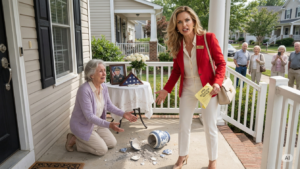
As he walked toward his truck, he passed the exact place where Karen had thrown her groceries.
The concrete had been cleaned.
There were no broken eggs, no scattered apples, and no crowd of suspicious strangers.
It looked like an ordinary sidewalk again.
Marcus was glad.
He had spent enough time living inside that moment.
It was time to move forward.