Chapter 2: The Woman Who Wouldn’t Leave
Patricia recovered from her shock faster than anyone expected.
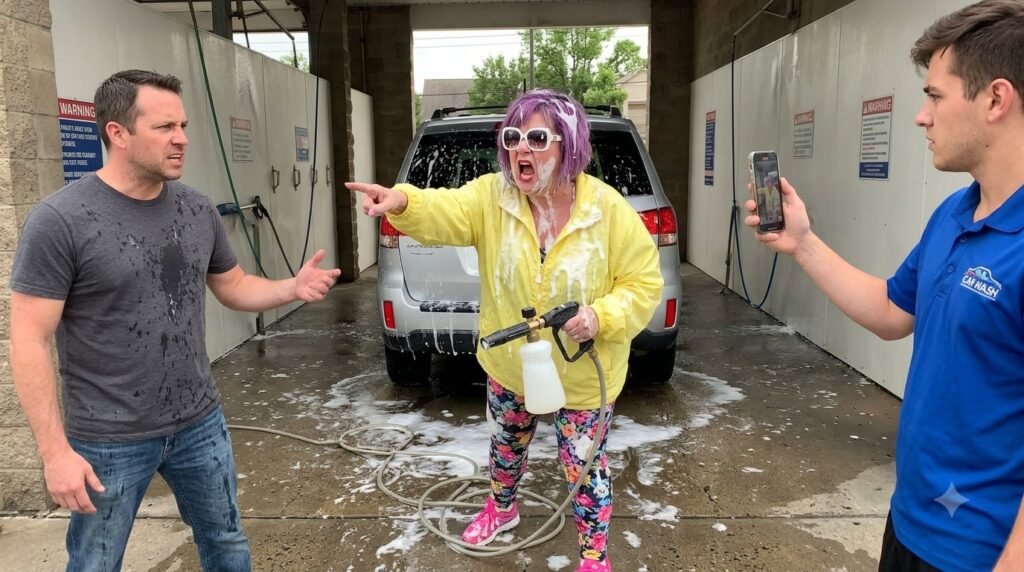
She straightened her yellow jacket, wiped soap from her sunglasses, and pointed a trembling finger toward Tyler.
“You can’t record me without my permission.”
Tyler lowered the phone slightly but didn’t put it away.
He had been standing near the equipment storage room when the argument began. At first, he thought it was another disagreement over washing time.
Then he saw Patricia grab the foam cannon.
He had started recording because he was worried someone might get hurt.
The video captured the deliberate spraying, Daniel’s attempts to protect himself, the hose tightening around Patricia’s ankle, and the accidental blast that covered her in foam.
Tyler knew the recording might be important.
Clearview was owned by his aunt, Margaret Brooks, a 63-year-old widow who had spent nearly three decades keeping the business alive.
She had taught Tyler that customers deserved patience, even when they were difficult.
But patience didn’t mean allowing someone to attack another customer.
Daniel wiped his eyes with a clean towel Tyler brought from the supply room.
His vision was clearing, although his skin still felt irritated.
He was less concerned about his clothing than about the fact that a stranger had deliberately sprayed chemicals toward his face.
Patricia, meanwhile, had moved from anger to accusation.
She claimed the foam cannon had malfunctioned.
Then she claimed Daniel had frightened her.
Finally, she insisted Tyler had deliberately caused the accident by failing to maintain the equipment.
Each explanation contradicted the one before it.
Tyler didn’t argue.
He simply told her that Margaret was on her way.
That announcement seemed to disturb Patricia more than the video.
Margaret Brooks was not a woman easily intimidated.
She had inherited the car wash from her late husband, Robert, who had built the original two-bay operation in 1994. Together, they had expanded it slowly, using savings instead of taking on unnecessary debt.
When Robert died six years earlier, several people advised Margaret to sell.
She refused.
The business was more than a source of income. It represented decades of early mornings, repaired machinery, unpaid vacations, and the belief that honest work could still build something lasting.
Margaret arrived in her faded blue pickup truck twelve minutes later.
She stepped out wearing jeans, a light denim shirt, and comfortable walking shoes.
Her silver hair was pulled into a practical ponytail.
She looked first at Daniel’s soaked clothing, then at the foam-covered pavement, and finally at Patricia.
“Is everyone all right?” she asked.
Daniel explained that he had been sprayed in the face.
Margaret offered him access to the office sink and an eyewash bottle from the first-aid cabinet. Tyler accompanied him inside.
Patricia immediately approached Margaret.
She demanded a refund, compensation for her ruined jacket, and the employee’s dismissal.
Margaret listened without interrupting.
Then she asked to see the video.
Tyler returned and played it.
The recording lasted less than a minute.
By the end, Margaret’s expression had hardened.
She watched Patricia deliberately aim the cannon at Daniel. She saw the hose catch around Patricia’s ankle. She watched the nozzle turn back toward the woman as she pulled against the line.
Nothing in the footage suggested a malfunction.
Margaret handed the phone back to Tyler.
She informed Patricia that she was no longer welcome at Clearview and asked her to leave.
Patricia stood motionless.
Then she reached into her handbag and pulled out her own phone.
She began photographing the washing bay, the equipment, and Margaret’s face.
“You’re going to regret humiliating me,” she said.
Margaret remained calm.
She explained that Patricia was free to document the property from a lawful location, but she could not continue disrupting customers or remain on the premises after being asked to leave.
Patricia walked toward her car, a white luxury crossover parked near the vacuum stations.
Before getting in, she turned and took one final photograph of the Clearview sign.
Then she drove away.
Daniel assumed the incident was over.
He thanked Margaret and Tyler, exchanged contact information with them, and returned home after making sure his eyes no longer hurt.
That evening, he told his wife, Laura, what had happened.
She was sitting at the kitchen table sorting bills when he described the woman, the foam cannon, and the unexpected reversal.
At first, Laura laughed.
Then she noticed how serious he looked.
Daniel explained that the woman had aimed the spray directly at his face.
Laura’s smile faded.
Their daughter, Emily, was sixteen and had recently started driving.
The thought of a stranger behaving that way around her was unsettling.
“People like that don’t always stop when they’re embarrassed,” Laura said.
Daniel hoped she was wrong.
The next morning, Margaret discovered that Patricia had already begun telling the neighborhood a very different story.