Chapter 5: The Footage Behind the Gate
Three days later, Marcus received Karen’s complaint through the company’s customer relations department.
He read it carefully.
The allegations were serious enough to require a formal response.
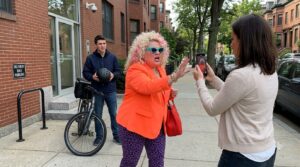
Karen claimed Daniel had entered her property without authorization, refused to remove his belongings, and behaved aggressively when she attempted to protect her driveway.
She also stated that Marcus had recorded her despite repeated objections.
The complaint omitted the water bottle.
It omitted the damaged scanner.
And it omitted the fact that Karen had been the person who initiated the physical interference.
Marcus forwarded the complaint to the regional safety manager, Angela Foster.
Angela was fifty-seven and had spent more than two decades investigating transportation and workplace incidents.
She was known for being thorough rather than dramatic.
She requested the original evidence, reviewed the route records, and interviewed both employees separately.
Daniel’s account remained consistent.
Marcus’s photographs supported the physical sequence.
Evelyn’s recording showed the decisive action.
The delivery company’s vehicle records also confirmed that Daniel’s van had been stopped legally along the curb.
Angela found no evidence that Daniel had threatened Karen or entered her yard.
Still, she wanted to address one remaining question.
Karen had claimed to possess security footage.
Angela sent a written request asking Karen to preserve any relevant recording and provide a copy if she wished the company to consider it.
Karen didn’t respond.
A second request received the same silence.
Meanwhile, Thomas had consulted the association’s attorney about the unofficial notices.
The attorney recommended preserving the documents and their distribution history, correcting the association’s records, and avoiding public accusations about criminal wrongdoing until the facts were established.
Thomas followed that advice.
He also learned something surprising.
Karen had not always been the neighborhood’s most difficult resident.
When she and her husband, Robert, moved into the development eight years earlier, she volunteered for holiday decorations and helped organize community garage sales.
Neighbors remembered her as outspoken but generous.
Things had changed after Robert died from a sudden heart attack three years earlier.
Karen had withdrawn from community activities.
Then she began complaining about minor disturbances.
Over time, her demands became more aggressive.
Evelyn remembered bringing her a casserole after the funeral.
Karen had thanked her, cried briefly, and then spent nearly an hour describing how frightening it felt to be alone in such a large house.
Evelyn hadn’t forgotten that conversation.
It didn’t excuse what Karen had done.
But it suggested that her need for control had grown out of something deeper than irritation over delivery trucks.
Thomas was careful not to confuse explanation with justification.
The board’s responsibility was to protect residents and ensure its name wasn’t misused.
Whatever Karen’s private struggles, she had crossed a clear boundary.
Then a new piece of evidence appeared.
A neighbor named Samuel Price contacted Thomas.
Samuel worked from home and had a doorbell camera overlooking the street.
He had reviewed footage from the afternoon of the confrontation after hearing about the HOA meeting.
His camera didn’t capture the actual water pouring.
But it recorded the minutes before the incident.
In the video, Daniel parked his van, retrieved a package, and approached the concrete ledge.
Karen emerged from her house shortly afterward.
She watched him place the scanner and bottle down.
Then, rather than asking him to move them, she walked directly toward the ledge.
She paused beside the objects.
Looked toward Daniel.
And reached for the bottle.
The recording showed that Karen had time to understand what she was doing.
This wasn’t an accidental spill.
It wasn’t an immediate response to a dangerous obstruction.
She had chosen to interfere.
Angela reviewed the footage and added it to the company’s investigation.
With the new recording, the sequence was now supported from two different angles.
But Samuel’s camera had captured one more detail.
Before approaching Daniel’s equipment, Karen had briefly held up her phone.
She appeared to be photographing the items on the ledge.
That raised a new question.
Had she intended from the beginning to manufacture evidence of a supposed violation?