Chapter 4: A Neighborhood Divided
The following Monday, Thomas called a special HOA board meeting.
He wasn’t interested in turning the gathering into a public trial of Karen Whitmore.
He wanted to establish the facts, protect the association’s records, and prevent another confrontation.
The meeting was held in a small community room beside the neighborhood pool.
Folding chairs lined the walls.
A pitcher of ice water sat on a table near the entrance.
By six-thirty, more than thirty residents had arrived.
Some were curious.
Others were angry.
A few believed Karen had a point about delivery vehicles, even if they disagreed with her methods.
Thomas opened the meeting by explaining the limits of the association’s authority.
The board could enforce valid community rules on property within its jurisdiction.
It could not grant individual homeowners ownership of public sidewalks.
It could not authorize residents to damage another person’s property.
And it could not permit someone to issue official-looking notices without approval.
Linda presented copies of the documents.
Several residents recognized them.
A retired schoolteacher named Patricia Wells said Karen had once handed her a notice after a visiting nurse parked near Patricia’s driveway.
A younger father, Michael Torres, described finding a warning attached to his sister’s car during a family birthday party.
Neither incident had involved an actual blocked driveway.
Karen had simply disliked the vehicles’ proximity to her house.
Then Evelyn described what happened to Daniel.
She kept her statement factual.
She explained where the scanner had been placed, how Karen emptied the water bottle, and how the driver attempted to save the device.
Thomas allowed residents to view the video privately on a laptop rather than projecting it for entertainment.
The room grew quiet.
The most disturbing part wasn’t Karen’s shouting.
It was the deliberate way she shook the bottle to empty the last of the water.
Several people looked away.
Karen arrived twenty minutes late.
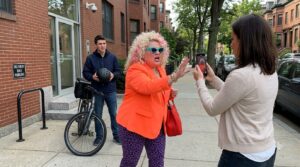
She wore a bright turquoise blouse, white trousers, and the same oversized purple sunglasses she had worn during the confrontation.
She entered with the confidence of someone who expected to take control of the room.
But the atmosphere had changed.
Thomas offered her an opportunity to respond.
Karen argued that the neighborhood had become disorderly.
She described delivery vans as an eyesore, complained about strangers walking near private homes, and insisted that residents deserved greater control over their surroundings.
She admitted pouring the water but characterized it as a spontaneous reaction to repeated disrespect.
When Thomas asked whether she understood that the scanner belonged to the delivery company, she dismissed the question.
Her position remained that Daniel should never have left it on the ledge.
A resident near the back finally asked why a delivery worker deserved to lose his drinking water in extreme heat.
Karen had no convincing answer.
She returned to her complaints about property rights.
Thomas kept the meeting focused.
The board voted to formally disavow the unauthorized notices, require their removal from association channels, and refer the signature issue for legal review.
It also approved a clearer process for reporting genuine parking and access problems.
The goal was not to eliminate legitimate complaints.
It was to ensure that complaints were handled lawfully and fairly.
Karen left before the meeting ended.
Outside, she sat in her SUV for several minutes, gripping the steering wheel.
For the first time, the neighborhood hadn’t accepted her version of events.
That frightened her more than she wanted to admit.
At home, she opened her laptop and began writing another complaint.
This one was addressed to the delivery company’s regional management.
She alleged that Daniel had threatened her, that Marcus had intimidated her, and that the company was responsible for trespassing and harassment.
She demanded a formal apology.
Then she added a sentence that would soon become important.
She claimed her home security footage would prove everything.
Karen attached no video.
She assumed the company would never ask to see it.