Chapter 8: The Sound of Coming Home
Margaret’s repaired hearing aids arrived on a Thursday morning.
The delivery van pulled into Willow Creek at 9:08 a.m.
There was no confrontation.
No warning notice.
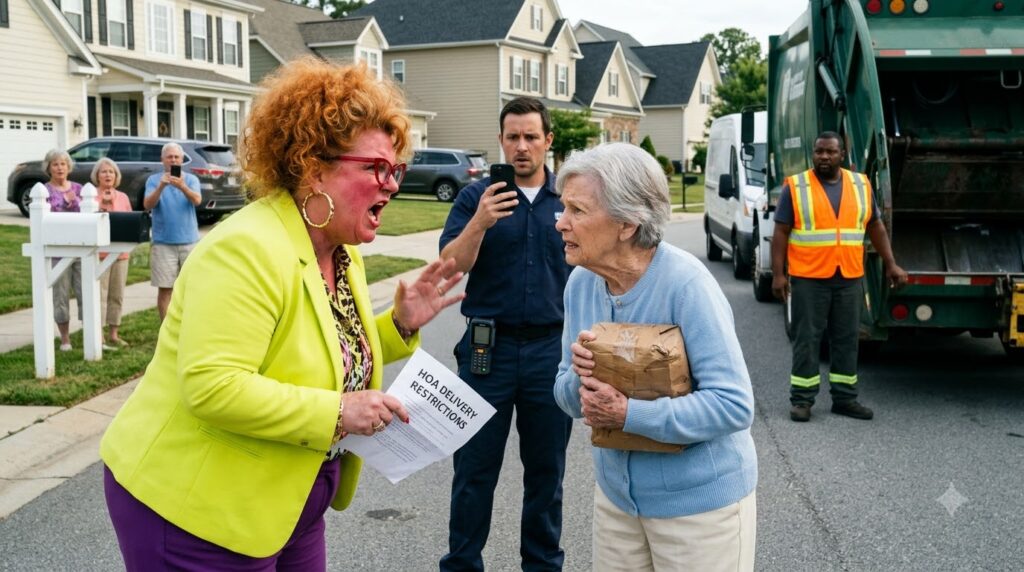
No angry figure standing beside a garbage truck.
The driver stopped in front of Margaret’s house, carried the package to her porch, and rang the bell.
Margaret opened the door.
She signed for the delivery.
Then she thanked him.
It was an ordinary exchange.
And after everything that had happened, its ordinariness felt extraordinary.
Evelyn drove Margaret to the audiologist that afternoon.
Dr. Shaw inspected the repaired devices, verified their operation, and completed the fitting adjustments.
Margaret sat quietly as the hearing aids were placed in her ears.
The doctor spoke.
Margaret heard her clearly.
Not perfectly.
The new devices required adjustment, and Margaret would need time to become comfortable with them.
But the difference was immediate.
She heard the soft rustle of paper on the desk.
The faint hum of the ventilation system.
Evelyn shifting in her chair.
For months, the world had seemed distant, as though everyone around her were speaking through closed doors.
Now those doors were beginning to open.
Margaret covered her mouth.
Tears filled her eyes.
Dr. Shaw gave her a moment.
That evening, Emily arranged a video call with her children.
Margaret sat at the kitchen table, the same table where she had opened the damaged package weeks earlier.
Her grandson, Noah, appeared on the screen.
He was seven years old and missing one front tooth.
Her granddaughter, Sophie, was four.
They had made a drawing for her.
It showed a little blue house, a bright yellow sun, and three smiling people holding hands.
Noah explained that the picture was for Grandma because she had been sad.
Margaret heard every word.
Then Sophie leaned toward the camera.
“Grandma, can you hear me now?”
Margaret smiled through tears.
“Yes, sweetheart. I can hear you.”
Sophie giggled.
The sound was clear.
Bright.
Beautiful.
Margaret had not realized how much she missed that particular laugh.
She listened as the children described their school day, their dog, and a birthday party.
For the first time in many months, she did not need Emily to repeat every sentence.
She did not pretend to understand.
She simply listened.
After the call, Margaret remained at the table.
Robert’s photograph stood beside the window.
She wished he could have witnessed the moment.
He would have been delighted by the technology.
He would have asked the audiologist a dozen questions.
And he would have been proud that Margaret had stood up for herself.
The following Saturday, Willow Creek held its annual neighborhood picnic.
Attendance was higher than usual.
Thomas, now serving as board president, had encouraged residents to participate in planning the event.
Several new volunteers helped organize food, seating, and transportation for homeowners with mobility limitations.
The board also introduced a simple program to assist residents who needed help coordinating medical deliveries or essential home services.
Participation was voluntary.
The program did not involve monitoring private medical information.
It simply gave residents a reliable contact when access problems arose.
Margaret attended with Evelyn.
Walter was working at the lemonade table.
Luis Mendoza, the sanitation worker who had retrieved the package, had been invited as a guest.
Daniel Brooks also stopped by briefly during his day off.
Margaret thanked both men again.
Luis smiled and said he was glad the truck had been stopped in time.
Daniel told her that he had thought about the incident often.
He was relieved that she had received her repaired equipment.
Margaret gave him a small handwritten thank-you card.
He tucked it carefully into his shirt pocket.
Across the picnic area, residents were talking beneath the trees.
Children ran across the grass.
Someone had brought homemade peach cobbler.
An older couple danced slowly near the clubhouse while a portable speaker played familiar songs.
Margaret watched the scene with a feeling she had not experienced in a long time.
Belonging.
She had spent years gradually withdrawing from conversations because she could not hear them.
Then Patricia’s actions had made her feel as though she no longer belonged in her own neighborhood.
But the neighbors had answered that cruelty with something stronger than anger.
They had shown up.
They had spoken honestly.
They had demanded fairness.
And they had changed the rules of how their community was governed.
Late in the afternoon, Margaret noticed Patricia standing on the sidewalk beyond the picnic area.
She was dressed plainly in a gray sweater and dark slacks.
Without her bright blazer and heavy jewelry, she seemed less imposing.
Charles stood beside her.
They were not attending the picnic.
They appeared to be returning from a walk.
For a moment, Patricia and Margaret looked at each other.
Patricia hesitated.
Then she approached.
Evelyn moved slightly closer to Margaret but said nothing.
Patricia stopped several feet away.
Her voice was quieter than Margaret had ever heard it.
She acknowledged that she should never have touched the package.
She said she was sorry for the damage and the distress she had caused.
Margaret listened carefully.
The apology did not erase what had happened.
It did not undo the weeks of anxiety or the humiliation in the street.
But Margaret had no desire to carry hatred into the remaining years of her life.
She thanked Patricia for acknowledging the wrong.
Then she explained that trust would have to be rebuilt through behavior, not words.
Patricia nodded.
She did not ask for forgiveness.
She did not defend the delivery rule.
She simply returned to Charles.
Margaret watched them walk away.
She did not know whether Patricia would truly change.
That was no longer her responsibility.
Her responsibility was to live her own life with dignity.
As the afternoon sunlight settled over Willow Creek, Walter approached carrying two glasses of lemonade.
He handed one to Margaret.
Nearby, Sophie and Noah were visiting with Emily, chasing each other across the lawn.
Sophie called out to her grandmother.
Margaret turned immediately.
She heard her name.
She heard her granddaughter laughing.
And she heard the ordinary, comforting sounds of a neighborhood that was learning to respect its residents again.
Weeks earlier, Patricia Hargrove had declared that her HOA rules mattered more than Margaret’s medical needs.
But the residents of Willow Creek had reached a different conclusion.
Rules were supposed to protect a community, not give one person power over everyone else.
A home was more than a property governed by regulations.
It was the place where people should feel safe, respected, and free to grow old without fear.
Margaret raised her glass and smiled at her grandchildren.
She had recovered her hearing aids.
She had protected her home.
And, perhaps most importantly, she had discovered that growing older did not mean surrendering her voice.
The End.