Chapter 2: The Rule Nobody Remembered Approving
By noon, Margaret’s kitchen telephone had rung eleven times.
Some calls came from neighbors who had witnessed the confrontation. Others came from residents who had already heard about it.
The story spread quickly through Willow Creek Estates, a neighborhood of 184 homes where most residents had lived long enough to recognize one another’s cars, grandchildren, and holiday decorations.
Margaret answered only three calls.
Her hearing was too poor to manage the others.
At 12:40 p.m., Evelyn Carter arrived carrying chicken soup and a folder.
Evelyn had worked as a registered nurse for thirty-eight years. She understood medical devices, insurance paperwork, and the particular exhaustion that came from being treated as a problem instead of a person.
She examined the hearing aid case without touching the equipment.
“Don’t try to use them yet,” she advised, speaking slowly and facing Margaret. “Let the audiologist inspect everything.”
Margaret nodded.
She had already contacted the hearing clinic through its online patient portal.
The earliest available appointment was Friday.
Three days away.
Evelyn opened her folder.
Inside was a copy of the Willow Creek Estates governing documents.
She had downloaded them several months earlier when Patricia attempted to fine her for keeping a flowerpot on her front porch.
The documents were seventy-three pages long.
Evelyn had marked the sections concerning deliveries.
According to the rules approved by homeowners, commercial vehicles were restricted from using certain residential streets between 10 p.m. and 6 a.m., except for emergencies and essential services.
There was no prohibition on morning package deliveries.
There was no rule allowing the HOA president to confiscate private property.
And there was certainly no provision authorizing her to throw medical equipment into a garbage truck.
Margaret stared at the highlighted paragraph.
“But she had a paper.”
Evelyn nodded.
“That’s what worries me.”
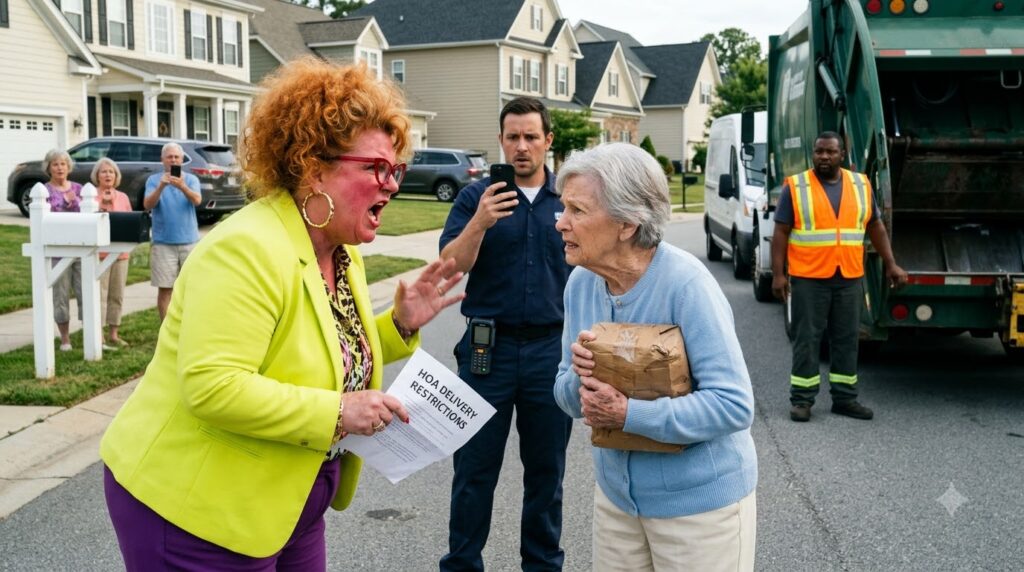
The paper Patricia had waved that morning was not part of the official governing documents.
It appeared to be a separate notice.
At 2:15 p.m., Walter Pierce arrived with a copy.
He had obtained it from another homeowner who found one taped to her mailbox.
The notice was dated two weeks earlier.
It stated that delivery vehicles could not enter the neighborhood before 10 a.m. without written HOA authorization.
At the bottom appeared Patricia’s signature.
Beneath it were the words:
Approved by the Willow Creek Estates Board of Directors.
Walter had served on several nonprofit boards during his career. He understood the importance of minutes, votes, and proper authorization.
He had a simple question.
When had the board approved this rule?
That afternoon, he emailed the HOA management company requesting the meeting minutes and vote record.
He also contacted two board members he knew personally.
One responded almost immediately.
She had never voted on such a restriction.
The second board member was traveling and promised to check his records.
Margaret listened as Evelyn explained the situation.
For the first time since the morning confrontation, her expression changed.
She was still upset.
But now she was beginning to understand that Patricia’s behavior might not have been an isolated outburst.
Someone had created an official-looking rule without clear evidence of proper approval.
Someone had used that rule to interfere with a medical delivery.
And someone was now threatening to punish the victim.
At 4:30 p.m., Margaret received an email from Willow Creek’s management office.
The subject line read:
NOTICE OF HOA VIOLATION — DISRUPTIVE CONDUCT
Margaret opened it.
The letter accused her of creating a public disturbance, interfering with sanitation operations, and verbally confronting an HOA official.
It imposed a proposed $250 fine, subject to a hearing.
It also warned that further violations could result in additional enforcement action.
Margaret read the letter twice.
Then she handed her tablet to Evelyn.
The retired nurse’s expression hardened.
“They’re trying to make you responsible for what happened.”
Margaret looked toward the kitchen table, where the damaged hearing aids remained untouched.
For years, she had paid her assessments on time.
She maintained her lawn.
She kept her house painted.
She had never received a violation notice.
Now she was being threatened with a fine for objecting when someone threw her medical equipment into the garbage.
Walter asked permission to photograph the notice.
Margaret agreed.
He added it to the growing folder of documents.
Meanwhile, Daniel Brooks was sitting in his delivery company’s regional office.
His supervisor had requested a detailed incident statement.
Daniel described the confrontation, the package’s condition, and Patricia’s claim of HOA authority.
He provided the recording from his phone.
The company preserved his delivery scan, vehicle location data, and dispatch messages.
Daniel’s supervisor also contacted the sanitation company to request any available vehicle-camera footage.
There was no guarantee the cameras had captured the incident.
But the request mattered.
A formal record was beginning to take shape.
That evening, Patricia sat in her spacious home overlooking the neighborhood’s central pond.
She believed the matter was settled.
The elderly woman had been warned.
The driver had been reported.
The neighbors would eventually stop talking.
Patricia had handled complaints before.
She knew that most residents disliked confrontation.
A stern letter, a threatened fine, and a reminder about property values were usually enough to make them retreat.
But this time, she had overlooked something important.
Margaret Whitmore was not the only homeowner who had suffered under Patricia’s interpretation of HOA authority.
And the others were beginning to compare their experiences.