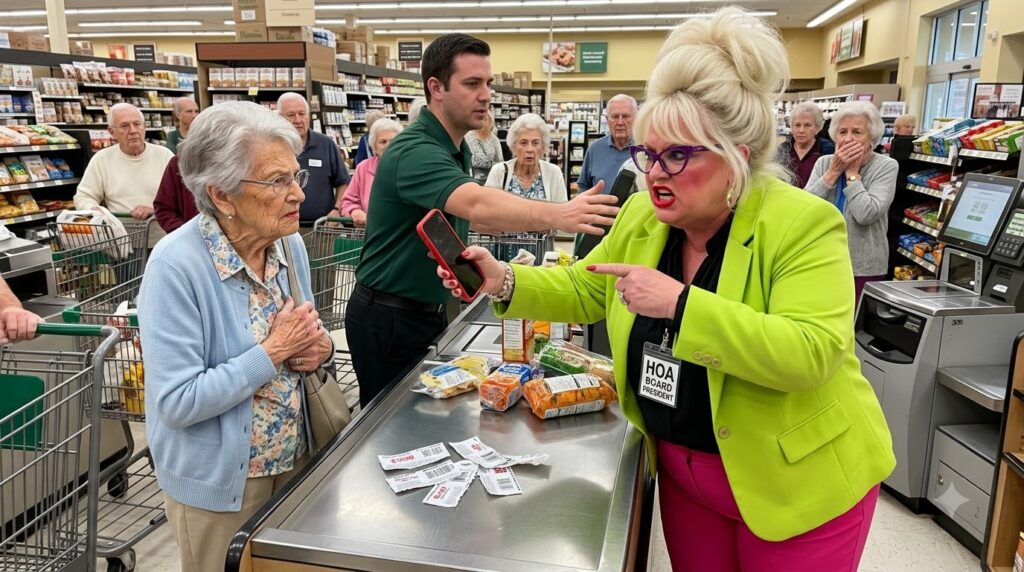
Chapter 6: The Meeting Patricia Couldn’t Control
The Willow Creek clubhouse had hosted birthday parties, holiday dinners, exercise classes, and countless neighborhood gatherings.
Margaret remembered dancing there with Robert during their fortieth wedding anniversary celebration.
She had never imagined returning to defend herself against the president of her own homeowners association.
On the evening of the emergency meeting, the parking lot was nearly full.
Residents arrived carrying folders, notebooks, and copies of violation notices.
Some came out of curiosity.
Others came because they had finally grown tired of being afraid.
Margaret entered with Susan and Evelyn.
Attorney Rebecca Collins accompanied them as an observer and adviser.
Patricia stood behind the meeting table.
She wore a bright purple jacket, oversized jewelry, and the same large HOA badge she had displayed in the supermarket.
Her expression hardened when she saw Margaret.
Two other board members sat beside her.
One was Richard Bell, a retired insurance agent who had served as vice president for three years.
The other was Linda Foster, a former accountant who had joined the board six months earlier.
Both looked uncomfortable.
Patricia opened the meeting by accusing a small group of homeowners of spreading misinformation.
She claimed the association’s enforcement program was necessary to protect property values.
She described complaints against her leadership as personal attacks.
Then she displayed a slide containing Margaret’s photograph from the supermarket.
A murmur moved through the room.
Margaret felt heat rise into her face.
Patricia described the incident as an example of conduct that reflected poorly on Willow Creek.
She did not mention the torn coupons.
She did not mention the store employee.
She did not mention the video.
When Patricia finished, Rebecca asked whether the board had authorized the use of Margaret’s image in the presentation.
Patricia bristled.
“This is an official HOA matter.”
Rebecca calmly requested the specific rule Margaret had allegedly violated and the records showing that the fine had been approved through the required process.
Patricia pointed toward a binder.
She claimed the policy had been adopted months earlier.
Linda Foster opened her own notebook.
“I don’t remember voting on that policy.”
Patricia turned sharply.
Linda continued.
She had reviewed the minutes before the meeting.
There was no recorded vote approving the broad community-reputation enforcement rule.
Richard Bell shifted in his chair.
He admitted that Patricia had presented the policy as already authorized when he joined the discussion.
He had never seen the original approval.
The room grew restless.
Margaret looked toward Susan.
Susan nodded.
It was time.
With permission to address the board, Margaret walked slowly toward the microphone.
Her hands trembled.
She had never enjoyed public speaking.
Robert had always been the outgoing one.
But she had spent too many nights worrying about her home to remain silent.
She explained that she had gone to the supermarket to buy ordinary groceries.
She had used coupons because saving money was sensible.
She had not broken any neighborhood rule.
She had not insulted the community.
Then she described Patricia tearing the coupons in front of her.
Her voice remained steady.
“I’ve lived here twenty-three years. I helped neighbors after hurricanes. I brought meals when people were sick. My husband and I paid every association fee we owed. I won’t accept being treated like I don’t belong because I watch my grocery bill.”
The room was silent.
Susan then asked permission to present the recording.
Patricia objected.
Richard Bell, looking increasingly troubled, supported allowing it.
Linda agreed.
The video played on a large screen.
Everyone watched Patricia seize the coupons.
They heard the paper tearing.
They heard the thousand-dollar threat.
They watched Margaret defend herself.
And then Patricia’s final declaration filled the room.
“I OWN THIS COMMUNITY! POOR PEOPLE DON’T BELONG HERE!”
A shocked silence followed.
Patricia’s face turned crimson.
She claimed the recording lacked context.
But the store surveillance footage, shown next, confirmed the physical sequence.
Several residents began speaking at once.
Walter Greene raised his violation notice.
Helen Price held up photographs of her memorial bench.
George Miller displayed the invoices from his driveway cleaning.
The meeting was no longer about Margaret alone.
It had become a public accounting of months of intimidation.
Rebecca requested that the board suspend disputed enforcement actions while an independent review took place.
Linda supported the request.
Richard agreed.
Patricia refused.
She insisted that the president had authority to make executive decisions.
Rebecca explained that the association was governed by its documents and applicable law, not by a president’s personal preferences.
Richard asked for a vote on suspending enforcement of the disputed policy pending review.
Linda voted yes.
Richard voted yes.
Patricia voted no.
The motion passed.
For the first time in years, Patricia had lost control of a board decision.
But the most consequential moment came afterward.
Linda approached Rebecca privately.
She said she had found invoices that concerned her.
The amounts were larger than she expected.
And several appeared to have been approved without the supporting documentation normally required.
She had brought copies.
Rebecca examined the first page.
The payments were not merely questionable.
Some appeared to have been issued for work that had never been performed.