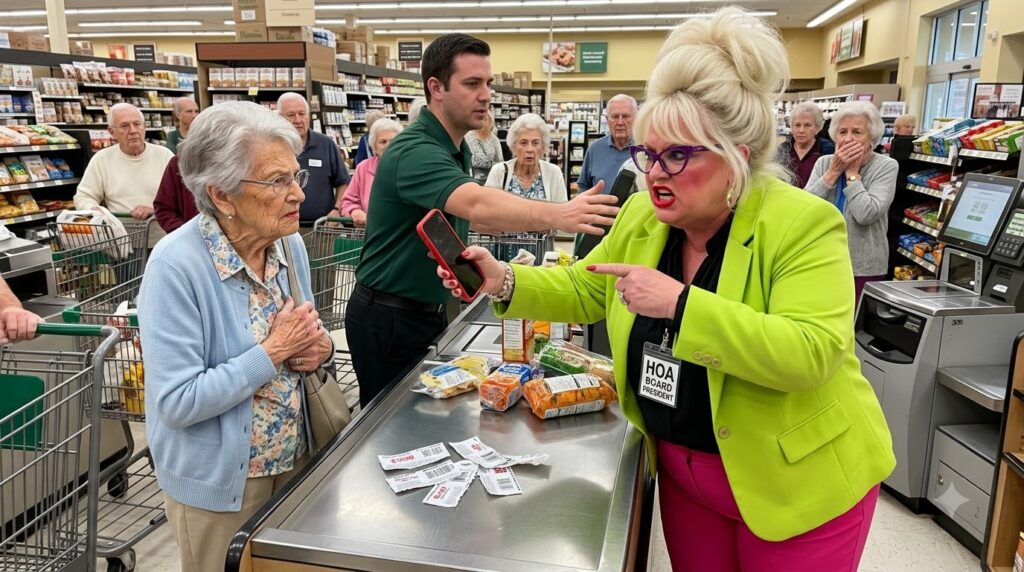
Chapter 4: The Camera That Remembered Everything
Daniel Brooks had seen plenty of difficult customers during his years in supermarket management.
He had dealt with arguments over expired coupons, pricing mistakes, and long checkout lines.
But he had never witnessed someone use a neighborhood association badge to threaten an elderly customer.
The incident troubled him long after Patricia left.
Margaret had looked genuinely frightened.
Daniel remembered how carefully she had collected her groceries, apologizing repeatedly even though she had done nothing wrong.
He also remembered Patricia’s phone pointed directly at the woman’s face.
When Margaret returned to the store with Susan, Daniel recognized her immediately.
He invited them into a small office behind the customer service counter.
Margaret thanked him for intervening.
Daniel assured her that the supermarket did not tolerate customers harassing one another.
Susan explained that the HOA president had issued a fine based on the incident.
Daniel frowned.
“A fine? For shopping here?”
Margaret handed him the notice.
He read it in disbelief.
The description claimed Margaret had caused a disturbance and refused to follow reasonable community standards.
Daniel shook his head.
“That’s not what happened.”
He explained that the store had surveillance cameras covering the checkout lanes.
The footage was retained for a limited period under company policy.
He could not simply hand over recordings without authorization, but he could preserve the relevant footage and refer their request to the company’s security department.
Susan asked him to do so immediately.
Daniel agreed.
He also offered to provide a factual witness statement, subject to company procedures.
Margaret felt an unexpected surge of relief.
For days, Patricia’s version of events had been circulating through Willow Creek.
Now there was a possibility of proving what had actually happened.
Two days later, the store’s corporate security office confirmed that the recording had been preserved.
After receiving a written authorization and reviewing the circumstances, the company provided a copy of the relevant footage to Margaret and Susan.
They watched it together at Susan’s dining room table.
The video was painful.
Margaret saw herself standing beside the register, smiling politely as she handed the cashier her coupons.
Patricia entered the frame moments later.
She appeared to recognize Margaret.
Then she moved directly toward her.
The footage showed Patricia snatching the coupons.
It showed her tearing them.
It showed Margaret recoiling.
It showed Daniel stepping between them.
And it showed Patricia raising her phone.
The store’s video had no useful recording of their conversation, but the physical sequence was unmistakable.
Margaret had not initiated the confrontation.
She had not threatened anyone.
She had been trying to buy groceries.
Susan replayed the opening moments.
“Look at this.”
Patricia had approached Margaret before the cashier even finished scanning the first item.
The encounter had not begun with an argument over a discount.
Patricia had deliberately singled her out.
That detail changed how Margaret understood the incident.
She remembered seeing Patricia in the parking lot several minutes earlier.
At the time, she had thought nothing of it.
Now she wondered whether Patricia had followed her inside.
The next afternoon, another piece of evidence surfaced.
A local resident named Thomas Reed contacted Evelyn.
Thomas was sixty-eight, a retired newspaper photographer who occasionally recorded neighborhood events for a community history project.
He had been shopping near the checkout lanes when Patricia began shouting.
Startled by the confrontation, he had taken out his phone and recorded part of it.
His video included sound.
The words were clear.
“No coupons! You’re embarrassing our HOA!”
Then the threat of a thousand-dollar fine.
Then Margaret’s response.
And finally, Patricia’s furious declaration.
“I OWN THIS COMMUNITY! POOR PEOPLE DON’T BELONG HERE!”
Thomas had not posted the recording online.
He disliked public humiliation, even when someone behaved badly.
But after learning that Margaret had been fined, he believed she deserved access to the evidence.
He sent the original file to Susan.
For the first time, Margaret heard the confrontation from outside herself.
Patricia’s voice sounded even harsher than she remembered.
Margaret watched her own frightened expression.
She saw her shoulders straighten.
She heard herself defend her right to buy food without harassment.
When the video ended, she remained silent.
Susan reached for her hand.
“You stood up for yourself.”
Margaret nodded.
But the recording also revealed something else.
During the final moments, Patricia had moved her phone close enough to capture the identification tag on Margaret’s purse.
The tag displayed Margaret’s full name and Willow Creek lot number.
A cropped image of that tag had appeared in the HOA’s warning email.
Susan realized Patricia had used information obtained during a personal confrontation to identify and publicly accuse a homeowner.
The implications extended beyond the fine.
Margaret’s privacy had been violated.
And the board might have distributed personal information without a legitimate association purpose.
Susan added the evidence to their growing file.
Then she contacted a Florida attorney who specialized in community association disputes.
The attorney’s office scheduled a consultation for the following week.
Margaret expected the legal review to focus on her thousand-dollar fine.
Instead, when the attorney examined the other residents’ letters, she noticed a far more serious problem.
The enforcement notices might be only one part of a larger misuse of HOA authority.