
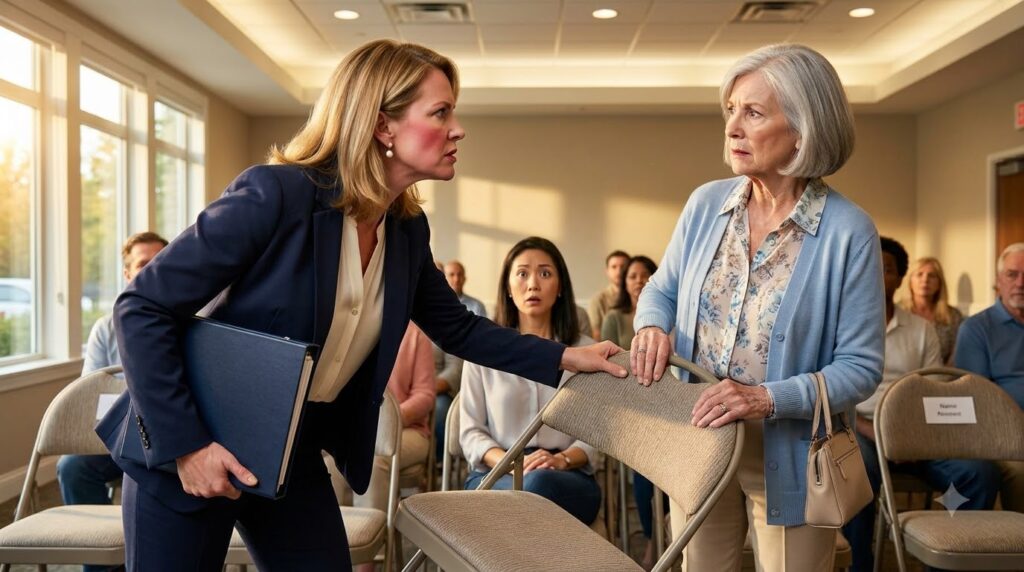
CHAPTER 3: THE CORKBOARD INQUEST
The manila folder was thick enough to hold three years of bad checks.
Pete let it drop onto Clara’s lap. The dull thud against the fabric of her slacks carried just enough weight to turn Arthur’s head again from the front aisle. Pete didn’t wait for a thank you. He wiped two fuel-blackened thumbs across the front of his twill work pants and turned back toward the rear door, his heavy steel-toed boots dragging across the wax with a rhythmic, rubbery squeak.
Karen didn’t give Clara the chance to untie the red string loop on the tab.
Before Pete had cleared row four, Karen was on her feet. Her chair legs barked against the tile as she pushed off, leaving the three-ring binder behind on the icy vinyl seat. She cut across the drafty corridor near the emergency exit, her heels driving hard into the floor, angling her trajectory to intercept the groundskeeper right beside the green-felt community bulletin board.
“Pete,” she said.
The word was clipped, low, stripped of its usual bureaucratic syrup.
Pete stopped with one hand resting against the aluminum push-bar of the kitchen door. He was sixty, maybe sixty-five, with ears burnt red from thirty summers behind an unshielded zero-turn mower. A ring of dried salt outlined the collar of his shirt. He didn’t turn all the way around; he just gave her his profile, his jaw shifting over a wad of wintergreen tobacco.
“Meeting’s starting, Mrs. Vance,” Pete said. “I got three sprinkler heads blown out on fairway nine.”
“You know what’s on that yellow slip,” Karen said, stepping into his line of sight, boxing him against the wall where the clubhouse rules from 1988 were pinned under clouded Plexiglas. “Who gave you that form? The office keys are in my safe.”
Pete looked past her, toward row one. Clara was sitting with the folder resting flat against her thighs, her fingers idle on the cardboard clasp. She wasn’t looking at them.
“I didn’t need your keys,” Pete muttered. He reached into his pocket, his knuckles grazing against a pocketknife handle before coming back out empty. “The maintenance shed was unlocked when I clocked in at five. Desk was open. Folder was sitting right next to the logbook with a ten-dollar bill on top for the copies.”
“Copies of what?”
“Bids,” Pete said flatly. “The gravel supply contract from three years ago. The one for the retention pond drainage ditch.”
Karen’s stomach dropped like an anchor through thin ice. Her throat closed up, the bitter taste of cold coffee rising under her tongue.
“That was approved by the quorum,” she said, her voice dropping to a harsh whisper that barely traveled past the corkboard. “We voted on that. Three out of five signed off.”
“Didn’t say you didn’t,” Pete replied. He shifted his stance, the sole of his boot scuffing a patch of gray floor paint away to show the raw concrete underneath. “Only thing is, the company that delivered that crushed limestone didn’t have an address in the county. Had an address on Willow Crest Road. Lot twelve. That’s your sister’s garage, ain’t it?”
The words weren’t loud, but in the tight alcove between the corkboard and the kitchen door, they sounded like a shotgun rack.
Karen’s hands went stiff at her sides. She could feel the stares of the room behind her—not turning around, she could feel them anyway, like heat radiating off a sun-baked asphalt strip. This was what they had pinned on the back of her chair. They thought they had her on a kickback violation. A five-thousand-dollar road base contract diverted to a family mailing address. Petty, local, dirty enough to force a resignation before the next budget cycle, but manageable. A fine, a censure, maybe an agreement not to run for treasurer next November.
They don’t know about the rest, she thought, a frantic calculation spinning behind her tight, dry eyes. If it’s just the limestone, I can say it was an administrative staging address. I can produce the freight delivery slips from the gravel pit.
“You had no business pulling that file,” Karen whispered. “That’s board property. That’s confidential personnel material.”
Pete looked down at her, his weathered eyelids drooping with complete indifference. He reached out with one thick index finger and tapped the brass clip holding a stack of pool schedules to the corkboard.
“Wasn’t me who pulled it,” he said.
He leaned slightly closer, just enough for the sour smell of diesel fuel and chewing tobacco to hit her nose.
“I just hauled the box up from the basement because Mrs. Albright had the key.”
Karen froze. Her ribs felt tight, bound by wire. “Clara doesn’t have the basement keys. The master set belongs to the sitting executive board.”
“Not the master set,” Pete said, his voice dropping an octave lower, almost drowned out by the rattle of the clubhouse refrigerator kicking into its cooling cycle. “She didn’t use the master set. She had the original brass one. The one with the squared-off teeth that fits the padlock on the boiler room wall safe.”
Pete reached down, pulled the kitchen door open by its handle, and stepped through without waiting for a reply. The pneumatic arm hissed, catching the heavy wooden slab and pulling it shut behind him, the latch clicking into the frame with the finality of a deadbolt.
Karen stood alone against the cork. Her chest rose and fell in rapid, shallow bursts.
The boiler room safe.
That wasn’t where vendor contracts were stored. The vendor folders were kept in the front office filing cabinet behind the Xerox machine. The boiler safe hadn’t been opened since Clara’s late husband, Thomas Albright, had collapsed on the ninth hole twelve years ago. The developer’s safe. The one that held the original unfiled subdivision covenants from before the township even had a zoning board.
Karen spun around.
Clara was no longer waiting. She had untied the red string. The manila folder was spread open on her lap, but she wasn’t reading the yellow carbon receipt or the limestone invoices. She had pushed those aside, letting them slide onto the linoleum at her feet.
In her right hand, Clara held a small, tarnished brass key stamped with the code B-0.
And lying across her lap was a heavy, linen-bound deed book with split calfskin binding, its edges blackened by thirty years of furnace soot.
Clara turned one page, slow and deliberate, and then looked directly over her shoulder—not at Arthur, not at the assembly, but straight through the dusty air toward row six.








