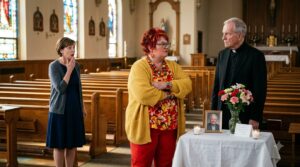
Chapter 5: The Cost of Being Right
The following week, the neighborhood association held an open meeting.
Walter almost stayed home.
He disliked attention.
He disliked conflict.
Most of all, he disliked the feeling that everyone was waiting for him to be some kind of hero.
He wasn’t.
He was an old man who had crossed a street.
That was all.
But when Ruth asked him to come, he agreed.
The room was full.
Several residents who had never spoken at meetings before were there.
One woman described avoiding the walking path because she had been criticized there.
An older couple said they stopped using a community bench after being told they were “occupying it too long.”
A father said his teenage son had been warned about riding a bicycle too slowly near the clubhouse.
The incidents sounded small when described separately.
Together, they told a different story.
People had become afraid of being inconvenient.
That was the real consequence.
The association formally changed its procedures.
Karen was no longer responsible for monitoring the cameras.
Her access was removed.
Complaints would require specific facts.
And the association clarified that pedestrian safety applied equally to people walking quickly, slowly, with canes, with walkers, or with other mobility needs.
Walter listened.
When the board asked whether he wanted to make a statement, he stood.
He did not prepare anything.
He looked around the room.
“I don’t want special treatment,” he said. “I just don’t want people treated badly because they need a little more time.”
That was all.
He sat down.
The room remained quiet for a moment.
Then Ruth began to clap.
Others followed.
Walter lowered his eyes.
He was embarrassed by the attention.
But this time, it was a different kind of embarrassment.
It was the warmth of being understood.
After the meeting, Karen approached him.
She looked different.
The bright clothes remained.
The red handbag remained.
But the certainty was gone.
“You made me look terrible,” she said.
Walter looked at her.
“No.”
She frowned.
“You did all this.”
Walter shook his head.
“I didn’t make you do anything.”
Karen looked toward the floor.
For several seconds, neither spoke.
Then she said, almost reluctantly, “I thought everyone was supposed to keep moving.”
Walter understood what she meant.
He had spent years learning that life didn’t work that way.
People got older.
People got sick.
People slowed down.
People recovered.
People grieved.
People needed help.
Nobody stayed at the same speed forever.
Karen looked at him.
“I was wrong.”
Walter nodded.
“Yes.”
She seemed surprised by his answer.
He did not soften it.
He did not attack her either.
“You can choose what you do next,” he said.
Karen looked at him for another moment.
Then she walked away.
Walter watched her go.
He did not know whether she would truly change.
That was not his decision.
His was simpler.
He would keep walking.