
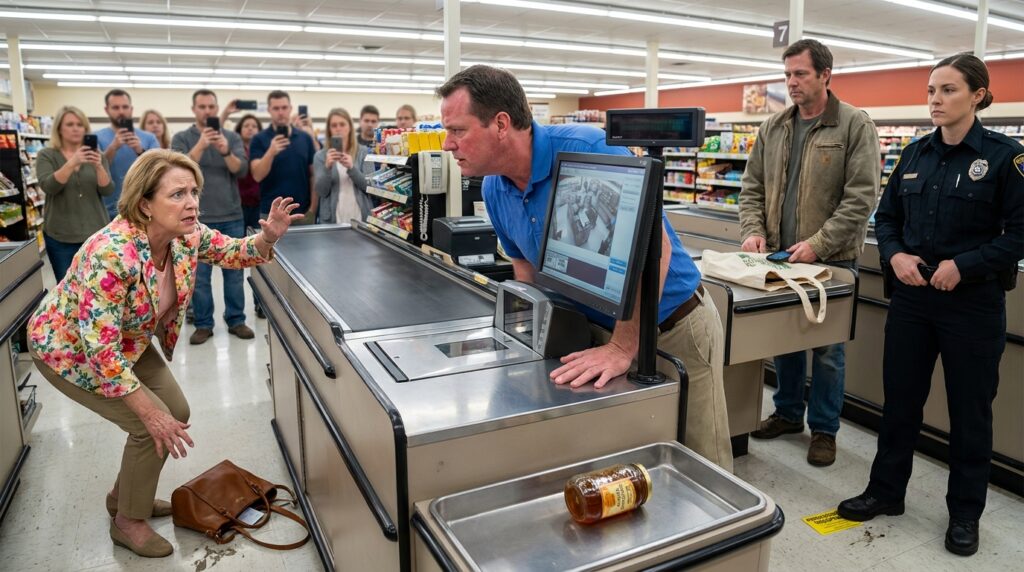
CHAPTER 1: AISLE SEVEN STANDOFF
The metal divider slammed onto the conveyor belt with a sharp, metallic crack that cut straight through the hum of Aisle Seven.
“He took those items straight off my cart while my back was turned, and he’s trying to scan them before security gets here!”
Brenda Carver didn’t just speak; she projected. Her voice had the cultivated, piercing resonance of someone who had spent decades dominating HOA board meetings and small-town zoning committees. She jammed her heavy leather handbag onto the rubber track, effectively sealing off Register Seven like a toll gate. Her bright floral jacket stood out against the desaturated grey of the supermarket lanes, her manicured index finger hovering two inches from my chest.
I didn’t step back. I didn’t reach for my tote. I kept my posture square, feeling the familiar, heavy stillness that twenty years in freight logistics gives a man. In supply chains, when a crate goes missing or a seal is broken, people shout to cover their tracks. The quiet ones are the ones holding the manifest.
“You can call security, Mrs. Carver,” I said. My voice was low, flat, and deliberately devoid of heat. “In fact, ask them to pull up the high-definition feed for Aisle Seven from exactly four minutes ago.”
Her eyes narrowed behind her designer sunglasses, the dark lenses pushed up into her short, styled hair. For a fraction of a second, her finger wavered—just a millimeter shift in the air—before she planted her feet deeper into the linoleum. She pulled her smartphone from her coat pocket with a swift, rehearsed flick of her wrist, aiming the lens directly at my face.
“Go ahead, act calm,” she sneered, raising her voice so the growing queue behind us could catch every syllable. “Look at him, everyone! This is how these people operate! They pretend they belong, they slide right past you in the aisle, and the second you turn toward the shelf, they’re in your basket!”
Behind her, wheels squeaked as a shopping cart ground to a sudden halt. A mother holding two cartons of milk pulled her young daughter back half a step. Across the aisle, a man in a work shirt paused mid-reach for a magazine, his head snapping toward the commotion. The ambient noise of barcode scanners and humming refrigeration units seemed to drop an octave, replaced by the subtle, collective intake of breath from twelve weekend shoppers.
I didn’t look at her phone lens. I looked directly past her floral shoulder, fixing my gaze on the dark, reflective glass dome mounted on the ceiling strut six feet above the scanning station. The little red LED inside the acrylic hemisphere was steady, casting a faint, crimson pinprick on the polished black surface.
It was a modern 360-degree dome, high-frame-rate, installed during the store’s system overhaul two winters ago. I knew the model; our regional distribution center used the exact same hardware to monitor loading docks. It captured twenty-four frames a second with zero blind spots over the register conveyers.
“You’re blocking the lane, Mrs. Carver,” I said evenly, resting one hand flat over the canvas lip of my tote bag. “And you’re making a record you won’t be able to edit.”
Brenda let out a short, harsh laugh—a sound like dry paper tearing. “I’m protecting this store! Manager! I need a manager at Register Seven right now!”
She took two steps to the left, strategically angling her body so her heavy handbag wedged tighter against the scanner hood, completely sealing off the register keyless pad. Her posture was absolute, armored in years of unchallenged suburban authority. She believed the room belonged to her because she spoke the loudest.
She had no idea that the ceiling camera had already logged the exact angle of her wrist when she reached into my canvas bag four minutes ago.
Want me to write Chapter 2?
Yes








