CHAPTER 2: THE SHADOW OF THE DOME
“She’s not just trapping a customer, Terrence,” Marcus said, his voice cutting through the hum of the refrigeration units like a blade through wet cardboard. “She’s banking on you being too terrified of a corporate complaint to enforce store policy.”
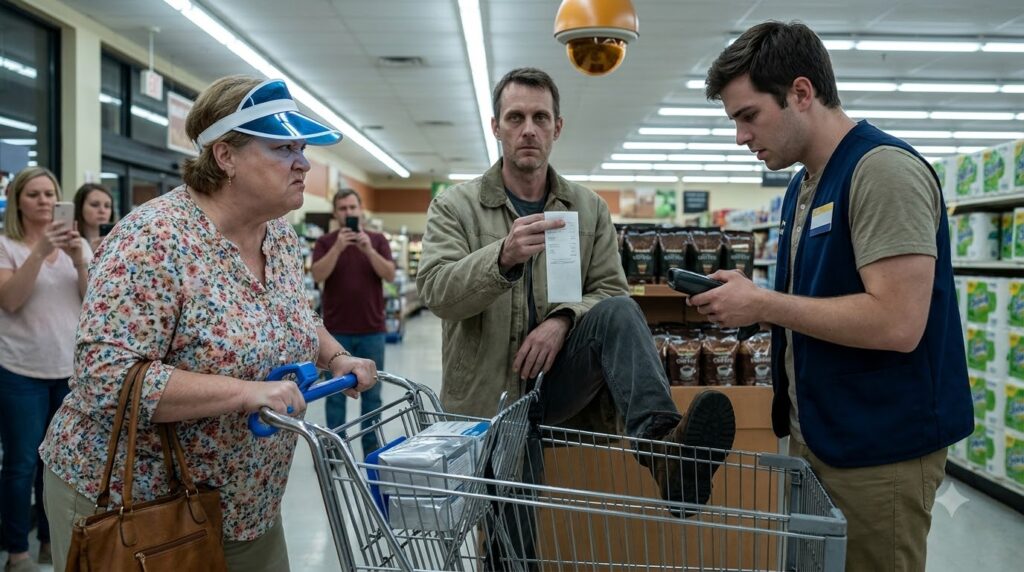
Brenda’s jaw tightened, the floral fabric across her chest straining as she shifted her weight. “Don’t you dare talk about store policy! I have lived in this neighborhood for twenty-five years. I know every manager in this district, and I know when a shoplifter is trying to talk his way past the threshold.” She turned her body, shielding the aisle further, her oversized tinted visor casting a harsh, diagonal shadow across her nose. “Terrence, look at the cart! Look at the silver seals on those boxes! He didn’t even put them in a store bag!”
“Because I haven’t left the building, ma’am,” Marcus replied without looking at her. His eyes remained locked on Terrence. “I scanned them at Kiosk 4. I paid with my debit card. The receipt is in my pocket, and the transaction logged to your local server three minutes ago.”
Terrence hesitated, the heavy plastic casing of his handheld terminal slick in his palm. He looked up at the high ceiling. Directly above the intersection of Aisle 4 and the bulk coffee display sat a opaque black acrylic dome.
High up on its side, a tiny LED indicator pulsed—not the steady, reassuring green of an active digital stream, but a slow, rhythmic amber.
“The dome is in diagnostic mode,” Terrence muttered, his voice dropping as the blood drained from his cheeks. “The storewide network went down for a scheduled firmware patch at seven o’clock. Main security overheads aren’t recording to the central manager’s desk right now.”
Brenda let out a short, sharp bark of laughter that made a shopper three feet away flinch. “Diagnostic mode! Did you hear that, everyone?” She turned to the small circle of onlookers, her hand sweeping wide to encompass the aisle. “The cameras are down! He knew the cameras were down! That’s why he picked tonight to clear out the pharmacy shelves!”
A murmur rippled through the spectators. The teenager with the phone stepped closer, angling his camera lens past Brenda’s shoulder to capture the three silver-sealed boxes sitting in the upper basket.
Marcus felt the cold edge of the trap closing, but his mind stayed sharp, dissecting the variables. He looked at the amber light. A diagnostic pulse meant the network stream was disconnected from the central server, yes—but the local hardware units in this specific chain were integrated models. They carried internal solid-state buffers to prevent data loss during power surges. The feed wasn’t gone; it was just stranded on the local drive.
“He doesn’t have a receipt, Terrence,” Brenda pushed, taking half a step into Marcus’s personal space, her heavy leather handbag swinging like a pendulum between them. “Or if he has one, it’s from yesterday. Or it’s for a bottle of soda. Make him empty his coat. Empty the cart onto the floor right now, or I am calling the precinct desk directly.”
“You don’t have the authority to search anyone, Mrs. Caulfield,” Terrence said, though his stance remained weak, his heels pressed back against a stack of boxed paper towels. “Sir, if the cameras aren’t streaming to my handheld, I can’t verify your transaction from where I’m standing without physical documentation.”
“I offered you the physical documentation twenty seconds ago,” Marcus said. He slowly began to draw his right hand from his coat pocket, keeping his fingers flat, open, and entirely visible so there could be no claim of a sudden gesture or hidden threat. Between his index and middle finger, he held the strip of thermal paper. The black ink of the timestamp was crisp, unsmudged, and glaring under the fluorescent tubes: 19:14:22.
Brenda didn’t even glance at the paper. She thrust her arm out, her hand snapping toward the handle of Marcus’s cart. “Give me that cart!”
Marcus didn’t pull back. He simply lowered his center of gravity, placing his left boot firmly against the lower metal crossbar of the front wheel. The cart didn’t budge an inch. The metal frame groaned under the sudden resistance, a sharp, metallic screech echoing down the corridor.
“Touch this property again,” Marcus said, his voice dropping into a register so quiet and devoid of heat that Brenda’s hand hovered in mid-air, “and we stop talking about store policy entirely. We start talking about unlawful restraint and physical interference.”
“Is that a threat?” Brenda gasped, looking around for validation from the crowd. “You all heard him! He threatened me!”
“It’s a boundary,” Marcus corrected smoothly. He extended the thermal receipt toward Terrence’s chest. “Take the paper, Terrence. Look at the top line. Look at the register ID. Then look at the handheld in your left hand and tell me if you have the guts to run the barcode, or if I need to press the emergency call button on Kiosk 4 myself.”
Terrence looked at the paper, then at Brenda’s trembling, indignant visor, and finally at Marcus’s unblinking eyes. The supervisor reached out a hand that had finally stopped shaking, his fingers closing around the cold, crinkled edge of the thermal armor.