
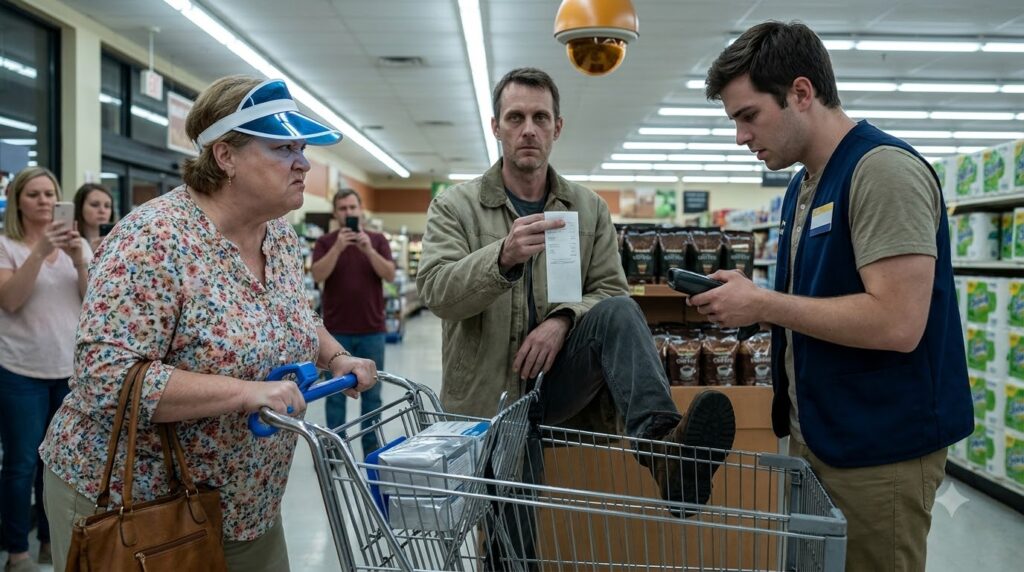
The Paper Armor of Aisle 4: A Study in Calculated Restraint and Public Vindication
CHAPTER 1: THE TOLL AT AISLE 4
“You’re not moving this cart another inch,” Brenda announced, her arm locked across the metal display rack like a toll gate.
The fluorescent bulbs overhead hummed with a low, sixty-cycle whine that seemed to vibrate directly inside Marcus Holloway’s skull. He didn’t flinch. He didn’t jerk the metal handlebar of the shopping cart, though every nerve in his forearms—strained from six straight days of lifting his father between the bed and the wheelchair—wanted to shove the frame straight through her floral blouse.
Instead, Marcus froze. His hands rested flat on the cool chrome bar. He let his posture relax into something deceptively slack, his faded canvas coat hanging loose around his shoulders. In a public space, movement was guilt; stillness was evidence.
“Excuse me,” Marcus said. His voice was flat, dry, carrying none of the exhaustion that was currently chewing at his ribs. “I need to reach the surgical tape behind you.”
Brenda Caulfield didn’t move an inch. Her eyes, narrowed behind the blue tint of her plastic sun visor, tracked down to the top basket of his cart. Sitting right there in plain view were three rectangular boxes of specialized silicone-bordered dressings, their silver foil seals gleaming under the store lights.
“You think I didn’t see you?” Brenda said, stepping forward until the scent of stale lavender perfume hit Marcus like a physical wall. She raised a manicured index finger, pointing it three inches from his chest. “You drifted through the back pharmacy aisle ten minutes ago when the counter was closed. Then you slipped up to the front, and now you’re creeping back into the deep aisles with ninety dollars worth of medical inventory hidden in open sight.”
“They’re not hidden,” Marcus said quietly. “They’re in the basket.”
“Because you’re waiting for the shift change!” Her voice rose, hitting that precise, shrill frequency engineered to command a room. Down the main concourse, two shoppers pushing overloaded carts slowed to a halt. A teenager holding a box of detergent turned his head, his thumb automatically sliding across his phone screen to record. “He’s stealing!” Brenda shouted toward the end-cap. “Floor supervisor! Lock the garden center doors!”
Marcus felt his pulse spike, a sharp bite of copper at the back of his throat. He thought of his father sitting in the dark living room three miles away, waiting for the fresh dressings before the evening fever set in. He thought of how easily a scene like this could turn—how three words from an aggressive stranger could draw three police cruisers to a supermarket parking lot and lock him in an interrogation room for four hours while his father lay unattended.
His right hand slid silently into his jacket pocket. His fingertips touched the thin, crinkled edge of the thermal paper receipt he had printed three minutes ago at Kiosk 4. It was cold, frail, and light as a feather, but as Brenda took another aggressive step toward his cart, Marcus gripped it like iron.
Fast footsteps squeaked against the polished tile. Terrence Vance, the night shift supervisor, rounded the corner of the aisle, his navy blue store vest unbuttoned and his handheld scanner clutched like a weapon. “What’s the issue here?” Terrence asked, his eyes darting from Brenda’s rigid posture to Marcus’s steady glare.
“I caught him, Terrence,” Brenda said, her voice dropping into a breathless, triumphant purr. “He’s staging high-value pharmacy items in his cart. He claims he paid, but he’s walking deeper into the store. Search his coat right now before he dumps the evidence.”
Marcus didn’t move his hand from his pocket. He looked Terrence dead in the eye, noticing the faint tremble in the young manager’s fingers. “Check the overhead dome behind you, Terrence,” Marcus said, his voice dropping an octave into a calm, dangerous quiet. “Then ask her why she’s physically trapping a customer who has already cleared the register.”

CHAPTER 2: THE SHADOW OF THE DOME
“She’s not just trapping a customer, Terrence,” Marcus said, his voice cutting through the hum of the refrigeration units like a blade through wet cardboard. “She’s banking on you being too terrified of a corporate complaint to enforce store policy.”
Brenda’s jaw tightened, the floral fabric across her chest straining as she shifted her weight. “Don’t you dare talk about store policy! I have lived in this neighborhood for twenty-five years. I know every manager in this district, and I know when a shoplifter is trying to talk his way past the threshold.” She turned her body, shielding the aisle further, her oversized tinted visor casting a harsh, diagonal shadow across her nose. “Terrence, look at the cart! Look at the silver seals on those boxes! He didn’t even put them in a store bag!”
“Because I haven’t left the building, ma’am,” Marcus replied without looking at her. His eyes remained locked on Terrence. “I scanned them at Kiosk 4. I paid with my debit card. The receipt is in my pocket, and the transaction logged to your local server three minutes ago.”
Terrence hesitated, the heavy plastic casing of his handheld terminal slick in his palm. He looked up at the high ceiling. Directly above the intersection of Aisle 4 and the bulk coffee display sat a opaque black acrylic dome.
High up on its side, a tiny LED indicator pulsed—not the steady, reassuring green of an active digital stream, but a slow, rhythmic amber.
“The dome is in diagnostic mode,” Terrence muttered, his voice dropping as the blood drained from his cheeks. “The storewide network went down for a scheduled firmware patch at seven o’clock. Main security overheads aren’t recording to the central manager’s desk right now.”
Brenda let out a short, sharp bark of laughter that made a shopper three feet away flinch. “Diagnostic mode! Did you hear that, everyone?” She turned to the small circle of onlookers, her hand sweeping wide to encompass the aisle. “The cameras are down! He knew the cameras were down! That’s why he picked tonight to clear out the pharmacy shelves!”
A murmur rippled through the spectators. The teenager with the phone stepped closer, angling his camera lens past Brenda’s shoulder to capture the three silver-sealed boxes sitting in the upper basket.
Marcus felt the cold edge of the trap closing, but his mind stayed sharp, dissecting the variables. He looked at the amber light. A diagnostic pulse meant the network stream was disconnected from the central server, yes—but the local hardware units in this specific chain were integrated models. They carried internal solid-state buffers to prevent data loss during power surges. The feed wasn’t gone; it was just stranded on the local drive.
“He doesn’t have a receipt, Terrence,” Brenda pushed, taking half a step into Marcus’s personal space, her heavy leather handbag swinging like a pendulum between them. “Or if he has one, it’s from yesterday. Or it’s for a bottle of soda. Make him empty his coat. Empty the cart onto the floor right now, or I am calling the precinct desk directly.”
“You don’t have the authority to search anyone, Mrs. Caulfield,” Terrence said, though his stance remained weak, his heels pressed back against a stack of boxed paper towels. “Sir, if the cameras aren’t streaming to my handheld, I can’t verify your transaction from where I’m standing without physical documentation.”
“I offered you the physical documentation twenty seconds ago,” Marcus said. He slowly began to draw his right hand from his coat pocket, keeping his fingers flat, open, and entirely visible so there could be no claim of a sudden gesture or hidden threat. Between his index and middle finger, he held the strip of thermal paper. The black ink of the timestamp was crisp, unsmudged, and glaring under the fluorescent tubes: 19:14:22.
Brenda didn’t even glance at the paper. She thrust her arm out, her hand snapping toward the handle of Marcus’s cart. “Give me that cart!”
Marcus didn’t pull back. He simply lowered his center of gravity, placing his left boot firmly against the lower metal crossbar of the front wheel. The cart didn’t budge an inch. The metal frame groaned under the sudden resistance, a sharp, metallic screech echoing down the corridor.
“Touch this property again,” Marcus said, his voice dropping into a register so quiet and devoid of heat that Brenda’s hand hovered in mid-air, “and we stop talking about store policy entirely. We start talking about unlawful restraint and physical interference.”
“Is that a threat?” Brenda gasped, looking around for validation from the crowd. “You all heard him! He threatened me!”
“It’s a boundary,” Marcus corrected smoothly. He extended the thermal receipt toward Terrence’s chest. “Take the paper, Terrence. Look at the top line. Look at the register ID. Then look at the handheld in your left hand and tell me if you have the guts to run the barcode, or if I need to press the emergency call button on Kiosk 4 myself.”
Terrence looked at the paper, then at Brenda’s trembling, indignant visor, and finally at Marcus’s unblinking eyes. The supervisor reached out a hand that had finally stopped shaking, his fingers closing around the cold, crinkled edge of the thermal armor.







