
Chapter 6: The Table Came Back
Saturday morning arrived with clear skies.
The community event resumed.
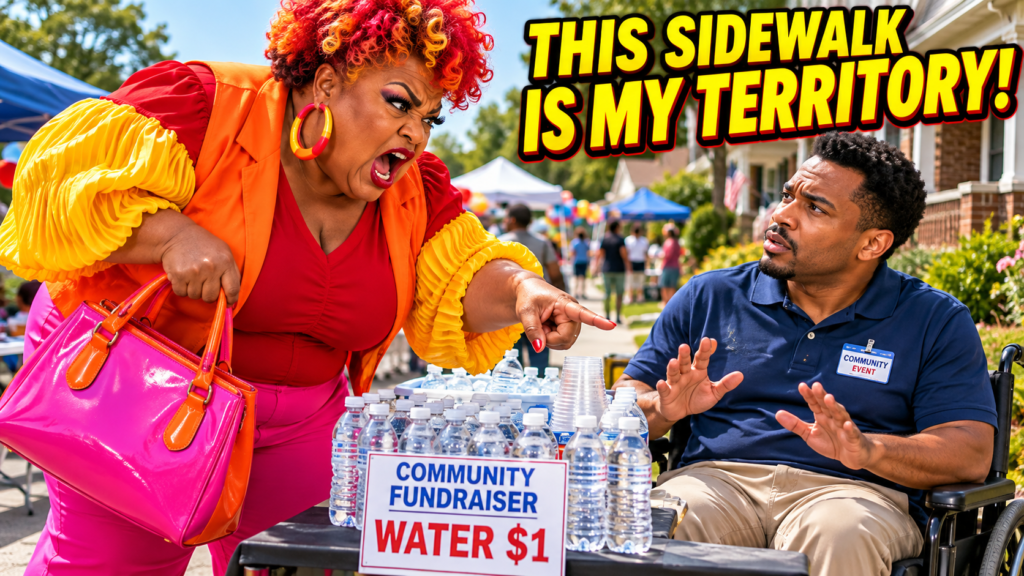
Marcus’s water table was back in its original position.
This time, a larger sign stood beside it:
COMMUNITY FUNDRAISER — WATER $1
ALL PROCEEDS SUPPORT ACCESSIBILITY PROJECTS
The pedestrian route was clearly marked.
The event staff had placed bright boundary tape around the selling area.
There was no ambiguity.
Karen arrived just before noon.
She stood several yards away.
Marcus noticed her but didn’t react.
She watched families pass.
An elderly couple stopped at the table.
A father bought water for his children.
A woman using a walker thanked Marcus for supporting the accessibility project.
Then Karen noticed something.
The woman using the walker lived two houses from her.
Karen knew her.
The woman had once struggled to climb the steps outside her own home.
She had been one of the residents who benefited from the neighborhood’s accessibility efforts.
Karen looked at Marcus.
Then at the fundraiser box.
She approached slowly.
Marcus prepared himself for another confrontation.
Instead, Karen placed a dollar bill on the table.
“I’ll take one.”
Marcus handed her a bottle.
She held it without opening it.
“You were right about one thing,” she said.
Marcus waited.
“I don’t own the sidewalk.”
It was not an apology.
But it was a beginning.
Karen looked toward the clear route.
“I still don’t like the table.”
Marcus almost smiled.
“You don’t have to.”
She nodded.
Then she looked at the fundraiser sign.
“What does the money actually pay for?”
Marcus explained.
Small ramps.
Doorway adjustments.
Better signage.
Repairs that helped older residents remain independent in their own homes.
Karen listened.
Her eyes moved toward the community center.
“My husband would have liked that.”
Marcus said nothing.
Karen opened her handbag.
She pulled out a check.
She placed it beside the water.
Marcus stared.
The amount was larger than he expected.
“I can’t take this.”
“You can,” Karen said.
“Why?”
Karen looked toward the sidewalk.
“Because if I needed that ramp once, somebody else might need one too.”
She walked away before Marcus could answer.
But the story wasn’t finished.
That afternoon, Karen returned to the association office.
She signed the paperwork to bring her own ramp into compliance.
Then she asked for something else.
She wanted to volunteer on the accessibility committee.
Not because she suddenly became a different person.
Not because one conversation erased everything.
But because she had finally understood that protecting her home did not require controlling everyone else’s space.








