Chapter 8: The Little Things That Matter
Nearly a year after Karen opened the package on Harold’s porch, the neighborhood organized a spring gathering.
Folding tables lined the community park.
Residents brought homemade pies, sandwiches, lemonade, and photographs from years gone by.
Margaret arrived wearing a pale blue dress and carrying a small framed picture of Thomas.
Susan brought the quilt her sister had made.
She displayed it across the back of a wooden bench, where several neighbors admired its intricate pattern.
Richard had already moved away.
A young family had purchased his former house.
Their arrival brought new energy to the street.
Harold had helped them unload several heavy boxes on moving day.
He had also introduced them to Margaret and Susan.
Life continued.
It did not erase the past, but it created room for something better.
Benjamin attended the gathering with his mother.
He was nearly twelve now and had become increasingly interested in robotics.
Over the previous year, he and Harold had spent many afternoons building small mechanical devices in the garage.
Their latest project was a remote-controlled vehicle assembled from inexpensive electronic components.
Benjamin demonstrated it to several children.
Then he reached into his backpack and produced one of the original mechanical cockroaches.
Harold recognized it immediately.
It was one of the toys he had repaired after Karen threw the package onto the porch.
Benjamin placed it on the picnic table.
The little motor buzzed.
The toy scurried toward a plate of cookies.
Margaret laughed so hard that she nearly spilled her lemonade.
Even Susan, who had initially found the entire incident upsetting, smiled.
Harold laughed with them.
For the first time, the mechanical cockroach seemed like nothing more than what it had always been intended to be.
A harmless toy.
A birthday surprise.
Something that made people laugh.
Later that afternoon, Margaret asked Harold to walk with her.
They followed the shaded sidewalk around the park.
She told him that she had started volunteering with a local organization that helped older residents preserve family photographs and documents.
Her experience had made her realize how easily precious memories could disappear.
She wanted to help others protect theirs.
Susan had also found a new purpose.
She and Patricia had begun making smaller quilts for patients receiving long-term medical care.
They could not recreate every piece of family history, but they could create something comforting for people who needed it.
Harold was pleased.
What began as an ugly act of selfishness had eventually inspired several acts of generosity.
Not because Karen deserved credit.
She did not.
The credit belonged to the people who decided that her behavior would not define their community.
That evening, Harold returned home with Benjamin.
They sat on the front porch beneath the white columns, watching the sunlight fade behind the palm trees.
A delivery truck stopped across the street.
The driver carried a package to a neighbor’s door.
Benjamin watched for a moment.
Then he asked whether Harold still worried about people stealing things.
Harold admitted that he was more careful than before.
He checked his delivery notifications.
He kept his security camera functioning.
He asked trusted neighbors for assistance when he traveled.
But he refused to spend every afternoon worrying about what might happen.
A person could be careful without becoming consumed by fear.
Benjamin seemed satisfied with that answer.
He reached into his backpack and handed Harold a small cardboard box.
Inside was a handmade wooden plaque.
Benjamin had painted it himself.
The lettering was slightly uneven, and one corner had been sanded more than the others.
It read:
A GOOD NEIGHBOR PROTECTS WHAT ISN’T HIS.
Harold ran his thumb across the painted letters.
He thought about Eleanor.
She would have loved it.
She had always believed that the character of a neighborhood was measured not by the size of its houses or the condition of its lawns, but by the way its residents treated one another.
Harold mounted the plaque beside his dark blue front door.
It remained there through the summer storms, the autumn holidays, and the following Christmas.
Visitors occasionally asked about it.
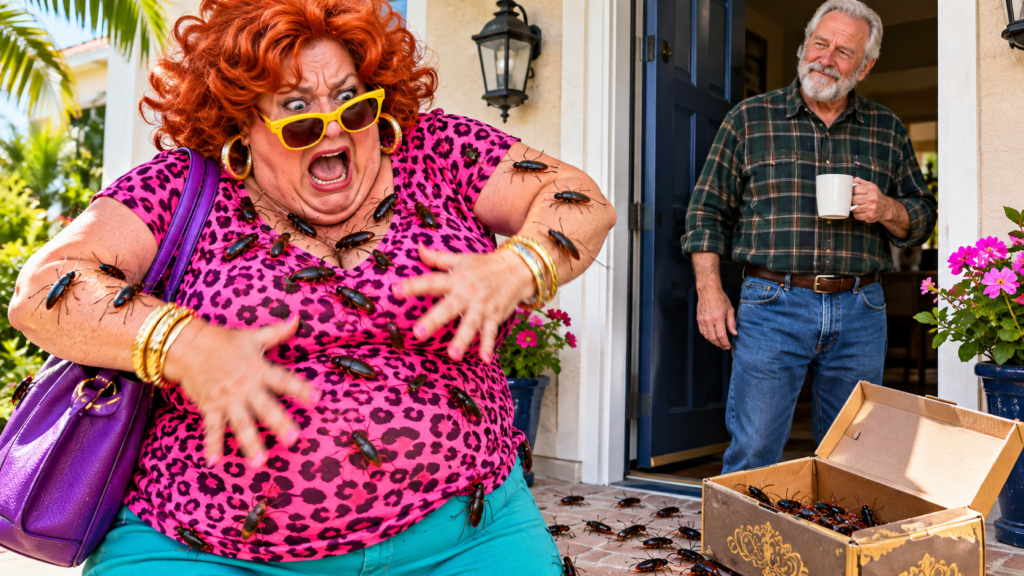
Sometimes Harold told them the story of the stolen package and the mechanical cockroaches.
They usually laughed at the beginning.
Then he told them about Margaret’s photographs, Susan’s quilt, and the residents who had worked together to recover what was lost.
By the end, they understood why the plaque mattered.
Karen had approached Harold’s porch believing that anything valuable was worth taking if nobody stopped her.
She had expected to walk away with something expensive.
Instead, her greed had exposed a pattern of dishonesty that had caused months of unnecessary pain.
She lost the trust of her neighbors, faced legal consequences, and was required to answer for choices she had repeatedly tried to excuse.
Harold, on the other hand, had gained something that could not be ordered online or delivered in a decorative box.
He had discovered how many good people lived around him.
People who respected boundaries.
People who stood beside their neighbors.
People who understood that dignity mattered more than possessions and that accountability mattered more than revenge.
The little mechanical cockroach eventually stopped working.
Benjamin offered to replace its motor.
Harold decided to keep it exactly as it was.
He placed it on a shelf in his workshop beside a photograph of Eleanor and a collection of handmade gifts from his grandson.
It was an unlikely keepsake.
But every time he saw it, he remembered that extraordinary Florida morning when a greedy neighbor mistook a box of children’s toys for a treasure.
She had been searching for something valuable.
She simply never understood what real value looked like.
Harold did.
It was family gathered around a birthday cake.
It was a widow holding her husband’s photographs.
It was a handmade quilt returned to the woman it belonged to.
It was the freedom to sit peacefully on your own front porch, knowing that your home, your memories, and your dignity deserved respect.
And those were things no amount of money could ever replace.