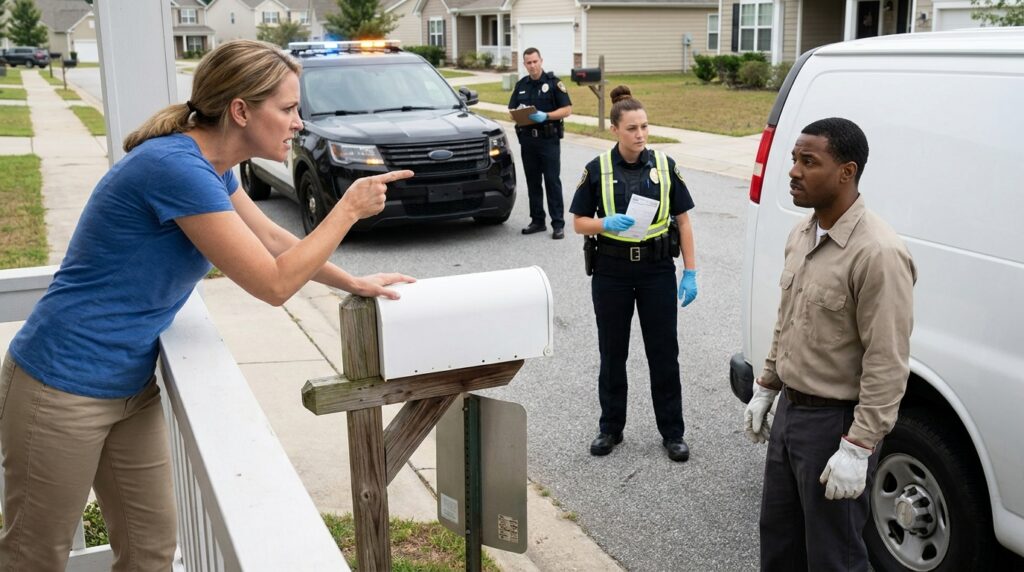
The Weight of the Curb and the Sovereignty of the Weathered Post
CHAPTER 1: THE JAGGED EDGE
The iron burr was small, no larger than a splinter of flint, but it caught the meat of her thumb before she could drop the electric bill into her bag. Elena didn’t yell. She pulled her hand back, watching a neat bead of dark blood form against the grain of the weathered wooden post.
Below the white paint of the mailbox, where the wood had split from three winters of freezing rain, a fresh rectangle of galvanized steel sat pinned by four unweathered screws. It hadn’t been there when the morning paper arrived at six. The stamped black letters across the metal face were crisp, blocky, and entirely without a municipal seal: NO CURBSIDE STAGING—SEC. 4 ACCESS ROUTE.
The air smelled of hot asphalt and dry dandelion heads. From down the block, the low, hydraulic whine of a diesel engine shifted gears, the sound vibrating through the soles of her sneakers.
She wiped her thumb against the thigh of her khaki pants, leaving a rusty streak across the fabric. The metal plate was still cool to the touch despite the mid-afternoon glare. When she tried to wedge the tip of her key beneath the upper left corner, the steel didn’t budge. It had been driven deep, the zinc heads of the screws stripped flat so no standard driver could back them out.
“You’re tracking grease on the right-of-way,” a voice said from the shadow of the maple tree across the ditch.
Elena didn’t look up immediately. She kept her palm pressed flat against the rough, sun-bleached cedar of the post, feeling the heat trapped within the timber. When she finally turned her head, the white service van was already idling three feet from her left heel, its bumper close enough to catch the fringe of her blue t-shirt.
The man behind the wheel wore a beige shirt that smelled of industrial laundry starch and stale tobacco. His white cotton gloves were spotless, stretched tight over thick knuckles as they gripped the plastic rim of the steering wheel. He didn’t turn off the ignition. The engine gave off a rhythmic, mechanical tick that sounded like oil dripping onto hot tin.
“The post is four inches inside the county line,” Elena said. Her voice was thin, dry from the dust raised by the passing delivery trucks, but she didn’t take her weight off the wood. “My grandfather sunk the concrete base in seventy-two.”
The worker reached into the passenger seat, his white-gloved fingers reappearing with a thick, leather-bound logbook. He didn’t look at her face; his eyes remained fixed on the small, dark stain her blood had left on the cedar post just above his fresh metal plate.
“Seventy-two doesn’t clear the current easement configuration,” he muttered, flipping a page with a dry rustle. “The sign stays. The vehicle in the lane behind me has six minutes before the staging violation logs into the automated queue.”
Elena looked over the roof of the white van. Her old sedan was parked exactly where it always sat, its tires parallel to the cracked concrete of her driveway, completely clear of the asphalt. But the van’s wide chassis had been tilted intentionally, its front wheels turned hard toward her grass, sealing her in behind two tons of unwashed domestic steel. Through the grease-filmed rear window of the van, she could see the silhouette of a second clipboard, and beneath it, a pair of heavy yellow wheel chocks resting on the floorboards.

CHAPTER 2: SEC 4 ACCESS ROUTE
“Six minutes,” Elena repeated, her voice scraping against her throat like dry gravel. She didn’t let her fingers drop from the sun-bleached cedar post. The metal scratch on her thumb was already thickening with a dark, tacky crust, but the physical sting was nothing compared to the slow, heavy heat settling behind her ribs. “You put that plate up five minutes ago, and you’re counting down a clock you brought with you in the cab.”
The worker didn’t blink. Up close, his beige shirt showed the fraying edges of an unbranded municipal patch that had been clipped away with shears, leaving behind a gray ghost of polyester thread. He shifted his grip on the leather-bound logbook, his white cotton gloves leaving a faint, chalky smudge across the dark cowhide cover.
“The timestamp is automated,” he said, his tone flat, carrying the mechanical indifference of a scale weighing gravel. “The county doesn’t negotiate the buffer. When the camera on the roof logs the bumper clearance, the citation issues to the tax assessor’s registry. If you want to argue the metric, take it to the regional zoning desk on Fourth.”
He swung the heavy door of the service van open. The rusted lower hinge gave a high, metallic shriek that cut through the low drone of the idling diesel. Elena’s eyes dropped to the exposed inner panel of the door—the factory paint had flaked away into dark, iron scales, and tucked into the side pocket was a small plastic jar containing an extra set of those same flat-headed zinc screws she’d found bored into her mailbox post. They were bright, unweathered, and entirely too clean for a common maintenance kit.
“My car isn’t moving,” Elena said. She took a step lateral, her boot heel sinking into the soft, unwatered clover at the edge of the ditch, wedge-blocking the narrow space between the van’s front fender and the white wooden post. “And you’re not locking those chocks under my tires while I’m standing here.”
The worker paused, his boots clearing the cab’s running board but his weight remaining balanced on the iron plate of the sill. He was short, but his shoulders had the wide, blocked mass of someone who spent his mornings hauling concrete parking curbs. He didn’t look at her; his eyes traveled down the length of her gravel driveway, tracking the property line to where her small, paint-peeled garage sat beneath the shadow of the overgrown willows.
“The notification is already pinned,” he said. He reached down, his white-gloved hand lingering over a loose, yellow carbon slip tucked into the clipboard on his knee. “You can stand there until the radiator blows, lady. The county owns twenty feet from the center line of the asphalt. Your grandfather didn’t buy the sky, and he didn’t buy the shoulder.”
A screen door slammed three houses down—a sharp, wooden report that signaled the first porch watcher had stepped out into the glare. Old man Miller was shifting his weight against his aluminum walker, his head tilted toward the sound of the idling van. The neighborhood was quiet, the type of place where people noticed when the gravel dust didn’t settle between deliveries, and the presence of a municipal vehicle parked across a private apron was already drawing eyes behind the screen windows.
Elena felt the dry wind whip a strand of blonde hair across her face, the salt from her forehead stinging her eyes. She didn’t brush it away. Her hand remained anchored to the post, her thumb pressing down directly on the sharp metal edge of the new regulation plate until the iron burr bit through the dried blood into the living skin beneath. She needed the pain to keep her steady. The worker was acting with the absolute confidence of a man who had a ledger backing his weight, but the unbranded patch on his shirt and the freshly stripped screws spoke to a different kind of labor. It was too fast, too targeted.
“Show me the county seal on the work order,” she said, her voice dropping into a hard, transactional register. “Not the logbook. The specific code assignment for Sector Four.”
The worker’s hand stiffened on the leather binding. For the first time, his gaze shifted from her garage to her face, his eyes small, dark, and perfectly neutral behind his plastic-rimmed sunglasses. He didn’t reach for the yellow slip. Instead, he pulled his boots back into the cab and reached for the gearshift, the transmission grinding with a low, metal-on-metal groan that vibrated through the air.
“You’ll see the assignment when the deputy signs the impound authorization,” he said softly. “Three minutes.”
CHAPTER 3: THE ENCROACHING LINE
“Two minutes,” the worker corrected himself, his voice dropping an octave as his boot came down hard on the accelerator while the transmission stayed pinned in neutral. The engine roared, a thick cloud of uncombusted diesel exhaust pluming from beneath the chassis, coating the green leaves of the willow trees in a fine, gray layer of soot.
Elena did not move her feet. She leaned her shoulder into the cedar wood of the post, her fingers gripping the grain so tightly the split timber groaned under the leverage. The heat radiating off the van’s front grill was a physical wall, thick with the smell of scorched sulfur and old antifreeze. Through the dust-filmed windshield, she watched his white-gloved hand slide the heavy gear lever into reverse. The reverse lights flickered once, their cracked plastic lenses leaking a dull, orange-white glow onto the gravel shoulder.
“If you back that van up an inch, your rear axle clears the drainage ditch line,” she called out over the rattle of the engine block. “That’s unmaintained private slope, not county asphalt. You sink a wheel in there, you’ll need a flatbed to haul yourself out.”
The worker paused. The service van shuddered as he held the clutch right at the friction point. His gloved thumb tapped against the side of the leather logbook. He was calculating the grade of the ditch—she could see it in the way his head tilted toward the side mirror, tracking the drop-off where the overgrown clover gave way to raw, yellow clay. He knew she was right about the slope. The local utility trucks never risked the shoulder on this side of the creek; the ground was too soft, water-logged from the subsurface runoff that pooled against her grandfather’s old concrete culvert.
With a sharp jerk of his wrist, he popped the transmission back into neutral and reached across the seat for the clipboard. The loose yellow carbon slip rustled against the aluminum backing plate. He held it up against the steering wheel, using a heavy black marker to jot a sequence of digits across the header line.
Elena’s eyes tracked the paper. From four feet away, she could see the stamp at the top—a circular seal that looked like the county transit crest from a distance, but lacked the clear, hollow watermark that always sat at the center of her property tax assessments. The edges of the carbon sheet were frayed, yellowed at the corners as if it had sat in the bottom of a metal filing cabinet for months before being dragged out onto the street.
“This is an official citation for obstruction of a civil access lane,” he said, turning the clipboard toward the side window so she could see his fresh, thick ink markings. “The number is logged. You can keep your hand on that wood all afternoon, but the fine doubles every sixty minutes the right-of-way remains blocked by an unregistered entity.”
“I am the registered entity,” Elena said, her voice dropping into the same flat, cold cadence her father used when arguing the grain shares at the old mill coop. “The deed is in the hall desk. There’s no civil lane between this post and the gravel fence. There’s only the ditch and the dirt I mow every Saturday.”
“The county map says different,” he countered, his gloved finger jabbing down onto the yellow sheet. “Sector Four includes a six-foot utility allowance from the centerline of the ditch. Your mailbox is dead center of the expansion path. If you don’t clear the apron, the department exercises the right of summary removal. That means a chainsaw through the cedar, lady.”
The screen door down the block creaked again. Old man Miller had come down his porch steps, his aluminum walker clicking against the cracked concrete sidewalk as he crept closer to the property line. On the opposite side of the road, the curtains in the house with the unpainted porch shifted. Two more neighbors were watching now, their faces pale blurs behind the wire screens. They weren’t stepping out to help, but they were keeping their phones low against their thighs, their thumbs moving across the glass. The presence of the white van was a disturbance in the street’s slow, seasonal rhythm—an uninvited piece of the city’s heavy machinery grinding against the neighborhood’s quiet, neglected edges.
Elena felt a cold sweat trace its way down her spine, chilling her skin beneath the damp cotton of her t-shirt. She could feel the weight of the street’s attention, the silent witness pressure building behind her back. The worker was using the language of the county like an iron bar, trying to crack her confidence before anyone else came close enough to check his paperwork. He wanted her to look away, to trip over her own lack of legal jargon so he could drop the chocks and lock the lane.
She reached out with her left hand, her fingers catching the top edge of the clipboard before he could pull it back into the cab. The aluminum plate felt cold, greasy with fingerprint oil and road grime.
“Let me see the water commission signature on that code entry,” she said.
The worker didn’t let go of the board. He pulled back hard, the metal edge scraping against her knuckles, leaving a gray streak of oxidized aluminum across her skin. His sunglasses slid down his nose, revealing two bloodshot eyes wide with a sudden, sharp spike of irritation that his cold bureaucratic mask could no longer hide.
“Get your hands off the county record,” he hissed, his white gloves bunching into a tight, heavy fist against the steering wheel. “That’s a federal violation, resident.”
Before she could answer, a low, warbling siren chirp cut through the heavy heat of the lane. A black police SUV had just rounded the corner by the old grain silo, its roof lights dark but its front grill pushing a long, slow shadow down the center of the asphalt toward her mailbox post.
CHAPTER 4: THE ANCHOR AT THE PROPERTY LINE
The cruiser did not run its siren, but the heavy, low-frequency throb of its engine cut through the diesel rattle of the van like a blunt blade. Its front tires crunched onto the gravel shoulder twenty feet back, kicking up a dry spray of gray grit that rattled against the van’s rear bumper.
Elena didn’t let her left hand drop from the edge of the clipboard, even as the worker gave another sharp, desperate yank to pull it back inside the cab. Her boots stayed wedged into the unwatered clover at the edge of the ditch. The heat coming off the van’s transmission was thick now, carrying the bitter smell of scorched lining and hot steering fluid, but her right palm was locked against the cedar wood of the mailbox post. The iron burr on the fresh metal plate had sliced deep enough that she could feel the steady, warm pulse of her own blood drying against the zinc screw heads.
The driver’s door of the police SUV swung open with a heavy, clean mechanical click.
“Step back from the vehicle,” a voice called out over the grass. It wasn’t loud, but it carried the flat, practiced weight of someone used to dealing with rural fence-line disputes before they turned into something involving a tool handle.
The worker’s fingers loosened on the clipboard. The mask of bureaucratic indifference didn’t just slip; it froze. He adjusted his stance on the running board, his white cotton gloves dropping to his sides, though he kept his wide shoulders squared to block the view of the cabin’s lower console.
Elena watched the primary officer move through the dry heat. She was a woman in her early 30s, her dark hair pinned back into a severe, tight bun beneath her uniform cap, her black reflective vest riding high over her utility belt. She didn’t have her hand on her holster, but her blue-gloved fingers were hooked light and steady into the front webbing of her vest. Behind her, a second officer—a man with short dark hair and a neutral, sun-reddened face—stepped out from the passenger side, carrying a heavy silver clipboard and a digital stylus. He didn’t look at Elena or the worker; his eyes went straight to the white service van’s rear license plate, his thumb already entering digits into a handheld terminal.
“He’s blocking the apron,” Elena said, her voice tight, dry from the rising dust. She didn’t remove her hand from the cedar timber. “He drove the front tires past the ditch line three minutes ago. He’s trying to chock my car on my own gravel.”
The worker cleared his throat, the sound wet and nervous behind his plastic-rimmed sunglasses. “This is an official code enforcement action under Section Four, Officer,” he said, his voice rising slightly as he reached down to tap the leather logbook on the seat. “The resident is interfering with a scheduled right-of-way clearance. I’ve already logged the obstruction into the automated queue.”
The female officer stopped two feet from the mailbox post. Her boots didn’t sink into the soft clay the way Elena’s had; she kept her weight balanced on the very edge of the hardened asphalt line. Her gaze traveled from the fresh, bright metal regulation plate bolted into the wood, down to the small pool of dark blood drying against the lower screws, and finally up to the worker’s unbranded, frayed shirt patch.
“Let me see the authorization slip,” the officer said. She didn’t look at the leather book. She held out her blue-gloved hand toward the clipboard that was still balanced between Elena’s fingers and the cab door.
The worker hesitated, his gloved thumb twitching against his trousers. He didn’t hand the board over immediately. Instead, he turned the yellow sheet toward his own chest, his pen tracing the hand-inked numbers at the top. “The county database hasn’t pushed the digital receipt yet due to the sector cell drop,” he muttered. “But the logbook entry is certified. It’s an active drainage easement expansion zone. The whole shoulder is scheduled for grading.”
Elena leaned forward, her shoulder checking the side of the wooden post. “Look at the seal at the header, Officer. There’s no embossed mark. He brought that plate out here in a tool box under his seat, and those screws are brand new. He’s trying to force my car off the lane so he can clear the access to the back lot.”
The officer’s eyes narrowed slightly behind her sunglasses. She didn’t answer Elena, but she extended her blue-gloved hand an inch closer to the cab window, her fingers open and still. “I didn’t ask about the database,” she said to the worker, her voice dropping into a clipped, transactional register that left no room for the street’s heat to breathe. “I asked for the physical notice you’re using to establish a curbside perimeter. Show the paper, then back your vehicle away from her mailbox.”
Down the road, old man Miller had stopped his walker at the edge of his driveway, his head tilted forward to catch the sound of the paper rustling. Across the asphalt, two more front doors clicked open. The silent witness layer of the street was thickening, the neighbors standing on their dry lawns with their arms crossed, watching the white van’s authority begin to fray under the steady glare of the cruiser’s dark roof glass.
The worker stood frozen on the sill, his white gloves bunching into tight, pale knots as the second officer stepped up behind the van’s rear wheel, his stylus clicking against the silver frame of his clipboard.
CHAPTER 5: THE BLUE LIGHT AMBUSH
The first stroke of the roof lights didn’t hit the white van; it sliced clean through the willow branches, casting long, rhythmic bars of blue across Elena’s unwatered grass. The light didn’t feel like a relief. It felt heavy, cold, and transactional, reflecting off the oily surface of the asphalt until the whole ditch line seemed to pulse with a low, mechanical warning.
Elena didn’t pull her boots back from the clover. Her skin was cold despite the rising grease-heat from the idling van engine, and her thumb stayed locked against the raw cedar fiber, right where the zinc screws had bitten through her skin. She watched the male officer move to the front of the cruiser, his shadow lengthening across her driveway until it met the front wheel of the white service van.
“State your dispatch number,” the primary female officer said, her voice remaining low but cutting beneath the rattle of the diesel exhaust. She didn’t look up at the worker’s sunglasses. Her blue-gloved hand remained open, waiting an inch from the aluminum edge of the clipboard.
The worker didn’t move his arm. The starch in his beige shirt seemed to stiffen his posture, holding him rigid against the cab door frame. “I told you, it’s an internal maintenance pull,” he muttered, his gloved fingers tightening on the leather-bound book until the hide puckered. “The regional desk cleared the sector by phone before the six-hundred shift. If you have an issue with the layout, you need to verify it with Supervisor Vance on Fourth.”
“Vance retired in October,” the second officer said from behind the van. He didn’t raise his voice, but the sound of his digital stylus tapping the screen was a sharp, rhythmic click that sounded like an iron rod hitting a small anvil. “The regional desk hasn’t run an internal pull on Sector Four since the winter main split. I’m looking at the county grid right now. This lane is marked clear for five houses in either direction.”
The worker’s jaw tightened, the skin along his cheek turning a dry, pale gray that looked like salt crust. He didn’t drop his boots to the asphalt, but his weight shifted backward into the cab, his right elbow nudging the center console where a faded blue folder lay tucked under an obsolete mapbook.
Elena noticed the movement. Through the open window, the folder looked thick, its edges yellowed and frayed from years in a damp basement rather than a clean county bin. On the tab, written in faded black ink that had turned the color of dried iron rust, was the name Miller Lane Extension—Draft 2011.
“He’s not logging an internal pull,” Elena said, her finger pointing straight through the cabin glass toward the blue folder. “Look at the year on that file, Officer. That’s the old drainage easement map from before the county abandoned the back lot project. He’s using the obsolete ledger numbers to make it look like he has a legal right to clear my post.”
The female officer didn’t lean into the window, but her head tilted just enough to catch the reflection of the folder against the chrome trim of the dashboard. Her hand dropped from her vest, her blue-gloved fingers coming to rest light and steady against the top latch of her utility belt, right over the heavy black polymer casing of her radio.
“Hand over the logbook,” she said, her tone flat, stripped of everything but the hard logic of the street line. “Now.”
“It’s private county property,” the worker hissed. He took a sudden, lunging step down from the running board, his boots hitting the hard edge of the concrete apron with a dull, rubbery thrum. He didn’t move away from her, but he threw his wide shoulders forward, trying to wedge his mass between the officer’s belt and the leather book on the seat. “You don’t have the clearance to pull internal agency logs without a division signature from the hall.”
The movement was too fast for the tight space. His heavy shoulder caught the edge of the wooden mailbox post, the sudden friction jar for the cedar timber making the rotten upper joint give way with a dry, hollow crack. The white mailbox tilted, its metal latch popping open to drop three unopened letters into the yellow clay of the ditch.
The primary officer didn’t draw her weapon, but her left hand shot forward like a mechanical piston, her blue gloves catching the worker’s beige collar right at the throat line. With a single, controlled twist of her wrist, she checked his momentum, forcing his hips back against the flaking iron panel of the van door before his weight could carry him into Elena’s space.
“Keep your boots on the asphalt,” the officer commanded, her face inches from his sunglasses, her voice thin and sharp as a razor blade through leather. “You don’t touch the resident, and you don’t touch the perimeter landmarks while I’m standing on the lane.”
Behind them, old man Miller had stopped his walker at the very edge of the grass, his fingers gripping the oxidized aluminum tubes so hard his knuckles were white. On the other side of the road, the neighbor with the unpainted porch stepped down into his gravel ditch, his phone held steady at chest height, the lens catching the blue pulse of the roof lights. The street was no longer silent; the wet sound of the creek runoff seemed to grow louder as the absolute failure of the worker’s authority became visible to the entire block.
The second officer stepped around the rear fender of the van, his clipboard locked under his elbow as his hand reached for his belt. “We have an unverified plate installation and a property damage event on site,” he said, his stylus tracking the split wood at the base of the mailbox. “He’s not in the system, Sarah. The plates are registered to an inactive vehicle out of the county garage pool.”
Elena felt the wind drop, the heavy grease-smell of the diesel exhaust settling over her face like a damp cloth. The worker was pinned against his own truck, his white gloves shaking against the rust-flecked iron door panel, but his eyes were still locked on the blue folder inside the cab—the decoy secret had just split wide open under the officer’s light, but the ultimate final reality of who had put him on her street was still buried behind the old paper in the dark.
CHAPTER 6: THE BLUEGLOVED VERDICT
The blue-gloved hand stayed planted against the worker’s starched collar, the fabric bunching into a tight knot of wrinkled beige under the officer’s knuckles. The white van’s chassis jarred against the curb as the worker’s boots scrambled for traction on the grease-softened asphalt lane.
Elena did not drop her arms. Her right palm was still pressed flat against the raw, split heartwood of the cedar post, feeling the vibration of the hollow timber where the rotten upper joint had just sheared away. The three dropped letters sat motionless in the yellow clay of the ditch, their white envelopes absorbing the dark water pooling at the base of the concrete culvert. Her heart thrummed against her ribs, thick with the chemical taste of diesel soot and adrenaline, but her eyes never left the faded blue folder resting on the cabin console.
“I need the document that matches the index number on that plate,” the primary officer said, her voice dropping another octave, turning cold and completely unyielding. She didn’t shake him; she simply held him locked against the iron door panel by his own momentum. “Not the retired database name. The active work order with a county manager’s barcode.”
The worker’s breathing was shallow, his sunglasses sliding further down his nose until the white glare of the sky caught the red, salt-bitten skin around his eyelids. His white cotton gloves twitched against the rust-flaked handle of the door. “The barcode is on the interior sheet,” he rasped, his eyes darting toward the second officer, who was now leaning through the passenger window of the cruiser to cross-reference the van’s vehicle identification number. “The regional desk runs the old series for Sector Four because the grid boundary hasn’t been remapped since the sewer bond failed. Ask Miller. He knows where the line sits.”
Down the road, old man Miller’s aluminum walker clicked against the hard edge of the concrete apron. He didn’t answer the worker’s call. He kept his chin tucked down into his collar, his old hands trembling as they clamped onto the foam grips of his frame, his body turning away from the light toward the shade of his own garage.
The second officer stepped back out of the cruiser cab, the silver frame of his terminal reflecting a sharp bar of white into the shade of the willow trees. He shook his head once, his face flat and hard as a paving stone. “The pool vin matches an inactive city asset scheduled for the scrap auction in June,” he said. He tapped the digital stylus against the corner of his screen with a dry, hollow snap. “The plate on the post doesn’t exist in the county transit registry. The index number is a dead entry from the old township ledgers before the incorporation.”
The primary officer’s fingers didn’t loosen on the worker’s shirt. She used her left hand to reach past his hip, her blue gloves snagging the edge of the blue folder from the console with a single, practiced sweep. The thick cardboard folder was heavy, the surface marked by oil circles from grease-smeared fingers and the dark, red smudge of old cellar mold.
Elena watched the folder split open between them. There were no municipal watermarks on the interior sheets. The top page was a hand-drawn blueprint, the ink faded into a dull charcoal gray that showed an unsigned road expansion cutting straight through her mailbox post, across her clover patch, and directly into the five-acre timber lot that sat locked behind her grandfather’s back fence line.
“This isn’t a county grading plan,” Elena said, her voice scraping dry against the rattle of the idling engine block. She pointed her thumb toward the blueprint’s margin, where a private corporate stamp had been blurred out with black marker. “That’s the access road proposal from the commercial logging outfit that tried to buy the timber lane back in eleven. The county turned them down because they didn’t have the drainage clearance.”
The worker didn’t argue the point. His mouth stayed open, his teeth dry and coated in yellow nicotine film behind his split lip. He didn’t look at Elena; his eyes stayed locked on the second officer’s silver terminal as the red light of the battery warning began to pulse against the glass.
The primary officer turned the blueprint over, her blue gloves tracing the edge of an obsolete county survey seal that had been cut out from another document and pasted onto the header line with dry rubber cement. The fraud was crude up close, built for the low visibility of a hurried afternoon dispute at the property line where an uneducated resident would stumble over the legalistic jargon and clear the way without checking the stamps.
“The vehicle remains on the lane as an evidentiary impound,” the officer told the worker, her voice thin and sharp as a razor blade through leather. She let her hand drop from his throat, but she didn’t step back from his shoulder line. “Take your gloves off and drop your pocket keys onto the hood of the cruiser.”
The neighbor across the street didn’t lower his phone. He took two steps closer to the curb line, his boots crunching loud against the loose gravel as the blue roof lights caught the glass of his lens. The entire block was watching the worker’s massive authority turn into a common city garage theft in the middle of a Tuesday afternoon. The decoy secret of the drainage expansion had just broken apart under the officer’s terminal light, but the ultimate final reality of the timber lot access was still locked behind the old name hidden in the draft’s small print.
CHAPTER 7: THE LOGGING INDEX
The brass house key hit the flat steel of the cruiser’s hood with a high, thin ping that cut right through the diesel rattle. It slid three inches through the white layer of limestone dust, leaving a dark, narrow track before it stopped against the base of the windshield wiper arm.
Elena did not reach down to pick up her letters from the yellow clay. Her fingers were still clamped to the split trunk of the cedar post, her nails digging into the damp, stringy bark where the trunk met the sheared iron of the bracket. The heat off the van’s front quarter panel was thick enough to make the air between her and the primary officer shimmer, heavy with the sharp reek of grease and old cabin wool. She watched the second officer’s thumb slide the silver clip of his terminal downward, locking the worker’s registration line into the county pool terminal.
“The key for the ignition box,” the primary officer repeated, her blue gloves remaining flat against the worker’s beige shoulder line. She didn’t press him down this time, but her boots were anchored into the edge of the asphalt so firmly her laces didn’t shift in the wind. “Not the gate set. The heavy iron tag on the master ring.”
The worker’s cotton gloves peeled away from the rust-flecked rim of the van door, the white fabric grayed across the palms from years of steering oil. He reached into his dark trousers pocket, his wrist jerking twice before he hauled out a thick ring of square-cut brass blanks. Tucked between two master keys was a flat, unplated strip of lead alloy, its surface hand-stamped with a five-digit sector reference that matched the number on the fresh galvanized plate bolted below her mailbox.
“The county asset pool cleared the chassis transfer,” the worker muttered, his eyes tracking the neighbor’s phone camera across the lane. He didn’t drop his chin; his neck stayed thick and rigid against his collar, his voice holding the low, stubborn drone of a man who had already been paid half his fee in cash. “The timber tract behind her wire has been landlocked since the creek crossing washed out in the flood. The county has a structural obligation to provide an alternate clearance road if the primary easement becomes impassable.”
“The county didn’t buy that timber tract,” Elena said. Her voice didn’t rise, but it carried the flat, hard clarity of the unpainted fence lines behind her barn. She pointed her thumb toward the blue folder the officer was still holding against her vest. “The Miller family split that five-acre section into three private plots back in ninety-eight. They sold the timber rights to a developer out of the city who couldn’t get his trucks through because my grandfather refused the right-of-way.”
The primary officer flipped the blue folder open again, her blue-gloved thumb catching the lower margin of the 2011 draft sheet. Beneath the black marker line where the corporate stamp had been blurred out, the paper had thinned, the bright glare of the afternoon sun passing through the fiber until a faint, hand-written signature became visible from the reverse side: G. Miller—Deputy Registrar.
The second officer looked up from his silver screen, his face hardening as he looked across the road toward old man Miller’s empty driveway. “George Miller was the clerk’s assistant before the county automated the deed index,” he said, his stylus striking the metal edge of his clipboard with a short, metallic tick. “He signed off on three obsolete draft maps before his retirement went through. This layout never went to the board for ratification, Sarah. It’s an unindexed private survey that was pulled from the cellar boxes after the family sold the timber parcel to the commercial trucks last winter.”
The worker didn’t move his boots. His mouth remained slightly open, his sunglasses crooked across his nose as the first large drop of rain from the western ridge hit the hot iron of the van’s hood, sizzling into a tiny gray circle of steam. He wasn’t looking at the officers now; his gaze had traveled past Elena’s shoulder to the back of her lot, where the rusted wire fence ran straight into the dense growth of the old willow grove.
Elena felt the cold grit of the limestone dust settle against the small cut on her thumb, the iron burr of the sign plate catching the skin whenever she shifted her balance. The tactical deception of the drainage code had been completely dismantled on her curb, but the real weight of the street’s history was still dropping into place. The confrontation wasn’t about a parking notice or a six-foot easement clearance; it was a private, multi-generational overreach that had used a stolen municipal truck to turn an illegal commercial road into an official public necessity before the neighborhood could check the deed.
“The vehicle remains under civil seizure,” the primary officer said, her hand coming down hard on the blue folder as she closed it against her chest. She turned her back to the worker, her blue gloves directing the second deputy to line the chocks behind the rear tires. “Get your clipboard, resident. We’re going to the house line to sign the formal boundary protection order.”
Down the street, the neighbor with the phone didn’t turn off his screen. He stood by his gravel culvert, his face perfectly still in the blue light as the white van’s engine gave one final, wet shudder and died under the officer’s hand.
CHAPTER 8: THE SOVEREIGN BOUNDARY RESTORED
The heavy drop of summer rain that hit the top of the white van’s radiator didn’t wash away the soot; it turned the dust into long, greasy streaks of slate-gray that ran down the flaking iron bodywork. The engine was dead, its cooling fan spinning to a slow, whistling stop that left only the wet sound of the creek runoff pouring through her grandfather’s concrete culvert.
Elena let her fingers uncurl from the cedar timber. The bark was cold now, slimy with rain and the sticky dark crust of her own dried blood where her thumb had pinned the edge of the galvanized plate. The skin was stiff, but she didn’t rub it. She stood steady in the unwatered clover, her boots sunk into the clay, watching the primary officer slide the heavy blue folder into the side compartment of her reflective vest with a clean, nylon snap.
“The ignition log stays with the station terminal,” the primary officer said, her blue-gloved hand gesturing toward the second deputy, who was already locking the oxidized aluminum chocks behind the van’s rear tires. She turned her sunglasses back toward the worker, her face remaining a flat, unyielding line in the blue glare of the roof lights. “Get your personal gear out of the cab. The tow line is three minutes out from the county yard.”
The worker didn’t reach for the brass ring on the hood. He stood on the edge of the asphalt apron, his white cotton gloves dark with steering grease, his shoulders dropping down until the starched seams of his beige shirt buckled under his chin. His mass seemed to shrink as the blue lights caught the edges of his unbranded patches. He didn’t look at the neighbors who had come down to their gravel fence lines; he kept his eyes on his boots, his teeth biting into his lower lip until a thin line of red showed through his gray salt-stain.
“It was an open tract,” he muttered, his voice dropping into a flat, dry raspy whisper that barely cleared the sound of the rising wind. “The old man said the county wouldn’t track the index numbers if the lane stayed clear of the ditch main. It was five hundred down and five hundred when the timber trucks cleared the back gate.”
“George Miller hasn’t had a validation stamp since eleven,” the second officer said, his digital stylus snapping hard against the silver frame of his clipboard. He walked around the front fender, his hand dropping to the heavy black casing of his belt radio as the terminal screen gave a final, green confirmation chirp. “The county pool hasn’t run an unindexed chassis since the consolidation. You’re logged for three counts of simulated enforcement and one of property destruction, resident. Move your boots to the rear seat of the utility car.”
The worker turned his back to the mailbox post, his white gloves lifting slow and heavy to his head as he stepped into the shadow of the police SUV. There was no argument left in his frame; the mechanical logic of his overreach had broken completely against the actual legal layout of the street.
Elena watched his boots clear her gravel apron. She didn’t look at old man Miller, who was now backing his aluminum walker toward his screen porch, his head low against his chest as his front door clicked shut against the rain. The ultimate final reality of the timber tract had been stripped down to its oldest line—not an official public necessity or a municipal drainage path, but a private, multi-generational greed that had used a junked city truck and a fake piece of tin to bypass a dead man’s boundary line.
The primary officer walked over to the cedar post, her blue gloves tracing the split where the rotten timber had sheared away from the iron bracket. She reached down, her fingers catching the three dropped letters from the wet clay of the ditch, and handed them back across the post. The white envelopes were damp, stained with gray limestone dust, but the names were clear beneath her thumb.
“The supervisor will have a maintenance crew out here by noon tomorrow to backout those zinc screws,” the officer said, her voice dropping into a quieter, transactional tone that left the street’s heat behind. “The plate goes into the evidence box. You keep your car exactly where it sits, Elena. The county line ends four inches before the wood, and no one clears that apron without a judge’s signature.”
Elena took the damp letters, her thumb pressing into the gray paper until she could feel the thick edge of the electricity bill inside. She didn’t offer a thank you; she didn’t smile. She simply stood her ground by the sovereign post, her boots anchored into the unwatered clover while the red and blue reflections from the cruiser’s roof lights faded into the dark, steady downpour of the afternoon. The blockade was breaking up, the tow truck’s heavy yellow lights already rounding the corner by the old grain silo to clear the lane, but her hand remained flat against the wood, guarding the old boundary her family had sunk into the dirt fifty years before.