The Measured Soil of Whispering Pines: A Narrative of Boundary Lines and Gritty Reclamations

CHAPTER 1: THE MEASURED SOIL

The iron pin didn’t lie, but it made a terrible sound when the surveyor’s sledgehammer drove it deep into the dry earth. It was a flat, unyielding ring—the sound of iron finding the definitive edge of county lot 402. I stood beneath the deep shade of my front porch eave, watching the dust settle around the small orange lawn marker the crew left behind. The heat at midday was thick enough to taste, carrying the faint, chemical tang of sun-bleached vinyl siding and scorched fescue.

Across the thin strip of dying grass, the yellow leather work gloves were already moving.

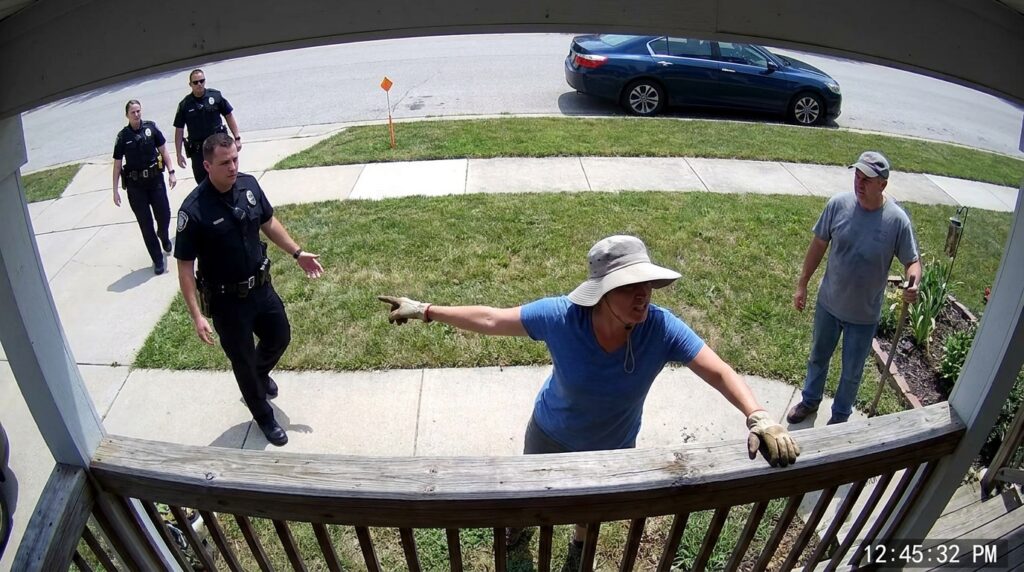
Helen didn’t look up immediately, but her rhythm had broken. She was kneeling at the edge of what she claimed was her perennial bed, her heavy silhouette framed against the glare of her dark blue sedan parked curbside. Her wide-brim straw hat tilted slightly, a frayed edge casting a jagged shadow over her face as she rammed her bypass shears into the root-choked dirt. She didn’t like the marker. To her, that three-inch plastic square was an act of war, an explicit rejection of the invisible kingdom she had spent fifteen years policing with clipboards and passive-aggressive notes about trash bin placement.

Beside her, leaning heavily on a long-handled shovel, her husband Arthur looked away. His gray T-shirt was dark with sweat between the shoulder blades, his cap pulled low to block the glare. He knew the history of the iron pin. He had watched the surveyor pull the steel tape tight from the city curb, proving what we both already knew: their garden was creeping across the line, an inch every season, eating into my plot like rust on an old fender.

“It’s about the standard,” Helen muttered, her voice carrying clearly across the quiet cul-de-sac. She wasn’t speaking to Arthur. She was speaking to the air, letting the venom drift across the property line. She stood up heavily, wiping loose dirt from her blue shirt with her gloved palms. Her fingers were stiff inside the leather, curling into tight, thick fists. “People come in here and think they can just change the geometry of a block.”

I didn’t answer. I kept my palms flat against the rough wood of my porch railing, feeling the grit of windblown dust beneath my skin. The railing was a boundary I didn’t intend to leave. In the dusty gray of a midday dispute, the person who moves first usually loses the ground they’re standing on.

She turned her face toward the porch, the sun catching the sharp edge of her sunglasses. She took two deliberate steps onto the sun-bleached sidewalk, her boots scuffing the concrete with a dry, scratching scrape. Her gaze was locked onto mine now, hard and proprietary, as if she could simply look the legal description of the land out of existence.

Then her hand went into her pocket, and she pulled out a crumpled sheet of paper—an old, unverified home association layout from 1994, its edges yellowed and soft from years in a kitchen drawer. It wasn’t a deed. It wasn’t a certified survey. But as she stepped off the sidewalk and onto my grass, her boots sinking slightly into the soft earth near the marker, she held it like a weapon.

A small, metallic click echoed from the corner of my eave. The green indicator light on the security camera blinked once, capturing the exact second her boot crossed the legal threshold.


CHAPTER 2: THE GLARE AT THE LINE

The click of the security camera housing was a tiny, plastic snap against the silence, but it signaled a shift in the air. Helen didn’t hear it—her focus was entirely on the distance between her dirty work boots and the small orange lawn marker driven into the fescue—but I did. Her left boot came down squarely on the parched grass four inches past the surveyor’s iron stake. The dry fescue crunched under her weight, a dull, snapping sound that felt loud in the oppressive midday heat.

She held the crumpled 1994 home association layout aloft like a fading flag. The paper was worn soft at the creases, its margins covered in frantic, heavily smeared pencil notations that had long since turned into a gray haze. But as she extended it toward me, the blistering sun caught the top corner of the page, illuminating a thick, unctuous stain that had seeped through the fiber. It wasn’t water. It was a dark, dark gray smudge, viscous and heavy, throwing off a faint, chemical odor as the heat baked the paper. It smelled vaguely of old machinery, of ancient iron gears drowned in fuel, a scent completely out of place against the standard suburban fragrance of cut grass and dry dust.

“Look at the line,” Helen said, her voice dropping into a raspy, defensive register that scraped against the quiet of the cul-de-sac. She didn’t take her eyes off me, her sunglasses reflecting twin distorted versions of my front porch. She gestured with the document, her yellow leather glove tightening until the paper groaned. “Look at the original platting from ninety-four. The drainage easement gives the perimeter committee the right to dictate landscape continuity. You don’t get to drive stakes into a unified drainage strip.”

I remained stationary behind the wooden porch railing, my fingers curled lightly over the grain of the top beam. The wood was hot, nearly blistering, the old white paint flaking off in dry scales under my palms. I felt the physical friction of the environment—the heat radiating up from the concrete sidewalk, the heavy hum of an air conditioning compressor kicking on three houses down, the dead weight of the afternoon.

“The city surveyor didn’t use a ninety-four sketch, Helen,” I replied, my voice measured, stripped of any inflection that she could seize upon as emotional leverage. I kept my eyes on the leather of her gloves, tracking her knuckles. “He pulled the coordinates from the county registry. The iron pin is exactly where the deed says it belongs. You’re four inches over it right now.”

Behind her, Arthur shifted his weight against the long-handled shovel. The spade end of the tool was buried three inches into the loose, turned earth of their unauthorized garden bed. When he moved, the metal blade scraped against a hidden stone with a sharp, iron shriek that set my teeth on edge. He didn’t look at his wife, and he didn’t look at me. Instead, his gaze was fixed on the soil at his feet. The earth in that specific section of their perennial bed didn’t look like the bright, reddish-tan clay native to this part of the county. It was darker, almost black, clumpy and saturated despite the three-week drought that had cracked the rest of the neighborhood’s lawns. Every time he stirred the dirt with the shovel, that same faint, oily machinery smell drifted across the grass, heavier now, hanging low in the stagnant air.

Helen’s jaw tightened, the muscles along her neck going rigid. “The county registry doesn’t live on this street,” she snapped. She took another half-step forward, her right boot dragging a small clod of my parched soil across the invisible boundary line. “We built the standard here. We kept the values up when the original developer went under in ninety-eight. I am not going to let some newcomer use city technicalities to ruin the sightlines of this entire curb.”

She was calculating her options; I could see it in the way her weight shifted from her heels to the balls of her feet. She wanted me to come down off the porch. She wanted the confrontation on the grass, where the lack of a physical barrier would give her bulk and her volume tactical utility. In the structural logic of neighborhood disputes, the person who leaves their threshold surrenders their legal advantage. I stayed where the shadow of the eave met the heat.

“Arthur,” I said, redirecting my gaze past her shoulder to the silent figure by the garden bed. “The city code enforcement officer is already reviewing the permit layout for that retaining wall you’re digging. If that spade hits the main utility conduit because you’re working past the lot line, it won’t be an association issue anymore.”

Arthur froze. His hands, also covered in work gloves, tightened around the weathered ash handle of the shovel. He looked up then, his eyes squinting beneath the brim of his cap, his face pale despite the heat. He opened his mouth as if to speak, to offer some quiet, pragmatic compromise that would allow them to retreat across the sidewalk without losing face.

But Helen didn’t give him the space. She stepped directly into his line of sight, her wide-brim hat cutting off his view of the porch. “Arthur, keep digging,” she commanded, her voice rising, losing its calculated restraint. She turned back to me, her face flushed red beneath the shadow of her straw hat, her finger pointing straight at my chest. “You don’t get to threaten my husband on my property. You don’t walk onto my place and judge how we maintain this block.”

She was entirely across the line now, both boots planted firmly in my yard, her shadow stretching across the grass toward the steps of the porch. The heat between us felt like a physical wall, thick with the smell of parched fescue, dry clay, and that persistent, metallic tang rising from the crumpled paper in her hand.

I looked past her toward the far end of the cul-de-sac. A low, rhythmic rumble was growing louder, the unmistakable sound of a heavy diesel engine shifting gears as it turned the corner into Whispering Pines.

CHAPTER 3: THE UNPERMITTED TRENCH

The low, rhythmic thrum of the diesel engine vibrated up through the wood of the porch railing before the vehicle even cleared the corner of the block. It was a heavy, industrial rumble that ground against the stillness of the afternoon. A moment later, a faded orange dump truck belonging to a third-party utility subcontractor ground its gears and slowed down at the curb, its air brakes releasing with a loud, metallic hiss that choked the air with a cloud of dry, sulfurous exhaust.

Helen didn’t flinch, but her arm remained frozen mid-gesture, her pointed finger hovering an inch from my chest. Her wide-brim straw hat shifted as she turned her head, her sunglasses catching the reflection of the truck’s rusted iron payload bed.

The driver didn’t get out. Instead, a man wearing a dirt-smeared safety vest and heavy work boots stepped down from the passenger side, holding a clipboard in one hand and a bundle of bright pink utility flags in the other. He stopped at the edge of the curb, looking back and forth between the fresh orange surveyor’s stake and the ragged trench Arthur had been carving into the dirt bed.

“Arthur,” I said again, my voice cutting through the mechanical idle of the truck. “I didn’t call code enforcement. I called the county utility inspector to verify the lateral lines before you poured the gravel footer. If your trench is within thirty inches of the old connection, you’re digging into the public right-of-way without an easement waiver.”

Arthur didn’t answer. He slowly leaned his weight onto the ash handle of his shovel, his boots sinking an inch deeper into the damp, black loam that smelled so strongly of old fuel oil. He looked at the utility worker, then down at the clumpy, dark soil clinging to the steel spade of his tool. The skin around his jaw went slack, his pale face glistening with a film of sweat that caught the brutal glare of the overhead sun.

Helen stepped back off the grass and onto the concrete sidewalk, her yellow leather gloves clenching the crumpled 1994 map tight against her hip. “This is a private lateral,” she said, her voice dropping into a harsh, transactional hiss that lacked its earlier performative volume. She pointed a gloved hand toward the worker. “We have the original association covenants right here. The developer left the maintenance of this boundary strip to the adjacent lots. The county doesn’t have jurisdiction over the residential landscape buffer.”

The worker in the vest didn’t look up from his clipboard. He walked four paces down the sidewalk, stopped exactly aligned with the orange survey stake, and looked over the fence line at the trench. He dropped a single pink flag into the grass three feet inside Helen’s property line—right where her driveway met the loose dirt of the perennial bed.

“Mone’s not here to talk about landscaping, ma’am,” the worker said, his voice flat, exhausted by the heat and the standard script of neighborhood friction. He used the tip of his boot to kick a piece of the dark earth Arthur had thrown onto the concrete. He frowned, stepping back as the faint smell of machinery drifted up from the friction of his sole against the dirt. “The county water authority flagged a pressure drop in the secondary main last Tuesday. We’re tracking a soil saturation anomaly. Your retaining wall is sitting right over the old industrial easement line from before the subdivision was platted.”

A sharp, sudden silence fell over the yard, broken only by the steady, heavy rattle of the truck’s engine.

I watched Helen’s shoulders go rigid beneath her blue T-shirt. She didn’t look at the pink flag, and she didn’t look at the worker. Her eyes snapped back to me, the glare on her sunglasses completely hiding whatever calculation was happening behind them. But her fingers were twitching inside the thick leather gloves, tearing a small, clean rip along the edge of the ninety-four paper document.

“There’s nothing under this dirt but roots,” she said. Her voice was too fast now, stripped of its legalistic authority and reduced to a sharp, defensive edge. “We laid this sod ourselves in ninety-nine. My husband knows exactly what’s down there. We don’t need a county subcontractor ripping up a permitted retaining wall based on a pressure reading from three streets over.”

She took three rapid steps toward Arthur, her hand reaching out to grab the handle of his shovel as if she could physically force him to fill the trench back in before anyone could look closer. Her movements were frantic, driven by a sudden, sharp panic that didn’t match a simple dispute over four inches of lawn.

“Arthur, put the tool down,” I said, my voice remaining flat, matching the heavy weight of the wood beneath my hands. “Look at the corner of that plat map your wife is holding. Look at the stain on the paper. That didn’t come from a kitchen counter.”

Arthur didn’t move to help her. He let go of the ash handle completely, stepping backward away from the dark, saturated loam of the trench. His gaze followed my words, landing on the dark, unctuous smudge that had soaked through the fiber of the old paper in Helen’s hand. In the blinding light of the afternoon, the smudge looked almost purple against the yellowed document, a thick, greasy residue that refused to dry.

The worker in the safety vest pulled a brass probe from his belt and walked toward the edge of the trench, his boots crunching heavily through the dry weeds at the boundary line. He didn’t ask for permission. He jammed the metal rod deep into the black soil Arthur had just turned over, leaning his weight into the handle until the steel gave a dull, wet thud against something solid and metallic buried two feet beneath the surface.

Helen froze, her gloved hand wrapped around the empty shovel handle, her face turning pale as the worker twisted the probe and pulled it clear, a thick, black glop of grease clinging to the tip of the brass.

CHAPTER 4: THE SLAM OF THE RAILING

The thick glop of black grease on the brass probe looked almost purple under the direct, unyielding glare of the midday sun. It didn’t drop; it clung to the metal thread, slow and heavy, giving off a sharp, sharp chemical stench that cut right through the diesel exhaust of the idling dump truck. The utility worker pulled a coarse white rag from his utility pocket and wiped the brass clean with a single, practiced stroke, his boots twisting into the dry weeds at the edge of the property line.

“That’s not county water lateral,” he said, his voice dropping into a flat, level grunt that carried across the parched yard. He held the stained rag out toward Helen, though he didn’t take his eyes off the dark, wet clods of loam Arthur had thrown onto the sidewalk strip. “You’ve got a dead iron casing down there, ma’am. Two feet down, right where your plans say there’s only drainage tile.”

Helen’s hand moved before her mind did. Her yellow leather work gloves went rigid, her fingers clamping down so hard on the edge of the 1994 layout that the weathered paper split clean through the middle crease. The dry rasp of the tearing sheet was thin, like an old leaf crushing under foot, but it broke the last remaining hold she had on her performative composure.

She turned away from the subcontractor, her heavy frame pivoting with a sudden, violent momentum that kicked a shower of loose gravel against the rear tire of her dark blue sedan. She covered the distance between the sidewalk and my front yard in three broad, heavy steps, her face completely flushed beneath the shadow of her wide-brim straw hat. Her sunglasses slid down the bridge of her nose, exposing her wide, calculated eyes as she stopped right at the bottom step of my porch.

“This is an old residential line,” she said, her voice rising into a sharp, raspy bark that echoed off the light vinyl house siding. She didn’t look down at the small orange lawn marker she was currently trampling into the fescue. She leaned forward, her weight shifting onto her front foot until her shadow swallowed the lower half of the steps. “It’s a grandfathered connection from the original farm boundary. It’s covered under the ninety-four easement map. You don’t get to stand up there on your clean little porch and call county inspectors to rewrite the history of this lot.”

She reached up and slammed her gloved palm hard against the top beam of the wooden porch railing.

The impact was a dull, heavy thud that rattled the old white paint scales from the wood, sending a small shower of plaster dust onto the dry grass below. She kept her palm flat against the railing, bracing her weight against the structure as her other hand lifted, her finger pointing straight toward my face. Her knuckles were dead white inside the leather.

“You don’t walk onto my place and judge how we keep this block together,” she spat, her breath hot and fast in the stagnant air. “We dug these beds. We built the standard. You think a three-inch plastic stake gives you the authority to tell me what’s under my own driveway?”

I stayed exactly where I was, my palms flat against the unyielding wood six inches away from her gloved fingers. The texture of the wood beneath my hands was rough, weathered by years of winter frost and blistering summer sun, but it didn’t give. In the strict economy of property disputes, volume is the first sign of a collapsing position. She was yelling because the physical boundaries were beginning to narrow around her.

“Arthur,” I said, my eyes tracking past her shoulder to the silent figure standing by the garden bed. “The ninety-four layout shows the driveway line, but it doesn’t show the three-foot municipal setback the city retained when they widened the cul-de-sac. The corporate line cuts right through the center of your perennial bed. That’s what the iron pin proved. That’s why the inspector is here.”

Arthur didn’t defend her. He let go of the long-handled shovel entirely, allowing the heavy ash handle to tip sideways until the iron spade fell with a dry clatter against the brick border of the bed. He stepped two feet backward, his boots leaving deep, clumpy impressions in the black loam that continued to ooze that dark, industrial grease. He looked at his wife’s back, then down at his own dirty work gloves, his mouth opening slightly but producing nothing more than a faint, dry wheeze.

“He doesn’t have the authority, Helen,” Arthur muttered quietly, his voice lacking any of the sharp resolve his wife was performing against the porch. He didn’t look up to see if she heard him. He just looked at the dark blue sedan, his shoulders dropping as if the weight of the heat had finally crushed the spine out of him.

The worker in the safety vest didn’t wait for them to finish. He turned back toward the idling orange truck and made a short, horizontal cutting motion across his throat. The driver killed the diesel engine. The sudden silence that followed was immense, heavy and sudden, leaving only the sound of a crow calling from the top of a distant utility pole and the dry, scraping sound of Helen’s boots as she tried to maintain her stance against my railing.

Then came the sound of a car door clicking open from the street lane behind the sedan—not the heavy clatter of a contractor’s truck, but the crisp, solid snap of a municipal vehicle door.

CHAPTER 5: THE CRUNCH OF THE GRAVEL

The crisp, solid snap of the municipal vehicle door was instantly followed by two more, the synchronous metallic thuds echoing down the windless asphalt of the cul-de-sac. It wasn’t the slow, heavy rattle of an arriving contractor. It was the distinct, clean weight of factory-sealed steel panels shutting under authority. Through the split pane of my porch railing, I watched three figures emerge from the lane adjacent to Helen’s dark blue sedan.

The lead officer didn’t rush. He moved with a measured, upright command posture, his black boots grinding with a dry, rhythmic crunch into the loose stones scattered along the curb. His dark, unmarked police uniform looked nearly blue-black under the blinding noon sun, the rigid leather of his duty belt creaking slightly with every step. Behind him, two backup officers split wide—a sharp, dark-haired female officer tracking the left yard line, and a stockier, older male officer with closely cropped gray hair moving into a supportive flanking position near the garden bed.

Helen didn’t lower her arm immediately. Her yellow leather glove remained clamped to my top rail, though her weight shifted backward off her front boot, her heels scraping across the dry fescue. The flaking white paint scales she had dislodged with her palm still drifted in the stagnant air between us, fine as ash.

“Is there a problem here, officer?” Helen asked, her voice hitching slightly as she tried to reconstruct the sharp, proprietary register she had used a moment prior. She didn’t remove her hand from the railing, bracing herself against the wood as if the physical structure could lend her status. “We are simply correcting an unpermitted property alteration. This resident has driven structural hazards into a grandfathered community drainage easement.”

The lead officer stopped exactly where the concrete sidewalk met my lawn, his alert eyes tracking from Helen’s flushed face down to her dirty work boots, which were still buried four inches deep inside my boundary line. He didn’t look at the torn 1994 layout she was clutching against her hip. His hands remained low, open, and clear of his holster, but his posture remained completely unyielding.

“Ma’am,” the lead officer said, his voice clipped, cool, and carrying the flat weight of an official directive. “Step back off the porch. Step onto the sidewalk where I can see your hands.”

The silence that followed was dense, broken only by the faint, rhythmic ticking of the cooling dump truck engine at the curb. Helen’s sunglasses slipped another fraction down her nose. For fifteen years, she had been the one who called the city; she had been the one who stood on the curb with folders, directing county inspectors toward other people’s violations. To have the uniform facing her, treating her silhouette as the active disruption, was a structural calculation she didn’t know how to complete.

“I am the lot owner at four-hundred-and-four,” she said, her voice rising an octave, the leather of her glove groaning as her grip tightened on the hot wood. “My husband Arthur is currently stabilizing our retaining wall footer. We have the legal description right here—”

“I didn’t ask about the lot description, ma’am,” the lead officer interrupted, taking one deliberate step forward into the pressure lane. His movement was fluid, but it placed his bulk directly between Helen and her dark blue sedan, cutting off her line of retreat. “Step behind the marker. Right now.”

Behind them, near the dug-up trench of the perennial bed, the stocky backup officer stopped beside Arthur. Arthur hadn’t moved since he dropped the shovel. His cap was pulled down so low his eyes were entirely in shadow, his gloved fingers twitching against his thighs. When the older officer glanced down into the trench, his brow furrowed beneath his short gray hair. The dark, saturated loam inside the hole was still oozing that thick, unctuous grease, the chemical smell of old machinery rising from the raw earth like a heat mirage. The older officer didn’t look at the boundary line; he looked at the texture of the soil, his boot heel testing the edge of the trench to see how deep the saturation went.

The utility contractor in the safety vest walked over to the female backup officer, holding out the brass probe that was still coated in the purple-black sludge. He pointed toward the concrete driveway line, then down toward the iron casing buried two feet below the perennial roots.

I kept my palms flat against the wood of my railing, watching the physical layout shift. The line wasn’t just an abstract legal concept anymore; it was being enforced by three distinct sets of uniform boots. Helen was losing the yard, inch by inch, her shadow shortening as the sun reached its absolute peak.

She slowly pulled her hand away from my railing, leaving five dark, greasy fingerprint shapes pressed into the flaking white paint. She took one step back, then another, her boots scuffing the concrete as she yielded the grass. Her shoulders went rigid beneath her blue shirt, her arms folding across her chest in a tight, defensive knot that looked more like an admission than a strategy.

The lead officer didn’t buy into her silence. He kept his palms out, his alert gaze locked on her face as he closed the remaining distance between them, his boots coming to a halt exactly beside the orange survey marker.

CHAPTER 6: THE RETREAT BY THE SEDAN

“Ma’am, stay there, hands where I can see them.”

The lead officer didn’t drop his hands, but his voice carried a flat, hydraulic finality that stopped Helen mid-stride. Her right boot, caked with the dark, heavy loam of the encroaching garden bed, slid off the grass and hit the gravel edge of the street with a wet, heavy crunch. Her posture went instantly rigid against the rear quarter panel of her dark blue sedan. The sheet metal was blistering under the straight overhead sun, radiating a dense, oily heat that shimmered against her blue shirt.

She folded her arms tight across her chest, her yellow leather work gloves tucking beneath her armpits as if she could hide the split, frayed remnants of the 1994 plat map. Her sunglasses remained precariously low on her nose, the lenses reflecting the cold, unblinking glare of the officer’s duty belt gear.

“This is entirely out of proportion,” Helen said, her teeth clicking slightly as she tried to force her voice back into its familiar, authoritative rhythm. She leaned her hip against the sedan’s hot metal, a subtle movement meant to project a calm she didn’t possess. “I am a member of the subdivision steering committee. We have a documented right to preserve the visual uniformity of this curb line. The resident on the porch is using a temporary municipal marker to bypass neighborhood standards.”

The lead officer didn’t look at her car, and he didn’t look at her map. He stood perfectly aligned with the orange survey stake, his shadow a small, dense circle around his boots. “The homeowner didn’t call us out here for a property line dispute, ma’am,” he said, his eyes scanning the sidewalk line, tracking the greasy clods of dirt her boots had dragged across the concrete. “The water authority unit flagged a systemic environmental hazard originating from this lot. Your husband’s digging is currently interfering with a county inspection perimeter.”

A low, sucking sound came from the garden bed behind her.

The stocky backup officer had stepped directly into the center of the turned earth, his heavy uniform boots sinking three inches into the saturated loam. He reached down and gripped the handle of Arthur’s discarded shovel, using the iron edge to clear away a thick shelf of clay near the fence line. When the metal blade sliced through the roots, it didn’t strike stone. It found something solid, thick, and hollow—a dead, muffled thunk that sent a heavy vibration through the parched soil under my own feet.

“Hey, Miller,” the stocky officer called out, his voice low, grunting against the heat as he straightened up. He wiped his forearm across his cropped gray hair, leaving a dark streak of grease on his skin. “We’ve got more than a lateral problem here. There’s an unlisted tank head about twenty inches down. Casing’s rotted straight through. The whole pocket under this driveway is black.”

Helen’s crossed arms went tighter, her fingers digging into the fabric of her blue sleeves until the leather of her gloves strained at the seams. Her face, flushed deep red from the heat moments before, drained into a sallow, dusty gray. She didn’t look back at the trench. She didn’t look at Arthur, who was now leaning his entire weight against the rusted trunk of their sedan, his eyes fixed on the pavement.

“It’s an old domestic fuel storage tank,” she said, her voice dropping into a rapid, transactional whisper that barely carried across the lawn. The performative neighborhood guardian was entirely gone; her words were sharp, frantic, and small. “It was decommissioned during the ninety-eight build. The developer signed off on the capping. It’s inside our deeded boundary.”

“The ninety-eight waiver didn’t cover an active structural leak into the county watershed, ma’am,” the lead officer replied, his voice remaining level, flat, and completely indifferent to her explanation. He reached down and touched the edge of his radio, his fingers moving with a slow, administrative precision that signalized the arrival of a much larger apparatus. “The city surveyor didn’t just find your line encroachment. He found the old easement boundary because the ground under your retaining wall is physically shifting.”

I kept my palms flat on the hot porch rail, watching her position dissolve from the structural safety of my threshold. She had spent fifteen years using rules as a weapon to push the edge of her property further into the block, believing that as long as she held the clipboard, no one would ever look beneath the sod. But the iron pin had held its ground, and now the earth itself was refusing to keep her secret.

The female backup officer walked over to the driver’s side of the sedan, her boots clicking sharply against the asphalt as she took up a containment position behind Helen, her hand resting casually near her duty belt. The neighborhood was quiet, completely dead under the heavy noon glare, but the windows of the surrounding houses were no longer empty. Shadows were moving behind the screens across the street—the silent porch watchers of Whispering Pines finally turning their attention toward the woman who had spent a decade policing their lawns.

Helen looked up at me then, her sunglasses finally slipping completely off her face to reveal eyes that were narrow, dry, and frantic with tactical exhaustion.

CHAPTER 7: THE TURN IN THE SOIL

The sunglasses hit the sun-baked concrete sidewalk with a sharp, plastic clink, the lenses skittering into the parched fescue just an inch away from the bright orange survey marker. Helen didn’t reach down to retrieve them. Her unprotected eyes blinked under the intense, white glare of the overhead sun, wide and dry, staring blankly past the lead officer’s shoulder toward her own garden bed.

Beside the rear trunk of the dark blue sedan, Arthur didn’t move to bolster her remaining narrative. His heavy, gloved hands slowly slid down the smooth ash handle of the shovel, allowing the metal blade to remain wedged deep in the clumpy, fuel-soaked loam. He sank back against the car panel, his boots tracking slick, black clay across the crisp line of the sidewalk. When he spoke, his voice was thin, stripped entirely of the neighborhood authority Helen had performed for fifteen years.

“It started weeping into the foundation drain during the spring thaw, Helen,” Arthur muttered. He didn’t look up at his wife. His gaze remained pinned to the wet, dark trench where the stocky backup officer was still clearing away the roots. “I told you the patch wouldn’t hold. I told you when we laid the new landscape timber that the easement check would catch the pressure drop.”

Helen’s jaw worked silently, her mouth opening and closing without a sound. Her fingers, still curled inside the yellow leather work gloves, twitched against the sleeves of her blue T-shirt. The split halves of the 1994 layout slipped from her underarm, the weathered sheets falling into the dirt like dead leaves, the large, grease-soaked smudge at the corner glistening under the midday heat.

The stocky officer cleared another heavy shelf of clay with the edge of his boot, exposing a broad, horizontal curve of heavily pitted, corroded iron casing buried twenty inches below the sod. A dark, iridescent sheen was bubbling up from a jagged fracture in the steel, a slow, continuous leak that had turned the entire subterranean root system into a black, saturated sponge. The air between our lots grew thick, choked with the pungent, oily reek of old heating oil baking under a July sky.

“Miller, get the city environmental response unit on the wire,” the stocky officer called out, his boots sinking with a wet, heavy sucking sound as he climbed back out of the trench. He didn’t use a civil tone. He wiped a smudge of the black grease onto his tactical trousers, looking at Helen with a cold, administrative finality. “This isn’t an association fence issue. The containment layer under this entire block has been breached. It’s draining right into the secondary storm lateral.”

The female backup officer took half a step forward, her hand resting flat against her duty belt, her form creating a solid physical perimeter that pinned Helen against the side of the sedan. “Ma’am, you need to step away from the vehicle,” she instructed.

Helen looked up from the sidewalk, her gaze drifting past the officers, past the orange dump truck, until it landed squarely on me. I remained behind the white wooden porch railing, my palms flat against the warm, flaking timber. The five dark, greasy fingerprint shapes she had left pressed into the wood were already starting to dry and crack under the intense midday heat, turning into permanent stains against the paint.

She had spent a decade using municipal codes and association bylaws as a precise, tactical scalpel to slice away at her neighbors’ property lines, creating an unassailable record of local perfection. But her overreach hadn’t been an act of pride; it was a desperate, bad-faith maintenance loop designed to keep anyone from ever bringing a surveyor’s tape or a county shovel near the rotted iron buried under her driveway. Her authority hadn’t collapsed because the rules changed—it collapsed because the physical ground beneath her feet could no longer sustain the weight of the truth.

Across the cul-de-sac, the shadows behind the window screens had stopped moving. Three separate neighbors had stepped out onto their front porches, their silent, watchful faces tracking the uniform boots moving through the mud.

The lead officer pulled a small, heavy plastic clip from his belt, his eyes fixed on Helen’s rigid, crossed-arm stance. “Arthur,” he said, his voice clipped and dry as he reached toward his radio. “Step clear of the trench. Nobody touches the soil until the containment inspector locks the boundary down.”

CHAPTER 8: THE SHADOW ON THE PORCH

“Everyone stay back, keep it calm.”

The lead officer didn’t shout, but his voice cut through the stagnant, oil-choked air with the heavy weight of an administrative seal. He raised one open palm, creating a firm, physical plane between the dark blue sedan and the wooden steps of my threshold. Helen remained completely motionless, her frame pinned flat against the blistering metal panel of her car door, her arms locked so tightly across her blue T-shirt that her yellow work gloves looked like rigid, wooden prosthetics.

Time didn’t move; it dilated, slowing to the heavy rhythm of the cooling diesel engine of the utility truck at the curb. Through the narrow slats of the porch railing, I watched a drop of dark, iridescent water gather at the base of the orange surveyor’s stake. It fell away into the dry fescue, leaving a small, greasy mirror that reflected the brutal white glare of the overhead sun. The boundary had been drawn, and now it was concrete.

The stocky backup officer moved out of the garden bed, his heavy boots making a thick, sucking sound as they left the saturated loam. He stopped exactly on the concrete sidewalk strip, pulling a length of bright yellow caution tape from his equipment belt. The plastic sheet groaned as he stretched it taut across the property line, tying it off to the rusted post of the ancient perimeter fence. When the tape snapped straight, it cut through the shadow of the porch eave like a neon razor.

Arthur didn’t watch him. He had completely detached himself from his wife’s side, his shoulders dropping under the weight of his gray shirt as he took three small, scuffing steps back toward the far edge of their driveway lot. He slowly pulled the leather gloves from his fingers, dropping them into the dry weeds near the garden timbers without looking up.

“The county remediation truck is five minutes out, Miller,” the female officer said, her voice dropping into a level register as she adjusted her duty belt. She took up a permanent position near the front bumper of the sedan, her presence finalizing the physical containment of the lot.

Helen looked up from her stance by the sedan. Her face was entirely bare without her sunglasses, the skin around her eyes pale and dry against the deep, sallow flush of her cheeks. She stared at the five dark, oily fingerprint marks she had left on my top railing—the messy residue of her performative authority now drying into a permanent, black crust on the flaking white timber. She didn’t offer a final complaint. She didn’t speak to the officers, and she didn’t look back at Arthur. Her absolute certainty had been ground down to a small, isolated square of concrete beside her own rear tire.

I kept my hands flat on the wood, feeling the heat vibrating through the old grain. The shadow of the eave had grown wider now, dropping a cool, protective sheet of dark gray across the porch floorboards, completely separating my threshold from the hot, grease-choked grass below. For ten years, the block had been governed by her unwritten rules, a slow, grinding pressure that had dictated the sightlines of every lawn. But the iron pin hadn’t moved an inch under her weight.

The cul-de-sac remained silent, the porch watchers across the street standing motionless behind their screens, their eyes fixed on the yellow tape that now defined the edge of lot 404. The kingdom had vanished into the dusty gray of an official report, leaving nothing behind but the small orange lawn marker and the raw, black earth leaking its secrets into the afternoon sun.

The lead officer turned his back to the sedan, his boots making a final, crushing sweep through the iron scales of the surveyor’s stake as he stepped onto the sidewalk lane, locking the boundary down for good.

Similar Posts

Leave a Reply

Your email address will not be published. Required fields are marked *