
The Weight of the Line: A Narrative of Rusted Edges and Suburban Friction
CHAPTER 1: THE WATER PATTERN
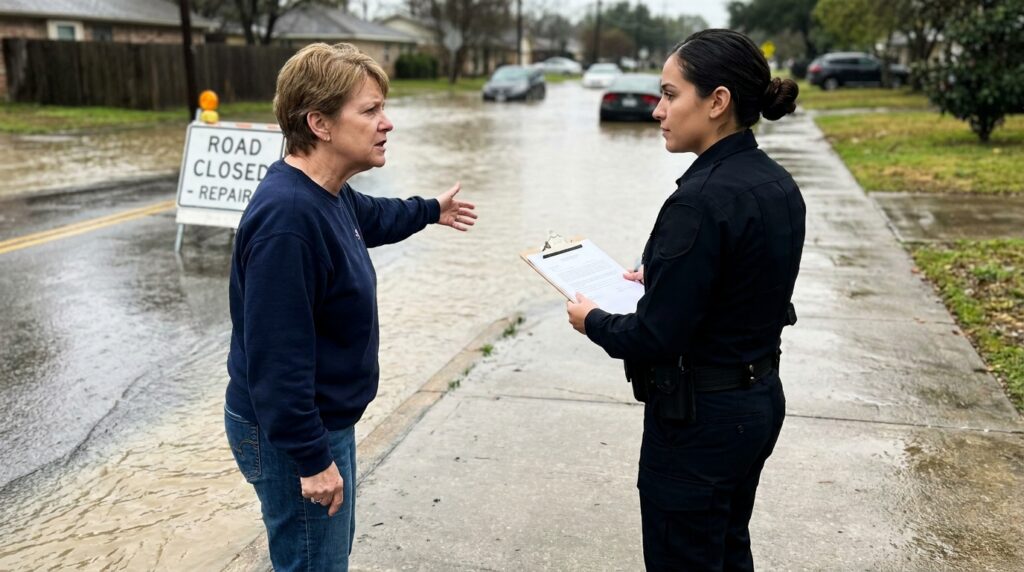
“You keep leaving me flooded out, fix this today,” the woman said. Her hand sliced downward through the damp morning air, her fingers rigid against the backdrop of grey, churning gutter water. She didn’t look at the man standing twenty feet away on the porch; her focus remained pinned to the silver badge on the officer’s chest. The fabric of her navy sweatshirt was stiff with salt from older sweat, the shoulders bunched tight like wire-wrapped insulation.
Arthur didn’t answer. He stayed near the rusted iron support post of his awning, his hands buried deep inside the front pocket of a salt-stained grey hoodie. The wool was heavy with mist. Beneath his boots, the concrete of his porch felt cold, a solid slab of unyielding, aggregate stone that had settled two inches to the left since 1994. He could smell the particular scent of the asphalt out here—wet oil, rotting pine needles, and the sulfurous tang of a backup in the lower culvert.
The officer, a woman named Miller whose dark hair was pulled into a flat, regulatory knot behind her ears, didn’t move her feet from the clean rise of the sidewalk. She held a heavy aluminum clipboard against her ribs. The metal was scratched, dull silver showing through grease-smudged corners where years of thumbs had worn down the factory finish. She looked at the water. It was four inches deep now, a wide, tea-colored mirror that transformed the suburban curb into a slick canal. Floating chunks of brown lawn thatch and crushed plastic soda bottles revolved slowly in the eddies near Arthur’s mailbox.
“The water isn’t coming from his grass, Mrs. Gable,” Miller said. Her voice had the flat, percussive rhythm of someone who spent forty hours a week reading municipal penal codes aloud to people who hadn’t slept. She turned a page on the clipboard. The paper made a dry, fibrous snap in the damp air. “The call came in as an unpermitted obstruction. I have to look at the easement first.”
“Look at it?” Mrs. Gable stepped off the curb. The heel of her white sneaker came down into two inches of muddy runoff, the water instantly sucking at the mesh toe box. She didn’t flinch. Her sunglasses, dark and rectangular, caught the reflection of the grey sky like two pieces of slag glass. “There’s nothing to look at but his drain. He stuffed it. He’s been stuffing it with lawn clippings since May. Look at the silt on his driveway. That’s state-line runoff.”
Arthur watched a drop of rain roll down the rusted edge of the utility box near the ditch. A single iron surveyor’s pin, buried six inches below the sod three feet to his left, was completely submerged now. He knew exactly where it was. He had dug it out with an old trowel three weeks after moving in, scraping away the clay until his fingers hit the cold, square head of the stake. The county map said that pin was law. Everything else—the arguments, the calls to code enforcement, the way Mrs. Gable stood at the edge of her lawn at 6:00 AM with a digital camera—was just noise.
Miller didn’t look up from the paper. “He hasn’t mowed in three weeks, Mrs. Gable. The silt is coming down from the ridge road.” She shifted her weight, the leather of her utility belt creaking like an old saddle. With the toe of her heavy regulatory boot, she reached out and nudged a loose piece of grey limestone that sat at the very edge of the water line. The stone didn’t belong to the street; it had a clean, machine-cut face, identical to the three hundred other blocks forming the low, unpermitted retaining wall that bordered Mrs. Gable’s driveway. When her boot tip touched it, the stone shifted, and a dark bubble of trapped grease and black mud burped up from beneath the surface, revealing a line of blue utility tape that had been sliced through by a shovel.

CHAPTER 2: SULPHUR AND METRIC THREADS
“That tape wasn’t there when the surveyor staked it in November,” Mrs. Gable said. Her voice didn’t rise in pitch; it simply hardened, a flat piece of cold-rolled iron snapping against the low thrum of the idling cruiser. She took another half-step into the gutter pool, the oily water now swirling grey foam around the white rubber rim of her sneaker. “He put that down himself. He’s been digging out there after dark, Officer. Ask him about the shovel marks behind my shed.”
Arthur didn’t shift his shoulders from the iron post. He reached down into the pocket of his hoodie, his fingers finding the small, notched brass key to his water meter box. It was cool and greasy against his palm, a simple mechanical tool that knew nothing about property lines or municipal easements. “The gas company laid that tracer line three years ago, Mrs. Gable,” he said, his voice flat, rhythmic, holding the low, steady cadence of a man who spent his days measuring tolerances on a lathe. “They ran it six inches inside the public right-of-way. Your wall is sitting four inches over the mark.”
Officer Miller didn’t look back at him. She remained balanced on the balls of her heavy black boots, her fingers hook-linked into the top edge of the aluminum clipboard. The grey morning light caught the fine sheen of diesel exhaust mist on the cruiser’s fender behind her. Slowly, with a deliberate, unhurried precision that came from five years of responding to identical suburban boundary skirmishes, she drew a yellow plastic grease pencil from her pocket. She didn’t write on the paper. Instead, she leaned down, the leather of her uniform belt groaning under the weight of her radio and cuffs, and made a single, thick yellow mark across the face of the limestone block she had nudged.
“Nobody’s citing anyone for excavation yet,” Miller said, her breath forming a brief, pale cloud in the damp air. She stood up, her eyes narrowing as she looked up the long, desaturated slope of the asphalt toward the ridge road. A quarter-mile up, where the tree line ended, the massive concrete retaining structures of the new logistics park sat like grey teeth against the sky. The water coming down the hill wasn’t clear rainwater anymore; it carried the thin, iridescent rainbow sheen of heavy machinery grease and industrial silt. “But this stone is sitting directly over a junction box that isn’t on my first-phase sheet. Mrs. Gable, did you hire the crew that poured the concrete footings for this driveway apron?”
“My husband did. Before the estate cleared,” the older woman replied instantly. Her chin came up, the stiff collar of her navy sweatshirt chafing against her jawline. Her fingers twitched against the plastic folder she held, the corners of the fake HOA notices inside soft and grey from the humidity. “We had the permit from the borough. It’s grandfathered. If there’s a box under there, it’s been there since the township put the original culverts in during the seventies.”
Arthur stepped down off the first concrete riser of his porch. His boots hit the wet grass with a soft, wet crunch. The ground here was oversaturated, the clay beneath the sod turned to a cold, slick paste that squeezed up through the eyelets of his leather work shoes. He walked toward the boundary line, keeping his eyes fixed on the yellow grease mark on the stone. He wasn’t looking at Mrs. Gable; he was looking at the way the water pattern changed when it hit that specific block. The runoff didn’t just pool; it spun in a tight, clockwise siphon, disappearing into the dark space between two improperly bedded stones with a distinct, hollow gurgle that sounded like a dry throat swallowing.
“That’s not an old municipal box,” Arthur said, stopping three feet from Officer Miller’s shoulder. He smelled the wet wool of his own sleeve, the sharp salt of the street runoff, and the burnt-oil stink of the cruiser’s catalytic converter. He pointed down at the base of the limestone where the sliced blue tape trailed off into the silt. “That’s a newly laid four-inch PVC sleeve. You can hear the vacuum from here. She didn’t block the drain, Officer. She harnessed it.”
Mrs. Gable’s shoulders stiffened, her jaw locking into a rigid, defensive square. “That’s a lie. We repaired the retaining wall after the frost heave last winter. That’s standard fieldstone reinforcement. You have no right to come off your property line to inspect my masonry.”
Miller didn’t intervene. She stepped back one pace, her boots splashing through the shallow edge of the flood, and let her hand drop naturally toward the side of her utility belt where the heavy black casing of her flashlight sat. She wasn’t reaching for a weapon; she was reaching for an extension of her eyes. She clicked the switch, the high-intensity LED beam cutting through the grey morning glare to strike the dark gap between the stones. The white light reflected off something smooth, clean, and unmistakably synthetic—the white, unweathered curve of a schedule-40 PVC pipe, its metric stamp still visible in bright red ink against the plastic.
“Arthur,” Officer Miller said without turning her head, her voice dropping into a quiet, tactical register that excluded the woman across the line. “Go back to your porch.”
“Officer—” Mrs. Gable started, her clipboard coming up like a shield.
“I said stay back, Mrs. Gable,” Miller interrupted, her tone flat, absolute, and completely devoid of the neighborly patience she had carried five minutes ago. She reached for her shoulder mic, her thumb clicking the lateral button with a sharp, plastic snap. “Dispatch, this is Unit Two. Have the shift supervisor contact Public Works. I need a locator crew at 414 Crestview, and notify the code enforcement officer on call. We have an unrecorded water diversion into the county right-of-way, and I’ve got a damaged tracer line on the gas main.”
The water kept rising, its cold, muddy edge now creeping over the lip of Arthur’s lower driveway, but the rhythm of the street had changed. The silence that followed the radio call was heavy, broken only by the distant, rhythmic clank of a diesel engine shifting gears further up the ridge road.
CHAPTER 3: THE WEIGHT OF LANDSCAPE
The static from Officer Miller’s shoulder microphone lingered in the humid space between them, a dry, electronic hiss that felt completely separate from the heavy gurgle of the gutter. Mrs. Gable didn’t drop her clipboard. Her fingers, small and spotted with pale liver marks, gripped the plastic edge so hard the cardboard backing groaned under the pressure. The wet hem of her navy sweatshirt shook slightly as she drew in a shallow, cold breath.
“An unrecorded water diversion?” Her voice didn’t carry the high pitch of panic; instead, it dropped into the low, calculated grit of a property owner who knew how many feet of pipe constituted a code violation. “This is an old retaining wall, Officer. If there’s plastic in there, it was put in by the previous owner to manage the spring line. My husband didn’t touch the township easement. We paid the assessment fees in 2018.”
“The assessment in 2018 didn’t include a four-inch commercial-grade PVC drainage sleeve running parallel to a high-pressure gas main, Mrs. Gable,” Miller said. She didn’t look at the older woman. Her hand remained resting on the black nylon grip of her heavy flashlight, the high-intensity beam still pinned to the muddy gap beneath the limestone blocks. The white plastic pipe gleamed through the silt like an old bone. “The gas company doesn’t leave their tracer wire loose for fun. That line was cut clean by a square-point shovel. You can see the spade scoring on the clay right behind the third course of stone.”
Arthur stood exactly where he had been told to stay, three feet inside his own property line, his boots sinking deeper into the oversaturated turf. The iron surveyor’s pin was completely lost beneath the tea-colored pool now, but his mind kept the coordinates locked. He could feel a strange, rhythmic vibration through the soles of his shoes—not the deep rumble of the logistics park trucks up on the ridge road, but something smaller, faster. A mechanical pulse. It was coming from the ground directly beneath Mrs. Gable’s retaining wall.
“Officer,” Arthur said, his hands still deep inside his hoodie pockets, his thumbs working the grooved edges of the water key. He didn’t look at Mrs. Gable; he kept his eyes on the grey foam swirling around the limestone. “That pipe isn’t pulling water in from the street. Look at the flow pattern near the edge of her grass. The water is backing out from behind her wall. The siphon I mentioned earlier—it just flipped.”
Miller shifted her gaze, tracking the beam of her light to the spot Arthur indicated. The tiny whirlpool that had been siphoning the street water into the gap had vanished. In its place, a steady, pulsing plume of yellowish, rusty water was pumping out from between the limestone joints, pushing against the grey street runoff like a small artesian spring. The smell changed instantly, shifting from the stagnant stink of dead leaves to the chemical sharpness of fresh lime and concrete curing agent.
“That’s enough,” Mrs. Gable snapped, her face turning a sharp, blotchy red under the grey morning light. She finally looked at Arthur, her dark lenses catching his silhouette against the white siding of his house. “You’ve been monitoring my property for three months, Arthur. Don’t think I haven’t seen you out here with your level and your string lines. You think because you bought the corner lot you own the flow calculations for the entire block?”
“I own the foundation of my garage, Mrs. Gable,” Arthur said. His voice was flat, empty of anger, carrying only the hard reality of a man who spent his life checking decimal points on iron castings. “And right now, your basement sump pump is overriding the city culvert because you buried your overflow line inside the public utility right-of-way. Every time your pump kicks on, it pours two hundred gallons of groundwater directly against my lower driveway apron.”
“It’s a protective measure,” she said, her voice dropping all pretense of unearned civic authority, replacing it with the sharp, defensive logic of a resident who felt cornered by the topography. “The ridge road development changed the water table three years ago. The county didn’t update the culverts under the avenue. If I don’t pump that crawlspace out twice a day during a front like this, the western foundation wall shears. The township wouldn’t help us. My husband had to lay that pipe himself before he passed.”
Miller let out a short, nasal sigh that looked like smoke in the damp air. She didn’t offer sympathy, nor did she issue a verbal warning. She simply took her yellow grease pencil and made two more thick, horizontal marks across the limestone wall, framing the white PVC pipe like a target.
“Your husband should have applied for a municipal variance, then,” Miller said, her boots making a slow, sucking sound as she pulled them from the gutter silt. She looked down the block toward the intersection, where the distant, rhythmic whine of a heavy diesel engine was getting louder. “Because Public Works just put the locator truck on the radio. They’re running a diagnostic on the whole street main. If that pipe of yours is tied into the gas company’s gravel bedding, it’s not just a code violation anymore. It’s an unpermitted hazardous infrastructure intersection.”
Arthur watched the water line. It had stopped rising against his lower driveway, held in check by the steady, counter-pressure of the rusty volume pumping out from behind Mrs. Gable’s wall. But the ground beneath his feet didn’t feel solid anymore. The small, fast vibration was growing stronger, traveling up through his ankles. It wasn’t the sump pump. The frequency was too low, too heavy, like an engine turning over deep inside the limestone ridge itself.
CHAPTER 4: THE SUBTERRANEAN BOUNDARY
The vibration didn’t taper off. It traveled cleanly through the dense, water-logged clay, striking the soles of Arthur’s work shoes with the rhythmic, relentless iron thump of a distant industrial piston. It wasn’t coming from the small residential pump hidden away inside Mrs. Gable’s cellar. A pump like that had a high, tinny whine that died out the moment its plastic float switch dropped. This was a heavy, low-frequency tremor—the unmistakable sound of a high-volume municipal bypass valve fighting a massive column of head pressure.
Officer Miller took her hand away from the flashlight casing, but she didn’t step back from the curb line. Her eyes remained locked on the steady, muddy plume that continued to boil out from between the limestone blocks of the wall. The rusty water was thicker now, bringing up tiny, grey flakes of stone slurry and ancient, rotted roots that had been trapped for decades behind the timber tiebacks.
“Arthur,” Miller said, her voice dropping beneath the low rumble of the approaching diesel engine down at the corner. She didn’t turn her head, keeping her eyes fixed on the greasy meniscus of the street pool. “That line isn’t running on gravity. There’s a forced main under this street that isn’t on the grid. Look at the color of that discharge. That’s not crawlspace runoff.”
Arthur moved an inch closer to the legal marker, his fingers tightening against the brass meter key in his pocket until the metal edges cut into his knuckle. “The color is raw limestone wash mixed with heavy industrial clay,” he said, his eyes tracking the way the thick, discolored plume refused to mix with the rainwater already in the gutter. It pooled separately, an oily, distinct ribbon of sludge that skittered across the dark asphalt like mercury. “That clay comes from the deep boring up on the ridge road. The logistics park foundations go down forty feet into the shale. They’ve been drilling into the upper aquifer since Tuesday morning.”
Mrs. Gable’s clipboard came down against her hip with a sharp, plastic slap that sounded like a small pistol shot in the damp air. “That’s enough of your theories, Arthur. My husband laid that pipe to save our basement from the county’s failures, and that’s all there is to it. If the ridge road project is dumping water into the water table, that’s a civil matter for the township trustees, not a reason for you to stand on my border and make accusations.”
“Your husband didn’t lay a commercial-grade four-inch sleeve sixty inches below the frost line with an industrial backhoe, Mrs. Gable,” Arthur said. His voice was flat, dry, holding the unyielding precision of an inspected iron surface. “He didn’t have the legal clearances to dig within three feet of a gas main tracer line. Someone else tapped that junction box. Someone who had the county schematics and a six-ton excavator.”
Miller’s thumb clicked the lateral button on her shoulder microphone again, the sharp beep of the transmitter cutting off Mrs. Gable’s immediate response. “Unit Two to Supervisor. Update the DPW callout. Tell them the unrecorded line is showing positive hydraulic pressure consistent with a commercial bypass discharge. We have structural erosion beginning along the sub-base of the concrete curb line at 414 Crestview. I need those locator trucks here before the shoulder of the road completely slumps.”
A heavy, yellow-painted municipal utility truck rounded the corner down at the avenue intersection, its roof-mounted amber strobe lights revolving slowly through the desaturated mist. The orange glare flashed rhythmically across the wet siding of Arthur’s house and the dark lenses of Mrs. Gable’s sunglasses. The truck’s massive diesel engine roared as the driver shifted into second gear, the broad steel tires throwing up twin fans of dirty grey spray from the flooded gutters.
Mrs. Gable didn’t look at the truck. She stood perfectly still on the wet grass, her knuckles white where she held the plastic folder. The confidence that had carried her across the street ten minutes ago had curdled into a cold, defensive rigidity. She wasn’t looking at the officer or the cruiser; she was staring down into the water swirling around her white sneakers, her lips pressed into a tight, thin line that looked like a scar.
“The county told us it was an overflow easement,” she muttered, her voice dropping its performative authority entirely, replaced by the flat, bitter pragmatism of a resident who had traded a secret for a guarantee. “When they took the lower acre for the ridge road runoff basin three years ago, they gave my husband the connection. They said if the basin ever backed up, the auxiliary line would handle the overflow. They told us it wouldn’t affect the street.”
Arthur watched the yellow strobe lights catch the thick, muddy water that continued to pulse from beneath the limestone. The trap had sprung, but the teeth hadn’t landed where he expected. The decoy secret—the hidden pipe he had tracked with his levels and string lines for three months—was real, but it wasn’t a simple act of neighborly malice. It was a pressure relief valve for an entirely different entity, and the real volume was still climbing through the dark clay beneath their boots.
CHAPTER 5: THE BLUEPRINT DEVIATION
The municipal truck didn’t clear the deep water at the curb lane. It settled sixty feet away, its massive, steel-belted tires grinding into the saturated gravel shoulder with a heavy, wet crunch that sent twin plumes of grey silt into Arthur’s lower lawn. The yellow strobe lights on the cab roof continued to slice through the overcast mist, casting rhythmic, pale amber bars across the clapboard siding of the houses and the wet leather of Officer Miller’s uniform belt.
A man in a stained orange high-visibility vest stepped down from the cab, his heavy work boots splashing instantly into four inches of muddy runoff. He didn’t look at Mrs. Gable or the folder she held pinned to her hip; his attention was locked on a rolled roll of large-format engineering paper he carried under his arm like a length of pipe. The paper was coated in clear plastic sheeting, beads of rainwater running off its surface as he approached the curb line.
“Unit Two,” the worker said, nodding once toward Miller. His voice was raw, scratched clean by twenty years of idling diesel engines and subterranean exhaust. He dropped the heavy roll onto the wet hood of the cruiser, the plastic wrapper making a sharp, wet crinkle against the metal. “I’m Miller’s dispatcher’s contact from Public Works. We ran the pressure readings from the lower cul-de-sac gate. The main block isn’t down here. The pressure is coming straight down from the ridge basin. Every meter of six-inch line between here and the ridge road is backing up under five atmospheres of head.”
Officer Miller stepped back from the stone wall, her boots leaving deep, muddy sockets in the lawn edge. She leaned over the cruiser hood, her fingers tracing the faded blue grid lines of the municipal drainage map the worker unrolled. “The resident claims this four-inch PVC bypass was installed as an overflow concession during the 2018 ridge road land acquisition,” she said, her voice dropping into a hard, procedural register.
The worker let out a short, wet laugh that smelled faintly of cheap tobacco and cold coffee. “The 2018 easement didn’t include an outlet on Crestview, Officer. The maps show the overflow route terminating four hundred yards east in the retention ditch behind the lumber yard.” He slapped his broad, grease-darkened palm against the center of the sheet, where a thick, newly stamped red line cut across the old lot markers. “Look at the grading signature. This isn’t a residential relief line. Someone altered the primary culvert invert level six months ago. They lowered the concrete bed by twenty-four inches up at the ridge road junction box.”
Arthur moved to the edge of the hood, his hands still tucked inside the wet pockets of his hoodie, the cold brass of the water key pressing into his palm. He looked down at the red ink on the blueprint. The line didn’t curve around the property boundaries; it cut straight across the corner marker he had dug out with his trowel. It crossed directly beneath Mrs. Gable’s limestone retaining wall, but it didn’t stop at her basement. It continued down the slope, its trajectory lined up exactly with the subterranean void he had been measuring under his own garage floor.
“They didn’t alter it for the street,” Arthur said, his eyes tracking the red line back up the ridge to the massive grey outline of the logistics park. “They lowered the bed to drain the footings of the commercial warehouses. If the water stayed in the ridge basin, the warehouse bays would have flooded during the first frost last November. The county didn’t give her husband a concession. They used her line to protect the commercial development’s liability.”
Mrs. Gable didn’t step forward to look at the map. She stood alone on the wet sidewalk, her fingers trembling against the soft corners of her fake HOA documents. The amber glare from the utility truck’s strobe lights flashed across her face, catching the deep, tense lines around her mouth that looked like cracks in old clay. Her sunglasses had slipped down her nose, revealing pale, wet eyes that stared blindly at the yellow grease marks Miller had scrawled across her wall.
“They said it was legal,” she whispered, her voice dropping beneath the steady, rhythmic chug of the utility truck’s idling diesel. “The man from the development board came to the house after the funeral. He said if we let them stabilize the retaining wall with the limestone blocks, they’d guarantee the basement wouldn’t shift. He had a county seal on the letter, Officer. He said it was part of the infrastructure expansion.”
The worker from Public Works didn’t look at her. He pulled a heavy, rusted iron T-wrench from the bed of his truck, the metric threads of the tool screeching as he set the handle against his thigh. “The development board doesn’t sign for the Department of Public Works, ma’am,” he said, turning his back to the wall as he walked toward the buried utility box near Arthur’s fence line. “And whatever they buried under this stone is currently structural failure territory. The pressure from that ridge bypass just blew the packing out of the main gate valve. The water isn’t just coming out between your stones anymore. It’s lifting the asphalt three feet out from the curb.”
Arthur looked toward his driveway apron. The dark, wet surface of the asphalt was bowing upward, a long, spiderweb fracture opening in the center of the pavement like a mouth. From between the cracks, a clean, high-velocity stream of sulfur-smelling water began to hiss, throwing up tiny, sharp shards of aggregate stone against the undercarriage of the police cruiser. The baseline truth remained locked behind the ridge road maps, but the ground beneath their feet had already begun to fail.
CHAPTER 6: THE RUSTED CROSSOVER
The first slab of asphalt didn’t split cleanly; it sheared with a sound like a wet pine log cracking under an axe. A six-foot ribbon of black driveway surface bowed upward by three inches, its internal steel mesh humming under the sudden tension of the water bursting through from the sub-base. The jet that erupted wasn’t a slow pool anymore; it was a high-velocity fan of grey silt and ground limestone that struck the driver-side door of the police cruiser with the rhythmic rattle of buckshot.
Arthur didn’t run back to his porch. He took two fast paces backward, his boots sliding through the loose, wet sod at his fence line until his spine hit the rusted galvanized post of his mailbox corner. His hand was out of his pocket now, the brass water key gripped between his fingers like an iron knuckle. “The pressure isn’t relieving through her wall anymore,” he yelled over the sound of the geyser. He pointed down at the expanding fracture where the blacktop met the concrete gutter. “The wall didn’t fail. The entire easement channel beneath her stones has collapsed into the gas main trench.”
Officer Miller was already moving, her heavy regulatory boots splashing through the widening pool as she grabbed the worker from Public Works by the sleeve of his high-visibility vest. She dragged him away from the cruiser’s hood just as a second fracture tore through the pavement, spitting out a fist-sized chunk of old aggregate stone that chipped the vehicle’s windshield. “Get your valves down,” she said, her voice cutting through the hiss of the spray with the cold authority of an engine brake. “Shut the avenue gate.”
“The avenue gate won’t stop the ridge basin,” the worker shouted back, his boots slipping on the slick slurry as he scrambled toward the rear utility bed of his truck. He yanked a five-foot steel T-wrench out from beneath a pile of wet sandbags, the heavy tool ringing as it hit the truck’s iron tailgate. “The ridge basin is six hundred thousand gallons of concrete runoff. If I drop the gate at the bottom of the hill, the head pressure will just blow the residential meters out of the cellars three doors up. We have to isolate the high-pressure diversion at the ridge road boundary line.”
Arthur watched the water pattern shift again. The spray hitting the cruiser was losing its dark, muddy color, turning into a thick, milky froth that smelled violently of industrial laundry detergent and raw diesel. He knew that smell. It was the surfactant used by the boring crews up at the logistics park to keep the drilling heads from binding in the deep shale. It wasn’t county water. It wasn’t stormwater. It was the direct waste output of the upper ridge development, routed through a pipe that wasn’t supposed to exist, under an agreement that had been signed in a kitchen.
He looked across the shifting line of the property border. Mrs. Gable hadn’t moved from her position on the wet sidewalk. The water from the new fracture was swirling around her ankles, her white sneakers completely hidden beneath a three-inch layer of grey slurry. Her clipboard had fallen into the grass, the fake HOA violations and laminated permit copies floating face-down in the muddy pool like dead leaves. She was staring at the base of her limestone wall, where the three courses of machine-cut stone were slowly tilting forward, the joints opening wide enough to show the bright red ink of the metric stamps on the white plastic pipe behind them.
“The survey markers are right next to your boots, Officer,” Arthur said, his voice dropping into a flat, steady register as he stepped back toward Miller. He wasn’t looking for a victory; he was checking the tolerances of the failure. He pointed at the square iron stake that was now visible again, its rusted head exposed as the rushing water washed away the top four inches of clay. “The pin hasn’t moved an eighth of an inch. Her wall moved six inches to the left when the sub-base cleared out. That means her private masonry is legally occupying the county’s primary utility trench.”
Miller didn’t answer him. She had her shoulder mic unclipped, her thumb grinding into the plastic button as she backed toward the dry grass of Arthur’s lawn. “Unit Two to Supervisor. We have a structural breach on the main easement. The road surface is undermined. Inform the gas company they have an exposed tracer line at 414 Crestview, and tell the shift supervisor I need the county road inspector here now. This isn’t a code dispute anymore. The commercial basin line has bypassed the public main.”
The worker with the T-wrench didn’t wait for the inspector. He drove the square foot of the iron tool down through the muddy water, hunting for the valve box lid beneath the surface of the gutter. When the iron hit the cast-iron rim of the box, it made a dull, heavy clink that traveled up the shaft into his arms. He began to lean his weight against the crossbar, his boots straining for traction against the slick asphalt as the gears inside the street box groaned against forty years of rust.
Arthur stood perfectly still, his eyes fixed on the red ink of the blueprint that still lay on the cruiser’s hood, its edges curling under the spray. The red line didn’t just stop at his property; it had a secondary notation—a metric coordinate that matched the depth of the municipal water main he used to fill his house. The decoy of Mrs. Gable’s illegal sump line had broken apart under the pressure, but the real infrastructure was still screaming deep inside the stone ridge, and the water was still coming down.
CHAPTER 7: THE COLD SHUNT
The T-wrench bar didn’t spin freely after the first three turns. It jammed with a dull, subterranean clink that caused the worker’s steel-toed boots to slip twice across the slurry-coated rim of the box. He didn’t curse; he simply leaned his ribs hard against the crossbar, using his weight to crush the forty years of scaling scale and silt packed into the metric iron throat of the housing.
Arthur didn’t go back toward his garage floor. He took three sliding steps along his fence line, his fingers trailing over the cold, rough knots of the wet wood until he reached the spot where his private water lateral ran underground. The ground there was swollen, a low, spongy dome of sod lifting the bottom wire of his chain-link. He could feel the hydraulic lift against the palms of his hands through his pockets.
“The gate valve isn’t seating,” Arthur called out, his voice dropped into a steady, flat tone that didn’t rise above the high, whistling spray from the ruptured asphalt. He kept his eyes locked on the worker’s straining forearms. “The column of water coming down from the ridge road box is already inside the lateral jacket. If you force that gate shut right now, the hammer is going to drop directly into her cellar wall. The air pocket has no place else to exit.”
Officer Miller didn’t move away from the unrolled blueprint on the cruiser’s hood, though the milky froth from the geyser was already soaking the bottom edge of the plastic covering. Her pen—the yellow grease pencil—was held steady between her leather-gloved fingers. “The cellar wall is already compromised, Arthur,” she said without looking up, her boots staying firmly planted in the widening wash of slurry. “Mrs. Gable, who signed the field clearance notice from the development board six months ago? Was it the county surveyor or an private engineer?”
Mrs. Gable didn’t look up at the sound of her name. Her hands, still clutching the loose, water-damaged edges of her plastic folder, had dropped down against the thighs of her wet jeans. The sunglasses had slipped completely down her nose, catching on the wide bridge of her nostrils, her uncovered eyes pale and sunken under the grey morning glare. She was watching the third tier of her limestone wall completely detach from the clay bank, the heavy blocks settling into the gutter like old luggage.
“The man had a card,” she said, her voice thin, scratched clean of any performative authority, barely lifting over the rhythmic thump-thump of the utility truck’s compressor. “He said he was with the regional water board. He had the county emblem on his truck door, Officer. He told me if we didn’t let them stabilize the lower easement line with the stone blocks, the borough would declare the entire lot an active erosion zone and pull our structural insurance.”
The worker with the T-wrench let out a harsh, wet grunt as the iron handle finally snapped two inches to the left, a sharp spray of brown water and rust flakes blasting straight out of the box opening to speckle the knee of his orange trousers. “That’s not the borough,” he spat, his hands sliding down the wet iron shaft to reset his grip. “The regional board hasn’t run a line on Crestview since the seventies. That was the development’s private civil contractor. They shunted their baseline drilling runoff directly into your old house line so they wouldn’t have to wait on the state EPA clearance for the primary basin.”
Arthur stepped down off the turf, his shoes splashing into four inches of the milky fluid that now completely filled the space between his lot and hers. He wasn’t looking at the crumbling stone wall; he was looking at a small, yellow plastic utility tag that had just floated out from beneath the fractured asphalt of his own driveway. The plastic was clean, the black lettering sharp and unweathered: PROPERTY OF OAKRIDGE INDUSTRIAL INFRASTRUCTURE – CLOSED SYSTEM.
He reached down and hooked his fingers through the small wire loop of the tag, the water freezing his wrist within two seconds. “Miller,” he said, turning the tag over to show the stamped metric serial number to the officer. “The pipe under her wall isn’t an overflow connection. It’s a closed industrial main. They didn’t tap into the city culvert to relieve her house; they buried their main line six inches inside her property line to hide the industrial discharge from the county inspector’s maps.”
Miller’s thumb hit the radio button with a sharp, heavy click that cut off the dispatcher’s incoming traffic. “Unit Two to Supervisor. I have physical evidence of an unpermitted industrial bypass on private property at 414 Crestview. The corporate tag matches the Oakridge logistics park development. I need an emergency environmental unit and a county building inspector at this location immediately. The road surface is no longer stable.”
The water kept coming, its high-velocity hiss turning into a deep, hollow gurgle as the sub-base beneath Arthur’s driveway completely washed out, the blacktop slumping into a dark, three-foot crater that filled with grey foam. The baseline victory he had spent three months tracking with his string lines was gone, replaced by the heavy, cold certainty that the entire street was sitting on an unrecorded corporate drain, and the ridge road basin hadn’t even begun to peak.
CHAPTER 8: THE STROBE BOUNDARY
The concrete apron didn’t settle; it dissolved from the bottom up as the high-pressure industrial line tore the rest of the gravel packing out from beneath the curb. A twelve-foot section of the public walkway sloped sharply into the pit, the aggregate face snapping off in clean blocks that slid through the white mud like grease.
Arthur held his ground on the high rim of his porch step, his boots unmoving on the aggregate concrete. He didn’t look back at his house. His right hand was locked around the brass water key in his pocket, his knuckles white against the metal joints. The yellow strobe lights from the public works truck spun across his chest, casting wide, rhythmic bars of amber light through the cold mist that smelled of limestone slurry and diesel wash.
“The gate isn’t holding,” the worker shouted. He had both hands flat against the crossbar of the five-foot steel T-wrench, his shoulder blades wedged hard against the side of the truck bed for leverage. The iron shaft was twisting, a narrow spiral of gray scale popping off the metal as the internal valve discs fought the column of industrial runoff from the ridge road. “The pressure isn’t coming from our main. It’s coming from the corporate feeder. The valve is bypassed up at the perimeter line.”
Officer Miller didn’t move away from the hood of her cruiser, even as the first spray of milky slurry began to skin over the rolled blueprints. She reached down, her gloved fingers picking up the small yellow plastic utility tag Arthur had pulled from the crater. The metal wire loop on the tag was cold, dripping a gray film of fine silt across her sleeve. She turned it over under her flashlight, tracing the stamped numbers with her thumbnail.
“This code isn’t on the township log,” Miller said. Her voice didn’t rise above the chug of the truck engine; it remained low, percussive, carrying the weight of a professional who had just found a deliberate alteration on a legal map. She looked across the broken pavement at the older woman standing on the grass. “Mrs. Gable, the man who brought you the stabilization letter after your husband’s funeral—he didn’t work for the county. The regional board doesn’t use these stamps. This is a private commercial routing code.”
Mrs. Gable didn’t speak. She stood perfectly still on the remaining strip of sod, her sneakers buried to the eyelets in the thick, gray slush that pumped out from the base of her limestone wall. The plastic folder she had held like a shield was completely empty now, its white permit sheets scattered face-down across the flooded ditch, their ink running into gray streaks against the mud. Her face looked like old lard under the amber strobe glare, the lines around her mouth dry and hard despite the rain.
“They said it was part of the easement,” she whispered, her voice barely lifting over the hiss of the water through the broken asphalt. “They said if we didn’t let them drop the stones and run the relief sleeve, the borough would declare the lower cellar a public hazard. We didn’t have the funds to pour a new foundation wall, Arthur. They paid for the masonry. They said it was just a backup line for the storm basin.”
Arthur looked up the hill toward the ridge road. The grey concrete forms of the logistics warehouses were completely hidden by the overcast mist, but the volume coming down the slope told him everything his levels hadn’t. The private development hadn’t just tapped into the block’s drainage to hide their silt; they had systematically lowered the core culvert bed by two feet to drain the footings of their multi-million dollar storage bays, converting the entire lower suburban street into a sacrificial overflow basin without changing a single public record.
“They didn’t give you an easement, Mrs. Gable,” Arthur said. He stepped down into the shallow water at his lawn edge, his boots crunching against the loose gravel that had washed up from the sub-base. His voice was flat, empty of any triumph, holding only the cold clarity of a checked measurement. “They gave you their industrial waste liability. Your husband signed a non-disclosure agreement disguised as a code variance, and they used your wall to hide the intersection from the county inspectors.”
Miller unhooked her radio from her shoulder, her thumb slamming the lateral button down with a hard, plastic click that overrode the dispatcher’s incoming code list. “Unit Two to Supervisor. Confirm the emergency environmental dispatch. I have a corporate utility tag matching Oakridge Infrastructure. The unpermitted line is actively discharging industrial drilling slurry through a private residential easement at 414 Crestview. The street sub-base is compromised, and the curb line has failed. I need the county road inspector and the building supervisor on site with a full stop-work order for the ridge road development.”
The worker with the T-wrench gave one final, desperate push against the crossbar, his boots slipping on the slick mud as the internal brass fittings of the street box sheared off with a sharp, iron pop. The handle spun free in his hands, and a fresh column of gray, sulfurous water erupted from the valve box opening, throwing a two-foot plume of gravel and rust flakes into the air.
The water didn’t rise further; it began to clear out a new channel through the center of Arthur’s ruined driveway, carving a deep, ragged trench through the clay toward the lower cul-de-sac. The physical confrontation at the property line was over, the limestone wall completely separated from the bank, but the real line—the one laid out in red ink on the plastic-coated blueprint—was still screaming deep under the asphalt, and the ridge basin hadn’t even reached its peak.
CHAPTER 9: THE LITMUS MARGIN
“Don’t let that run hit the storm grate,” the man in the bright yellow slicker yelled. He didn’t look at Arthur or Mrs. Gable; his boots were jammed deep into the newly carved trench running through the center of the ruined driveway apron. He held a three-foot fiberglass sampling rod with a set of plastic test strips clipped to the tip, the small paper squares instantly turning a deep, unnatural plum color as they touched the milky froth. “It’s testing over nine on the pH scale. That’s straight bentonite slurry from the deep boring rigs. It’ll cure like grout inside the lower neighborhood pipe main if we don’t treat it before it drops.”
Arthur stood on the narrow lip of his remaining sod, his fingers tight against the cold brass water key inside his pocket. The rain had settled into a fine, freezing drizzle that turned the gray slurry in his yard into a dull, iridescent mirror. Two more county vehicles—heavy white utility trucks with DEPARTMENT OF ENVIRONMENTAL PROTECTION stamped across their tailgate panels—had backed onto the grass three houses down, their warning beepers pulsing a flat, percussive rhythm through the overcast air.
“The storm grate is already full, inspector,” Arthur said. His voice was quiet, rhythmic, holding the level cadence of an inspector checking an oversized bore. He pointed with the toe of his wet shoe toward the iron bars of the intake at the corner of his lot. “The water’s been backing up through the brickwork since six this morning. The sub-base under the concrete apron is completely gone. If your crew drops a vacuum line down there right now, the suction is going to pull the rest of the sidewalk into the hole.”
Officer Miller didn’t look back from the hood of her cruiser. She had a field report sheet clamped under her thumb on the aluminum clipboard, her pen scratching gray graphite lines across the wet paper. Beside her, the worker from Public Works was using a handheld grease gun to pump red sealant into the sheared valve box, his knuckles covered in a mixture of dark grease and cold mud.
“Mrs. Gable,” Miller said, her eyes tracking the movement of a large, dark sedan that had just stopped at the top of the hill near the logistics park gates. The vehicle’s headlights were on, cutting two pale yellow tubes through the desaturated mist. “The man who gave you that letter—the one who paid for the limestone blocks—did he leave a corporate contact number, or did he tell you to route all complaints through the regional drainage clerk?”
The older woman didn’t move her arms from her sides. The white sneakers were completely invisible now, buried beneath four inches of dense, gray limestone paste that had washed out from the core of her retaining wall. Her short, light-brown hair was flat against her forehead, soaked by the drizzle, her uncovered eyes staring at the white PVC sleeve that lay exposed in the mud like a broken bone.
“He said the clerk would handle the billing,” she whispered. Her voice carried no performative unearned authority now; it was simply the dry sound of a resident who had found the absolute limit of her property value. “He said if we noticed any settling in the driveway, we were to call the number on the back of the card. He told us it was a private account. He said it was faster than waiting on a borough council appropriation.”
The inspector in the yellow slicker let out a short, sharp whistle, pulling the sampling rod out of the muck with a wet, sucking sound. “The regional drainage clerk hasn’t had an active account since the county restructured the sewer authority in 2022,” he said, walking toward Miller’s cruiser with his boots heavy with gray clay. He held up the tip of the rod, where the plum-colored paper was already beginning to dry into a hard, brittle crust. “This code belongs to a private shell corporation registered out of Delaware—Oakridge Utilities LLC. They aren’t a public utility, Officer. They’re a private sub-contractor hired by the logistics development to handle their heavy industrial dewatering.”
Arthur watched the dark sedan at the top of the ridge road. The driver-side door opened, and a man in a dark grey trench coat stepped out onto the wet asphalt, his hand instantly coming up to hold an umbrella against the drizzle. He didn’t come down the hill toward the police cruiser; he simply stood near the concrete perimeter wall of the logistics warehouse, watching the yellow strobe lights of the public works trucks slice through the fog.
“They didn’t give her an account, Officer,” Arthur said, his hand finally coming out of his hoodie pocket to reveal the wire-looped corporate tag he had pulled from the crater. The plastic was slick, smelling of raw diesel and industrial surfactant. “They gave her a dead end. They knew the county wouldn’t check a private residential retaining wall for an industrial bypass until the warehouse footings were poured and the state EPA had signed off on the primary basin maps. They just needed the line to hold until the inspections cleared.”
Miller took the tag from Arthur’s hand, her thumb tracing the stamped red numbers on its face before sliding it beneath the heavy metal clip of her board. She looked up the slope toward the man with the umbrella, her jaw setting into a hard, professional line that matched the grey slate of the sky.
“Arthur,” she said, her voice dropping into the quiet, tactical register she used when the boundaries of the situation shifted beyond the municipal codebook. “Keep your line clear. I’m pulling the county property clerk out of bed. We’re going to find out whose names are on that Delaware registration before the logistics park shifts their drilling crews to the northern ridge.”
The water in the driveway didn’t stop, but its flow was slowing, the thick gray silt beginning to settle into a heavy, unyielding pavement of mud that sealed the legal surveyor’s pin completely beneath the surface of the clay.
CHAPTER 10: THE LIABILITY DEMARCATION
The heavy staple gun snapped against the wooden fence post with a dry, metallic report that made the floating paper copies in the ditch ripple. The county code enforcement officer, a man wearing a stiff canvas jacket that smelled of stale tobacco and wet mud, didn’t look back at Mrs. Gable as he smoothed down the fluorescent orange placard. The neon ink seemed to bleed into the gray drizzle, its bold block lettering screaming against the weathered pine: ORDER TO ABATE: ILLEGAL SURFACE ALTERATION & HAZARDOUS DISCHARGE.
“You have seventy-two hours to clear the right-of-way, ma’am,” the inspector said. He didn’t raise his voice; he carried the flat indifference of an official who had hung the same card on a hundred unpermitted sheds and retaining walls across the borough. He slid his steel rule back into his thigh pocket, the metal clicking against his brass snap. “If the DPW crew has to bring the backhoe back to clear these stones out of the channel, the township will attach the machine hours directly to your tax duplicate. That’s five hundred an hour, starting from the perimeter fence.”
Arthur stayed inside his boundary line, his boots sinking an inch into the cold, clay-choked grass near his mailbox. The water level had dropped slightly, but the ground was left coated in an unyielding, oily crust of gray bentonite slurry that had begun to skin over like wet cement. He looked down at the orange card, then up toward the ridge road. The dark sedan was gone, but a new set of tire tracks—deep, dual-wheeled ruts from a commercial utility rig—had been cut fresh into the mud right outside the logistics park’s chain-link gate.
“The masonry isn’t the primary blockage anymore, inspector,” Arthur said. His hands were tucked deep into his sweatshirt pocket, his fingertips resting against the smooth, worn handle of his trowel. “The wall is just where the pipe cracked under the head pressure. If she pulls these blocks down without a trench box supporting the shoulder, the whole utility bank is going to slide into my lower driveway. The gas main tracer line is completely exposed under the third course.”
Officer Miller didn’t argue. She stood near the open driver’s door of her cruiser, her radio microphone held flat against her collar bone as she watched two white trucks with corporate logos slow down at the intersection below the avenue. The trucks didn’t turn onto Crestview; they parked across the entrance to the cul-de-sac, their hazard lights blinking a rhythmic, silent orange against the wet brick faces of the lower houses.
“They aren’t sending a repair crew, Arthur,” Miller said, her voice dropping into that low, transactional register that bypassed the public record. She didn’t look at Mrs. Gable, who was now sitting on the bottom step of her porch, her face gray, her fingers slowly unweaving a loose thread from the cuff of her wet sweatshirt. “The legal department for Oakridge Infrastructure just filed an emergency injunction with the county clerk. They’re claiming the four-inch line under the wall is an authorized municipal discharge extension under a 2018 county infrastructure variance. They’re trying to lock the street file before the building supervisor signs the structural damage assessment.”
“The variance doesn’t list Crestview,” Arthur said. He stepped closer to the orange placard, his eyes tracking the fine print at the bottom of the township enforcement code. “The maps the public works driver had on his hood showed the termination code ending behind the commercial yard. If they had a valid variance for this block, they wouldn’t have used a private Delaware shell to sign the masonry contract with her husband.”
Mrs. Gable lifted her head. Her pale eyes were bloodshot from the cold drizzle, her voice coming out as a flat, dry rattle that barely reached the fence line. “The man from the development board didn’t mention a variance, Arthur. He just said the county was modifying the easement and we had to sign the maintenance release or face a civil citation for the foundation runoff. My husband was too sick to go down to the borough hall to check the books. We thought it was the city.”
The code inspector didn’t pause his work to offer an assessment. He took a heavy yellow wax crayon from his pocket and drew a thick, diagonal cross directly over the center of Mrs. Gable’s limestone blocks, marking the stones for structural removal like a condemned wall in an old rail yard.
“The city didn’t sign for this clay, ma’am,” the inspector said, gesturing with his thumb toward the thick, milky crust coating Arthur’s grass. “This is industrial dewatering waste, and the county drainage main isn’t rated for it. If that corporate rig up on the ridge road starts their second-phase boring before this channel is cleared, this entire block’s lateral system is going to back up into the kitchen sinks.”
Arthur looked down at the small yellow utility tag he still held between his thumb and forefinger. The wire loop was rusted, but the stamped corporate serial number was perfectly intact, a physical link to a ledger that didn’t exist on the inspector’s clipboard. The decoy of the neighborly dispute had been washed away by the gray silt, but the real line was still buried sixty inches deep in the clay, and the corporate trucks at the end of the street were waiting for the clock to run down.







