The Measured Weight of Silver and Stone: A Chronicle of Silence and Long-Overdue Honor

CHAPTER 1: THE PERIMETER RUG

“Step out of the queue, sir. The registration lane is closed to non-ticketed personnel.”

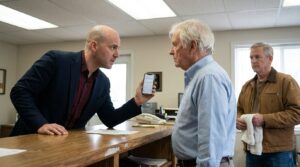
Preston Vance did not look up from the glass screen of his tablet. His index finger made short, precise swipes across the surface, illuminating a matrix of names, corporate table allocations, and military ranks. He spoke with the automatic, flat efficiency of a man who viewed human beings as obstacles to a clean spreadsheet. Around them, the lobby of the civic center smelled of expensive wool coats, floral arrangements, and rain tracking off the pavement outside.

Arthur Vance did not move. He kept his boots firmly planted on the edge of the plush burgundy carpet that marked the entrance to the main ceremonial hall. His hands were buried deep inside the pockets of his olive field jacket, his thumb steady against the cold, scarred edge of the brass lighter he kept tucked away. The fabric of his sleeves was stiff, clean, and faded to the exact shade of river moss. To the people passing him—the state representatives in tailored gray suits and the young junior officers whose shoulder boards caught the track lighting above—he was a gray fixture, an unpolished stone in a room full of glass.

“My name is on your list,” Arthur said. His voice was low, devoid of urgency, carrying the flat cadence of the midwestern plains.

Preston finally lifted his eyes. His gaze was diagnostic, taking in the frayed hem of Arthur’s collar, the lack of a laminate VIP pass, and the absolute lack of deference in the old man’s posture. Preston took a half-step forward, shortening the distance between them to use his height as a quiet leverage point.

“Sir, I run the entrance layout for the entire foundation,” Preston said, his voice rising just enough to turn the heads of a major general’s administrative staff waiting behind them. “If your name were on the registry, the digital terminal would have pinged when you cleared the exterior metal detector. It didn’t. This hall is reserved for registered dignitaries and honorees only. The public memorial is on the lower level near the concourse.”

The junior officers in the line behind them stopped talking. The silence grew outward from the velvet rope, cold and infectious. Arthur looked at Preston’s hands—the manicured nails, the pristine silver watch strap that shifted against a crisp white cuff. He didn’t see an enemy; he saw an unseasoned clerk who had never learned how to look at a man’s shoulders to measure his weight.

“Check the physical manifest,” Arthur said. He reached slowly into his interior breast pocket and pulled out a thick, legal-sized manila envelope. The paper was old, the edges reinforced with yellowing cloth tape. “The office in St. Louis sent the paperwork through the local liaison. It doesn’t use the code on your screen.”

Preston didn’t reach for the envelope. He let his tablet slide into the crook of his left elbow and tapped his communication headset twice. “Front gate security to the East entrance. We have a boundary issue with an unlisted individual blocking the VIP lane.”

The crowd shifted backward slightly, creating a five-foot crescent of clear tile around Arthur. No one spoke. A captain in dress whites adjusted his belt, his eyes fixed on the floor. Preston turned back to his screen, his posture rigid, completely dismissing the old man standing on the line. But when Arthur’s fingers uncurled from the manila envelope, a small, laminated plastic card slipped from the seam, fluttering face-down onto the glass screen of Preston’s digital terminal. It wasn’t an invite. It was a current-issue base clearance pass, but the name printed in red ink across the top did not belong to Arthur Vance.


CHAPTER 2: THE COLD CORNER

The plastic card hit the glass with a sharp, hollow click. It lay there, face-down, its modern barcode catching the harsh glare of the halogen track lighting above the registration desk. Preston Vance’s fingers froze a centimeter above his screen. The reflection of the red ink bled across the polished surface, cutting a clean, hard line through the digital grid of names.

Arthur did not lean forward to retrieve it. He stood perfectly still, his weight evenly distributed across the balls of his boots, his hands remaining deep within the pockets of his olive field jacket. Through the heavy cotton lining, his thumb traced the cold, metallic edge of his brass lighter. He timed Preston’s breathing. Four short, shallow inhalations before the young man’s shoulders locked into a rigid, defensive square.

Preston used the tip of his luxury pen to flip the card over. The movement was fast, a sharp twitch of irritation masked as clinical inspection. When the name face up registered, Preston’s jaw tightened, the muscles along his jawline flaring beneath his smooth skin.

“Where did you get this?” Preston’s voice dropped into a sharp whisper, the corporate hospitality completely stripped away. He glanced toward the major general’s staff waiting behind Arthur, his eyes flicking like a cornered animal evaluating lines of sight. “This is an active-duty command clearance for Sector Four. And the name isn’t yours.”

“I told you to look at the paperwork inside the envelope,” Arthur said. His voice remained a flat, low rumble, a blunt instrument against Preston’s rising panic. He didn’t blink. He watched the way Preston’s thumb twitched against the edge of his sleek tablet—a clear tell of an administrative operator whose system had just encountered an unresolvable error code.

“This card belongs to a Captain Donald Vance,” Preston muttered, his voice tightening as he leaned over the desk, attempting to obscure the card from the view of the junior officers behind them. “That’s an active procurement officer with the regional logistics division. This event is under strict federal oversight, sir. Carrying mismatched, high-level credentials into a secure perimeter isn’t just a scheduling conflict. It’s a breach.”

Arthur observed the sharp angles of the registration desk, the way the glass partition created a physical barrier designed to make the civilian feel small, processed, and subservient. He knew the geography of desks like this; they were built by institutions to shield small men from the consequences of their choices.

“Then call the captain,” Arthur said softly. “Ask him who gave it to him.”

Before Preston could answer, the heavy tread of rubber-soled boots echoed against the marble floor. Two security guards cut through the crescent of the waiting crowd. Their uniforms were crisp, dark charcoal gray, their duty belts heavy with nylon pouches, cuffs, and the black polymer grips of their sidearms. They didn’t look at Arthur’s face; they looked at his jacket, his hands, and the space between his feet, calculating the physical effort required to move an old man who looked like he had rooted himself into the floorboards.

“Mr. Vance,” the lead guard said, addressing Preston while keeping his eyes locked on Arthur’s right shoulder. “We have a boundary issue?”

“Anomalous credentials,” Preston said, his confidence returning the moment the gray uniforms flanked the desk. He tapped the laminated card with his pen. “The individual is presenting non-transferable active-duty clearance passes that do not match his civilian identification. Clear the lane, please. Take him to the holding alcove behind the press risers until we can verify the source of the duplication.”

The lead guard took a step forward, his hand rising in a standard, non-threatening gesture meant to guide a compliant body away from a public space. “Sir, let’s step out of the queue. Walk with us.”

Arthur didn’t shift his stance. He let his gaze drift from Preston to the guard’s hand, noting the tension in the officer’s forearm, the way the fingers hovered near the retaining strap of his holster. It was an entry-level tactical posture, full of unearned certainty. Arthur let his hands remain in his pockets, his posture loose but unyielding.

“The envelope,” Arthur said, his eyes returning to Preston, cutting through the young man’s administrative shield like a cold draft. “Open it. If you have the intellect to run this floor, you have the intellect to read a standard manifest. It takes thirty seconds. Your security team can wait thirty seconds.”

“The system doesn’t require manual overrides from unverified sources,” Preston snapped, his face flushing a dark, blotchy red beneath the track lights. He picked up the manila envelope by its corner, handling it as if it were contaminated linen, and tossed it into the plastic bin behind his chair. “We don’t read paper here. Everything is encrypted. Everything is logged. Your paperwork is thirty years out of date, and your pass belongs to a man who actually has a right to be in this room.”

Behind Arthur, the crowd remained suspended in a heavy, cautious silence. A young lieutenant colonel narrowed his eyes, his gaze shifting from the faded moss-green of Arthur’s field jacket to the old manila envelope sitting in Preston’s trash bin. The atmosphere in the lobby had changed; it was no longer an administrative delay. It was a calculated extraction in progress.

Arthur felt the lead guard’s fingers brush against the thick canvas of his right elbow—a subtle, testing pressure meant to gauge his resistance. Arthur didn’t pull away, nor did he lean into it. He simply lowered his center of gravity by a fraction of an inch, converting his lean, elderly frame into a dead weight that would require a public, unseemly struggle to dislodge.

“Thirty seconds, Preston,” Arthur repeated, his voice dropping an octave, carrying the distinct, gravelly resonance of an old officer who had spent decades commanding men through the roar of diesel engines and mortar fire. “Open the envelope, or look up from your screen and watch the door. Because the man who signed that digital pass is already parking his car.”

Preston’s hand froze over his headset button. The sharp click of the security guard’s radio cut through the quiet, a burst of static that made the receptionist at the adjacent counter flinch.

CHAPTER 3: THE COMPLIANCE TRAP

The radio static tore a jagged hole through the lobby’s quiet.

“East gate, hold status,” a voice clipped through the guard’s shoulder mic, thin and metallic. “Command escort is entering the lower rotunda. Clear the secondary transit lanes immediately.”

The lead guard’s fingers remained wrapped around Arthur’s right elbow, but the physical pressure shifted. The calculation had changed from an extraction to a positioning problem. Arthur didn’t pull away. He stood perfectly rigid, letting the guard feel the dense, unyielding mass of an old veteran who had anchored defensive perimeters against human waves in the Central Highlands.

“Step back,” a new voice cut across the registration counter.

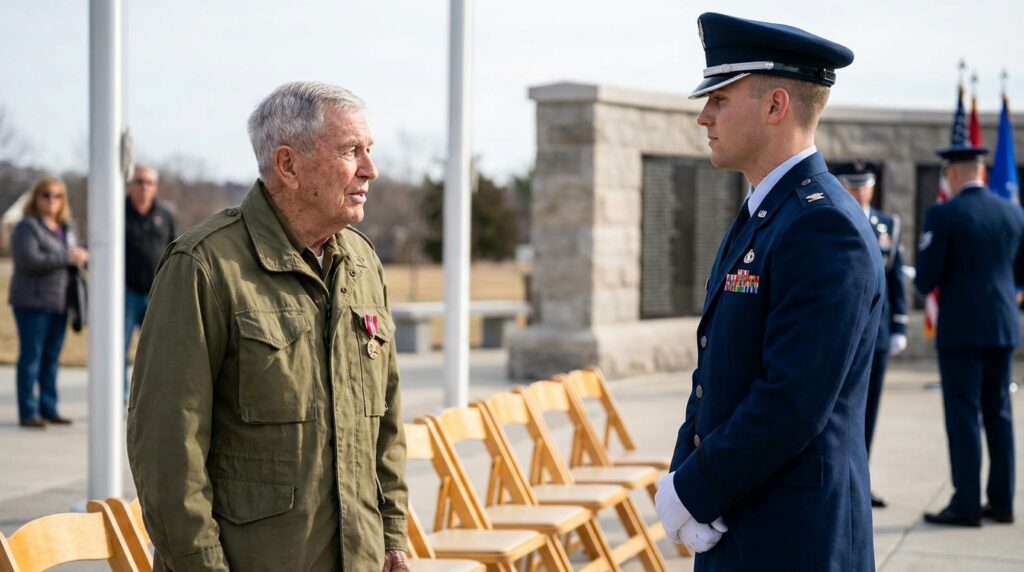
The Uniformed Service Member stepped through the security perimeter. His dark blue ceremonial dress uniform was immaculate, the white creases of his trousers falling in razor-sharp lines over highly polished leather shoes. His white-gloved hand extended across the counter space, his jaw set in a hard, geometric square that made Preston’s sharp-suited posture look fragile, almost brittle.

“Let me see the credential,” the service member ordered. He didn’t look at Preston; his eyes were fixed on the plastic bin where the yellowed manila envelope had been discarded.

Preston laughed nervously, a quick, defensive bark that failed to move the ice in the room. “Sergeant, this is a civilian registration matter. The individual has breached protocol by carrying a duplicated procurement pass under an assumed identity. Security is handles—”

“I didn’t ask for a narrative analysis, sir,” the sergeant said. His voice was a clean, clipped blade. “I asked for the credential.”

With a jerky, defensive movement, Preston reached into the bin and pulled out the old envelope, sliding it across the glass surface along with the laminated card belonging to Captain Donald Vance. The sergeant picked up the plastic card with his white gloves, his eyes tracking the micro-print along the margin. Then, with deliberate precision, he turned the manila envelope over.

Along the bottom edge of the old paper, beneath decades of grime and storage dust, was a faint, purple ink stamp from a long-disbanded supply depot in Da Nang. Below it sat a jagged ink signature, faded to a dull charcoal gray. The sergeant’s left hand rose automatically to his chest, his fingers tightening against the seam of his tunic as his eyes darted from the old ink to the weathered face of Arthur Vance.

“Sir,” the sergeant said, his voice dropping into a register reserved for high-stakes operational briefings. “This pass is flagged as a placeholder entry code within the active logistics network. It was generated by Captain Donald Vance’s office forty-eight hours ago.”

“Exactly,” Preston said, leaning forward, his tablet raised like a shield. “It’s a placeholder code for a fraud detection sweep. The system flagged it because it doesn’t map to a living civilian profile in the current database. He used a dead code to bypass the outer ring.”

Arthur remained motionless, his thumb still tracing the flat brass edge of the lighter in his pocket. He watched Preston build his trap, piece by piece, using the rigid logic of a machine that only knew how to read binary inputs. The young man was smart, but he was operating within a closed loop. He had no concept of the reality that existed before the software was written.

“The code isn’t dead,” Arthur said softly. “It’s archived.”

“It’s an unauthorized duplication,” Preston countered, his finger tapping the screen to finalize the security log. “The regulations state that any unverified paper manifest carrying military markers without an accompanying federal cryptographic key is to be treated as a counterfeit threat. Sergeant, instruct your guards to remove him before the general’s vehicle clears the interior checkpoint.”

The sergeant did not move toward Arthur. Instead, he gripped the edges of the manila envelope and pulled. The old yellow paper tore with a dry, sharp hiss, revealing a stack of dense, carbon-copy sheets packed inside—sheets with green borders and typed text blocks that had never been scanned into a modern server. Stuck to the very first sheet was a secondary, unlisted security card with a magnetic strip that had been obsolete since 1994.

“What is that?” Preston asked, his brow furrowing as he leaned over the partition to see the physical contents. “That’s not in the system map.”

“It wouldn’t be,” Arthur said, his eyes locking onto Preston’s with a cold, diagnostic certainty. “The system you’re using was built by contractors who weren’t born when these orders were drafted. That pass doesn’t open your doors, Preston. It locks them.”

The sergeant ignored Preston entirely. He flipped to the back page of the carbon copies, his white-gloved thumb resting on a line of dark text that read: Operational Manifest 71-Delta: Special Procurement and Extraction. The signature at the bottom was identical to the purple ink stamp on the outside, but here, the ink was raised, pressed into the paper with the heavy hand of a man signing a warrant for human lives.

A sharp chime echoed from Preston’s tablet, followed by a double-pulse vibration that rattled the glass counter. The screen went dark, replaced by a single, flashing crimson bar: PERIMETER LOCK – COMMAND LEVEL INTERVENTION.

Preston stared at the screen, his fingers hovering over the dead keys. “The terminal just dropped offline. Sergeant, what did your unit just queue into the local network?”

The sergeant didn’t answer. He carefully folded the carbon copies back into the ruined envelope, stepped around the velvet rope, and positioned his athletic frame exactly one pace behind Arthur’s right shoulder, effectively turning himself into a formal military escort.

“The lane is frozen,” the sergeant announced to the waiting line of officers behind them. His voice left no room for negotiation or administrative appeal. “All registrations are suspended by order of the installation commander.”

Preston looked up, his face pale under the track lights, realizing for the first time that the security guards were no longer looking at Arthur—they were looking at him.

CHAPTER 4: THE SHIFTING LINE

The rhythmic click of leather heels against polished stone rose from the glass-walled concourse. Preston Vance did not move his fingers from his frozen tablet; he stayed locked in a fixed lean, his eyes tracking a three-man detail cutting through the wide-open expanse of the lower rotunda.

At the center of the detail walked an active-duty lieutenant general. His service dress coat was pinned with rows of ribbons that caught the cold vertical down-lights of the atrium, but he carried himself without the stiff, rehearsed grandeur of the political brass Arthur had spent forty years avoiding. He walked with a heavy, left-sided hitch—a limp earned on iron soil, not behind an office desk. In his right hand, the general gripped a scuffed leather document case, its brass security latch conspicuously missing its lower hinge pin.

Arthur didn’t turn around to watch the approach. He kept his eyes on Preston’s hands, tracking the precise moment the young man’s fingers began to sweat against the synthetic casing of his sleek device. Arthur knew the general’s stride before he heard the voice. He knew the timing of the boots on stone.

“Report status on the perimeter lock,” the general said. He did not yell. He spoke with the quiet, devastating clarity of a man who assumed every wall in the building was listening to his command frequency. He stopped exactly two paces from the velvet rope, his eyes skipping past the security team, past the line of waiting junior staff, and stopping directly on the faded olive sleeve of Arthur’s jacket.

Preston cleared his throat twice, his bureaucratic shield dissolving into a frantic search for vocabulary. “General Miller, sir. We have a registration discrepancy. The digital interface flagged a high-level procurement credential carried by an unlisted civilian. We applied the baseline security protocol to isolate the boundary threat—”

“The software didn’t lock this room, son,” General Miller interrupted. He took a single step closer to the desk, placing the leather document case on the glass partition with a heavy, solid thud that made the tablet rattle. “I did. From the vehicle console five minutes ago.”

The sergeant in white gloves stepped forward, his posture hitting a perfect ninety-degree snap as he presented the torn manila envelope. “The documents from the St. Louis archive are verified, General. The physical manifest matches the historical logistics log for Sector Four. The signature lines are clear.”

Preston’s eyes darted between the general and the torn paper, his logic loop failing to find an exit path. “Sir, with respect, the regulations on modern data integration are absolute. If we allow paper overrides from unverified personnel without a current cryptographic profile, the entire foundational event loses its compliance certification. I am simply enforcing the administrative parameters established by the board.”

“The board didn’t sign the field orders that pulled my father’s battalion out of the valley near the border in seventy-one,” Miller said. His voice remained conversational, but the sharp edges of his gaze locked onto Preston’s face until the younger man shifted his eyes back to the floor. “And the man who did sign those orders doesn’t need a cryptographic key from your company.”

Arthur finally pulled his right hand out of his pocket. His fingers were dry, holding the scuffed brass lighter by its flat edge. He placed it next to the general’s leather case on the counter. The metal-on-glass click sounded exactly like the plastic card had two chapters earlier, but the weight of the sound was entirely different.

“You’re late, Thomas,” Arthur said simply.

The line of junior officers behind Arthur went rigid. A captain near the back actually took a half-step away from the rope, his face settling into an expression of profound, professional shock. To address a three-star commander by his first name without a title was an institutional sin that usually ended a career before the afternoon briefing.

General Miller looked down at the brass lighter, his mouth tightening into a thin, grim line. He didn’t offer a handshake; he didn’t lower himself to a public display of sentiment for the benefit of the room. He picked up the lighter, turned it over once to check the stamped serial number on the base, and slid it into his own pocket.

“The transit from the airfield was delayed by civilian traffic,” Miller replied, turning back to Preston. “Open the gate lane. Now.”

Preston’s hand shook as he reached for the manual release override beneath the counter lip. “Sir, the name on the digital placeholder card… it still points to Captain Donald Vance. If the security log reflects a mismatched entry, the audit trail—”

“The audit trail is closed,” Miller said, his voice dropping into the cold register that signaled a permanent operational decision. “Captain Vance is the logistics officer who pulled this specific file from the secure vault on my authority. The card was issued to ensure Arthur Vance could pass through the automated exterior gates without being forced to explain fifty-five years of unclassified history to a machine. But it seems the machine isn’t the problem here.”

The velvet rope dropped with a loose, soft thud against the carpet. The path into the main hall was clear, the long rows of aligned ceremonial chairs visible through the tall double doors just twenty feet away. The light inside the hall was softer, amber, completely detached from the cold halogen glare of the registration lobby.

Arthur stepped across the perimeter line, his faded boots leaving a faint trace of damp street dust on the plush burgundy rug. He didn’t look back at Preston, nor did he look at the security guards who had spent the last ten minutes calculating his removal. He walked with his head up, his frame upright, moving with the slow, measured pace of a man who had already survived the worst things the world could throw at him.

But as General Miller picked up the leather case to follow, the scuffed leather flap shifted, revealing a small, typed label pasted inside the inner pocket—a label bearing an official security designation that Arthur’s peripheral vision caught instantly. It didn’t say Department of the Army. It said Defense Intelligence Agency – Retraction Bureau.

Arthur’s stride didn’t break, but his fingers tightened against the empty fabric inside his pocket. The decoy of a simple historical medal presentation had just collapsed, leaving a deeper, colder structure visible beneath the ceremony.

CHAPTER 5: THE REVERBERATION CHAMBER

The amber light inside the main ceremonial hall didn’t warm the air; it only made the shadows between the rows of chairs look deeper. Arthur Vance kept his eyes focused on the center aisle, tracking the polished grain of the oak floorboards. Behind him, the double doors clicked shut with a heavy, magnetic thud, sealing out the lobby’s ambient noise. The absolute stillness of the room felt structural, an artificial vacuum designed to deaden the sound of incoming boots.

He walked toward the front row, his movements measured, his left hand slipped loosely back into his field jacket pocket. He no longer had his brass lighter to ground him, but his mind had already shifted into a cold, diagnostic assessment of the room’s geometry. Six aligned chairs on the raised platform. A single brass microphone stand. To his left, General Miller’s limp created an asymmetrical rhythm against the floorboards—two light steps, one heavy drag.

“The seats are cleared, Arthur,” Miller said, passing him to take a position near the lower step of the stage. He dropped his scuffed leather document case onto a small side table. The flap swung slightly open, the white adhesive edge of the intelligence agency label catching the sharp amber down-light. “We didn’t bring the public in for this part. The foundation wanted an audience, but I truncated the schedule.”

Arthur stopped at the edge of the platform. He didn’t look at the stage; he looked at the leather case. “You didn’t truncate it for the foundation, Thomas. You truncated it because the manifest I carried from St. Louis isn’t a historical archive. It’s an active ledger.”

Miller didn’t deny it. He stood perfectly square, his lined face catching the hard side-lighting from the wings. “The ledger became active the second Donald Vance opened the vault forty-eight hours ago. The board members outside think this is a routine correction for a clerical oversight from nineteen-seventy-one. They want a clean photo, a handshake, and a signed release for their endowment archives.”

“But Donald didn’t find a clerical oversight,” Arthur stated, his voice flat, a low vibration in the empty hall. “He found the extraction logs from the border post. The ones that list thirty-four names that never appeared on the official casualty rolls.”

The young Uniformed Service Member stepped onto the carpeted platform from the left wing, carrying a small, velvet-lined presentation box. His white gloves were spotless, but his fingers held the edges of the box with an intense, calculated grip that didn’t match the rehearsed ease of a standard military escort. As he set the box down on the small table next to the microphone, the metallic contents shifted with a dry, heavy rattle—a sound that lacked the distinct ring of solid silver.

Arthur’s eyes narrowed slightly, tracking the specific weight of that rattle. He had handled enough field ordnance and survival gear to know the density of standard-issue decorations. The object in that box was too heavy; it had an added mass beneath the pinned ribbons.

“The presentation is ready, General,” the sergeant said. His voice was steady, but his eyes didn’t make contact with Arthur’s face. He kept his gaze fixed precisely one inch above Arthur’s left shoulder, hitting a rigid, artificial stance that felt less like tradition and more like a tactical hold.

“Preston is still outside trying to trace the digital loop,” Arthur said, turning his head slowly toward Miller. “He thinks I’m a security breach. But his software didn’t lock the terminal because the name was mismatched. It locked because the system detected a document signature that still holds active command authorization over the supply lines in Sector Four. My signature.”

Miller reached into his pocket and pulled out Arthur’s brass lighter, setting it down next to the presentation box. The metal clicked against the wood, a sharp, clean sound that seemed to draw the final boundary line across the scene.

“The authority doesn’t exist on paper anymore, Arthur,” Miller said softly, his voice dropping into a guarded, transactional cadence. “The extraction post was buried under three tons of concrete in seventy-three. But the logic of the orders remains. The agency needs the original manifest you carried today. They need the physical carbon copies with your ink signature to finalize the redaction files. That’s the price for the medal.”

Arthur looked at the sergeant, then back at Miller. The chess board was fully visible now. The public humiliation at the velvet rope hadn’t been an accident of civilian arrogance; it had been the first layer of an administrative filtration system. If he had broken under Preston’s pressure, if he had left the envelope behind or allowed security to escort him to the holding alcove, the physical records would have been isolated without a three-star general ever having to enter the room.

“You didn’t come here to honor the battalion, Thomas,” Arthur said, his hand tightening into a fist inside his empty pocket. His voice was a cold draft through the quiet room. “You came to buy the signature back before the logistics office realizes what Donald actually pulled from the vault.”

The sergeant took a half-step closer to the presentation box, his white-gloved fingers resting just an inch above the velvet edge, his weight shifting forward as the silence in the hall turned thick and absolute.

CHAPTER 6: THE RETRACTED FORCE

The sergeant’s hand suspended over the velvet presentation box did not shake, but the weave of his white glove stretched taut against his knuckles. The silence inside the hall had expanded until it possessed a heavy, physical density—the kind of stillness that precedes a kinetic breach.

Arthur looked down at the velvet bed. The service medal sat pinned to its backing, but the silver star at its center caught the amber down-lights with an unnatural, flat refraction. It was too thick by half. Within the small, hollow space between the silver face and the mounting clasp lay a microscopic storage cell—the digital kill-switch for the remaining unredacted databases of Sector Four.

“The signature isn’t for sale, Thomas,” Arthur said. His voice was very low, an unhurried drawl that cut through the vacuum of the room with the steady scrape of iron over stone. He didn’t look up at General Miller’s chest ribbons; he kept his eyes on the leather case on the side table, tracking the broken line where the missing lower hinge pin had left the raw internal lining exposed.

General Miller took a slow, deliberate breath, his shoulders shifting beneath the weighted epaulets of his service dress uniform. The left-sided hitch of his posture became more pronounced as he stepped closer to the microphone stand, his leather boots dragging across the floorboards with a dull friction.

“If the carbon files leave this building, Arthur, the names on that manifest will enter the public record within twelve hours,” Miller said, his voice dropping into a tight, diagnostic whisper that barely cleared the edge of the stage. “The logistics network will reconstruct the entire transit chain from seventy-one. They will trace the destination coordinates for those thirty-four men. You think you’re protecting a legacy, but you’re opening a vault that was meant to stay beneath the concrete.”

“I’m keeping the books straight,” Arthur replied. He reached forward with a slow, mechanical precision, ignoring the sergeant’s sudden defensive shift. His weathered fingers didn’t touch the heavy medal; instead, he reached past the velvet box, his hand closing around the old, torn manila envelope containing the carbon sheets. The paper felt stiff, cold, and heavy with the dust of the St. Louis archive. “The families of those men were told the records were lost in a warehouse fire. They weren’t lost. They were archived under an assumed procurement index so your foundation could draw funding from the recovery appropriations.”

The sergeant did not strike. He stood locked in his ninety-degree snap, but his eyes flicked toward Miller, waiting for the silent drop of a wrist or a tilt of the chin that would signal an intervention. Arthur observed the distance between them—exactly forty-four inches. He knew the timing required for a white-gloved hand to cover that space. He had spent his youth training men to close distances faster than a trigger could reset.

“The signature stays on the manifest, Thomas,” Arthur said, sliding the heavy packet into the deep internal breast pocket of his olive field jacket. The stiff canvas flattened against his chest, a solid, protective shield over the raw ink of 1971. “And your agency can keep the silver.”

Miller did not command the guards. He stood perfectly still by the side table, his hand resting near Arthur’s old brass lighter. The lines around his eyes looked deeper under the amber side-lighting, the stark, sharp illumination exposing the tactical exhaustion of a man who had spent his career managing secrets that had already outlived their operational utility.

“You won’t clear the exterior gate layout, Arthur,” Miller said, his voice devoid of anger, settling into a flat, professional assessment. “Preston has already initiated the system-wide audit code. The moment you step back onto the perimeter rug, the civilian security network will flag the manual entry override as an unverified security breach. They don’t need my authorization to lock the outer turnstiles.”

“They won’t lock them,” Arthur said, his voice flat and unyielding as he turned toward the center aisle. He adjusted the collar of his faded moss-green jacket, the rough fabric scraping against his lined jaw. “Because Donald Vance didn’t just pull the file for me. He pulled the server logs for the regional logistics division. He knows exactly who signed the electronic release for the foundation’s endowment last month. If the gate doesn’t clear when my boots hit the tile, the procurement audit goes to the federal oversight committee before the general’s staff finishes their lunch.”

The silence returned, absolute and unpunished. Miller did not call out. The sergeant stayed on the platform, his white gloves dropping back to his sides as Arthur turned his back on the stage, the aligned ceremonial chairs remaining empty and silent in his wake.

Arthur walked down the center floorboards, his boots making a steady, rhythmic click that echoed into the rafters of the empty hall. He didn’t look at the walls; he didn’t look at the high, polished glass of the upper view-galleries. He focused entirely on the heavy double doors at the far end of the transit lane.

When he pushed the brass handles outward, the cold, halogen glare of the registration lobby hit him like a physical draft. Preston Vance was still standing behind the glass partition, his fingers frozen over a dead terminal screen, his face entirely pale as the automated velvet ropes parted smoothly before Arthur’s advance. The security guards in charcoal gray uniforms stepped back into the shadows of the concrete pillars, their hands remaining clear of their duty belts, their eyes tracking the slow, upright stride of the old man in the faded olive jacket.

Arthur did not look at them as he cleared the exterior threshold. He stepped out into the rain, his fingers dipping into his pocket to touch the empty space where his lighter used to sit, his face settling into the cold, diagnostic calm of a commander who had just held the line one final time.

Similar Posts

Leave a Reply

Your email address will not be published. Required fields are marked *