
The Ironing of the Earth: A Chronicle of the Forgotten Line
CHAPTER 1: THE WEIGHT OF THE UNIFORM
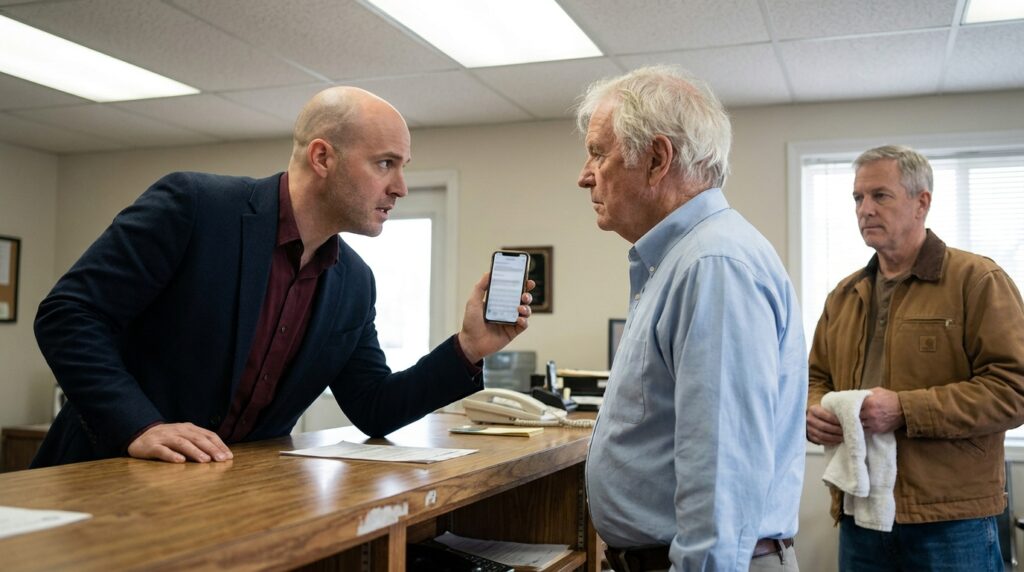
“You’re taking up space where real men should be sitting, old man.” The words didn’t travel; they dropped heavily onto the Formica table like a wet handful of gravel.
Caleb did not blink. He kept his eyes fixed on the ceramic rim of his mug, where the dark, bitter pool of roadside coffee had gone completely still. Outside, the midday heat was baking the state highway into a desaturated ribbon of melting asphalt, but inside the booth, the air smelled exclusively of burnt fat, old vinyl, and the sharp, sour tang of young iron.
The man leaning across the table was wide—built from the kind of heavy, low-rent muscle that came from tossing dry-wall sheets and drinking cheap domestic lager after five o’clock. His dark overshirt was unbuttoned at the cuffs, revealing wrists thick with grease-stained hair. He was leaning far enough forward that Caleb could smell the peppermint tobacco rotting on his breath.
“I asked you a question,” the boy said, his index finger coming down with a dull thud against the laminated wood, right beside Caleb’s thumb. “The cap. You think because you found it in a surplus bin it gives you the right to sit here during the noon rush while people with actual work to do are waiting for a seat?”
In the next booth, the boy’s companion—shorter, wearing a brown jacket that looked too warm for July—shifted his weight. The legs of his chrome chair gave a brief, metallic screech against the grit on the tile floor. “Leave it, Wayne,” the friend muttered, his eyes darting toward the grease-filmed window. “The ham loaf’s coming out anyway.”
“No,” Wayne said, his voice dropping into that rhythmic, rhythmic register of a man who had decided his own grievance was a form of public service. “I’m tired of looking at ’em. Sitting around on the county’s dime. Acting like they own the air.”
Caleb finally raised his head. The movement was slow, a deliberate pivoting of the neck that felt like the shifting of an old iron gate on ungreased hinges. His spine, however, did not slump. Beneath the faded green cotton of his jacket—a coat that had lost its tracking numbers before Wayne’s father had gone to his first prom—Caleb’s shoulders remained square, set at a precise ninety-degree angle to the edge of the booth.
He reached out. His hand was spotted with liver marks, the skin over the knuckles as thin and dry as parchment paper, but when he pointed his own index finger back at Wayne, the hand did not shake. The tip of his finger stopped exactly one inch from the bridge of the young man’s nose.
“You may laugh now,” Caleb said. His voice wasn’t loud—it had the dry, whistling quality of wind moving through a rusted culvert—but it carried a flat, command-level weight that made the waitress behind the counter freeze with her glass pot suspended over a saucer. “But you’ll regret judging too quickly.”
Wayne’s mouth twitched, his face darkening with the sudden, ugly heat of a bully whose target hadn’t shrunk. He began to straighten, his shoulders bunching beneath the dark overshirt, his hand clenching into a mallet of bone and calloused skin. “What did you say to me, you old—”
“That’s enough.”
The voice came from the aisle, heavy and deadened by the institutional authority of thirty years on the county payroll. A thick hand, clad in the long-sleeved dark wool of the sheriff’s department, came down firmly on Wayne’s shoulder. The fabric of the deputy’s sleeve was stiff, the metal star pinned to the chest catching the yellow glare of the overhead fluorescent tube. Sheriff Miller didn’t look at Wayne; his eyes, small and gray under his cropped hair, were fixed entirely on Caleb.
“Show the man the respect he deserves, Wayne,” Miller said. The command was dry, delivered without any anger, which made it twice as absolute. “Get your coat and get out to the truck.”
Wayne’s posture broke. The sudden influx of institutional weight seemed to drain the oil from his joints. His hand dropped from the table, his eyes darting from the star on Miller’s chest to the steady, unblinking glare of the old man in the green jacket. “Sheriff,” he stammered, “he was just—”
“I know what he was doing,” Miller said, his thumb hooking into his leather utility belt, right above the heavy walnut grip of his sidearm. “And I know who he is. Move.”
The silence in the diner was total now, save for the rhythmic, dry tick-clack of the pocket watch inside Caleb’s breast pocket—a sound that caught on every third beat with a faint, metallic scrape. Wayne muttered something low into his collar—a submissive, “Understood, sir”—before turning on his heel and pushing through the screen door, his friend trailing behind like dust in a wake.
Sheriff Miller waited until the screen door slapped shut twice against the frame. Then, with a slow, heavy deliberation, he turned back to the booth. He didn’t offer a smile. He simply reached up, his fingers touching the brim of his campaign hat in a gesture that was less a greeting and more a formal recognition of rank.
“The quarry road’s washed out near the culvert, Commander,” Miller said, his voice dropping so the waitress couldn’t hear. “But that’s not why I’m here. They found the lock on the gate broken this morning. The old lock. The one you kept the key for.”
Caleb’s hand went slowly to his breast pocket, his fingers closing around the cold, heavy shape of the brass watch that had long since stopped telling the correct time.

CHAPTER 2: THE CORROSION OF SACRIFICE
The passenger side door of the truck didn’t close so much as it jammed into the frame, requiring three hard shoves with the heel of Caleb’s hand to make the latch catch. The metal was pitted with red scale, flaking off in dry wafers onto the parched earth of the diner’s parking lot. Sheriff Miller didn’t offer to help. He simply watched from the cab of his cruiser, his engine idling with a low, hydraulic thrum that vibrated through the floorboards of Caleb’s ancient Ford.
Caleb turned the key. The starter ground itself against the flywheel for four agonizing seconds before the inline-six caught, coughing up a blue plume of unburnt oil into the midday haze. He shifted into first, the transmission linkage loose and grinding like a bucket of bolts, and pulled out onto the gravel lane.
The three miles back to his homestead were defined by the glare. The ditch-weed along the shoulder was gray with dust from the limestone quarry, its leaves choked and heavy. For thirty years, Caleb had watched this county dry out, the topsoil blowing east until nothing remained but the jagged white teeth of the gravel pits and the people too stubborn to die. Wayne had been right about one thing—space was running out. But the boy didn’t understand that the land had been dead long before he was old enough to hold a shovel.
When the truck cleared the final rise before the creek bed, Caleb tapped the brakes. The pedal felt spongy, sinking nearly to the floorboards before the pads caught the rusted drums.
His mailbox—a dented steel tunnel mounted on a cedar post—was leaning at an unnatural angle. The galvanized door had been pried open with a crowbar, the metal lip twisted upward like a broken tooth. Inside, there were no letters, only a handful of dry dirt and three dead cicada husks that had curled up in the heat.
Caleb climbed down from the cab. His knees gave off a dry, popping sound that mirrored the ticking of the brass watch in his pocket. He didn’t look at the road; he looked at the ground. Two sets of heavy-lugged boot prints had torn into the dry grass around the post, the tread marks sharp enough to indicate recent business. Not Wayne. Wayne wore smooth-soled work boots with steel toes. These were deeper, heavy-rimmed tactical treads—the kind issued to the state transport police or county deputies.
He stood by the ruined mailbox, the sun beating down on his beige cap until the heat began to soak through the fabric into his scalp. His thumb traced the edge of the twisted metal door.
Inside his breast pocket, the brass watch gave one final, violent click and fell completely silent. The mainspring had snapped. He could feel the lack of its vibration through his shirt, a sudden absence of weight that felt like a localized drop in air pressure.
Caleb reached up and pulled his cap off. The white hair beneath was damp with sweat, clinging to his temples in thin, silver strands. He turned the cap over in his large, scarred hands. The faded green cloth of his jacket scraped against the stiff canvas of the brim.
He had worn this cap since the year the depot closed. It was a standard-issue logistics piece, unadorned except for the grease stains around the crown. But as his thumb drifted over the inner sweatband, his calloused skin caught on something rigid.
The stitching along the rear seam was thick, done with black nylon thread that didn’t match the original factory assembly. Someone had used a heavy glover’s needle to close an emergency seam. Caleb brought the cap closer to his face, the smell of old sweat and copper filings filling his nose.
Through a small tear where the thread had frayed against his skull, a dull sliver of metal gleamed. It wasn’t iron. It didn’t have the rust. It was silver—tarnished, soft, and shaped like the bit of an old cabinet key.
He didn’t pull it out. He didn’t have to. His fingers knew the weight of it through the lining, the three small ridges near the shoulder that identified it as a Master-Key for the subterranean ventilation grids at the northern edge of the ridge. The keys hadn’t been collected when the military turned the surface acres over to the county council in ’89. They had simply forgotten they existed, buried under thirty years of municipal deeds and land-use waivers.
A crow called out from the skeletal branches of a dead elm near the barn, its voice flat and dry.
Caleb looked up toward the limestone quarry three miles to the north. A pale cloud of dust hung over the horizon, never quite settling, like smoke from a fire that had gone underground. Miller had said the lock was broken. The old lock. The one that sat on the iron hatch behind the crusher shed, where the concrete reinforced walls went three stories deep into the shale.
He put the cap back on his head, pulling the brim low until his eyes were lost in the shadow of the canvas. The silence of the dead watch against his chest was louder than the engine of his truck had been. He walked back to the cab, his boots sinking into the loose gravel of his own driveway, his mind calculating the distance between the sheriff’s warning and the tracks by the mail post. The chess board hadn’t changed, but someone had changed the rules while he was sitting in the diner.
He shifted the truck into reverse, the gears groaning in protest as he backed out into the heat.
CHAPTER 3: THE PIT AT NORTHERN RIDGE
The headlights of the Ford cut through the chalky dark like yellow teeth, catching the suspended particulate that never truly left the air above the quarry. Caleb cut the ignition fifty yards from the primary gate, letting the truck roll to a halt against a bank of crushed stone. The cooling manifold gave off a series of sharp, rhythmic pings that sounded exactly like the watch he had left on his kitchen table—dead metal counting down nothing.
He didn’t use a flashlight. He knew the limestone shelf by the tilt of his boots against the aggregate, his ankles absorbing the uneven pitch of a grade he had mapped with a transit three decades ago. The perimeter fence was chain-link, six feet of heavy-gauge wire coated in zinc that had long since gone dull and white from the lime dust. Where the main gate met the corner post, the heavy log-chain had been dropped to the dirt, its links unlinked not by bolt cutters, but by a key.
Caleb knelt. The gravel bit through the thin denim of his trousers, the cold moisture of the midnight earth soaking through to his skin. He lifted the end of the chain. The iron was heavy, oily to the touch, and unrusted inside the loop where the padlock had lived. A fresh smear of lithium grease clung to the pin of the staple. It was clean work. Professional. The kind of maintenance that happened under a work order, not an act of vandalism.
“You always did like the dark, Caleb.”
The voice came from behind the stone crusher—a massive, skeletal superstructure of iron shoots and conveyor belts that cast a jagged shadow across the basin floor. Sheriff Miller stepped into the faint wash of the moon, his uniform jacket open, his hands tucked loosely into his front pockets near the leather of his belt. The gray hair at his temples looked like salt under the dim sky.
Caleb did not stand immediately. He let the heavy iron chain drop back into the dust with a dry, muffled clink. When he did rise, his joints made a hollow clicking sound, his shoulders setting into that rigid, straight line that had defined his years before the retirement board took his commission.
“The gate wasn’t pried,” Caleb said, his voice flat as a surveyor’s level. “Someone had the brass four-tumbler pattern. There are only two of those left in the county pool.”
Miller didn’t deny it. He walked toward the edge of the pit, his boots crunching rhythmically against the stone. He stopped ten feet away, looking down into the deep, terraced bowl where the limestone had been carved out in concentric rings. At the very bottom, three hundred feet down, the surface water collected in a dark, opaque pool that smelled faintly of sulfur and burnt rubber.
“The state inspectors are coming down from the capital on Tuesday,” Miller said quietly. His jaw line looked tight, the skin pulled hard against the bone. “They aren’t looking for missing gravel, Caleb. They have deep-core rigs. They’re drilling the northern seam, right under the old civil defense grid.”
Caleb shifted his weight, his fingers instinctively tightening against the canvas brim of the cap in his coat pocket. “The grid was sealed under the ’89 hand-over. The logs were archived at the district office.”
“The logs are gone,” Miller countered, turning his head just enough to catch Caleb’s profile in the dark. “They were cleared out during the municipal merger five years ago. But the concrete down there isn’t holding. The limestone is porous, Caleb. You knew that when the company laid the first blasting charge. Every gallon of runoff from the valley floor is draining straight through the lower vault.”
A draft of cold air moved up from the floor of the pit, carrying the thick, sweet odor of chemical rot. Caleb’s mind moved with the cold, calculating precision of a logistics officer checking a manifest. The decoy was already failing. The broken lock wasn’t an intrusion; it was an extraction. Someone had realized that the silver key in his possession didn’t open a forgotten military storeroom—it unlocked the accountability trail for forty thousand tons of industrial solvent that had kept the county’s banks solvent during the lean years of the embargo.
“Wayne and his boys don’t know what they’re digging into,” Caleb said, his words dropping into the space between them like lead shot. “They think it’s a land dispute. They think the old man is just an obstacle.”
“Wayne’s a fool,” Miller said, and for the first time, a sharp edge of exhaustion clipped his tone. “He thinks muscle can protect a fence line. But the people behind the bid—the ones who bought the quarry lease from the county council—they know exactly what’s under the shale. And they know who signed the variance that allowed the storage cells to be built without a clay liner.”
Caleb took a step forward, his boots catching on a loose piece of flint. The sound was a sharp crack that echoed down the terraced walls of the pit. The strategic pursuit was no longer about keeping a secret; it was about containing the perimeter before the rot reached the well-heads.
“The key is still where it belongs,” Caleb said.
“It won’t matter by Tuesday,” Miller replied, his hand moving slowly toward his pocket, his fingers extracting a small, square ledger bound in black oilcloth—the missing log from the crusher station. “They didn’t find the key, Caleb. But they found the delivery receipts from ’92. Your name is on every manifest from the rail-head.”
The paradigm shifted beneath Caleb’s boots like shifting shale. The sheriff wasn’t here to protect the town’s legacy from outside developers; he was securing the evidence before the state transport police set up their barricades. The long, gray road of the veteran’s life hadn’t led back to an honorable peace—it had led back to the trench he had helped dig.
Before he could speak, the high-pitched whine of an old alternator cut through the dark from the access road behind them. Headlights—high, wide, and unaligned—bounced violently against the aggregate as a second vehicle cleared the ridge speed-trap, moving fast toward the open gate.
CHAPTER 4: THE SUBTERRANEAN LEGACY
The high beams swept across the white quarry rim, turning the airborne dust into a blinding wall of chalk. The vehicle—a beat-up dual-axle rig with its muffler scraped completely off—fishtailed through the gate, the tires flinging gray aggregate against the side of the crusher shed. Through the grease-smeared windshield, Caleb saw the wide, bulked silhouette of Wayne. The boy hadn’t gone home; he had gone back to the job site to fetch the heavy tools.
“Miller!” Wayne shouted over the roar of the unbaffled engine, killing the headlights but leaving the truck idling hard. He swung down from the cab, an iron pry-bar balanced across his shoulder like a mechanical rifle. Behind him, two more men stepped into the dim moonlight, their faces shadowed by grease caps. “We saw the lights from the highway. We thought someone was tampering with the machinery.”
Wayne stopped ten feet from the concrete pad where Caleb and the sheriff stood. His eyes drifted down to the black oilcloth ledger in Miller’s hand, then to Caleb’s faded green jacket. His jaw bunched. “You’re still here, old man. Still digging around where you don’t belong.”
Caleb did not answer with words. He reached into his coat pocket, pulled out the canvas cap, and with a swift, clean stroke of his pocket knife, sliced through the coarse black nylon thread inside the sweatband. The tarnished silver key dropped into his calloused palm with a faint, metallic clink. He held it out, not to Wayne, but toward the heavy steel hatch set flush into the concrete foundation of the crusher shed.
“Wayne,” Miller said, his voice dropping into that heavy, tired register of a man who had reached the end of his county script. “Get your men back in the truck. You don’t know the parameters of this site.”
“I know the county leased the quarry to a development firm out of the capital last month,” Wayne spat, his index finger pointing aggressively at the concrete under their boots. “And I know our crew was slated to clear the lower levels until the county office locked the gates. We’re losing thirty dollars an hour sitting on our hands while this old ghost walks the property.”
Caleb stepped past the sheriff, his boots striking the concrete pad with an impossibly straight, military cadence. The physical weight of his years seemed to compress into raw momentum. He knelt by the circular iron hatch, ignoring the pain that shot up his knees from the cold stone. The key fit the ancient cylinder without a single catch, the internal tumblers turning with a heavy, wet click that had been greased by thirty years of stagnation.
He hauled the hatch open.
A vertical shaft dropped into the dark, the rungs of a rusted iron ladder disappearing into a subterranean vault that vibrated with a low, hydraulic hum. The air that rushed up from the hole was thick and sweet, laced with the sharp, acidic stench of deteriorated chemicals and wet, toxic shale. It was the smell of the ’92 manifest—the secret that had kept the town’s grain elevators running and the local banks from foreclosing during the long drought.
Wayne walked over, his arrogant stride faltering as the chemical vapor hit his face. He looked down into the darkness, the pry-bar lowering until the tip dragged against the gravel. “What is this? This isn’t on the quarry blueprints.”
“It’s the foundation of this valley,” Caleb said. He stood up, his spine perfectly rigid, his shadow casting a long, dark line across the open hatchway. “Every road you drove on, every school roof the county repaired when you were a boy—it was paid for by the content of those lower vaults. I signed the authorization sheets. The town was dying, Wayne. I traded the deep soil for thirty years of survival.”
The young contractor looked from the hole to Caleb, his face losing its aggressive heat, replaced by the sudden, blank shock of a man who had realized the floor he stood on was entirely hollow. The equal intellect of the landscape had asserted itself; there was no simple villain to fight, no external enemy to evict with an iron bar. The rot belonged to the town’s protector.
Miller stepped up to the edge of the shaft, holding the oilcloth ledger out like a piece of dead weight. “The state inspectors aren’t coming to audit the gravel company, Wayne. They’re coming to condemn the well-water for three counties. The seals in the lower sector started weeping through the limestone last winter.”
The silence that blanketed the pit was total now, save for the low, rhythmic thrum of the underground seepage far below their feet. Caleb took the canvas cap from his pocket and pulled it back over his white hair, his fingers smoothing the brim with absolute, unyielding discipline. His legacy wasn’t a medals box or a parade; it was a limestone container that had finally run out of room.
He turned toward the ladder, his boot catching the top rung. He didn’t look back at the sheriff or the young men who were left standing in the dust. He had one final maintenance log to fill out, and the key was already in the lock.
CHAPTER 5: THE LOWER VENTILATION VAULT
The iron rung bent under the heel of Caleb’s boot, the flaking rust shearing off in dry, heavy flakes that hissed into the black pool three stories below. He didn’t look down. In the vertical shaft, the world was reduced to four inches of wet metal directly in front of his face and the greasy, chemical sweat that sat in the small of his back.
His shoulders—stiff from thirty winters of farm work—protested every shift of his weight, but the military precision of his movement didn’t falter. A man who had climbed down missile silos in the Dakotas didn’t forget how to trust his hands, even when the hands looked like cured leather and his knees clicked like dry kindling.
Ten feet above him, the square of the hatchway was a dim, grey frame silhouetted by the midnight sky. Wayne’s face peered down, a pale circle of confusion frozen against the darkness. The young man wasn’t shouting anymore; the arrogance had been completely siphoned out of him by the smell rising through the concrete floor.
Caleb’s boots hit the bottom pad with a dull, wet thud. The floor was reinforced concrete, but it had gone slick with an oily condensation that ran down the curved walls in gray rivulets. The air here was heavy, vibrating with a low-frequency hum from the ancient auxiliary exhaust fans that had survived the ’89 decommission. It tasted of old zinc, battery acid, and something sweet—like rotting fruit dipped in kerosene.
He reached into his jacket and pulled out a small penlight. The beam was weak, cutting through the suspended moisture to reveal a long, vaulted gallery lined with oxidized steel conduits. The labels on the junction boxes had been painted over with gray primer, but the stenciled military serial numbers still showed through in faint, embossed ridges.
This was Layer 1 of the old grid—the buffer zone.
A heavy, industrial respirator was hooked to a rusted peg near the main junction. It wasn’t standard logistics issue; it was a civilian defense model, the rubber facepiece cracked and white with dry rot. Caleb shined the light closer. Stenciled across the filter housing in yellow grease-pencil was a name: MILLER. Not the sheriff. The sheriff’s elder brother, who had died in the lime kilns back in ’94 from what the county clinic called a quick consumption.
Caleb’s thumb moved over the filter’s seal. It had been breached. The safety tape was torn, and inside the intake port, the charcoal pellets had dissolved into a black paste that looked like wet soot.
The sound of boots scraping against the ladder rungs echoed down the shaft. It wasn’t the rhythmic, heavy tread of the sheriff; it was erratic, frantic, the heavy work boots of Wayne catching on the narrow steel steps. The boy was coming down anyway, his iron pry-bar clinking against the rungs as he descended into the dark.
“Caleb!” Wayne’s voice was different down here—stripped of its diner echo, hollowed out by the masonry. “The sheriff’s truck just pulled up to the main gate. He didn’t lock it behind him. There’s another set of headlights coming down the quarry road from the highway. Two rigs, driving without their running lights.”
Caleb turned the penlight toward the end of the gallery, where the concrete vault narrowed into a low-profile drainage culvert. The steel teeth of the overflow sluice-gate were visible, covered in an unblemished, green corrosion that looked like moss but smelled of sulfur.
The system wasn’t just leaking from old age. The valves had been manually cleared. The grease on the gear-tracks was fresh—black, synthetic, and completely free of the limestone dust that choked everything on the surface. Someone had been down here within the last forty-eight hours, and they hadn’t used a silver key to get through the door.
Caleb looked at the silver key still gripped in his own palm, its edges sharp and cold against his skin. The chess board hadn’t just expanded; the pieces were already moving in the dark, and the perimeter he thought he was protecting had been compromised from the inside out.
“Wayne,” Caleb said, his voice flat, dropping into the low hum of the exhaust fans. “Get behind the transformer housing. Don’t use your light.”
CHAPTER 6: THE SURFACE COLLUSION
The iron square of the hatch slammed shut three stories above with a flat, ringing concussion that vibrated through the limestone floor like a small blasting charge. The dim circle of midnight sky vanished, leaving only the greasy yellow beam of Caleb’s penlight reflecting off the sweating concrete wall.
Caleb didn’t flinch. He simply let his thumb drop across the switch, plunging the gallery into absolute blackness a microsecond before the sound of the deadbolts sliding home echoed down the shaft.
Clack. Clack.
The lock on the surface hadn’t been kicked or broken from the outside. The mechanisms had been turned smoothly by a key that fit the external standard-issue municipal housing. Sheriff Miller was sealing the perimeter.
Beside him in the dark, Wayne’s breath hitched, a sharp, ragged sound of working-class panic. The iron pry-bar gave off a dry, scraping rattle against the concrete as the boy’s hands began to shake. “He locked us in,” Wayne whispered, his voice rising toward the damp ceiling. “The bastard locked the hatch from the outside.”
“Be quiet,” Caleb commanded. The tone was low, carrying the unyielding weight of an officer who had spent forty years listening to the structural failures of underground concrete. “Listen to the machinery.”
Overhead, through eighteen inches of reinforced masonry and shale, a second diesel engine was idling. It wasn’t the rhythmic, loose knock of the sheriff’s cruiser or the raw roar of Wayne’s dual-axle rig. This was a heavy, industrial power-take-off unit—the kind used to drive high-pressure sludge pumps or pneumatic drill strings. The vibrations traveled through the vertical rungs of the ladder, a steady, high-frequency shudder that made the stagnant water around Caleb’s boots ripple in concentric rings.
They weren’t here to audit. They were here to flush the grid.
Caleb reached out in the dark, his calloused palm finding the slick, cold casing of the primary transformer housing. His fingers traced the edge of the metal box until they caught on a deep, horizontal seam in the lime plaster behind it. The brickwork was loose. The mortar had been scraped out with a cold chisel, leaving a soft, powdery residue that smelled of wet clay and sulfur.
He clicked the penlight back on, shielding the lens with his fingers until only a narrow sliver of yellow light pierced the dark. He jammed the blade of his pocket knife into the mortar line and pried. A square section of the aggregate face slid forward, revealing a hidden alcove lined with dry oilskin paper.
Inside lay the unmanifested blueprints—the original routing sheets from the ’92 expansion that had never been transferred to the county archives.
Caleb unrolled the stiff, yellowed linen against the transformer box. His thumb followed the blue ink lines, tracking the main drainage gallery past the chemical storage vaults. It didn’t stop at the quarry floor. The line bifurcated behind the limestone crusher, a three-inch bypass pipe cut directly through the living stone toward the southern shelf—the exact location of the town’s primary municipal well-head.
“This is the line your brother was working on, Wayne,” Caleb murmured, his gaze fixed on the faded draftsman’s signature at the bottom of the sheet.
“My brother was a mechanic,” Wayne said, stepping closer, the pry-bar dragging behind him like a broken limb. “He didn’t know anything about blueprints. He just kept the pumps running.”
“He knew enough to keep his mouth shut when the county council increased the pressure on the injection valves,” Caleb replied, his voice flat, devoid of anger but heavy with the weight of an old ledger. “Look at the dates. The bypass wasn’t built to hide a spill. It was engineered to overflow whenever the river gauge reached the flood stage.”
The sound of a heavy valve turning on the surface cracked through the ventilation shaft—a sharp, hydraulic hiss followed by the deep, gurgling roar of thousands of gallons of fluid rushing into the upper intake lines. The air in the gallery changed instantly, the sweet, toxic odor of chemical wash thickening until it stung the back of Caleb’s throat like liquid ozone.
The town council wasn’t trying to hide the leak from the state investigators. They were forcing the failure. If the contamination hit the valley aquifer before Tuesday, the federal emergency declaration would trigger an immediate, mandatory buyout of every ruined acre along the ridge—a multi-million dollar corporate exit package funded by the state’s environmental mitigation reserve. The local economy wasn’t being saved by a secret; it was being liquidated by design.
“The sheriff isn’t waiting for the inspectors,” Wayne whispered, the realization finally breaking through his stubborn pride like water through sand. “He’s emptying the storage cells tonight. If that stuff hits the creek bed, my dad’s farm won’t be worth the fence wire.”
Caleb rolled the linen sheet tight, shoving it deep into the inner pocket of his faded green jacket. His hand moved back to his beige cap, pulling the brim low over his eyes as the structural vibrations overhead increased in intensity. The strategy was no longer about containment or protecting the town’s history from the outside. The chess moves were over; the board was being broken in half.
He looked toward the low-profile drainage culvert at the end of the gallery, where the green-flecked sluice-gate held back the lower pressure lines. The iron teeth of the valve were weeping synthetic grease, the black oil slicking the concrete pad around their boots.
“We aren’t going back up the ladder,” Caleb said, his eyes locking onto the dark tunnel. “Grab the bar, Wayne. We have to clear the overflow gate before the head pressure seals the chamber.”
CHAPTER 7: THE COLD RESERVOIR LINE
The sludge didn’t rise smoothly; it came through the floor joints in violent, oily spurts that coated Caleb’s work boots in a thick, desaturated grey film. The temperature in the lower culvert had dropped twenty degrees within minutes, the massive influx of raw surface water carrying the deep chill of the subterranean shale into the narrow masonry.
Caleb shoved his shoulder against the iron frame of the sluice-gate. The metal was pitted, rough like broken basalt, its scales grinding into the faded green cotton of his jacket sleeve. Every breath down here felt heavy, a hot, chemical scrape that settled behind his breastbone right where the dead brass watch used to tick.
“Use the bar, Wayne,” Caleb rasped, his eyes fixed on the massive iron counterweight that hung frozen in its track. “The bypass valve is slaved to the secondary pressure line. If we don’t sheer the pins on the actuator, the head pressure will lock this gate completely.”
Wayne didn’t answer with words. The boy was breathing in wet, desperate gulps, his boots losing traction on the oil-slicked concrete floor as he jammed the chisel end of his iron pry-bar into the gear-teeth. The raw, physical friction of metal on iron gave off a shower of pale orange sparks that lit the wet vault walls for a microsecond before dying in the cold grease.
“It’s not budging!” Wayne yelled, his throat raw from the ozone fumes. “The rust has welded the spindle. It’s too old, Caleb! The whole damn town is too old!”
“The machinery isn’t old,” Caleb said, his voice dropping below the mechanical thrum of the pumps overhead. He didn’t use anger; he used weight. He reached out with both hands, his calloused palms wrapping around the freezing iron shaft of the bar right beside Wayne’s thick wrists. “The machinery is just dirty. Lean your weight into the leverage. Now.”
They threw their mass forward in unison. Caleb’s spine went rigid, his old military posture locking into a singular column of leverage against the stone. For three seconds, the world was nothing but the heat of their sweat and the screaming groan of over-stressed iron.
Crack.
The shear-pin split with a sound like a rifle shot. The counterweight dropped six inches, its iron teeth chewing into the guide rail with a dry, metallic screech. The sluice-gate shuddered, sliding upward into its housing just enough for a torrent of black, chemically charged runoff to break through the opening, swirling around their shins in a freezing vortex.
Caleb turned his penlight down the newly opened shaft. The beam caught the structural ribbing of the secondary culvert—a four-foot concrete pipe that drilled straight through the bedrock toward the south.
But it wasn’t empty.
Bolted to the crown of the tunnel was a fresh, galvanized steel conduits line that hadn’t been on the yellowed linen blueprints. It was clean. The zinc coating was unspotted by lime dust, and every five feet, a municipal inspection tag was riveted to the bracket. The tags were dated from the previous winter, signed with the stamped initials of the county council treasury office.
Caleb waded into the flow, the cold water dragging at his legs like heavy mud. He reached up, his rough fingers tracing the wire seal on a small, rectangular lockbox mounted directly above the pipe’s main junction. The lead seal was brand new, stamped with the sheriff’s department star, but the paint around the hinge had been chipped away by a fresh screwdriver blade.
He didn’t need to break the box. Through the small plexiglass window on the face of the housing, a digital metering valve was ticking over in red, luminescent numbers. It wasn’t monitoring the flow from the quarry; it was regulating the injection of a secondary solvent—a chemical designed to accelerate the breakdown of the concrete cells in the main vault.
The failure wasn’t a natural degradation of the ’92 storage site. The council hadn’t just left the gates unlocked; they had spent the last eight months actively feeding the leak with chemical thinning agents through an unmonitored line.
“Caleb,” Wayne said, his voice dropping into the hollow register of a man looking at his own grave. He was holding his light toward the floor of the pipe. “Look at the drift. This isn’t draining into the creek bed. The grade is too steep. This pipe is feeding directly into the intake basin for the lower valley water district.”
Before Caleb could answer, the low, rhythmic stamping of the diesel pump overhead changed its pitch. The high-frequency vibration stopped, replaced by a deep, hollow sucking sound that echoed down the vertical shaft behind them. The line was running dry. They had emptied the first three holding cells into the main artery.
Then came the secondary sound—the slow, metallic ring of a heavy wrench striking the iron rungs of the ladder inside the primary vertical shaft. Someone was coming down, and they weren’t using the emergency handle.
Caleb extinguished his penlight, the darkness collapsing over them like cold wool. He reached into his coat pocket, his fingers finding the rough canvas of his cap, pulling it out to feel the empty seam where the silver key had spent thirty years hiding the truth of his own signatures. The tactical circle was closing, and the enemy wasn’t at the gate anymore—they were down in the ditch with them.
“Get behind the weir wall,” Caleb whispered into Wayne’s ear, his hand tightening on the boy’s dark overshirt until the fabric bunched. “Leave the bar where it is.”
CHAPTER 8: THE BREAKTHROUGH INSIDE THE BUNKER
“That’s far enough, Caleb.”
The yellow beam of a high-powered tactical light split the blackness, reflecting off the oily surface of the swirling knee-high sludge. Behind the light stood Sheriff Miller. His heavy leather duty belt was stained gray with limestone mud, his dark uniform shirt damp from the humidity of the vault. In his right hand, the walnut grip of his service weapon remained steady, pointed down the center line of the concrete pipe.
Caleb did not back away. He didn’t drop his hands. His spine remained straight, a solitary column of ninety-year-old structural bone locking into the center of the drain. The cold water rippled violently against his shins, the sweet, heavy stench of the thinning agents burning his nostrils like open ammonia.
“You always were a good logistics officer, Miller,” Caleb said. His voice was thin, but it held the flat, level pitch of an old commander who had lived through three separate artillery closures. “But you didn’t check the seals on the bypass box. The red paint is fresh. The council didn’t even use the industrial grade.”
Miller didn’t drop the muzzle. The light shifted slightly, catching the edge of the concrete weir wall where Wayne was crouched, his fingers white around the shaft of the iron pry-bar. “The council did what you did thirty years ago, Caleb. They looked at the ledger. This town has four hundred families left, and seventy percent of the wells are pulling up dry lime before the July heat even hits. There’s no money in the municipal fund for a new line. There’s no money for the road maintenance. We’re drying out.”
“So you poison the reservoir to get the federal buyout,” Caleb stated. It wasn’t a question. It was the absolute final reality, laid out on the concrete floor like a manifest sheet.
“The buyout funds a new pipeline from the southern valley,” Miller said, his jaw tightening until the skin over his temples went white. “It moves the families out of the ridge zone before the shale goes completely dead. It’s a clean extraction, Commander. The same kind you authorized when the depot closed.”
“I signed for storage, Miller,” Caleb said, his voice dropping an octave into the roar of the flowing sludge. “I didn’t sign for injection. You’re pouring the thinner directly into the municipal line. My name might be on the ’92 receipt, but your brother’s name is on the respirator that sat in the main gallery when the first valve was cleared.”
Wayne rose from behind the weir wall then, his heavy work boots splashing into the stream. The arrogance that had defined him at the diner booth was completely gone, replaced by a cold, gray fury that made his thick shoulders bunch beneath his dark overshirt. “My brother didn’t die of a quick consumption, did he, Sheriff? He was down here patching the concrete when the first cell started weeping.”
Miller’s focus didn’t break. His eyes remained fixed on Caleb. “Your brother knew what it took to keep the school vouchers paid, Wayne. He didn’t ask questions about the manifests because he lived in the town. We all live in it.”
Caleb took a step forward. The movement was slow, deliberate, his boot cutting through the freezing gray film with a heavy, wet scrape. The physics of his age were a limitation, but the momentum of his purpose was unyielding. He reached into his coat pocket, his hand closing not around a weapon, but around the roll of yellowed linen blueprints he had pulled from the transformer wall.
“The state transport police aren’t coming on Tuesday, Miller,” Caleb said. He held the blueprints out like an old battle flag, the edges dark with wet grease. “I called the district investigator from the diner before I drove out to the homestead. They aren’t looking for a leak. They’re looking for the state mitigation funds that disappeared from the county treasury line six months ago.”
The sheriff’s posture broke. The absolute certainty of the institutional trap closed around him like cold iron. The muzzle of his firearm dipped two inches, his eyes darting from the yellowed paper in Caleb’s hand to the digital counter on the injection box that continued to tick over in red, luminescent numbers. The equal intellect of the game had reached its terminal node; the council hadn’t hidden the money well enough to survive an audit.
“You’re an old man, Caleb,” Miller whispered, his voice losing its professional authority, hollowed out by the masonry. “You won’t survive the investigation. Your signatures are on the original land-use waivers.”
“I’ve been dead since the day I took off the uniform, Miller,” Caleb said, his hand moving back to his canvas cap, pulling the brim low until his face was lost in the shadow of the vault. “But this ground belongs to the people who bleed on it. Turn off the valve.”
The silence that followed was heavy, defined only by the rhythmic, dry drip-drip of the condensation falling from the concrete crown into the grey pool. Miller looked down at his weapon, his fingers loosening on the walnut grip before he slid the revolver back into its leather holster with a hollow, mechanical click. He reached into his pocket, pulled out the standard-issue municipal wrench, and walked past Caleb toward the lockbox.
The iron teeth of the valve groaned as the sheriff threw his weight against the handle, cutting the flow of the thinning agent into the reservoir line with one final, crushing turn.
CHAPTER 9: THE DAWN BLOCKADE
The iron rungs of the upper ladder didn’t get warmer as Caleb climbed; they simply shifted from the slimy grease of the deep vault to the dry, chalky grit of the surface shelf. When his hand broke the plane of the hatchway, the air that hit his face was cold and thin, carrying the sharp scent of wild mustard and diesel exhaust from the highway corridor.
Caleb hauled his frame over the lip of the concrete pad, his joints giving off a dry, hollow pop that sounded like a dry branch snapping underfoot. He didn’t brush the gray limestone mud from the knees of his trousers. He stood straight, his fingers automatically reaching up to adjust the brim of his canvas cap, pulling it down until his white hair was tucked safely beneath the faded green stitch.
Behind him, Wayne stumbled out of the hole, his dark overshirt torn at the shoulder, the iron pry-bar balanced across his palm like a blunt staff. The boy was squinting against the early light—a flat, desaturated slate-gray that was rising over the eastern ridge like a bruise.
“Caleb,” Wayne muttered, his voice dropping into his chest as he looked toward the primary quarry gate. “That’s not the county pool.”
Three hundred yards down the aggregate lane, where the chain-link fence met the asphalt of the state highway, the road was gone. It had been replaced by a wall of high-clearance utility rigs and dark, unmarked cruisers parked grille-to-grille across the gravel lane. The rotating light-bars weren’t the familiar blue and gold of the county department; they were flat, white strobes that cut through the valley mist with a rhythmic, clinical pulse.
Men in heavy, stiff-collared canvas coats were already moving along the ditch line, their boots sinking into the wet clay as they strung yellow high-visibility tape from the post tops. They didn’t carry the standard leather utility belts of rural deputies. They carried modular nylon vests, their chests stenciled with the white, block letters of the District Mitigation Enforcement Division.
Sheriff Miller climbed out of the hatch last, his uniform cap missing, his gray hair plastered to his forehead by the subterranean sweat. He took one look at the cruisers and his hand drifted instinctively toward his empty holster before dropping to his side like a dead weight.
“They aren’t state investigators, Caleb,” Miller said, his teeth clicking slightly against the cold. “Look at the plates on the lead rig. Those are municipal bankruptcy units. The state treasury didn’t send an auditor. They sent a receivership board.”
Caleb took two paces forward, his boots crunching rhythmically against the sharp flint of the aggregate. His eyes, small and cold beneath the shadow of his brim, tracked the movement of a tall man in a dark trench coat who was walking up the center of the lane. The man didn’t look at the limestone pits or the machinery; he was looking directly at a digital tablet held in his gloved left hand.
The chess board hadn’t just changed; it had been cleared away while they were down in the cistern. The call Caleb had placed from the diner hadn’t triggered a regulatory intervention; it had accelerated a corporate foreclosure that had been signed into the county ledger six months prior. The town council’s injection project wasn’t a secret plan to cheat the system—it was the final, desperate attempt to trigger an insurance buyout before the state took physical possession of the entire water table.
“Wayne,” Caleb said, his voice dropping into that flat, command-level weight that had quieted the diner line. “Give the bar to Miller.”
“What?” Wayne bared his teeth, his grip tightening on the iron. “Caleb, those bastards are locking down the access road. My dad’s trucks are supposed to be on the ridge by six.”
“Your dad’s trucks aren’t moving today,” Caleb said, his gaze fixed on the man in the trench coat who had just reached the perimeter of the crusher shed. “And neither are we. Put the iron down before they log it as an active resistance.”
The man in the coat stopped five feet from Caleb’s boots. He didn’t offer a badge or a greeting. He looked at Caleb’s faded green jacket, his eyes drifting over the stenciled laundry numbers on the collar before checking the screen of his tablet.
“Caleb Vance?” the man asked. His voice had the dry, synthetic neutrality of an insurance adjuster reading a claims manifest. “Retired Logistics Commander, Third District?”
“I’m Vance,” Caleb said.
The man tapped the screen once with his stylus. “I have a federal mitigation writ signed by the district supervisor at four-thirty this morning. As of this hour, this site, including the subterranean drainage grids under Sector Four, is under state receivership. No municipal personnel or local residents are permitted within the perimeter.”
He looked past Caleb toward the sheriff, his expression completely blank. “Sheriff Miller, your department is being relieved of local enforcement duties for the duration of the audit. Your cruiser keys are to be turned over to the transport detail at the gate.”
Wayne took a step forward, his chest heaving under his dark overshirt, but Caleb reached out with a singular, spotted hand and caught the boy by the forearm. The grip was impossibly tight—old muscle and dry bone locking like a vise around the young man’s wrist.
“We’re leaving,” Caleb said to the investigator, his voice flat as the limestone shelf. He didn’t look at the writ or the tablet. He turned his back on the shaft, his boots turning toward the old Ford idling near the bank of crushed stone. “The valve in the lower gallery is shut. If you want to turn it back on, you’ll need a different silver key than the one I’ve got.”
The investigator didn’t call after them. He simply watched as the three men walked down the aggregate lane, their shadows stretching out long and thin across the gray mud of a valley that no longer belonged to the people who had built its roads.
CHAPTER 10: THE CLOSING LANE
“The ’92 parameters are no longer subject to local review, Commander Vance.”
The document was pushed across the long oak conference table, its thick linen paper scraping against the grain with a dry, whispery sound. The man behind the table wore the desaturated gray wool suit of a senior liquidator for the state treasury. His skin was pale, waxy under the amber flicker of the basement fluorescent tubes, his fingers stained with the purple ink of institutional stamps.
Caleb did not reach for the paper. He sat perfectly straight, his thin, ninety-year-old shoulders squared against the back of the metal folding chair. He had kept his beige cap on, the brim casting a sharp, triangular shadow across his eyes that hid the dull silver scar along his temple. Beside him, Wayne was silent, his massive hands clenched into clubs on top of his blue jeans, his dark overshirt smelling of the damp limestone sludge they had left behind at the ridge.
“The county council didn’t file for an environmental variance,” Caleb said, his voice flat as a dry coulee. “They filed for a debt structure adjustment. The injection lines weren’t built to clear the storage wells; they were built to change the asset appraisal of the northern sector before the foreclosure order was published.”
The liquidator didn’t look up from his ledger. He turned a page, the heavy parchment crackling like dry brush under a boot. “The state has an obligation to secure the collateral, Vance. When the local water district defaulted on the infrastructure bonds in November, the physical subsurface rights reverted to the state development bank. The presence of the ’92 chemical cache isn’t a regulatory violation—it’s an asset impairment that lowers the municipal buyout threshold to zero.”
The room was small, buried beneath the old county courthouse where the air smelled exclusively of wet coal, starch, and sixty years of rotting land deeds. Through the grease-filmed high windows, the boots of the state transport police were visible, passing back and forth across the gravel courtyard in a rhythmic, military pattern that matched the slow, heavy thrum of the building’s generator.
The strategy of the town’s survival had been pulled apart, line by line, by men who had never dug a post-hole or cleared a silt valve. The corporate developers hadn’t tricked the council; they had waited for the local wells to go dry, knowing that a community without water was just a collection of empty frames waiting for the salvage crews.
“My brother died for that variance,” Wayne said, his voice rising from his chest, heavy with the raw, jagged friction of the working class. “He stayed down in those pipe galleries until his lungs were full of lime dust because the sheriff told him the county needed the manifests cleared to keep the schools running.”
The liquidator finally raised his head. His eyes were small, watery, and entirely devoid of malice—the eyes of a clerk who had seen fifty similar towns disappear into the state ledgers before the summer grass died. “Your brother was paid his hourly rate, Mr. Miller. The vouchers were cleared. The state doesn’t audit intentions; we audit the balance sheets.”
Caleb reached into his jacket, his calloused thumb tracing the edge of the yellowed linen blueprints he had pulled from the transformer housing. He didn’t lay them on the table. The legal framework of the room didn’t care about draftsman signatures or forty years of command-level logistics. The trap had been laid the day the first rail-car had dropped its load of industrial solvent into the shale, and the old man’s name was on the foundation stone.
“The northern well-heads are still tied to the county reservoir,” Caleb said, his words dropping into the space between them like lead sinkers. “If your crews don’t pull the injection rods by midnight, the head pressure will force the remaining thinner into the town’s main line.”
“The main line is being disconnected at noon,” the clerk replied, his pen ticking against the desk with a dry, rhythmic sound. “The state has authorized a temporary tank-truck circuit from the southern district. Three gallons a day per household, distributed at the railway depot. The residents will be cleared from the ridge zone by the end of the fiscal quarter.”
The equal intellect of the system had completed its calculation. There was no reversal coming from the state court, no hidden regulation that would save the farms from the white dust of the quarry. The town wasn’t being rescued; it was being folded up and stored in a gray steel cabinet labeled Unrecoverable Liability.
Caleb rose from the chair. The movement was slow, the vertebrae in his lower back clicking like a rusted winch, but his military posture didn’t yield an inch to the low ceiling of the basement. He didn’t look at the liquidator or the signed writs on the oak table. He turned toward the narrow concrete stairs that led up to the light, his fingers settling firmly over the brim of his cap.
“Wayne,” Caleb said, his voice carrying that unblinking, command-level stillness that had stopped the room at the roadside diner. “Get your truck. We have to clear the homestead before the transport teams set up the secondary barricades at the creek line.”
The liquidator didn’t call for the guards as the screen door slammed shut behind them. He simply dipped his pen into the violet ink and began the next line of the manifest, counting down the hours until the town’s name was officially removed from the state highway map.
CHAPTER 11: THE DRY VALLEYS HORIZON
The watch didn’t tick when Caleb laid the balance wheel back into its recess; it caught for a fraction of a second against the small steel anvil, then began a low, rhythmic whir that vibrated through the pine wood of his kitchen table. The mainspring was a salvaged piece from a old boiler-gauge recorder he had found in the lean-to—coarser than the original Swiss wire, heavy-rimmed and stubborn—but it held the tension without slipping.
Caleb picked up his tweezers, his scarred thumbs steady as he turned the brass casing over to tighten the small set-screws. Outside the grease-filmed window, the afternoon heat was breaking into long, desaturated purple shadows that crept out from the limestone ridge like oil stains on dry linen.
The Ford sat in the driveway, its block cooling with a sharp, intermittent ping-ping that mirrored the newly restored clockwork on the table. Through the screen door, the gravel lane gave off a dull, low-frequency rumble as the first two white tanker rigs cleared the creek bridge. The trucks were massive, three-axle commercial tankers with pristine chrome shells that reflected the setting sun like mirrors, but the municipal crests on their doors had been stenciled directly over the ghost-lines of a corporate utility logo.
Wayne stepped onto the porch, his heavy work boots striking the pine boards with a slow, deliberate thud that lacked the aggressive swagger of the diner booth. He didn’t push the screen door open. He stood against the frame, his dark overshirt stiff with the dried gray plaster of the lower gallery, his large hands buried in his pockets.
“The transport teams are setting up the distribution manifolds at the rail depot, Caleb,” Wayne said through the wire mesh. His voice was flat, stripped of its youthful iron by the reality of the basement writs. “They’re charging four cents a gallon after the first three. The council signed the water-right waiver over to the holding company before the state cars even left the capital.”
Caleb rose from the table. The movement was a slow extension of old bone, his spine straightening click-by-click until his shoulders squared against the low kitchen joists. He reached down and picked up the canvas cap, smoothing the faded green fabric with his palm before pulling it low over his silver hair.
“The holding company was always the end of the line, Wayne,” Caleb said. He walked to the screen door, his boots catching the grit on the linoleum floor. “The ’92 cache was just the leverage they needed to clear the title deeds. A town with a clean well-head has leverage; a town with a poisoned aquifer has nothing but an exit date.”
He pushed the door open, the rusted coil spring giving off a dry, high-pitched screech that died instantly in the vast silence of the valley ridge.
Sheriff Miller was sitting on the bottom step of the porch, his uniform jacket gone, his dark shirt unbuttoned at the throat where his silver collar pins had left two small, green-ringed punctures in the fabric. He was holding a small piece of emery cloth, methodically cleaning the rust scale off the latch-pin of his leather utility belt. He didn’t look up when Caleb’s boots cleared the threshold.
“The district board filed the condemnation notices on the north-side farms an hour ago, Commander,” Miller said, his thumb moving rhythmically against the steel. “They’re using the signatures on the ’92 environmental variance to prove the soil was structurally compromised before the families took out the federal improvement loans. They don’t have to pay the relocation value. They just have to cancel the debt.”
Caleb walked out to the edge of the parched lawn, where the topsoil had blown thin enough to reveal the white, jagged skull of the underlying limestone shelf. The two tankers passed the gate post, their heavy diesel engines knocking under the load of the valley grade, leaving a thick trail of unburnt oil and limestone dust that settled over the dry ditch-weed like flour.
The sovereign protector hadn’t saved the home. The calculations he had signed his name to in the dark of the Cold War bunker hadn’t preserved the line; they had simply deferred the extraction until the cost of the water was higher than the value of the blood that had been poured into the furrows. The town hadn’t been beaten by a bully at a diner booth or a corrupt sheriff with a key; it had been dismantled by the very balance sheets Caleb had spent his youth organizing for the defense sector.
He reached into his breast pocket, his fingers closing over the cold, heavy brass circle of the watch. It was ticking now—loud, metallic, and completely indifferent to the state map or the receivership writs. It was the only machine left on the property that still answered to his hands.
“What do we do with the equipment in the lower shed, Caleb?” Wayne asked, walking down the steps until he stood beside the old man, his eyes tracking the dust cloud from the vanishing trucks. “The state guys left two guards at the main hatch, but the secondary culvert behind the kiln is still clear.”
Caleb didn’t look at the ridge. He turned his eyes down to the small, spotted knuckles of his own hand, then reached up to touch the brim of his beige cap one final time, setting it square against the horizon.
“We don’t touch the valves, Wayne,” Caleb said, his voice flat and level as an iron transit line. “The valves belong to the state now. We clean the trucks. Tomorrow we start hauling the grain down to the rail-head before the transport board sets the tariff on the county road.”
He turned back toward the house, his boots sinking with a dry, rhythmic crunch into the gravel of a driveway that would be listed as an unrecoverable state asset by the end of the fiscal quarter.







