
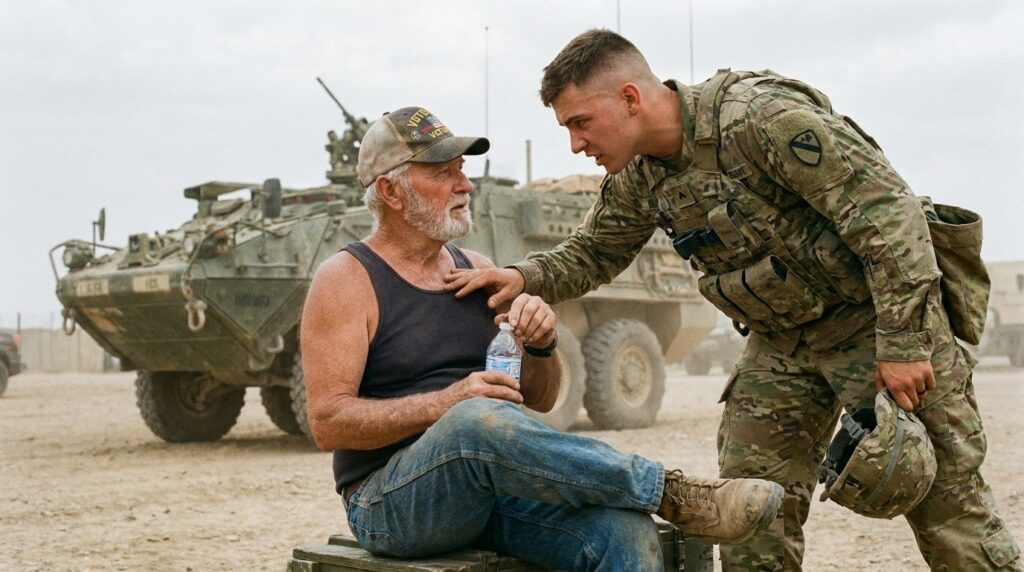
The Iron Horizon: A Reckoning of Steel and Dust at the Vehicle Staging Line
CHAPTER 1: THE PRESSURE LANE
The heat in the vehicle staging yard didn’t just radiate from the sky; it rose from the sun-baked iron of the flatbeds and the heavy, ticking engines of the modern transport fleet. Everything smelled of unrefined diesel, ozone, and the sour tang of industrial grease. Specialist Miller wiped a streak of gritty condensation from his forehead, his thumb catching on the stiff, unwashed collar of his pristine camouflage utility uniform. The logistics tracking screen in his hand was flashing a persistent, rhythmic amber—three late shipments, a fouled manifest, and a supply chain backup that reached all the way to the state line. His combat boots felt heavy, the leather rigid and unyielding against the cracked gravel. He needed a clearing in the noise. He needed everyone to move precisely where they were told, when they were told.
Instead, he found the old man.
He sat on a low concrete barrier right in the shadow of a heavy Oshkosh transport vehicle, a massive relic of green steel that looked like it had been dragged out of a Cold War motor pool. The old man didn’t belong to the system. He wore a dark, threadbare tank top that exposed shoulders like knotted oak roots, a pair of grease-stained jeans, and heavy work boots that had seen decades of dry earth. On his head was a faded, oil-spotted veteran cap, its brim low enough to cast a deep shadow across his face. He wasn’t tracking the digital screens or listening to the screech of pneumatic wrenches. He was just holding a simple, unbranded plastic water bottle, his calloused fingers wrapped around the ridges with a steady, unblinking stillness.
To Miller, the man was a blockage in the throat of the yard. A civilian loiterer watching the frantic choreography of active-duty soldiers with a quiet, maddening detachment.
Miller marched across the lane, each step kicking up fine plumes of white dust that settled on the polished leather of his boots. His chest tightened with the dangerous, defensive energy of a man who believed his uniform gave him a monopoly on the local gravity.
“Old man,” Miller said, his voice cutting through the distant whine of an impact driver. “This is an active staging area. If you don’t have a modern biometric pass, you’re interfering with federal logistics. Stand up.”
The veteran didn’t move. He didn’t blink. He slowly tilted his head back, just enough for the noon sun to catch the hard, silver stubble along his jawline. His eyes were a pale, desaturated blue—clear, cold, and entirely devoid of the frantic panic that Miller was used to seeing in the junior ranks.
“The trucks are running three hours behind, son,” the old man said. His voice had the dry, scraping texture of gravel being shifted by a shovel. “Your tracking system is looking at the wrong hub. You should look at the line before you cross it.”
The dismissal was total. It wasn’t loud, but it carried the weight of a man who had commanded perimeters before Miller’s parents were born. Miller’s face flushed a deep, hot crimson beneath his short military haircut. His fingers twitched against the plastic edge of his digital tablet. The presence of the mechanics and junior troops in the background—suddenly slowing their work, their eyes turning toward the barrier—only sharpened the edge of his humiliation. He couldn’t let a civilian break the hierarchy. Not today.
Miller dropped the tablet onto the hood of the transport, stepped into the old man’s personal space until the heat of his starched uniform pressed against the cool shadow of the concrete, and reached down. His hand, thick and athletic, balled into a fist, grabbing a fistful of the old man’s dark tank top right at the throat.
“Get up and show some respect right now,” Miller barked, pulling upward to force the veteran to his feet.
The veteran’s hand didn’t drop the water bottle. But underneath the faded cotton of his shirt, the old man’s frame didn’t yield an inch. It felt like grabbing a rusted iron stanchion bolted deep into the bedrock of the base.

CHAPTER 2: THE BALANCE SHIFT
Miller’s fingers clenched into the weathered cotton of the old man’s tank top, expecting the sudden upward jerk to yank the civilian off balance, to force a stumble that would instantly reestablish the yard’s proper hierarchy. Instead, his knuckles slammed into what felt like a solid block of cured oak. The fabric groaned, but the old man’s spine remained an unyielding vertical axis. The sheer resistance of that frame sent a jarring shock up Miller’s forearm, the friction of the coarse cotton burning against his palms. In that microsecond of static resistance, Miller noticed a tiny, bizarre detail—the plastic cap of the veteran’s water bottle was notched with a deeply grooved brass casing welded directly into the synthetic twist-top, a tarnished relic of some forgotten caliber catching the brutal glare of the noon sun.
Then, the world tilted.
The veteran didn’t shout. He didn’t pull back. He simply let go of his internal stillness, shifting his weight by a mere three inches. His left boot, cracked and white with vehicle yard dust, pivoted into the gravel with a dry, crunching scrape. It wasn’t a strike; it was an invitation. The old man absorbed Miller’s aggressive, forward-leaning momentum, pocketing his hip just enough to let the active-duty soldier’s own explosive force carry him into the void. The veteran’s free hand—the left one, thick-veined and scarred with the pale tracking marks of old shrapnel—came up from the side, his palm cupping the underside of Miller’s extended right elbow with a light, almost delicate precision.
It was a masterclass in kinetic redirection. The leverage was absolute. Miller felt his own center of gravity betray him as the veteran’s thumb found the exact nerve cluster beneath his tricep, deadening his grip on the tank top. The young soldier’s starched camouflage uniform, stiff with sweat and factory starch, bunching tightly around his shoulders as he was swept forward. The gravel seemed to rush upward to meet him. There was no theatrical throw, no cinematic pause; there was only the cold, unfeeling law of physics. Miller’s boots lost their purchase on the loose stone, his legs flailing against the empty air as his entire torso rolled over the pivot point of the old man’s hip.
He hit the staging yard floor with a heavy, hollow thud that rattled the fillings in his teeth. The impact knocked the oxygen straight from his lungs in a sharp, involuntary hiss, a small explosion of fine white dust billowing outward from beneath his back to coat the pristine camouflage patterns of his sleeves. His helmet—unbuckled in his arrogance—tumbled from his head, clattering against the rusted rim of the transport truck’s massive tire before settling in the grit.
For three long seconds, Miller couldn’t draw a breath. The sky above him was a blinding, desaturated blue, framed by the stark, angular silhouette of the Cold War-era Oshkosh truck. The air in his throat tasted entirely of oxidized iron and pulverized limestone. He tried to roll onto his side, his muscles twitching with the hard-wired instincts of a trained combatant, but his ribs ached from the hard landing, and his right arm felt strangely detached, buzzing with a heavy, pins-and-needles numbness from the veteran’s precise nerve grip.
Above him, the veteran remained completely stationary. He hadn’t fallen. He hadn’t even dropped his plastic water bottle. The old man stood exactly where he had been sitting, his work boots planted symmetrically in the dirt, his breathing as slow and metered as a machine at idle. The shadow of his faded veteran cap fell directly across Miller’s face, a cool, dark wedge cutting through the suffocating heat of the yard.
“Your balance is all in your mouth, son,” the old man said softly, looking down without malice, his eyes steady behind the silver stubble of his jaw. “You lean too hard on things you didn’t build. When you grab a line, you better make sure you know what’s holding it on the other end.”
Miller stared up, his chest heaving as a ragged breath finally tore through his throat. The heat of his anger had instantly vanished, replaced by a cold, hollow vacuum of disbelief. His mind raced, calculating the tactical reality of what had just occurred. He was twenty-two, in the peak of his military conditioning, trained in modern hand-to-hand integration courses—and a man who looked older than the base itself had dismantled his posture in less than half a second using nothing but a balance shift and a single point of leverage. It wasn’t luck. It was the flawless, unpolished residue of an elite capability that had been refined in places where people didn’t wear nametags.
Around them, the rhythmic sounds of the logistics yard began to die a sudden, bleeding death. The persistent, metallic clink-clink-clink of a mechanic’s wrench against a manifold stopped mid-stroke. The low, rumbling idle of a nearby diesel generator suddenly seemed to fill the vacuum, its vibrations humming through the dry earth beneath Miller’s bruised shoulder blades. He could feel the eyes of the logistics personnel, the junior specialists, and the contracted grease-monkeys locking onto him from the shadows of the maintenance bays. The silence was heavier than the heat. The power dynamic of the entire staging line hadn’t just flipped; it had been driven directly into the dirt, leaving the pristine uniform stained with the permanent, gray grit of the old base.
Miller swallowed hard, the dry limestone dust scraping against his esophagus as he gripped the loose gravel with his left hand, trying to find enough leverage to hoist his own heavy, compromised pride back off the ground.
CHAPTER 3: THE ECHOING YARD
The heat seemed to compound inside the silence, pressing down on the open expanse of the staging area until the air itself felt heavy enough to fracture. Miller remained flat on his back for two more jagged inhalations, his shoulders grinding against the sharp crushed limestone. The dust he had stirred up settled over his eyelashes and into the open pores of his skin, gritty and sour with the chemical residue of standard-issue industrial runoff. No one moved. Across the lane, a mechanic holding a high-torque pneumatic wrench froze with his forearm resting over the hot, exposed block of a generator engine. The dull, green-painted metal surfaces of the surrounding fleet seemed to absorb the glare of the noon sun, radiating a dry, choking warmth that turned the fine sweat on Miller’s neck into a paste of fine earth and salt.
The old man didn’t offer a hand. He didn’t adjust his stance. He stood over Miller like an old piece of structural iron left out to weather in the high desert, his knuckles loose around the body of his water bottle. The shadow of his cap remained fixed across Miller’s chin, an unmoving border between the baking gravel and the cool, silent authority that had just dropped an active-duty specialist onto his spine.
Miller’s left elbow dragged across the stones as he forced his torso off the deck. His muscles rebelled, a deep, hot ache blooming between his shoulder blades where the physics of his own momentum had driven him home. He reached out, his fingers brushing against the cold, scarred rubber of the Oshkosh truck’s front tire to steady his weight. His knuckles scraped against a jagged, raised seam on the steel fender—a heavy, hand-stamped serial sequence that didn’t match the standardized laser-etched barcodes of the modern supply vehicles. It was primitive, deep, and deeply oxidized, the orange flakes of rust transferring to his sweat-slicked thumb like dried blood.
“Get up,” a voice called out from the edge of the line. It wasn’t the veteran. It was Sergeant Vance, the bay manager, stepping out from the shade of the tool locker with his sleeves rolled tightly past his elbows. His boots didn’t pace; they thudded against the dirt, hard and fast, his face pulled into a tight, gray grimace that spoke of forty-eight hours without sleep and a manifest that was still short five thousand gallons of jet fuel. “Get up and clear the lane, Miller. You’re holding up the transport tracking cycle.”
Miller pushed himself into a low squat, his knees popping with a loud, distinct snap in the quiet yard. His pristine camouflage trousers were grayed from hip to ankle, the fabric stiffened by the dirt until it rustled like heavy paper with every motion. He retrieved his helmet, his fingers trembling slightly as he jammed the nylon straps into the plastic lining. The baseline humiliation wasn’t a sudden explosion; it was an abrasive, grinding realization that every eye in the logistical lane had seen his authority completely dismantled without a single punch being thrown.
“He doesn’t have an active biometric pass, Sergeant,” Miller said, his voice sounding thin, dry, and alien in his own ears. He pointed a stiff finger toward the concrete barrier, though he kept his distance from the old man’s reach. “He’s loitering near a high-priority asset. The system flagged the perimeter twenty minutes ago.”
Vance didn’t look at Miller’s digital screen. He didn’t even look at Miller’s dust-covered chest. He stopped three feet from the old man, his hands dropping to his sides in a posture that wasn’t standard military attention, but carried the quiet, heavy compliance of an operator who recognized a permanent fixture when he saw one.
“The system doesn’t know what it’s looking at, Specialist,” the old man said, his gravelly tone cutting through Vance’s approach before the sergeant could speak. He didn’t raise his voice, but it carried across the bay, stopping a junior private who had been creeping closer to listen. “You’ve got six flatbeds sitting at the north checkpoint because your modern digital routing network doesn’t recognize the weight variance of the old steel bridges on Route 9. They’re going to sit there until the tires rot if you keep trying to push the manifest through a server in Virginia.”
Vance’s jaw tightened, the skin around his temples turning a dark, congested red. He didn’t correct the civilian. He didn’t demand to see an identification card. Instead, he reached into his top pocket and pulled out a grease-stained notebook, his pencil hovering over the page with a raw, physical urgency.
“The bridge at the river mile marker twelve?” Vance asked quietly.
“The three-span iron truss,” the veteran nodded, his thumb tapping the side of his water bottle. The grooved brass casing welded to the cap gleamed once under the direct light. “The county lowered the load rating four years ago when the abutment started to shift. Your computerized system thinks it’s still rated for eighty tons because nobody bothered to punch the physical inspection logs into the database. If you send that fuel convoy over the ridge, you’re going to drop twenty thousand gallons of diesel into the creek and lose the entire logistics lane for six months.”
Miller watched the interaction with a growing, cold friction in his chest. His digital tablet sat on the hood of the Oshkosh, its screen still pulsing with the amber warning lights of the delayed shipments, completely blind to the physical reality the old man had just laid out from memory. The world wasn’t running on the smooth, polished data Miller had been trained to trust; it was grinding along on old iron, structural limits, and the unwritten memory of men who knew how much weight the earth could bear before it buckled.
“Miller,” Vance said without turning his head, his pencil scratching furiously against the paper. “Go down to the maintenance shack. Grab the legacy hard-copy routing manuals from the bottom locker under the old master grease charts. The ones with the canvas binders.”
“Sergeant, those are obsolete,” Miller began, his hand dropping back toward his tablet. “The new fleet protocols strictly state—”
“I didn’t ask for a data report, Specialist,” Vance interrupted, his voice dropping into a low, dangerous register that echoed the hard stillness of the old man beside him. “Move your boots. Bring the manuals out here before I have you cleaning the inside of every oil separator on this line with a toothbrush.”
Miller held his breath, his eyes shifting from Vance’s weathered face back to the veteran. The old man hadn’t moved from his spot near the concrete barrier, his posture as immovable as the heavy green transport behind him. The young soldier reached out, grabbed his tablet off the hot steel of the hood, and turned on his heel. Every step toward the maintenance shack felt like dragging his boots through wet cement, the dry grit of the yard crunching under his soles as he carried his stained uniform and his fractured ego away from the line.
CHAPTER 4: THE DECOY BLUEPRINT
The maintenance shack smelled of fifty years of trapped humidity, old gear oil, and decaying wood pulp. Inside, the roar of the staging yard’s diesel engines dropped into a muffled, rhythmic thrumming that vibrated through the cracked concrete floor beneath Miller’s boots. Dust motes danced lazily in the thin shafts of orange light cutting through the high, reinforced windows. Miller lunged toward the back corner where the old steel lockers stood, their green enamel finishes blistered with patches of dark, scabby rust that scraped painfully against his knuckles as he yanked at the handle. The locking mechanism was seized, jammed tight by years of non-use and fine yard grit that had packed into the tumblers.
Miller cursed under his breath, his chest burning with the raw remnants of his humiliation out on the line. He didn’t use a key. He grabbed a rusted iron pry-bar from a nearby workbench, wedged the flat edge into the seam of the bottom locker, and threw his weight against it. The metal screamed—a sharp, tearing sound of rivets giving way—before the door burst open with a dull clang, dumping a cloud of gray, chalky dust over the knees of his already ruined trousers.
At the bottom of the locker, buried beneath a heap of dried-out neoprene gaskets and brittle fan belts, sat the heavy canvas binder Sergeant Vance had demanded. The fabric was stiff, discolored by water rings, and secured by a heavy brass latch covered in a thick layer of green oxide. Miller dragged it out, the weight of the book surprising him; it felt like a chunk of ballast stone rather than a routing index. He slammed the binder down on the grease-stained workbench, the impact sending a small shockwave of grit across the polished screen of his digital tablet.
He popped the corroded latch, the dry hinges scraping like bone, and flipped the heavy parchment pages. These weren’t standard military shipping logs. They were meticulously hand-drawn engineering schematics and operational flowcharts of the entire regional logistics grid, executed in fading blue ink. His fingers traced the rigid, crisp lines of the mountain routes, tracking the precise geographical choke points until he found Route 9.
The entry for the three-span iron truss bridge was flagged with a heavy red grease pencil circle. But it wasn’t the load rating that caught his eye; it was a physical document folded neatly into the sleeve of the binder page. Miller pulled it out, unfolding the stiff paper with shaky fingers. It was an unredacted structural blueprint revision from 1974, detailing the bedrock foundations of the base’s main supply routes. Down in the bottom approval block, stamped in faded purple ink, was an official military logistics design registry. The signature initials in the box read M.V.—the exact same font structure and alignment as the identification insignia on the vintage transport truck outside.
Miller’s breath caught. He shifted the document closer to the light. The blueprint explicitly showed that the modern computerized routing architecture—the system he had been trained to consider infallible—had completely overwritten a vital structural routing vulnerability. The server networks were routing the heavy modern fuel convoys based on modern concrete freeway specifications, completely blind to the fact that the actual underlying physical infrastructure of the regional pipeline junctions sat directly underneath the degrading foundations of Route 9’s iron bridges. If those trucks crossed, the weight variance would shatter the old pilings, triggering a catastrophic back-pressure collapse that would sever the fuel supply lines to every forward operating location across the eastern seaboard.
The old man wasn’t a random veteran loitering in the dust. He was the original architect who had physically mapped the structural limits of this entire operational sector. He didn’t need a digital biometric pass to know the line was failing; he had drawn the line before the modern network even existed.
Miller stared at the paper, the dry grain rough beneath his thumbs. The realization felt like a heavy, physical blow to his sternum, harder than his fall in the dirt. The digital system pulsing in his left hand suddenly looked shallow, a superficial layer of pristine, automated data laid over a cracking, rusted reality that was only held together by the unwritten memory of the man he had just tried to bully. He had been looking at the old man as an obsolete relic, totally blind to the fact that his own modern logistical prime was running headlong into a disaster that only that relic could prevent.
He snatched the canvas binder off the bench, his thumb pinning the 1974 document against the cover as he turned back toward the door. The friction of his starched uniform against his skin felt tight, restrictive, and suffocating. He didn’t walk; he ran back out into the blistering noon heat of the yard, the bright glare hitting his eyes as he hurried back toward the transport vehicle where Vance and the veteran were waiting.
CHAPTER 5: THE COMMAND ARRIVAL
The canvas binder felt like a slab of dense iron against Miller’s ribcage as he burst out of the shade and back into the white glare of the vehicle yard. The heat hit him like a physical blade, thick with the unwashed exhaust of forty idling multi-fuel engines. The fine limestone dust, kicked up by his own running boots, coated his throat until every breath tasted like dry rust. He sprinted across the lane toward the green bulk of the old transport truck, his fingers gripping the frayed cloth edges of the ledger tightly.
“Sergeant!” Miller called out, his voice cracking against the dry air. He didn’t check his stride until he cleared the rear bumper of the heavy transport. “I found it. The blueprint—the signatures from ’74—it’s all here.”
Sergeant Vance didn’t take the book. He didn’t even turn his head. He was standing perfectly still, his spine pulled straight, his grease-stained notebook clamped tightly against his thigh. The loose mechanics and logistics troops who had been lingering near the tool bays had backed away entirely, their boots pressed into the narrow shadows of the concrete walls. Every wrench had stopped clanking. The quiet was absolute now, deeper than before, broken only by the low, distant whine of a high-torque starter motor spinning somewhere down the line.
The reason for the stillness sat right at the entrance of the staging lane.
A heavy, matte-black staff vehicle had pulled up through the perimeter fence, its tires chewing through the gravel with a low, heavy crunch before settling to a halt. The dust hadn’t even begun to clear from the glossy fenders when the rear door swung open. A tall man in a crisp, pristine command uniform stepped into the heat, the sharp, silver glint of four stars on his collar catching the direct noon sun like fragments of broken mirror. It was General Brooks, the installation commander, his face pulled into a hard, unreadable mask of weathered skin and grey eyes.
Miller froze, his thumb still pinning the 1974 blueprint against the canvas cover. His heart hammered against his ribs, a frantic, rhythmic throbbing that felt too loud for the silent yard. He looked down at his own uniform—the starched camouflage gray with limestone dirt, his helmet strap trailing in the dust, his pride shattered into the gravel—and then up at the highest authority on the base.
The General didn’t look at Vance. He didn’t look at Miller. His heavy leather boots crunched across the lane, pacing directly toward the concrete barrier where the old veteran still sat with his unbranded water bottle.
Miller held his breath, expecting the hammer of a formal summary court-martial to drop right there in the dirt. He had initiated a physical confrontation with a civilian loiterer in front of the base’s logistics network, and now the entire command hierarchy was witnessing the aftermath. He braced his heels, preparing to drop his tablet and accept the consequence of his own entitled arrogance.
But the General stopped exactly two paces from the old man’s work boots. He didn’t ask for a pass. He didn’t demand an explanation for the broken locker door or the dust on Miller’s sleeves.
With a single, synchronized movement that seemed to split the hot air of the yard, General Brooks brought his right hand up to his brow, locking it into a flawless, unyielding salute. His eyes were fixed on the faded veteran cap, his posture stiffer than any iron stanchion bolted into the base’s bedrock.
“General Vance,” Brooks said, his voice carrying a resonant, structural clarity that cut straight through the low thrum of the idling transport engines. “We didn’t expect you on the line today, sir.”
The words hit Miller like a physical shift in the earth. General Vance. His gaze flicked frantically from the General’s stiff salute back down to the 1974 document in his hands, his eyes finding the initials M.V. stamped in purple ink at the bottom of the regional infrastructure ledger. Marcus Vance. The man who had laid the first foundations of the entire eastern logistics grid wasn’t a loiterer; he was the foundational ghost of the installation itself, a legendary former commander who had retired before Miller’s uniform had even been drafted into design.
The old man slowly lowered his water bottle, his calloused fingers releasing the plastic ridges with a dry scrape. He didn’t stand up. He didn’t return the salute with military pomp. He just nodded once, the brim of his faded cap casting a deep, dark wedge across his silver beard as he looked into the eyes of the man who now held the keys to his old command.
“The server’s running blind, Tommy,” the veteran said softly, using a name that made Sergeant Vance’s eyes widen in absolute disbelief behind his grease charts. The old man pointed a thick thumb toward Miller’s digital tablet, which lay face-up on the gravel. “Your boys are trying to push eighty tons of fuel over an iron truss that was rated for fifty when I poured the concrete back in ’68. If you don’t drop the gates at the north checkpoint within the hour, you’re going to lose the entire regional artery.”
General Brooks didn’t look back at the staff vehicle. He didn’t call for a digital confirmation. He turned his head just enough to lock his cold grey eyes onto Miller’s face, his expression hardening until it looked like the rusted armor plate of the Oshkosh truck.
“Specialist,” the General barked, the tone dropping the room temperature by ten degrees despite the noon sun. “Bring that ledger to my vehicle. Now.”
Miller’s legs moved before his brain could process the command, his combat boots hammering against the loose stone as he stumbled forward, the weight of the canvas binder suddenly feeling like an absolute verdict on his entire military future.
CHAPTER 6: THE BLOODLINE LEDGER
The rear door of the staff vehicle clicked shut with a deadened, pressurized thud, instantly slicing through the grinding roar of the vehicle yard’s multi-fuel engines. Inside, the air conditioning hummed, a thin, clinical stream of chilled air that did nothing to lower the hot, suffocating burn in Miller’s chest. The desaturated gray upholstery felt unyielding against his dirt-caked camouflage trousers. General Brooks sat rigidly beside him, his gaze fixed on the heavy canvas binder resting across Miller’s trembling knees. The leather bindings of the book looked impossibly thick, its edges frayed into coarse, grey threads that caught on the synthetic weave of Miller’s uniform.
“Open it,” the General said. His voice was no longer a command meant for the public squares of the yard; it was flat, heavy with a jagged, structural fatigue.
Miller thumbed the corroded brass latch. As the heavy parchment pages fell open toward the red-circled layout of Route 9, the sharp motion dislodged a second document that had been jammed deep behind the ledger’s rear reinforcement strip. It was a charred, dog-eared field manifest, its top margin stained with black soot and oil rot. Miller pulled it out mechanically, his thumbs scraping against the coarse paper grains. His eyes scanned the unpolished, typewritten print at the top: Joint Logistics Task Force – Off-Grid Deployment, Sector 4.
“Look at the unit routing logs at the bottom, Specialist,” Brooks murmured, his gray eyes darkening as he leaned closer, the silver stars on his shoulder line casting a hard shadow across the desk plate. “The network failure isn’t something we are anticipating. It already happened.”
Miller’s gaze dropped to the casualty summary appended to the back of the manifest. His eyes locked onto a single name: Staff Sergeant David Vance. Lost in transit, Sector 4 operational corridor. Structural bridge failure during fuel asset retirement.
The dry air in Miller’s lungs seemed to turn to solid stone. Vance. His mind reeled back to the yard outside—to the old man sitting on the concrete barrier with his weathered cap, and to Sergeant Vance, the bay manager, who was currently out there tracking shipments with a grease pencil.
“David was Marcus’s eldest grandson,” General Brooks said, his hand coming down onto the top of the canvas binder with a dull, hollow thud. The iron rings of the binder groaned under the pressure. “Three weeks ago, our central automated routing system sent David’s logistics column across an unverified secondary bridge in an off-grid sector. The computerized manifest marked the route clear based on drone photography. It didn’t factor in the physical decay of the foundational pilings beneath the waterline. The entire platform folded under the lead truck. David went down with the cargo.”
The silence inside the staff vehicle became absolute, a suffocating weight that crushed the remaining remnants of Miller’s institutional entitlement. He looked out the tinted glass window, where the old veteran was still visible through the haze of diesel exhaust. General Marcus Vance hadn’t driven down to this dusty staging yard to protect an obsolete manual or to demand unearned deference from active-duty specialists. He had come because the system’s digital blindness had already cost him his blood—and because he knew that the modern fleet, running blindly on automated telemetry, was about to send another forty men down the exact same fatal corridor on Route 9.
“Marcus built these supply lines thirty years ago with his own hands,” Brooks continued, his fingers tracing the hand-inked initials M.V. on the 1974 blueprint. “He knew every bolt, every structural tolerance, and every weakness in the bedrock. When the automation took over, we quarantined his original logs because they didn’t fit the new network format. We locked the truth in the bottom locker of a maintenance shack and called it progress.”
Miller looked down at his own dust-stained sleeves, the white limestone grit embedded in the fabric looking less like a badge of labor and more like the residue of a profound, dangerous ignorance. His digital tablet, still pulsing with automated alerts in his cargo pocket, felt entirely useless—a flat, glass toy that had nearly led him to enforce a perimeter rule at the expense of an entire column’s survival. The old man’s tactical reversal out in the dirt hadn’t just been an act of self-defense; it had been the first necessary fracturing of a young soldier’s blind faith in an unyielding, unverified network.
“The system doesn’t know pain, Specialist,” Brooks said, his voice dropping into a low, scraping register that mirrored the old general’s tone outside. “But the men inside the uniform do. Marcus came here to fix the line because nobody else has the memory left to do it.”
Miller gripped the edges of the canvas binder until his calloused knuckles turned white against the stained fabric. The true architecture of the conflict was finally bare before him—not a simple clash of generations or institutional authority, but a grim, pragmatic race to save a modern peacetime force from the fatal weight of its own digital hubris. He didn’t say a word. He simply closed the ledger, the heavy brass latch clicking back into place with a definitive, metallic snap that signaled the absolute end of his ignorance.
CHAPTER 7: THE RUSTED LINE
The door of the staff car popped open, and the pressurized chill of the interior was instantly destroyed by the physical hammer of the noon heat. Miller stepped out into the glare, his heavy leather combat boots hitting the limestone grit with a dull, heavy thud. The canvas binder was clutched against his stomach, its ancient brass edges burning hot against his fingers as the sun claimed the metal. He walked with a different weight now. The starched camouflage uniform that had felt like a shield of institutional status twenty minutes ago now felt thin, coarse, and deeply inadequate against the raw, unyielding history of the yard.
He moved toward the concrete barrier where the old man sat. Sergeant Vance stood a few paces back, his grease charts hanging limply in his fist, his gaze locked onto the gravel between his boots. The entire line had gone completely cold. The mechanics, the logistics junior troops, and the drivers had formed a loose perimeter of absolute silence, their faces reflecting the grim gravity that had just rolled out of the commander’s vehicle.
Miller stopped exactly two feet from the elder general. He didn’t stand at a rigid, unthinking attention. Instead, he slowly dropped to one knee in the white dust, matching the old man’s vertical frame by lowering his own center of gravity. He extended his arms, offering the heavy canvas binder back to its original creator. His hands were coated in a fine layer of gray limestone dust, the grit grinding between his skin and the rough cloth cover as he held the ledger steady.
The old man didn’t reach for the book immediately. He let his pale, desaturated blue eyes rest on Miller’s face, tracing the dark streak of dirt along the young soldier’s jawline where his arrogance had met the earth. The silence between them dilated, slowing time down until Miller could hear the individual ticking of the massive green Oshkosh engine as it cooled under the sun.
Miller’s eyes flicked to the water bottle cap in the old man’s hand. In the harsh, vertical light, he could see the deeply grooved brass casing welded to the synthetic twist-top. It wasn’t a random relic; the firing pin mark on the base was clean, precise, and carried the specific identification sequence of a logistics defense detail—the exact unit David Vance had commanded when the iron bridge collapsed. It was a fragment of a grandson’s final reality, preserved in oxidized metal, carried by an old protector who was still trying to keep the remaining pieces of the line from breaking.
“I found the entry for Route 9, sir,” Miller said, his voice dropping into a low, transactional rasp that carried no traces of the power-tripping arrogance that had started the day. “The system’s routing logs have been manually bypassed. The north checkpoint gates are dropping now.”
The old man’s thick-veined hand came down onto the canvas binder, his heavy, calloused fingers gripping the edges with a physical certainty that had been earned through forty years of unpolished labor. He didn’t offer a dramatic speech. He didn’t acknowledge Miller’s submission with a grand gesture of forgiveness. He simply pulled the book onto his lap, the coarse paper grains inside rustling like dried leaves as he verified the position of the 1974 blueprint.
“Respect isn’t given with the uniform, son,” Marcus Vance said softly, his shovel-gravel voice cutting through the dry heat with an unyielding clarity. “It’s earned by the man inside it. When the machines tell you the road is clear, you look at the iron beneath your boots first. The data doesn’t bleed when the bridge gives way.”
Miller closed his eyes for a single second, the heat bouncing off the gravel burning his face as he swallowed the bitter taste of his own correction. He felt the cold truth of Layer 2 settle deep into his bones—the realization that his entire active-duty prime was nothing but a fragile veneer laid over an ancient, unyielding structure of blood and labor. He wasn’t a passive observer anymore; he was a flawed driver who had finally been forced to see the cracks in his own system.
He stood up slowly, his knees popping against the quiet of the yard as he brushed the white dust from his camouflage trousers. He didn’t reach for his digital tablet. He turned toward Sergeant Vance, his hand dropping to his side in a quiet, instinctive posture of readiness.
“Sergeant,” Miller said, looking toward the long line of idling flatbeds waiting near the maintenance bays. “Get the grease monkeys. We’re going to verify every physical load limit on the Route 9 convoy manually. We line them up by weight, the old way.”
Sergeant Vance looked up, his tight, gray grimace loosening just enough for a hard, professional nod to break through his exhaustion. He didn’t say a word, but his pencil immediately went back to work against the grease charts, his boots thudding against the dirt as he turned back toward the maintenance bay.
The old general watched them move, his faded cap casting a long, dark wedge of shadow across the concrete barrier as he took a slow, metered sip from his water bottle. He remained stationary—an immovable monument of steel and dust sitting at the edge of the line, watching the younger generation finally learn how to measure the true weight of the earth before they crossed it.
CHAPTER 8: THE ROUTE 9 AUDIT
The automated tracking terminal didn’t just flash amber anymore; it bled a violent, continuous crimson. Miller’s hand slammed down onto the hood of the old Oshkosh transport truck, his fingers slipping across a dry, flaky patch of green paint that left a pale powdery residue on his knuckles. The digital screen in his palm was dead—he had manually severed its link to the base’s main server, but the local buffer was still rendering the horror of the last five minutes.
“They’re already past the outer perimeter,” Miller said, his voice flat, stripped of everything except the raw calculations of a man watching a fuse burn down toward an explosive cache. “Three M978 fuel tankers. Sixty thousand gallons of aviation fuel total. They used an automated logistics override issued by the commercial hub in Virginia two hours before General Vance dropped the gates.”
Sergeant Vance didn’t look up from the canvas ledger. His grease pencil tore through the margins of the 1974 blueprint, leaving thick, black scars over the hand-drawn coordinates of river mile marker twelve. The dry smell of rotting paper and oil fumes rose from the binder as he flipped to the bridge abutment logs.
“They’re tracking at fifty-five miles an hour down the grade,” Vance said, his thumb pinning the ancient structural log against the rusted steel of the truck’s fender. “The automated navigation system thinks Route 9 is reinforced concrete all the way to the interstate. It doesn’t know that the structural iron beneath the river span has been pocket-rusted since the winter floods. If the lead tanker hits the truss at that velocity, the vibration alone will shear the support rivets before the rear axles even clear the approach ramp.”
Miller didn’t wait for a command from General Brooks or a formal dispatch from the staging office. His body moved on the pure, unpolished survival instincts he had inherited from the old man’s brutal correction in the dust. He vaulted into the high cabin of the Cold War-era Oshkosh, his combat boots slamming against the bare iron floor plates with a hollow, metallic clang that rattled the unbushed dashboard gauges.
The interior of the truck smelled of fifty years of oxidized copper wiring, ancient horsehair insulation, and parched vinyl. On the dashboard, right above the heavy air-brake toggle, someone had scratched a five-digit radio frequency directly into the green paint with the tip of a bayonet—a raw, unlisted channel that didn’t appear on any modern digital encrypted comms roster.
Miller grabbed the heavy, unyielding gear lever, the cold steel biting into his palm through the limestone dust still caking his skin. He threw his weight against the shifter, forcing the transmission into low gear with a violent, grinding engagement of iron teeth that sent a shudder straight up his arm.
“Specialist!” Sergeant Vance shouted from the yard floor, his face white beneath the glare of the noon sun as he hauled the canvas binder up toward the open cab window. “Take the manual. You’re going to need the exact shear thresholds for the center pier if you can’t turn them around before the ridge.”
Miller reached out, his calloused fingers locking onto the frayed canvas binder. He didn’t look back at the staging yard or the loose collection of silent troops watching him from the bays. He hammered his boot onto the accelerator, and the massive diesel engine roared to life with a thick, black plume of unrefined exhaust that blanketed the barrier in a gray soot. The tires clawed at the loose gravel, spitting white stones against the undercarriage as the heavy transport truck lunged forward, bursting through the perimeter line and running headlong into the dry, blinding heat of the mountain road.
CHAPTER 9: THE RACE TO THE IRON TRUSS
The old Oshkosh transport vehicle screamed down the mountain switchbacks like a loose cage of structural iron being dragged down an incline. Every rivet in the cabin vibrated with a rhythmic, tooth-shattering shudder that traveled from the steering column straight through Miller’s forearms. Outside, the dry pine trees blurred into a desaturated green smear against the baking rock of the canyon wall, the blinding noon sun reflecting off the cracked hood in long, white daggers of pure glare. Miller slammed his boot down on the heavy mechanical brake pedal, but the friction lining was old, parched, and weeping oil; it responded with a high-pitched, metallic squeal that barely slowed the twenty-ton truck’s forward lurch.
The heat inside the uninsulated cab rose instantly, thick with the sharp smell of hot rubber and scalding differential fluid. The heavy canvas binder sat jammed between the passenger seat frame and the steel dashboard, its edges vibrating violently against the iron floor plates.
Miller leaned his shoulder into the unassisted steering wheel, forcing the truck through a sharp, gravel-slick hairpin turn. The rear dually tires broke traction for a fraction of a second, sliding outward with a dry, ripping sound across the loose stones before the old chassis caught the crown of the road. His palms were slick against the heavy bakelite wheel, the gray limestone dust from the staging yard mixing with his sweat to form a slippery grit that ground into the fine creases of his hands.
His eyes flicked down to the unlisted frequency scratched into the dashboard green paint: 31.45.
He lunged with his right hand, keeping his left forearm locked against the bucking steering wheel, and yanked the heavy tactical radio toggle toward the manual override circuit. The old vacuum tubes inside the unit hummed, static crackling through the metal speaker grille like dry brush catching fire. Miller spun the analog dial, his fingers catching on the sharp, knurled metal edge of the tuner until the needle rested precisely on the scratch mark.
“Convoy Lead, this is Specialist Miller, Staging Area 4,” he barked into the heavy plastic handset, his voice competing with the deafening hum of the transfer case beneath his seat. “Brake your line immediately. You are tracking onto an unverified infrastructure corridor. Pull your rigs into the shoulder before the river mile marker twelve.”
The static sputtered, the dry frequency pop-popping before a crisp, synthesized voice cut back through the receiver. It was the lead driver of the M978 convoy, his tone flat and entirely insulated by the automated cabin systems of his modern fleet vehicle.
“Negative, Staging Area,” the voice replied, devoid of urgency. “Our tactical network routing is green all the way through the mountain sector. We have a real-time satellite verification layout showing clear transit across the state line. Clear the channel, Specialist.”
“The system doesn’t know what it’s looking at,” Miller shouted back, his hand tightening around the handset until the plastic groaned. He looked through the bug-splattered windshield, his heart slamming against his ribs as the canyon opened up into the wide, sun-baked basin below. “Look at your physical line. Look at the road width. Your servers are reading a blueprint that hasn’t existed since the winter washouts. You’re hauling sixty thousand gallons of jet fuel onto an iron truss that cannot support your dead-weight configuration.”
There was no answer, only the steady, rhythmic hiss of the encrypted channel background. Miller dropped the handset onto the seat, his teeth grinding together as he shoved the heavy shifter into a higher gear, letting the mass of the old transport plunge down the final stretch of the incline.
Through the heat shimmer rising off the cracked asphalt of the valley floor, he finally saw them.
Three massive, pristine camouflage fuel tankers were rolling in a tight, synchronized column, their tires kicking up tiny, disciplined plumes of gray dust that settled onto their polished utility hitches. They were less than a mile from the river crossing, tracking at fifty-five miles an hour on a direct, automated trajectory that would put them on the approach ramp within two minutes. The modern computer systems in their cabs were whispering that everything was green, completely blind to the ancient, pocket-rusted reality waiting right beneath the waterline of the iron truss bridge.
Miller’s boot slammed the accelerator flat against the iron floor, the old Oshkosh lunging forward as its transmission screamed under the load, its heavy green frame hurtling toward the junction line in a raw, mechanical sprint to cut the path before the concrete gave way.
CHAPTER 10: THE BEDROCK BOUNDARY
The front bumper of the old Oshkosh smashed through a rotten wooden perimeter barrier at the edge of the approach ramp, sending a shower of gray, splintered shards bouncing off the hot hood. Miller hauled the wheel hard to the left, putting the twenty-ton transport truck into a brutal, sideways slide across the entrance of the iron truss bridge. The massive rubber tires howled against the hot asphalt, ripping chunks of tread away as the vehicle came to a rest diagonally across the lane, completely blocking the entry span.
Less than fifty feet away, the lead M978 fuel tanker slammed on its modern air brakes. The massive, pristine camouflage rig hissed violently, its computerized anti-lock system pulsing with an automated rhythm that left smoking, black hatch-marks across the approach road before it ground to a halt inches from the Oshkosh’s exposed flank. The two trailing tankers shuddered behind it, their massive frames bunching together like an armored accordion.
Miller didn’t waste a breath. He kicked his heavy cab door open, grabbing the frayed canvas binder as he dropped down onto the iron deck plates of the bridge. The structure beneath his boots was already vibrating—a low, rhythmic, groaning hum that travelled up his shins from the riverbed below. The sheer weight of the three fuel rigs resting on the approach was already taxing the shifting abutments.
The lead driver slammed his modern composite door open and dropped to the deck, his face flushed red under his helmet, his fingers twitching toward his digital manifest screen.
“What the hell are you doing, Specialist?” the driver shouted, his voice echoing off the overhead rusted steel lattice. “Our network shows this route clear. We have a priority delivery mandate for the support airfield!”
“Look down,” Miller said, his rasping voice cut thin by the heat and the sharp scent of parched hydraulic fluid. He pointed a dust-caked finger at the structural joints beneath the lead tanker’s front tires. “Your screen is reading the surface, corporal. Look at the iron.”
Under the massive weight of the lead truck, the old connection plates were weeping orange flakes of deep oxide. A two-inch rivet had already sheared, its head popping completely out of its recess to clatter against the bridge deck with a hollow, metallic ring. The main support span was bowing downward by a visible fraction of an inch, the rusted girders scraping together with a sound like a dull knife grinding against a stone wheel.
Miller threw the canvas binder open onto the hood of the modern fuel truck, pinning the 1974 blueprint against the hot metal. His fingers traced the original hand-notched engineering annotations Marcus Vance had inked into the margins.
“The bedrock underneath the southern pier is shifting,” Miller said, tracing the red grease-pencil markings that mapped the pocket rust beneath the waterline. “The modern computerized system is tracking the gross weight of your fleet, but it doesn’t calculate the resonant vibration of three heavy tankers entering the span simultaneously. If you try to roll across this truss at fifteen miles an hour, you’re going to hit the harmonic collapse frequency of the center pier. The entire deck will fold like paper.”
The driver looked from the faded parchment blueprint to his own digital screen, which was suddenly flickering with an aggregate weight warning error that it couldn’t resolve. The modern tactical network was cycling blindly, trying to find a digital override for a physical structural failure that had been charted half a century before the software was written.
“We can’t back them out,” the driver said, his voice dropping its defensive edge as he felt the distinct, sickening shudder of the deck plates shifting beneath his boots. “The grade behind us is too steep for a reverse column with full tanks. If we sit here, the dead weight will drop the approach.”
“We don’t back out,” Miller said, his jaw tightening as he channeled the exact unyielding pragmatism he had taken from the old general in the dust. “We decouple the trailers. We run the prime movers across one by one at dead idle, using the legacy weight-distribution vectors from this manual. We line the wheels up precisely along the original structural spine, not the modern lanes.”
He turned back toward the cab of his old Oshkosh, his hand locking onto the rusted iron pry-bar he had taken from the maintenance shack locker. Every step across the groaning iron structure felt like walking on a wire, the friction of the cracking metal beneath him a stark, visceral reminder that the line between survival and structural disaster was no longer hidden behind an automated screen. It was right here, etched into the rusted iron and the unpolished memory of the men who knew how to hold it together.
CASE B: INCOMPLETE / EVOLVING NARRATIVE
CHAPTER 11: THE SPINAL ALIGNMENT
The steel deck plate beneath Miller’s left boot didn’t just vibrate; it groaned with a deep, low-frequency resonance that vibrated straight through his marrow. He stood in the center of the bridge lane, his uniform caked in a thick layer of white limestone dust and the sour smell of raw diesel vapors. In his hand, the canvas binder was folded backward, its grease-spotted blueprint pages flapping violently in the hot canyon draft that rushed up through the open ironwork from the riverbed below.
“Dead idle!” Miller roared, his hand slashing downward through the blinding glare of the noon sun. “Keep your wheel locked three inches to the left of the main seam! Do not touch the accelerator!”
The first uncoupled fuel tractor—a massive, six-wheeled prime mover stripped of its trailing tank weight—crept onto the center span. Its engine hummed with a low, computerized purr that sounded strangely delicate against the massive, scraping protests of the iron truss. Without the weight of its trailer to pin the chassis down, the tractor’s massive rubber tires bounced subtly over the raised rivet heads, each impact triggering a sharp ping-ping-ping that sounded like rifle fire echoing inside a steel vault.
Miller walked backward, his eyes locked onto the front tires of the rig and then flicking down to the blueprint. According to Marcus Vance’s 1974 hand-drawn notes, the structural spine of the bridge wasn’t aligned with the modern asphalt paint lines. The true load-bearing beam—the heavy, unpolished iron girder bolted deep into the bedrock—ran slightly diagonal to the modern lane, hidden beneath two inches of crumbling, sun-baked blacktop.
He found the marker. Right at the center expansion joint, someone had deep-notched the iron plate with a hand-file, a rough, V-shaped scar covered in a crust of dark orange rust. It was Marcus’s old alignment anchor, completely invisible to the satellite tracking systems but perfectly clear to anyone willing to look into the dirt.
“Hold the line right there,” Miller shouted, his palm extending toward the driver’s cab.
The truck paused, its massive exhaust pipe puffing a small, blue cloud of unrefined fumes into the hot air. Beneath the front axle, the expansion joint began to weep a fine, gray cloud of pulverized concrete dust. The bridge was settling further into the shifting southern pier, the iron teeth of the connection plates grinding together with a high-pitched, metallic shriek that set Miller’s teeth on edge. The leverage was failing. The dead weight of the remaining trucks on the approach ramp was translating directly into horizontal stress, pushing the pocket-rusted pilings beneath the waterline toward their absolute shear threshold.
Miller’s fingers tightened against the canvas cover of the ledger, his mind running the calculations he had taken from the old general’s physical discipline. They were running out of structural velocity. They had isolated the first vehicle, but the time-lag required to manually guide each tractor across the spinal alignment was allowing the foundational decay to compound beneath them. The modern network tracking screen in his cargo pocket vibrated once—a useless, automated notification that the shipment was now officially forty-five minutes overdue—before he reached down and ripped the battery pack completely from the housing, throwing the glass device through the iron floor lattice into the dark river below.
He didn’t need the automated telemetry. He needed the friction of the iron, the unyielding weight of the legacy ledger, and the precise, unpolished coordination of the men on the line. He turned back toward the second rig waiting on the approach, his combat boots chewing through the loose limestone grit as he prepared to pull the next chunk of the column across the cracking boundary before the bedrock gave way entirely.
CHAPTER 12: THE ABUTMENT FAILURE
“Get the second rig moving now!” Miller yelled, his hand slicing through the thick, choking haze of diesel exhaust. His voice was raw, scraped thin by the blistering canyon heat and the sharp, toxic stench of boiling engine oil.
He didn’t wait for a confirmation from the corporal. He sprinted back toward the approach ramp, his heavy combat boots skidding across the loose, sun-baked limestone gravel. Behind him, the second uncoupled M978 fuel tractor began its agonizingly slow crawl onto the iron truss, its massive rubber tires biting into the crumbling asphalt precisely along the diagonal spine he had mapped out from the 1974 canvas binder.
Then, the riverbed screamed.
It wasn’t a slow groan; it was a sudden, thunderous detonation of tearing metal that vibrated violently up through the bedrock. Fifty feet below, the pocket-rusted southern pier—already eaten away by decades of hidden underwater corrosion—finally hit its absolute shear threshold under the dead-weight leverage of the halted convoy. The concrete foundation fractured with a sharp, subterranean crack, dropping the entire southern support assembly by three vertical feet into the muddy current.
The bridge deck didn’t just bow; it sheared. Miller lost his footing instantly as the steel lattice plates beneath him jerked sideways, the impact driving his knees hard into the exposed rivet heads of the center expansion joint. The canvas binder flew from his grip, its old pages rustling frantically as it slid across the tilting blacktop toward the edge of the span.
“Brake!” Miller roared, his hands clawing at the rough, oxidized surface of a side girder as the world tilted. “Brake the line!”
The driver of the second rig slammed his pedal down, but the sudden tilt had already disrupted the vehicle’s center of gravity. The massive camouflage prime mover broke traction, its rear dually wheels spinning uselessly against the steepening slant of the deck. A high-pressure hydraulic line near the tractor’s hitch ruptured under the sudden twisting force, spraying a hot, blinding mist of red fluid across the windshield and into the air. The truck slid backward by six feet, its rear bumper crunching violently into the thick steel framework of the overhead lattice with a sickening screech of collapsing metal.
The bridge was splitting in two. Right at the hand-filed alignment notch he had used as his anchor, a massive, jagged hairline fracture tore through the main structural girder, yawning open like a hungry mouth to expose the raw, crumbling interior of the old ironwork. The section of the deck holding Miller, the second tractor, and the third fully loaded fuel trailer was now completely isolated, hanging over the rushing river by nothing but three twisting steel tension cables that hummed with a terrifying, high-pitched pitch.
Miller dragged his torso upward, his camouflage uniform soaked in red hydraulic oil and gray concrete dust. His muscles burned with tactical exhaustion, every rib aching from the hard impact against the joint plates. He looked back toward the northern approach, his vision blurred by the heat shimmer and the chemical spray. The road behind them was blocked by the collapsed framework of the entry ramp; they were trapped on a fracturing island of unyielding iron and sixty thousand gallons of highly volatile asset weight, and the automated network screen in his pocket was no longer there to calculate a rescue.
He reached out, his calloused fingers locking onto the edge of a structural pillar to stop his slide. The metal felt blisteringly hot, its blistered green paint peeling back under his grip to reveal the deep, flaky orange rust beneath. The bridge was settling further into the void with every tick of the clock, the physical limits of the material failing right beneath his feet. He was the active driver of this column now, and he was running out of line to hold.
CASE B: INCOMPLETE / EVOLVING NARRATIVE
CHAPTER 13: THE LEGACY EXTRACTION
The second tension cable severed with a sound like a small mortar detonating inside the canyon, its broken steel braid whipping across the sky to slice clean through the modern fiberglass wind-fairing of the trapped fuel truck. The isolated section of the iron truss groaned, dropping another four inches into the brown, churning river current below. Miller lunged across the buckling blacktop, his fingers scraping into a fresh crack in the asphalt to arrest his downward slide. Red hydraulic oil, hot and slick from the ruptured lines, seeped into the knees of his dust-caked camouflage uniform, turning the fine limestone grit into a dark grease.
Then, the ground on the northern riverbank shook with a heavy, unyielding vibration that didn’t belong to the collapsing bridge.
Through the haze of smoke and pulverized concrete dust, a massive silhouette tore through the perimeter brush. It wasn’t one of the modern, computerized logistical recovery rigs with digital outriggers and automated leveling sensors. It was a twin-axle, 1960s-era military recovery crane—a heavy, blocky monstrosity of olive-drab iron that looked like it had been welded out of battleship plate. Its massive 12-cylinder engine bellowed with a deep, analog thrumming that drowned out the metallic shrieks of the structural collapse.
At the open cab window of the crane, his calloused hands locked onto the heavy mechanical lever system, was General Marcus Vance. His weathered veteran cap was pulled low against the blinding glare of the afternoon sun, his silver beard stark against a face hardened into an expression of absolute, unpolished certainty.
“Miller!” the old man’s gravelly roar cut through the noise of the canyon. He didn’t use a radio frequency. He didn’t consult a data terminal. He threw the heavy mechanical winch lever forward, and the massive steel drum at the rear of the crane began to spin, its ancient gears spitting out clumps of dark, sulfur-scented grease as a five-inch braided steel cable began to pay out across the gap. “Get the anchor line secured to the lower gusset plate! Stop looking at the water and find the iron!”
Miller didn’t check his balance. He dragged his bruised body upright against the steepening slant of the deck plates, his boots scrambling for purchase on the exposed rivet heads. The heavy steel hook of the recovery cable was sliding down the blacktop toward him, a fifty-pound chunk of forged metal that carried the physical weight of their only exit.
He looked down through the widening fracture in the main centerline girder. Beneath the oil-slicked surface, right at the structural pivot point Marcus had marked in the 1974 canvas manual, was a heavy, hand-welded gusset plate—an unpolished, double-thick reinforcing block that had been bolted directly into the riverbed anchorage during the original Cold War construction. It was ancient, covered in a scabby skin of deep orange rust, but it was the only piece of metal on the entire span that wasn’t bowing under the load.
Miller threw his weight forward, his raw palms catching the freezing, greasy braid of the cable hook as it slammed into the deck beside him. The friction tore through the palm of his uniform glove, drawing a thin line of hot blood that mixed instantly with the gray limestone dust and hydraulic fluid. He didn’t flinch. He dropped into the yawning gap between the tearing girders, his shoulders wedged against the vibrating metal as he hauled the heavy hook toward the rusted eye of the gusset plate.
The structure gave another violent lurch, a sharp crack-crack-crack of shearing rivets echoing right beneath his spine as the third tension cable began to unspool. He had less than thirty seconds before the isolated deck split entirely from the northern approach, dropping him, the second tractor, and sixty thousand gallons of high-priority asset weight into the rushing void below. He jammed the hook into the rusted eye, his knuckles grinding against the raw, flaking iron as he slammed the heavy safety latch home with the heel of his boot.
“Locked!” Miller screamed into the wind, his hand throwing a jagged, desperate salute back toward the riverbank. “Pull the line, sir! Pull the line!”
CHAPTER 14: THE FINAL ANCHOR
The braided steel line didn’t just tighten; it went rigid with the violent, high-pitched hum of a piano wire under maximum tension. On the riverbank, the old 1960s-era military recovery crane groaned from the very center of its boxed iron chassis. Its massive 12-cylinder engine note deepened into a guttural, earth-shaking thrum that blew thick rings of charcoal-black exhaust directly into the sun-baked sky. Miller was still wedged into the widening fracture of the centerline girder, his palms burning where his raw, blood-streaked skin rubbed against the freezing grease of the five-inch hook.
“Take up the slack, sir!” Miller screamed, his jaw clenched against a fresh shower of pulverized concrete dust that sprayed from the grinding expansion plates. “The lower gusset is holding, but the side tension lines are completely gone!”
General Marcus Vance didn’t look at a digital strain gauge. His boots were planted firmly on the worn iron floor plates of the crane’s exposed cab, his calloused forearms absorbing the violent bucking of the heavy mechanical valve levers. He clutched the winch clutch with a measured, slow precision, tracking the angle of the cable by the pure, analog feel of the resistance traveling up through the machine’s steel skeletal frame. He knew exactly how much strain the old welds could take before they turned into shrapnel.
The bridge deck gave another terrifying, sideways lurch. The third tension cable snapped near the northern approach with a sound like a small artillery blast, sending a whip-like braid of jagged wire slicing across the blacktop. The impact sheared the side mirror clean off the trapped fuel tractor, splashing bright red, pressurized hydraulic fluid across the windshield in a jagged pattern. The isolated section of the deck dropped another eight inches, hanging now entirely on the crane’s single anchor point and the deep bedrock foundations Marcus had poured three decades ago.
Miller dragged himself out of the gap, his boots scrambling for purchase on the steepening, oil-slicked slant of the deck. The massive camouflage prime mover was sliding backward by inches, its dual tires shredding against the sharp rivet heads of the splitting joint as it fought the gradient. The red hydraulic mist hung thick in the air, coating Miller’s face in a sticky, bitter film that tasted entirely of industrial failure and heat.
He lunged toward the driver’s cabin of the trapped truck, his fingers catching on the handle of the heavy composite door. He yanked it open, his weight swinging outward over the rushing, mud-brown river below as the bridge settled further into the void.
“Get out of the cab!” Miller barked at the corporal inside, whose face had gone completely white behind the reflection of his flashing automated error screens. “Leave the manifest! The network can’t pull this truck off the line. Move your boots now!”
The driver scrambled out, his boots slipping on the fluid-sprayed metal of the running board before Miller caught him by the coarse fabric of his uniform collar. Together, they scrambled up the tilting metal plates of the bridge deck, crawling hand-over-hand toward the northern bank as the centerline girder beneath them fractured into three separate, jagged segments.
Behind them, the crane’s engine roared in a final, apocalyptic burst of power. The heavy steel drum spun backward by three fast rotations, catching the full weight of the isolated deck section just as the remaining iron structural connections severed completely. The metal screamed—a long, agonizing tear of overloading iron that echoed through the canyon—before the crane’s line locked the asset into a permanent, suspended equilibrium against the rocky slope of the bank.
Miller lay flat on his stomach on the solid gravel of the approach road, his chest heaving as he drew in the dry, dust-laden air of the valley. His hands were shaking, the blood from his torn glove drying into a dark, rough crust against the gray limestone grit. He looked back at the canyon. The three fuel tankers were halted, safe on the solid earth, their sixty thousand gallons of vital asset weight preserved because an old man had remembered where the iron was buried. The modern digital system had failed every calculation, but the unpolished, analog truth of the line was still holding together under the noon sun.
CHAPTER 15: THE UNPOLISHED RETURN
The sun had shifted past its zenith, casting long, angular shadows of green steel across the parched expanse of Staging Area 4. The heavy 1960s-era military recovery crane sat at the center of the yard, its massive 12-cylinder engine ticking loudly as it cooled, radiating waves of heat that smelled heavily of scorched sulfur grease and ancient hydraulic seals. Miller stood by the driver’s side fender, his hands shaking slightly as he peeled away his torn, oil-slicked uniform gloves. The dried, dark crust of blood across his left palm ground against the fine white limestone dust that had settled into every fiber of his camouflage utility trousers.
The yard was no longer silent, but the noise had changed. The clanking of pneumatic wrenches had returned, yet the rhythm was different—deliberate, metered, stripped of the frantic, automated choreography that had defined the morning.
Sergeant Vance stood at the door of the maintenance shack, his grease charts pinned flat against the corrugated iron siding by a heavy, rusted crescent wrench. He wasn’t tracking the digital screens. His pencil moved with an unpolished, physical weight across the parchment sheets, manually recording the axle configurations and dead-weight thresholds of every logistics tractor in the lane. Behind him, three junior specialists were pulling old canvas-bound manuals from the lower lockers, their hands stained gray by the ancient graphite grease that preserved the physical inspection logs.
Miller walked across the lane, his combat boots dragging through the loose stone with the heavy, unyielding cadence of a man who had left his blind institutional pride down in the canyon. He stopped beside the low concrete barrier near the old Oshkosh transport.
General Marcus Vance sat exactly where he had been four hours earlier, a simple unbranded plastic water bottle cradled loosely in his thick-veined fingers. The shadow of his faded veteran cap fell completely across his face, obscuring his pale blue eyes, but the hard, silver stubble along his jawline glinted under the late afternoon light. The grooved brass casing welded to the twist-top caught the glare—a tiny, permanent reminder of David Vance’s final station that no longer felt like a mystery to the young soldier.
Miller didn’t drop his tablet or check a tracking notification. He slowly reached down and placed the frayed canvas binder onto the concrete barrier beside the old man’s boots. The cover was stained with red hydraulic fluid and marked with the gray grit of the riverbank, its brass latch scratched down to the raw, unpolished copper beneath.
“The convoy is reorganized, sir,” Miller said, his voice dropping into a low, transactional rasp that carried the deep, internal quiet of a man who had seen the foundations yield. “We’re routing the fuel assets through the old eastern ridge line by line. Every vehicle is being spaced according to the 1974 structural tolerances.”
The veteran didn’t open the book. He didn’t look up at the starched, dirt-stained uniform of the specialist standing before him. He reached out, his thick, calloused thumb tracing the rough, torn fabric of the ledger’s binding spine with a slow, heavy stillness that seemed to absorb the entire heat of the yard.
“You don’t build a legacy on a green screen, son,” the old man said, his gravelly tone cutting through the distant rumble of an idling generator like a spade hitting bedrock. “The data changes when the servers cycle, but the iron stays exactly where you bolt it. If you don’t know what’s holding the road up from the bottom, you have no business commanding the top.”
Miller stood steady, the wind from the staging yard blowing fine plumes of gray limestone dust across his boots. He looked toward the gate, where the matte-black staff vehicle was pulling out toward the perimeter fence, its tires chewing through the gravel with a low, heavy crunch. General Brooks had left the yard, but the unwritten memory he had saluted remained fixed in the center of the line, bolted deep into the bedrock of the base by the presence of the man who had laid the first stone.
The active-duty specialist reached up, his fingers catching the brim of his helmet to adjust its seat against his short military haircut. He didn’t feel the dangerous, entitled gravity that had pulled him into the lane that morning. The uniform still fit tightly against his shoulders, but it no longer felt like a license to dictate the space. It felt like an obligation—a heavy, unpolished duty to look at the cracked surfaces, to measure the friction, and to honor the rusted truth of the men who had paved the way before him. He turned back toward the maintenance line, his boots grinding into the parched earth as he stepped back into the lane to check the next truck by hand.







