
The Iron Silence of an Unadorned Legend: The Price of Disrespect in the Concrete Halls of Fort Hogan
CHAPTER 1: THE WEIGHT OF THE LINEN
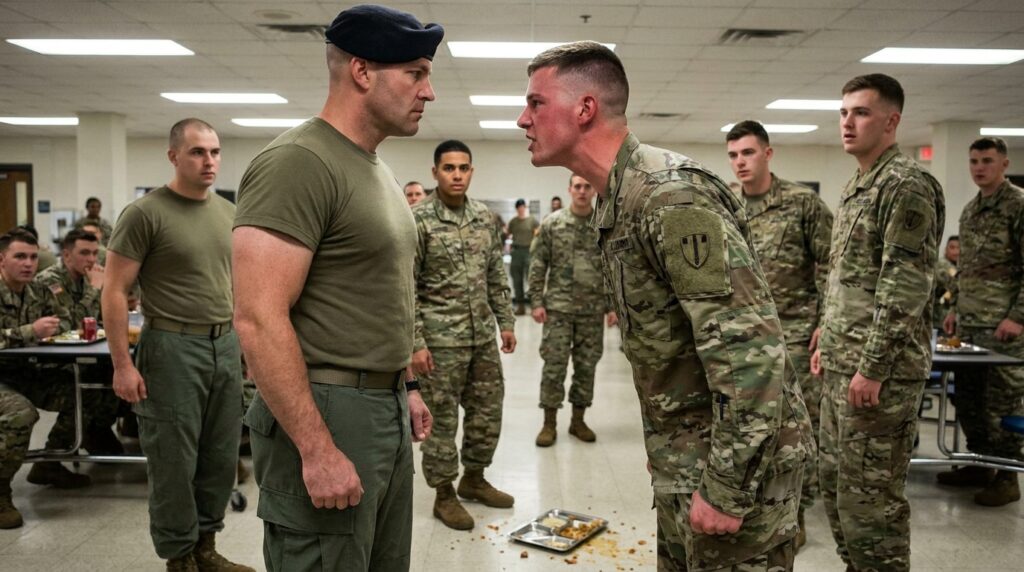
“You don’t scare me, I’m not backing down,” the boy sneered, his chest slamming hard against the faded green cotton of Marcus Vance’s t-shirt.
The plastic tray was still bouncing on the grey linoleum between them, a slurry of lukewarm creamed corn and greasy meatloaf splattering across the pristine leather of Private First Class Miller’s combat boots. The dining facility smelled heavily of industrial bleach and burnt coffee, a dense, humming cavern of five hundred recruits all waiting to see if the older man in the blank green t-shirt would crumble.
Marcus Vance did not shift his boots. He let his weight settle into the concrete floor, his center of gravity dropping an inch. To his left, three junior infantrymen from Miller’s squad leaned off their metal benches, their eyes tracking the sharp, white-knuckled tension in Miller’s shoulders. They wanted a show. They wanted to see the arrogant, unbadged civilian contractor acknowledge the young, hardened skin of an active-duty platoon.
Vance looked at the boy’s jawline. There was a tiny, rhythmic pulse vibrating right below Miller’s left ear—the telltale sign of a frantic adrenaline spike masquerading as courage. Vance’s internal clock measured the distance between them: four inches chest-to-chest, an unsafe perimeter for an untrained fighter, but an absolute trap for anyone caught inside Vance’s reach. He didn’t speak. He didn’t look down at the ruined food. He kept his eyes locked on the bridge of Miller’s nose, calculating the exact trajectory of the kid’s weight if he decided to lean forward another half-inch.
The silence around the tray return counter began to spread outward, a cold grease fire choking out the ambient clatter of stainless steel forks and distant laughter. The room was tilting toward the center lane.
“I asked you a question, old man,” Miller whispered, his voice pitching higher as the lack of an immediate reaction began to rattle his confidence. He stepped his right foot forward, a classic, aggressive crowding maneuver meant to force a flinch. “You lost your tongue along with your unit patches?”
Vance felt the air leave the boy’s lungs just before the muscle in Miller’s shoulder twitched. It was an offensive movement—clumsy, telegraphed, driven entirely by the expectation that an unadorned elder would shrink from a uniform.
Vance’s right hand moved with the economic precision of an hydraulic piston. He didn’t swing. He didn’t draw back. His fingers simply shot forward, catching the stiff, starchy lapel of Miller’s camouflage blouse right below the throat. With a single, sharp twist of his scarred wrist, Vance gathered the fabric into an iron knot, pulling Miller down and forward three inches while driving his thumb directly behind the boy’s clavicle.
The momentum of Miller’s entire body came to a dead stop. His breath caught in his throat with a wet, ragged gasp, his spine instantly arching as the leverage of the grip locked his collarbone into place. His hands flew up instinctively to grasp Vance’s forearm, but the muscle there was like a frozen oak branch—unyielding, dense, and entirely indifferent to the frantic pulling of a twenty-year-old recruit.
The entire cafeteria dropped into a vacuum. A fork clattered against a tray three rows back, the sound echoing like a pistol shot against the cinderblock walls.
Vance leaned his head in closer, his perfectly shaped green beret tilting just enough to cast a shadow across Miller’s widening eyes. He spoke in a clipped, low command tone that didn’t carry past the immediate aisle, but hit Miller like ice water.
“Watch your tone before this gets worse.”
Vance’s eyes drifted past the boy’s terrified face, catching a small, glinting shape sticking out from Miller’s unbuttoned chest pocket—a heavy, serialized brass keycard bearing the red security stamp of the Base Commander’s private office, an object no Private First Class should have possessed.

CHAPTER 2: THE SHARP EDGE OF THE CROWD
“You’re tracking something you shouldn’t be, Private,” Marcus Vance said, his voice a low, granular vibration against the roar of the dining facility’s refrigeration units.
He didn’t release the collar. The starched camouflage fabric remained gathered in his fist, a stiff knot of cotton-poly blend that kept Private First Class Miller anchored at a precise, forward-leaning tilt. Up close, the boy smelled of cheap hair pomade and the cold, metallic sweat of someone who had just realized his armor was made of paper. Miller’s eyes darted downward, his pupils dilating as he tried to follow Vance’s gaze toward his unbuttoned chest pocket.
The brass edge of the serialized keycard glinted under the harsh, unshielded fluorescent bars overhead. To an ordinary recruit, it looked like a standard facility pass. To Vance, who had spent a decade routing operational logistics through the dark corners of the Pentagon’s elite readiness groups, the specific layout of the three indented ridges near the magnetic strip was unmistakable. It belonged to the Base Commander’s inner sanctum—the secure planning room where the upcoming Tier 1 combat assessment keys were stored.
“I don’t… I don’t know what you’re talking about,” Miller stammered. His cockiness had dissolved into a frantic, shallow breathing pattern, his chest heaving against Vance’s arm. “It’s just an old locker badge. Let go of me.”
“Locker badges don’t carry the red three-dot stamp of Fort Hogan’s headquarters command cell,” Vance murmured, his voice cutting through the localized silence like a razor blade through wet canvas. “And they certainly don’t match the specific metallurgy of a Class-A encrypted lock cylinder. Try again, Private. While you still have the breath to manage it.”
Behind Miller, the three members of his squad had stopped grinning. Their bodies, previously loose and arrogant, snapped into a rigid, defensive alignment. The largest of them—a square-jawed specialist with a recent combat infantry badge pinned to his chest—shifted his boots on the linoleum, his hand dropping toward his side in a mechanical reflex that simulated a weapon draw. He took a single, heavy step into the aisle, his boots crunching through the splattered meatloaf and creamed corn.
“Hey, pal,” the specialist muttered, his voice dropping into a menacing, transactional tone. “The Private told you to let him go. You’re a civilian contractor. You touch active-duty personnel again, and this room isn’t going to be big enough for you to hide in.”
Vance didn’t turn his head toward the specialist. His vision remained fixed on Miller, but his peripheral awareness locked onto the specialist’s posture, calculating the distance at precisely five and a half feet. A lunging step would take ninety milliseconds; a swinging blow would take double that. The environment was filled with sharp edges—the stainless steel edges of the tray return line, the bolted metal legs of the dining tables, the hard concrete floor. Every object was a potential point of leverage or disruption.
“Sit down, Specialist,” Vance said, his tone entirely devoid of anger, carrying only the absolute weight of professional certainty. “Your squad leader is currently a half-second away from a structural separation of his collarbone. If you move your right foot another three inches forward, I will use his mass to break your knees.”
The specialist froze, his boot hovering a fraction of an inch above the grey linoleum. The sheer psychological dominance of the command—issued without a single trace of hesitation or theatrical bravado—slammed into the squad like a physical barrier. They were trained for violence, but they were trained within the boundaries of conventional military protocols. They had never encountered a man who measured an alley fight with the clinical indifference of an actuary.
Miller’s fingers were still clawing uselessly at Vance’s wrist, trying to find a gap in the tendon, a moment of weakness to break the lock. But Vance’s grip was absolute, maintained by decades of muscle memory that had held target indicators steady during high-altitude jumps and deep-sea insertions. He could feel the pulse in Miller’s throat spiking past one hundred and forty beats per minute.
“Who gave it to you?” Vance asked, his eyes narrowing as he analyzed the micro-expressions on the boy’s face.
“Nobody,” Miller hissed through gritted teeth, his eyes darting frantically toward his table, where a black tactical notebook lay half-hidden beneath a pile of paper napkins. “It’s none of your business. You’re just a guest instructor. You’re supposed to teach us how to shoot, not poke your nose into base security.”
Vance’s internal logic clicked into place. The squad wasn’t just bullying recruits for amusement; they were protecting an active breach. The tactical notebook, the keycard to the commander’s office, the sudden, hyper-aggressive territorial defense of a simple cafeteria aisle—they had the assessment keys. They were planning to cheat on the Tier 1 deployment readiness evaluations, a screening process designed to filter out the psychologically unstable before they were sent into high-threat operational zones.
“It becomes my business when the men I am sent to evaluate turn out to be thieves,” Vance said softly. He allowed his left hand to rise, his index finger tracing the red security stamp on the exposed card without breaking his right-handed grip on Miller’s neck. “Because a thief in a staging area is a corpse in the field. And I don’t waste my time training ghosts.”
The silence in the dining facility had deepened into something suffocating. The hundreds of recruits at the surrounding tables had entirely stopped eating, their faces turned toward the aisle like rows of grey stone markers. The air was thick with the low, electric hum of the overhead lights, casting long, sharp shadows across the concrete.
Vance could feel the tactical paradigm shifting. He had the private locked down, but the squad was getting desperate. The specialist’s jaw was clamped tight, his eyes darting toward the exit doors at the far end of the facility, looking for a distraction, a way out before the structural reality of the base crashed down on them.
Then, from the far side of the double-doored entryway, the unmistakable, heavy rhythmic click of polished low-quarters boots began to echo down the long concrete corridor, moving steadily toward the mess hall.
CHAPTER 3: THE ANATOMY OF THE ARCH
The rhythmic, heavy click of polished low-quarters against the concrete hallway stopped exactly at the threshold of the double doors.
Marcus Vance did not alter the pressure of his grip by a single ounce. His thumb remained dug cleanly behind Private First Class Miller’s clavicle, a steady anchor of pain that kept the boy’s spine locked in a submissive, backward-curved arc. Vance’s internal calculations had already compartmentalized the newcomer’s stride before the boots even cleared the frame: a heavy heel-to-toe strike, precise twenty-eight-inch spacing, and the slight, systemic squeak of high-gloss regulation dress leather. It was an old soldier’s walk. A man who had spent thirty years letting a base layout adjust to him, rather than the other way around.
The doors swung inward with a dull, hydraulic hiss. The cold air from the main corridor rolled across the grease-thick warmth of the dining hall, cutting through the smell of the spilled meatloaf between Vance and Miller.
It wasn’t a patrol leader. It wasn’t a duty officer.
Command Sergeant Major Reynolds stood in the open geometry of the doorway, his olive-drab utility jacket immaculate, the black-and-gold rank insignia on his chest catching the harsh, overhead fluorescent glare like a pair of polished iron teeth. His eyes, set deep into a face that looked like it had been carved from North Carolina limestone, did not drift toward the five hundred recruits who had instantly frozen with their forks halfway to their mouths. He didn’t look at the splattered tray on the linoleum.
Reynolds’s gaze traveled straight down the center aisle, locking instantly onto Vance’s unadorned green t-shirt and the precisely shaped green beret resting low on his weathered brow.
“Private Miller,” Reynolds said. His voice wasn’t loud, but it possessed the flat, gravelly resonance of a mortar baseplate hitting frozen earth. The sound seemed to bounce off the white cinderblock walls, dropping the ambient noise of the entire facility into an absolute, unbreathing void. “You appear to have lost your balance.”
Miller didn’t answer. He couldn’t. The iron lock Vance maintained on his collar fabric kept his windpipe compressed just enough to turn any attempt at an explanation into a faint, breathy click. His fingers, still wrapped around Vance’s forearm, had gone white at the knuckles, trembling from the sheer isometric strain of trying to pull down a wall.
To Vance’s right, the square-jawed specialist who had taken an aggressive step forward pulled his boot back so fast the heel left a black skid mark on the grey floor. The entire squad seemed to shrink, their shoulders dropping two inches as they tried to dissolve into the bolted metal benches behind them. The specialist’s hand, which had been hovering near his side, snapped flat against the seam of his cargo pants.
Vance watched Reynolds walk down the aisle. The Sergeant Major didn’t hurry. He moved with a heavy, deliberate pace, his eyes never leaving Vance’s face. There was no anger in Reynolds’s expression; there was only the cold, investigative ledger of a man who knew every structural vulnerability of the base he commanded. He stopped exactly two feet from the dropped tray, his polished low-quarters resting on the very edge of the creamed corn slurry.
For three seconds, the room existed in a state of absolute, suspended animation. The five hundred recruits watched the unadorned civilian contractor hold a platoon leader by the throat in front of the most feared enlisted man on the installation.
Then, Reynolds’s spine went rigid. His right hand snapped up from his side, his fingers forming a flawless, razor-sharp plane that stopped exactly half an inch above the outer corner of his right eyebrow. A perfect, textbook regulation salute.
“Master Sergeant,” Reynolds said, his tone striking the concrete room like a hammer. “Base Command did not inform me you had arrived ahead of the logistics transport.”
The shock wave among the recruits was silent but visible. Vance saw Miller’s eyes roll back slightly in his sockets, his jaw going entirely slack as the word Master Sergeant registered through his panic. The boy’s gaze flicked from Vance’s plain, unbadged tee up to the green beret, finally identifying the specific, aggressive tilt of the wool that only came from a lifetime in the teams. He wasn’t dealing with a civilian clerk. He was dealing with Marcus Vance—the guest consultant brought in to run the black-box readiness evaluations that would determine who went to the line and who stayed behind to paint fences.
Vance let his right hand uncurl from Miller’s lapel. He didn’t drop the boy; he simply released the tension, allowing Miller’s boots to hit the floor with a clumsy, hollow thud. The boy stumbled back two steps, his hand flying to his throat as he drew in a ragged, whistling lungful of air, his chest heaving under his stiff camouflage uniform.
Vance didn’t return the salute with a hand gesture. He simply nodded once—a sparse, professional acknowledgement between two men who had shared the same dirt in Kandahar when Miller was still in elementary school.
“The transport was running forty minutes behind schedule, Sergeant Major,” Vance said, his voice flat and level. “I prefer to move under my own power. The dining facility seemed like a reasonable place to observe the local standard of discipline.”
Reynolds turned his head slowly, his eyes fixing on Miller, who was currently trying to steady his breathing while keeping his head bowed. The Sergeant Major’s gaze then drifted to the table behind the boy, tracking the precise spot where the black tactical notebook lay half-concealed under a pile of crumpled paper napkins.
“And what is your assessment of the local standard, Master Sergeant?” Reynolds asked softly.
Vance glanced down at the glinting brass edge of the keycard still protruding from Miller’s unbuttoned chest pocket. The physical evidence was clear, but the chess board had just expanded. If he exposed the keycard right here, in front of five hundred witnesses, the leak would become public record before the sun went down. The squad would go to the brig, but the security breach at headquarters would force Base Command to lock down the entire training cycle, ruining the timeline for the deployment.
Vance reached out, his thick, scarred thumb catching the lip of Miller’s pocket. With a single, smooth downward stroke, he pushed the brass card deep into the fabric, hiding the red three-dot stamp from the room’s view.
“The physical discipline is soft, Sergeant Major,” Vance murmured, his eyes locking onto Miller’s terrified face, letting the boy know exactly what was being withheld. “The Private here crossed a boundary line because he didn’t check his corners. But the real deficiency isn’t physical. It’s operational.”
Reynolds didn’t blink. He tracked Vance’s hand movement, his old soldier’s intellect instantly calculating the significance of the hidden card and the half-covered notebook. A faint, hard line deepened at the corner of Reynolds’s mouth. He knew exactly what Vance was doing. He knew the master sergeant was keeping the investigation local—for now.
“Private Miller,” Reynolds barked, the sudden volume causing the boy to jump.
“Yes, Sergeant Major!” Miller choked out, his voice cracking.
“You have exactly ninety seconds to clear this aisle of your incompetence,” Reynolds said, pointing a heavy finger at the splattered linoleum floor. “You will use your bare hands to gather every scrap of that tray. Your squad will assist you. If I see a single grain of rice on this floor when the clock hits zero, I will personally ensure your entire platoon spends the deployment cycle unloading shipping containers in the rain.”
The square-jawed specialist and the rest of the squad didn’t wait for a second order. They dropped to their knees like broken hinges, their fingers tearing at the paper napkins, scraping the greasy meatloaf off the grey floor with frantic, desperate speed. Miller scrambled down beside them, his uniform trousers soaking in the spilled gravy as he grabbed the plastic tray, his hands shaking so violently it rattled against the concrete.
Vance watched them crawl. His mind was already moving past the cafeteria floor, tracking the cold, iron reality of the brass keycard. Miller was just the carrier. The person who had actually bypassed the encrypted lock at headquarters was still sitting in an office upstairs—and that person was the real target.
CHAPTER 4: THE PRESSURE OF THE LOCK
“You skipped three steps on your approach, Private,” Marcus Vance said, his boots clicking in a low rhythm against the dark concrete floor of the corridor outside the main dining hall.
Behind them, the muffled clatter of five hundred scraping trays died out, replaced by the damp, quiet chill of the headquarters basement tunnels. Command Sergeant Major Reynolds walked two paces ahead, his arms locked rigidly behind his back, his polished low-quarters moving without a single hint of hesitation toward the administrative holding blocks. Miller followed between them, his boots dragging, the knees of his camouflage uniform still wet with grease and gray dishwater from the floor.
“I didn’t… I didn’t mean to cross a line, sir,” Miller muttered, his teeth clicking together in a tight, uncoordinated rhythm. The arrogance that had inflated his chest minutes before had collapsed entirely, leaving behind only the cold, mechanical panic of a junior soldier who had just realized his entire squad was pinned to a sinking ship.
“You didn’t just cross it, Miller. You built a camp on it,” Vance murmured, not turning his head. His eyes mapped the architecture of the corridor: concrete pillars spaced every twelve feet, heavy iron electrical conduits running overhead like black veins, and the stark glare of reinforced wire-glass windows looking into empty briefing rooms. It was an environment designed to suppress noise and individual leverage. Every surface was cold, flat, and hard.
Reynolds stopped abruptly in front of a heavy steel door marked Enlisted Administration – Secure Holding. He turned his key in the lock with a sharp, double-click that echoed down the concrete passage. He pushed the door open, stepped inside, and waited until Miller and Vance cleared the threshold before slamming it shut. The heavy iron latch dropped with a finality that made the air in the room expand against Vance’s ears.
The room was small—ten by ten—with a single bolted steel table and two plastic chairs. No windows. A single, naked bulb hung from an iron box in the ceiling, casting long, sharp-edged shadows down the cinderblock walls. On the table sat the black tactical notebook Vance had spotted under the paper napkins in the dining hall, brought along by Reynolds’s orderly without a single word being spoken.
“Sit,” Reynolds barked.
Miller dropped into the nearest chair as if his joints had been dissolved by acid. His hands flat on the cold steel table, he stared down at his own knuckles, his short infantry haircut glistening with sweat under the bare bulb.
Vance walked to the far corner of the room, leaning his massive, muscular shoulders against the cold concrete block. He didn’t sit. He liked the vertical advantage; it allowed him to look down at the geometric lines of Miller’s posture, noting the twitch in the boy’s right forearm and the shallow, frantic rise and fall of his chest.
Reynolds picked up the tactical notebook, threw it flat onto the center of the steel surface, and leaned forward until his weathered, stone-carved face was three inches from Miller’s eyes.
“Where did you get the keycard, Private First Class?” the Sergeant Major asked, his voice dropped to a level that was deadlier than a shout. “And don’t tell me you found it in the motor pool. That card is serialized to the Base Commander’s inner desk. The logs show it hasn’t been checked out since the readiness evaluation materials arrived last Monday.”
Miller’s tongue darted out to wet his lips. His gaze flicked to the notebook, then up to the green beret resting low on Vance’s brow, looking for any gap in the wall. Finding none, his shoulders slumped further.
“It was Specialist Geller,” Miller whispered, his voice cracking under the pressure of the single light bulb. “He… he said the assessment keys were already leaked on the internal server. He said everybody was using them to pass the tier-one screening. We weren’t the only ones, Sergeant Major. The whole third platoon has the files in that notebook. We just needed the physical pass to clear the terminal in the study room.”
Vance’s internal ledger shifted. It was an elegant answer—too elegant. A Specialist in an infantry battalion didn’t simply find a hole in an encrypted command server, and he certainly didn’t walk out of the headquarters building with a Class-A security card without tripping three separate silent indicators. The kid was telling the truth about the cheating, but the explanation was a false flag. It was a decoy secret designed to satisfy an investigator who was only looking for a standard case of academic fraud among the ranks.
“Geller didn’t steal that card, Miller,” Vance said from the darkness of the corner, his voice causing the boy to flinch. “A Specialist doesn’t have the biometric clearance to open the secondary locker where that brass is kept. Someone handed it to him. Someone who wanted your squad to walk into that study room and download those files.”
Miller looked up, his pupils wide and dark. “No, sir. I saw the logs on Geller’s phone. It was an open link. It came from the operations officer’s clerk. We just thought… we thought someone forgot to lock the folder after the morning brief.”
Reynolds turned back toward Vance, his bushy gray eyebrows drawing together in a hard, investigative line. “Master Sergeant, if third platoon has been using leaked keys, the validity of the entire combat readiness score is compromised. I’ll have to notify the Colonel immediately. We’ll have to halt the staging sequence.”
Vance didn’t answer right away. He walked to the table, his thick, scarred fingers picking up the black notebook. He flipped through the pages, his eyes skipping past the handwritten tactical diagrams and the strings of alpha-numeric assessment keys until he found what he was looking for: a tiny, purple ink smudge on the inside margin of the binding. It wasn’t an operational stamp. It was an inspection dye—the specific kind used by the Department of the Army’s Internal Safeguards Division to track documents during counter-intelligence stings.
The trap wasn’t just local.
Vance looked at Reynolds, the reality of the situation clicking into place like the teeth of a heavy gear. If Reynolds called the Colonel to report the leak, he would be walking directly into a pre-engineered snare. The leak hadn’t been an accident by a careless clerk. It was a bait system, and Miller’s squad was just the vermin that had tripped the wire. But before Vance could voice the calculation, the iron handle of the secure room door rattled violently.
The latch clicked back, and the door swung open, revealing the sharp, high-gloss leather boots of an administrative captain standing in the cold light of the corridor, an urgent red clearance file clutched tightly in his hand.
CHAPTER 5: THE APEX OF THE CROWD
“The Colonel wants the room cleared immediately, Sergeant Major,” the administrative captain said, his hand bracing the heavy steel frame of the doorway.
He didn’t step fully into the holding room. Instead, his eyes darted from Private First Class Miller’s shivering shoulders to the massive shape of Marcus Vance leaning against the back corner’s cinderblock wall. The red clearance folder clamped under the captain’s arm was thick, its edges reinforced with heavy plastic tape that caught the hard overhead glare like a blood-slick blade.
Command Sergeant Major Reynolds snapped his head around, his jawline locked so tight the skin over his limestone features turned a brittle, bloodless white. “The interrogation is active, Captain. This private is in possession of a high-security asset card. The chain of custody is compromised.”
“The chain of custody has been re-routed,” the captain snapped back, his voice tight, carrying the fast-paced panic of someone delivering a death warrant. He stepped forward exactly twelve inches, extending the red file toward Reynolds. “Special Authorization Order 40-Alpha. Signed by the Base Commander ten minutes ago. The screening cycle isn’t being halted, Sergeant Major. It’s being locked down under external oversight.”
Vance watched the exchange from his corner, his pulse remaining at a flat, calculated fifty-two beats per minute. His tactical intellect dissected the layout instantly. The captain’s boots were pristine, but there was wet red clay clinging to the inner groove of his left heel—the specific soil from the perimeter fence where the Department of the Army’s Safeguards team had set up their mobile command trailer. This clerk hadn’t come from the Colonel’s office upstairs. He had come from the wire.
Reynolds ripped the folder open, the stiff cardboard crackling in the small room like dry brush catching fire. As the Sergeant Major’s eyes scanned the typed lines, Vance stepped out of the shadows. His heavy cargo pants didn’t rustle; his movement was entirely silent, a dense shadow sliding over the concrete until he stood over Reynolds’s shoulder, his gaze dropping to the paper.
The document was an immediate transfer of authority. Third Platoon wasn’t being court-martialed for cheating; they were being isolated for immediate field deployment under a classified operational annex. The black notebook and the brass card were explicitly listed as internal training props—controlled counter-intelligence bait designed to identify personnel susceptible to coercion before deployment.
Vance’s mind cleared the board, resetting the pieces with a cold, unforgiving click.
Miller’s squad hadn’t found a leak. The server breach had been an engineered test. The red three-dot card Miller had used to mock him in the dining facility was never a stolen key; it was a tracking beacon. And by stepping in to neutralize the boy, Vance hadn’t just exposed a cheating ring—he had intercepted a live, controlled screening operation overseen by the base’s highest authorities. The decoy secret of the simple leaked keys had just fractured, exposing a far wider structure of institutional manipulation.
“They knew,” Miller whispered from the steel table, his face draining of what little color remained. He looked up at Reynolds, his fingers clawing at the cold metal edge. “The Specialist… Geller said it was too easy. They left the doors unlocked on purpose. They wanted us to take it.”
“Shut your mouth, Private,” Reynolds growled, but the flat, gravelly weight of his voice had vanished, replaced by the hollow realization of an old soldier who had just discovered he was policing a stage play. He looked up at Vance, his eyes dead and unblinking under his gray brows. “Master Sergeant… if this order is authentic, my reporting line is cut. The Colonel isn’t the one running this installation anymore.”
“He never was, Sergeant Major,” Vance murmured, his voice a low, level rasp. He reached out, his thick, scarred thumb pressing against the signature block of the order. The ink was fresh, but it lacked the standard department watermark. It was a local fabrication—an automated emergency printout meant to freeze local leadership before they could document the breach on official channels.
The captain stepped into the room now, his hand dropping to the buttoned flap of his service holster. “Master Sergeant Vance. You are a civilian consultant on this base. Your contract covers tactical instruction, not structural oversight. You will surrender the private’s notebook and vacate the administrative block immediately.”
The room’s geometry shifted toward a violent execution lane. The captain was tense, his weight distributed poorly on the balls of his high-gloss boots, his shoulder twitching with the telegraphed panic of a desk officer out of his depth. Vance stood three feet from him. The steel table was an obstacle, the hanging light bulb a visual barrier, the small concrete space a trap for anyone who couldn’t move within sixty milliseconds.
“You’re breathing too fast, Captain,” Vance said, his eyes narrowing as he locked onto the man’s posture. “And your holster flap is still secured by the storage clip. If you’re going to threaten a Tier 1 consultant in a closed cell, you should ensure your equipment isn’t configured for office work.”
The captain flinched, his fingers freezing on the leather flap. The psychological leverage of Vance’s absolute stillness slammed into him, stopping his momentum as cleanly as the collar lock had broken Miller in the cafeteria.
Vance didn’t look at the clerk’s face. He looked at the red folder in Reynolds’s hand. Underneath the primary transfer order, tucked into the plastic sleeve of the cardboard binding, was a second, smaller document—a list of five names, all senior tactical instructors assigned to the base.
Vance’s own name was at the top, marked with the same purple inspection dye he had found on the binding of Miller’s notebook.
The final reality remained locked behind the iron door, but the immediate target had changed. Vance wasn’t here to evaluate the recruits. The base command structure was evaluating him—and the test had just entered its second phase.
CHAPTER 6: THE FINAL RECKONING
The captain’s thumb remained paralyzed on the leather strap of his service holster, his breathing hitting a ragged, hyper-ventilated ceiling.
Marcus Vance did not give him the ninety milliseconds required to correct the error. Moving with the smooth, terrifying momentum of a falling iron beam, Vance closed the three-foot gap. His left hand shot under the captain’s extended arm, his fingers clamping like vice grips around the cylinder of the captain’s weapon through the leather casing, physically locking the firing pin before it could rotate. Simultaneously, Vance’s right forearm smashed into the captain’s chest, driving the air out of the man’s lungs in a short, wet whistle and pinning him flat against the iron door frame.
The red clearance folder fell from the captain’s grip, its stiff cardboard pages snapping against the concrete floor, scattering the white documents across the wet gray stains left by Private Miller’s boots.
“You’re done speaking, Captain,” Vance said. His voice was an unhurried, bone-dry whisper that sounded like a shovel sliding into gravel.
He didn’t look at the clerk’s wide, bloodshot eyes. His gaze remained leveled at the floor, tracking the scattered papers until it stopped on the secondary sheet—the one carrying the five names marked in purple inspection dye.
Beside the steel table, Command Sergeant Major Reynolds stood entirely still, his hands still clenched into hard, heavy hammers at the seams of his utility trousers. He didn’t intervene. His old soldier’s intellect had already parsed the watermarks on the spilled papers. The entire administrative block was a constructed vacuum, and the man standing in front of him wasn’t an ordinary contractor; he was the operator who had designed the very counter-intelligence screening filters being executed right now.
“The signature isn’t the Colonel’s,” Reynolds said softly, his voice low and heavy in the concrete room. He leaned down, his thick fingers picking up the edge of the sheet bearing the instructor names. “This is a provisional screening roster from the Department of the Army’s Safeguards Division. They didn’t leak the keys to catch Miller. They leaked the keys to see which instructors would protect the chain of command—and which ones would execute an extra-legal interrogation.”
Vance slowly released the pressure on the captain’s chest, allowing the gasping clerk to slide down the iron door frame until his high-gloss leather boots flat-lined against the concrete. Vance reached down, plucked the red file from the floor, and slid the purple-inked list into the deep pocket of his cargo pants.
“The private stays here, Sergeant Major,” Vance murmured, his eyes locking onto Reynolds’s weathered face. “He’s a carrier, nothing more. The squad cheater thinks he found an open door, but the door was built around him.”
Miller sat paralyzed in the plastic chair, his hands shaking so violently against the cold steel table that his knuckles made a rhythmic, clicking sound against the metal. “Sir… am I going to the brig?”
Vance turned toward the doorway, his perfectly shaped green beret casting a long, sharp-edged shadow across the white cinderblocks of the passage outside. He didn’t look back at the boy.
“You’re going to the line, Private,” Vance said flatly. “Where the ground doesn’t have an administrative safety switch. Clean your uniform. You look like a civilian.”
Vance walked out of the secure holding room, his boots striking the dark concrete of the basement tunnel with a slow, heavy rhythm that cut through the damp chill of the subterranean complex. Behind him, the heavy iron latch of the holding cell door dropped back into place with a dull, hydraulic crunch, locking the captain and the junior soldier inside the institutional framework they had tried to manipulate.
As Vance cleared the final security checkpoint at the end of the corridor, the stark, white midday sun of Fort Hogan slammed into his face through the wire-glass windows of the main exit. Standing on the gravel driveway forty yards away, a blacked-out transport utility vehicle sat with its engine idling, its exhaust pipes venting a thin, blue plume of diesel smoke into the dry Carolina air.
The rear door of the vehicle swung open exactly three inches.
Sitting in the dim shadow of the interior leather was Command Sergeant Major Reynolds’s orderly, holding a fresh, unmarred administrative folder with an official Department of the Army watermark—the real training directive for the cycle that was about to begin.
Vance adjusted the tilt of his beret, settled his weight into the gravel, and walked toward the vehicle. The cafeteria clash was over, the status flip was complete, and the baseline of his authority had been driven into the concrete of Fort Hogan like an iron spike. The real deployment evaluation was waiting in the tree lines beyond the wire, and he was the only man left who knew where the boundaries were buried.







