
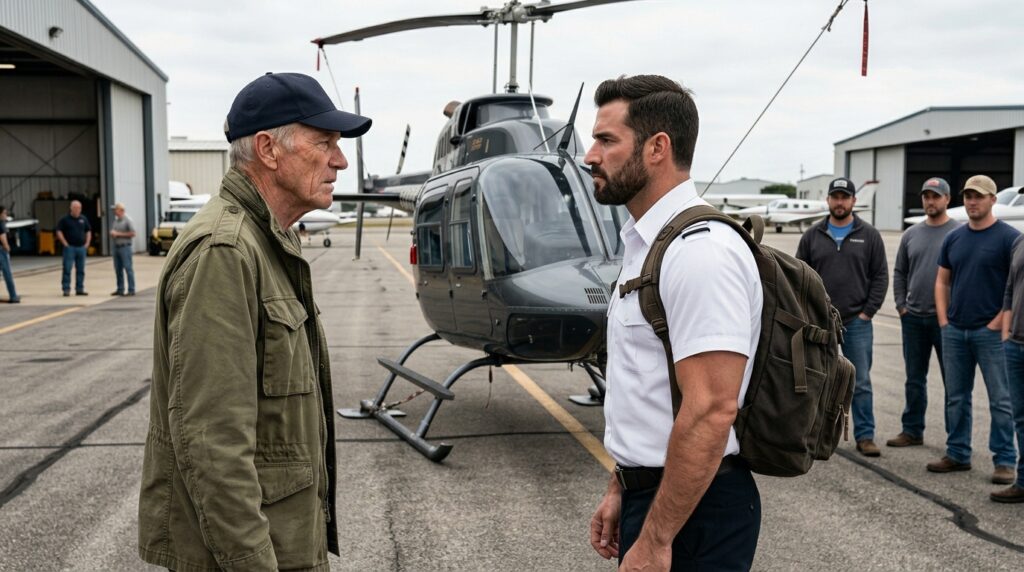
The Weight of Air and Iron: A Reckoning on the Tarmac of the High Desert

CHAPTER 1: THE TARMAC LINE

The heat on the concrete did not rise in waves; it sat flat and heavy, smelling of burnt kerosene and iron filings. Every step onto the runway line felt like pressing a boot into dry leather. Underneath the dark bill of his veteran cap, the old man kept his chin tucked, his eyes fixed on the gray tail rotor of the Bell 206 idling sixty yards out. His fingers, stiffened by old weather and the permanent ache of salt-mine labor, clamped around the edges of a worn leather ledger. The binding was split down the middle, revealing white threads like exposed tendons. He did not look at the perimeter fence behind him or the warning signs that had lost their yellow paint to the high desert wind. He only looked at the machine.

A shadow broke the glare from the aluminum hangar doors to his right.

“Hey! Old man! You’re in the path of the rotor wash!”

The voice was clean, amplified by the flat expanse of the tarmac. The younger man didn’t run; he marched with the heavy, deliberate stride of someone whose boots were brand new and heavily cushioned. He wore a crisp white uniform shirt, the seams sharp enough to cut grease, and a heavy tactical backpack strapped tightly across his chest like armor. His trimmed beard didn’t show a single gray hair, and his hands were already clear of his sides, fingers hooked slightly as if waiting for a whistle.

The veteran didn’t stop. He didn’t speed up. His boots, split at the welt and covered in a fine layer of alkaline dust, kept their rhythmic click-clack against the aggregate concrete. He could feel the vibration of the helicopter through the soles of his feet—a low, rhythmic thrumming that matched a pulse he had spent forty years trying to forget.

“I said halt,” the younger man called out again, his shadow now stretching long enough to touch the old man’s boots. He stepped directly into the lane, his muscular frame cutting off the view of the cockpit. He smelled of laundry detergent and synthetic gun oil. “This area is restricted under Section Four. Turn around and take the gate back to the access road.”

The old man stopped. He didn’t drop the ledger. He stood with his shoulders slightly rounded, the olive jacket hanging loose over a frame that had lost its meat but kept its bone.

“The logs are for Miller,” the old man said. His voice was like two gravel bags rubbing together in the back of a truck. “Tell him the book from the canyon is here.”

“There’s no Miller on this flight manifest,” the contractor said, stepping closer until his chest gear nearly brushed the frayed zipper of the olive jacket. His hand rose—a thick, pale hand with reinforced composite knuckles on the glove. He reached out and grabbed the veteran by the meat of his chest, fingers locking into the fabric to shove him back toward the gravel. “You need to turn around right now, old man—this area is restricted.”

The old man’s feet didn’t slide. They stayed rooted into the concrete, his weight shifting forward into the contractor’s palm just enough to kill the momentum of the push.

“Take your hands off me,” the old man said, his eyes rising to lock onto the contractor’s blue irises, “and show some respect.”

The contractor didn’t let go; his jaw clenched, his knuckles tightening on the olive cloth. In the reflection of the helicopter’s canopy behind them, a dark silhouette was moving inside the cockpit, but the old man didn’t look. He didn’t have to. His left hand dropped the ledger three inches, catching it by the split binding with his fingertips, while his right hand moved up the contractor’s forearm with the smooth, frictionless velocity of an iron piston that had been oiled every morning for fifty years.


CHAPTER 2: THE LEVERAGE POINT

The old man didn’t pull back. Pulling back was an admission that the other man’s weight belonged where it was. Instead, he drove his right thumb directly into the soft gap between the contractor’s carpal bones—the small, unarmored valley just behind the reinforced composite knuckles of the glove. It was a precise, localized pressure, the kind learned in the hold of gray transport hulls where space was small and noise had to be kept to a minimum.

The contractor’s breath left him in a sharp, wet hiss. His fingers uncurled from the olive jacket like old iron cooling in water.

Before the younger man could calculate the failure of his grip, the old man pivoted his left heel into the concrete aggregate, his boot heel grinding a small circle of white dust into the tarmac. He didn’t lift his arms in a theatrical display of force. He simply dropped his center of gravity three inches, allowing the contractor’s forward momentum to slide off his shoulder like rain off a tin roof. With a short, tight rotation of his forearm, he cleared the lane entirely, stepping three inches into the younger man’s perimeter.

The contractor stumbled, his boots scraping heavily against the grit of the runway before his knees locked to find their balance. His heavy tactical backpack shifted with a dull clatter of plastic clips, the white uniform shirt wrinkling across his shoulder blades as his arms went wide to catch the air.

The old man stood exactly where he had ended the motion. The split leather ledger was still tucked against his side, his left fingers hooked into the binding. His breath didn’t rattle. His pulse stayed slow, a rhythmic tick against his jawline that had survived three separate desert deployments before the contractor had even learned to tie his first standard issue laces.

“You’ve got grease-pencil on your cuff,” the old man said, his gravelly voice flat against the thrum of the idling Bell 206. He pointed with his chin toward the younger man’s left wrist, where a faint purple mark crossed the starched fabric just above the watch line. “Sector Three logistics mark. Miller’s mark. Don’t tell me he’s not on the manifest when you’re carrying his ink.”

The contractor’s face went from the dark red of sudden exertion to a tight, gray pallor. His eyes dropped to his own wrist for a fraction of a second, his jaw clenching until the muscle beneath his trimmed beard twitched. He didn’t reach for his belt. The initial instinct to dominate through bulk had been replaced by something older and much more dangerous: caution. He looked at the old man’s cap, then at the stable, wide-rooted stance of the split-welt boots. The arrogance had drained out of his posture, leaving only the hard, professional posture of a man who had realized the parameters of the room had changed without his permission.

Behind them, the helicopter’s turbine whined higher, the blades cutting the high desert air into rhythmic, slicing thuds that kicked up tiny pebbles from the runway line. The heat shimmer between them grew thicker, smelling of hot hydraulic fluid and parched earth.

“You’re Miller’s hand,” the old man continued, his eyes remaining unblinking beneath the dark bill of his cap. “He always did like them big. Thought it kept people from looking at the numbers in the book. But you don’t know how to carry your weight on concrete. You’re all top, no foundation.”

The contractor let his arms drop slowly to his sides, his fingers no longer hooked. He took a single step back, not in retreat, but to re-establish the dynamic distance he should have kept from the beginning. His eyes remained fixed on the veteran’s hands, watching for the slightest shift in the leather folder.

“The manifest is locked from the tower,” the contractor said, his voice dropping an octave, the institutional clip gone from his delivery. It was the tone of one operator talking to another across a perimeter line. “I don’t look at the names. I look at the clearances. And your name isn’t on the gate log.”

“My name was on this concrete before they poured the topcoat,” the old man said. He lifted the ledger slightly, the cracked leather catching the harsh glare of the midday sun. “And Miller knows exactly what happens if this book stays out in the canyon after the three-o’clock bird leaves.”

The contractor looked from the ledger back to the old man’s weathered face. A mechanic across the tarmac dropped a heavy socket wrench, the metallic clank echoing off the side of the aluminum hangar like a rifle shot. Neither man flinched. The distance between them remained three feet—the exact range of a knife-hand strike or a short, liver-seeking thrust.

“The three-o’clock bird isn’t for corporate,” the contractor muttered, his eyes darting toward the cockpit silhouette where the pilot was adjusting the overhead toggles. “They told us it was a recovery run for the old ordnance dump.”

“They lied to you,” the old man said softly. “They wanted to make sure you’d stand here and take a punch for a pile of rusted iron. But this isn’t iron.”

He turned the ledger over in his hand, revealing a small, brass-rimmed eyelet set into the lower corner of the back cover—a naval classification marker that hadn’t been used since the old operations along the salt flats were closed down by executive order in eighty-four. The purple grease-pencil mark on the contractor’s cuff matched the faded violet ink stamped into the margin of the ledger’s first visible page.

The contractor took a deep breath, his chest gear rising and falling against his white shirt. He looked at the helicopter, then back at the veteran, his hand rising not to strike, but to touch the small communication bud hooked behind his ear. His fingers hovered over the plastic switch for three long seconds while the wind from the rotor blades began to pull at the collar of his uniform.

“Miller,” the contractor said into the small microphone, his eyes never leaving the old man’s face. “We have an anomaly at the Sector Four line. He’s holding the purple ledger.”

A long pause followed, filled only by the rising scream of the turbine. The contractor’s face tightened as the response came through the earplug, his shoulder blades dropping as the tension left them, replaced by a sudden, chilling clarity. He looked at the old man with a new kind of attention—the kind reserved for a ghost that had suddenly materialized on a live firing range.

“He wants you in the hangar,” the contractor said, dropping his hand from his headset. He stepped out of the physical lane, his body pivoting to clear the path toward the idling machine. “But he said to leave the cap outside.”

The old man didn’t move immediately. He looked down at the concrete between them, where the dust was swirling in the wind from the blades, then looked straight into the darker shadows of the open hangar bay forty yards away. A figure was standing there, just beyond the light line, hands behind its back.

“The cap stays on,” the old man said. He tucked the ledger deeper under his arm and stepped into the cleared lane, his boots clicking in a steady, unbroken rhythm against the hot stone.

CHAPTER 3: THE TURNING LINE

The wash from the rotor blades lessened slightly as the old man drew closer to the cavernous opening of the hangar, but the air here carried a different kind of friction. Inside the threshold, the light changed from the white glare of the desert floor to a deep, oil-stained twilight. The concrete underfoot was no longer raw aggregate; it was smooth, decades-old slab, crosshatched with hairline cracks that had filled with black grease and fine silica over forty seasons of heavy maintenance.

He didn’t look back to check the contractor’s position. He could hear the heavy, rubberized slap of the younger man’s boots trailing five paces behind, the synthetic fabric of his chest rig whistling with each stride. That was the distance of compliance, but it was also the distance of execution. The old man kept his stride deliberate, each step pulling his olive jacket tight across his shoulder blades, the leather folder anchored hard against his ribs.

As his eyes adjusted to the shade, the massive interior of Hangar 3 revealed its true geometry. This wasn’t a standard corporate logistics bay. Against the back wall sat three olive-drab tool cabinets, their drawers locked with thick, brass padlocks that bore the anchor stamp of the old Navy procurement boards. Overhead, a steel gantry crane hung stationary on its tracks, its hoist chains rusted to a dark cocoa brown, frozen above an empty workspace where a heavy radial engine had once leaked its weight into the floor.

The figure standing in the shadows didn’t move as the old man crossed the light line.

“You haven’t changed the boots, Frank,” the man said.

The voice didn’t carry the contractor’s aggressive volume. It was thin, reedy, worn down by forty years of air-conditioned offices and dry valley drafts. Miller stepped forward into the gray illumination cast by the high clerestory windows. He was eighty now, his frame slightly more stooped than the old man’s, wearing a loose-fitting khaki flight jacket with the patches cut away, leaving only the dark squares of adhesive residue where his name and rank had once been stitched.

“The soles are still good,” Frank said, stopping exactly four feet from the khaki jacket. He didn’t drop his left hand from the folder. “The topcoat out there is getting thin, though. You can see the old bedrock coming through near the tie-downs.”

Miller looked down at Frank’s boots, his faded eyes tracking the alkaline line along the leather welts before rising to the dark bill of the veteran cap. He let out a dry, clicking breath through his teeth. “I told the boy out there to take the cap. He doesn’t know what it means, but the logistics team from the capital has a satellite link active in the office. They see that emblem, they start checking the deactivated files. We don’t want them looking at eighty-four, Frank.”

“Then you shouldn’t have authorized the grease-pencil on his cuff,” Frank said, his voice flat, deadened by the vast corrugated tin walls around them. “He’s running manifests for the canyon route. I saw the three-digit marker on the belly of that machine out there before the paint dried. That’s not a civilian registration number, Miller. That’s the tail from the old salt flats detachment.”

Behind them, the contractor stepped up to the threshold, his bulk blocking a portion of the midday light. “Mr. Miller, he broke my grip on the line. He has a non-standard classification document.”

Miller didn’t look at the contractor. He kept his eyes fixed on the cracked leather binding under Frank’s arm. “Go back to the fuel truck, son. Secure the perimeter ropes. If the three-o’clock bird doesn’t have its clearance papers signed by the time the wind shifts, nobody’s leaving this valley.”

The contractor hesitated, his fingers twitching against the straps of his tactical backpack. For a second, his jaw set as if he wanted to argue the logic of leaving a civilian inside the primary bay, but the absolute stillness of the two older men seemed to press against him like physical mass. He dropped his hand, turned on his heel, and let his boots scrape back across the concrete toward the idling engine outside.

When the sound of the contractor’s footsteps faded into the steady thrum of the rotor blades, Miller reached into his khaki pocket and pulled out a small, nickel-plated penknife. He didn’t open the blade; he just rolled the cold metal between his palms, the click-clack of his knuckles matching the distant sound of the repair crew across the field.

“The funding line was dissolved six months ago, Frank,” Miller said softly, his voice dropping into the confidential rhythm of an old tactical briefing. “The capital closed the account. They called it a ‘recollection of legacy resources.’ That contractor out there thinks he’s guarding a scrap contract for old titanium casing. That’s what the firm told him. That’s what the regional ledger says.”

“But the logs inside this book say something else,” Frank said. He didn’t offer the folder yet; he held it like an shield against his ribs. “The fuel consumption columns from seventy-nine through eighty-three don’t match the weight of titanium. They match the payload of the heavy transport runs into the border sector. The runs we signed for with the violet ink.”

Miller stopped rolling the knife. His thumb pressed into the nickel plating until his skin went white. He looked toward the deep rear of the hangar, where a stack of old canvas-covered crates lay beneath a layer of gray dust so thick it resembled felt.

“We buried those flight coordinates forty years ago, Frank,” Miller muttered, his eyes narrowing as a draft from the runway rattled the loose tin sheets near the roof line. “If that log gets entered into the digital manifest for the three-o’clock flight, the recovery fund gets audited by the civilian oversight committee. Every name on those old crew sheets gets pulled out of retirement. My name. Your name. The ones we left out in the salt.”

Frank looked down at the frayed edge of his own cuff, where the thread was unraveling against his wrist. He could smell the old canvas from the rear crates—a musty, vinegar scent that brought back the memory of the long nights under the camouflage netting, watching the blacked-out transport planes drop their bellies into the dry lakes.

“The oversight committee isn’t what’s coming on that plane, Miller,” Frank said, his voice dropping into a gravelly whisper that barely carried across the four feet between them. “I saw the cargo list at the canyon checkpoint before I walked the line. They aren’t auditing the funds. They’re clearing the physical archive before the field lease expires tonight.”

A shadow crossed the high windows of the hangar as a larger cloud moved over the desert sun, plunging the interior into a sudden, deep twilight. From the office at the far end of the bay, a blue digital line flickered behind the glass—the active terminal connection to the capital, waiting for the upload that would either erase the line forever or pull the old operations back into the light.

CHAPTER 4: THE VIOLET INK

The blue light from the office terminal cut through the hangar’s gloom like a welding arc through dirty glass. It pulsed with a steady, rhythmic flicker, casting long, wavering shadows across the concrete floor. Frank did not wait for Miller to grant permission. He stepped away from the older man, his split-welt boots carrying him toward the partitioned glass of the foreman’s office.

The door was propped open with a rusted iron cylinder head. The air inside smelled of ozone, stale coffee, and the sharp, metallic tang of overheated circuitry.

Frank stepped to the desk. It was an old military-surplus tanker desk, the green paint chipped away at the edges to reveal raw steel oxidized by decades of desert humidity. He dropped the worn leather ledger onto the surface. The impact sent a small vibration through the floorboards.

Miller appeared in the doorway, his silhouette blocking the ambient light from the high windows. He didn’t enter the room. He stood on the threshold, a pragmatist calculating the blast radius of a bomb he had helped build.

“You can’t stop the handshake protocol, Frank,” Miller said, his voice flat over the whine of the server tower beneath the desk. “The terminal is linked directly to the capital’s logistics hub. Once the helicopter pilot enters the transponder code, the digital manifest locks. The old fund is wiped clean. We walk away.”

Frank didn’t look up. He reached out with a stiff, calloused thumb and hit the spacebar on the terminal keyboard.

The screen flared bright blue, displaying a cascading wall of routing strings and alphanumeric transit codes. At the top of the header, in stark white block letters, read the active contract: TITANIUM SCRAP RECOVERY – REGIONAL SECURITY ALLOCATION.

“Walk away to where, exactly?” Frank muttered. He opened the ledger. The spine cracked with the sound of snapping tendons. The pages were stiff, yellowed at the edges, smelling of vinegar and dry rot. He bypassed the front pages and flipped directly to the center of the book, to the columns stamped in faded violet ink. “You think the capital is just going to erase the slate and leave us our pensions? They don’t erase, Miller. They reallocate.”

Frank dragged his index finger down the columns of the old ledger. Forty years ago, these numbers represented fuel weight, munitions, and the unspoken tonnage of things left buried out in the salt flats. Now, he tracked the corresponding sequence of digits on the terminal screen.

He found it halfway down the active transfer window.

Frank tapped the thick glass of the monitor. “Look at the routing string for the security firm guarding the perimeter outside. The private military contractors. Look at the origin account.”

Miller finally stepped into the room. He leaned over the desk, his faded eyes narrowing as he read the sequence of numbers beneath Frank’s bruised fingernail. The origin account for the private security firm wasn’t a corporate treasury. It was an exact numeric match to the deactivated military recovery fund in the violet ledger.

The heavy reality of the ledger settled over the room like iron dust. This was the decoy they had been sold.

“They didn’t dissolve our old fund,” Frank said, his voice dropping into a deadly, quiet cadence. “They’re using our own black-budget money to pay for the mercenaries standing outside. That contractor on the tarmac thinks he’s guarding a corporate titanium salvage op. He doesn’t know his paycheck is being drawn from the exact operation he’s been hired to help erase.”

Miller exhaled a long, slow breath. He didn’t look surprised. He looked tired. The moral ambiguity of his pragmatism was written in the deep lines around his mouth.

“It’s clean, Frank,” Miller said softly. “It’s brilliant, if you think about it. You use the buried money to hire ignorant guns. The contractors keep the local sheriffs out. They keep the FAA blind. They provide a physical wall between the canyon and the oversight committee. And when the three-o’clock bird takes off with the archive crates, the fund zeroes itself out. The mercenaries go home, and the operation officially never existed.”

“And the men who ran the operation?” Frank asked, closing the ledger with a heavy, definitive thud. “What happens to the loose ends who know the account numbers?”

“We survive,” Miller said, his jaw tightening. “Which is more than we would do if the civilian oversight committee digs up what we put in the ground in eighty-four.”

Frank looked past Miller, through the glass partition of the office, out into the massive, oil-stained expanse of the hangar. His eyes drifted over the rusted gantry crane, the stack of dust-covered canvas crates at the rear wall, and finally, the three olive-drab tool cabinets.

Something was wrong with the friction of the room.

Frank stepped around the desk, his boots heavy on the linoleum, and pushed past Miller. He walked back out onto the hangar floor, the air instantly feeling colder despite the ambient heat radiating from the tin roof. He didn’t walk toward the crates. He walked straight toward the three military-issue tool cabinets lined up against the reinforced concrete wall.

“Frank, leave the hardware alone. We are out of time,” Miller warned, following a few paces behind, his boots scuffing the floor.

Frank ignored him. He stopped in front of the center cabinet. The heavy steel unit was coated in a thick, undisturbed layer of gray silica dust—the kind that takes years to accumulate in the dead air of a closed hangar. But the heavy brass padlock securing the hasp was different.

The padlock was gleaming.

It was completely devoid of dust, the brass polished by the recent friction of a leather-gloved hand. A faint smudge of violet grease-pencil marked the edge of the keyhole.

“You said the firm told the contractor out there this was a titanium scrap run,” Frank said, his eyes locked on the brass lock.

“They did,” Miller replied, his voice suddenly losing its confident, pragmatic edge. He stepped up beside Frank, his eyes dropping to the clean padlock. He hadn’t noticed it.

“Then why,” Frank asked, reaching out and gripping the heavy brass lock, “has someone already been inside the secondary manifest cabinet?”

He didn’t wait for Miller to answer. Frank pulled downward on the body of the padlock. It didn’t resist. The shackle hadn’t been clicked shut; it was only resting inside the hasp, staged to look locked.

With a sharp, grating scrape of metal on metal, Frank slid the hasp free and pulled the heavy steel door open. The rusted hinges screamed in the quiet hangar.

The shelves inside, meant to hold the backup flight logs and physical maintenance records for the old canyon routes, were completely empty. There were no papers. No logbooks.

Sitting in the exact center of the rusted steel shelf was a single, high-frequency transponder key—the exact model required to bypass the capital’s digital lock and authorize the helicopter’s takeoff. Beside it lay a fresh pair of reinforced tactical gloves, identical to the ones worn by the contractor outside, heavily stained with white alkaline dust.

Someone inside the private security firm wasn’t a decoy. Someone already knew exactly what was in the crates, and they had just secured the only key to fly it out.

CHAPTER 5: THE PRESSURE RAMP

“The boy didn’t do this alone,” Frank said. His fingers remained wrapped around the cold brass shape of the open padlock. He didn’t pull the transponder key from the shelf; to touch the key was to trigger a countdown he wasn’t ready to time. “The smudges on this shelf aren’t from a contractor’s supply kit. They’re from standard-issue logistics boxes. The ones with the three-digit tracking stamps.”

Miller didn’t answer right away. His boots made a short, heavy scraping sound against the concrete as he turned back toward the open office door. The light from the terminal was still flashing blue behind the partition, but the speed of the blinking text had accelerated. “The digital upload has reached ninety percent, Frank. The handshakes are completing. If that transponder key is sitting there, it means the system has already registered the pilot’s clearance code from the tower. We aren’t looking at an audit. We’re looking at a handoff.”

Frank turned his head slowly, his eyes narrowing beneath the bill of his veteran cap. “A handoff to who, Miller? You built the fund. You set up the routing numbers in eighty-four. Who has the secondary keys?”

“The people who bought the field lease,” Miller muttered. He reached into his pocket, his knuckles rapping against the nickel-plated knife. He looked out across the open tarmac where the Bell 206 was still thrumming, its rotor wash sending a thin line of gray sand across the hangar’s threshold. “The firm that hired the boy outside isn’t a private contractor company from the capital. It’s a holding name. I thought it was ours. I thought the numbers were routed to keep the old crew quiet. But someone changed the destination index three weeks ago.”

Before Frank could reach into the cabinet to inspect the tactical gloves, a heavy thud vibrated through the metal roof of the hangar. It wasn’t the sound of a tool dropping. It was the distinct structural shudder of a secondary aircraft entering the local airspace—a low, twin-rotor rumble that shook the rusted chains of the overhead gantry crane until they began to chime against the iron tracks.

Frank stepped away from the tool cabinet, his split-welt boots clicking hard as his pace quickened. He didn’t run, but his posture shifted, his shoulders dropping low as his center of gravity aligned with the stone floor. He moved back to the foreman’s office, his hand reaching out to grab the worn leather ledger from the green desk.

“The three-o’clock bird just arrived early,” Frank said, his voice dropping into the hard, rhythmic tone he had used when the perimeters went red in the salt flats. He pointed the corner of the leather book toward the monitor. “Look at the terminal line. The upload didn’t finish. It was interrupted by an external command string.”

The blue screen had gone flat gray. A single line of yellow text was blinking across the center: GATEWAY TERMINATED VIA REMOTE CARRIER.

Miller stepped into the office behind him, his breath coming faster now, the thin, dry wheeze of his lungs audible over the cooling fan of the server. “That’s a command override from an airborne transponder. The helicopter outside isn’t the one taking the crates. It was the beacon.”

Through the grease-stained glass of the partition, the open runway came into view. The small Bell 206 was no longer alone. A massive, dual-rotor transport helicopter, painted a matte, desaturated gray with no registration markings or national flags, was hovering ten feet above the aggregate concrete. Its rotor wash was immense, a miniature hurricane of alkaline dust and loose gravel that smashed against the hangar doors, rattling the corrugated tin until the sound resembled a heavy machine-gun barrage.

The younger contractor in the white shirt was out on the tarmac, his hands raised to shield his eyes from the blinding storm of stone and dust. His tactical backpack shifted as he staggered backward, his boots losing their purchase on the aggregate. He was shouting into his earbud, his jaw working furiously, but the roaring scream of the twin turbines drowned out everything within two hundred yards.

Frank watched the contractor through the glass. He noticed the man’s left hand move toward his belt—not for a radio, but for the sidearm tucked into his utility rig.

“The boy thinks he’s still in charge of the gate,” Frank said, his gravelly voice cutting through the office silence. He tucked the ledger under his left arm and moved toward the doorway. “He’s about to find out how much a private contract is worth when the company changes the asset list.”

“Frank, stay inside the frame,” Miller shouted, his hand finally pulling the nickel knife from his jacket pocket, though the blade remained closed. “You don’t have the clearance for a grey-market transport team. If they see the ledger in your hand, they’ll clean the whole bay.”

“They’re going to clean it anyway,” Frank said without looking back. “The padlock was clean, Miller. That means someone from the ground crew has been feeding them the inventory list since morning. The keys are already gone.”

He stepped past the iron cylinder head holding the door and into the main bay. The wind from the tarmac was pouring into the hangar now, cold and sharp, smelling of scorched turbine blades and unwashed sand. The dust was a thick, gray curtain that reduced the light line to a hazy smudge.

As Frank reached the midpoint of the hangar floor, two figures broke through the gray curtain at the threshold. They weren’t wearing the white uniform shirts of the local field contractors. They were dressed in heavy, desaturated flight suits, their faces completely obscured by dark, high-altitude helmets and ballistic visors. Neither man carried a clipboard or a manifest sheet. In their hands were short, black carbines, held at the low-ready position, their muzzles pointed directly at the aggregate concrete between Frank’s boots.

The younger contractor was behind them, his arm pinned behind his back by a third man in a flight suit. His white shirt was already torn across the shoulder, the tactical backpack ripped away and lying in the dust behind him. His overconfident jaw was slack, his trimmed beard covered in a layer of gray sand as he was shoved hard onto his knees at the threshold line.

The first visitor didn’t speak. He lifted his left arm, revealing a heavy, digital pad strapped to his wrist. A purple light flickered across the screen, casting a brief, violet glow onto the dust between them. He looked from the pad to the leather ledger tucked beneath Frank’s olive sleeve.

The muzzle of the carbine rose three inches.

CHAPTER 6: THE RETIREMENT COUNT

The black muzzle didn’t waver, but the old man didn’t move his ribs away from the ledger. He stood perfectly square, absorbing the high-velocity grit that tore across his olive sleeves from the open runway. Through the gray haze of the storm, the dual rotors of the transport helicopter screamed like a circular saw hitting a knot of old white oak.

“The book doesn’t go on the bird,” Frank said. He didn’t drop his chin. He raised his gravelly voice just enough to find the narrow acoustic valley between the twin turbine thuds. “The pilot outside already ran the pre-flight check. If you take the binder before the tower records the mechanical log, the gateway registers a complete system failure. You won’t get your clearance to cross the basin.”

The man with the digital pad on his wrist didn’t adjust his posture, but his ballistic visor tilted three inches down toward the split leather spine. His companion with the carbine stepped slightly to the left, his heavy boots making a wet, oily slide across a black grease patch on the concrete. It was an entry-team adjustment—widening the cone of fire to ensure that a single sudden shift by the old man wouldn’t leave a blind spot in the bay.

Behind them, the younger contractor stayed on his knees, his face pressed near the aggregate, his muscular shoulders trembling under the weight of the hand pinning his collar. The overconfident contractor was completely broken; the tactical backpack that had felt like armor ten minutes ago was now just a heap of blue canvas rolling through the dust toward the empty fuel drums.

“Frank,” Miller’s thin voice drifted from the darkness near the partition office, weaker now, vibrating with the rattle of the corrugated siding. “They have the flight clearance override from the capital. They aren’t waiting for the logs.”

“They’re waiting,” Frank said, his eyes fixed on the side of the first operative’s weapon. He noticed the silver-gray scar where the serial-number plate had been ground down with a high-speed wheel—the identical marking methodology used on the untraceable equipment his old unit had dropped into the salt flats during the summer of eighty-four. “They’re waiting because they know the transponder key from the tool cabinet is only half the code. The manual verification numbers are stamped into the center pages. In the violet ink.”

The lead visitor took a single, deliberate step into the hangar. The soles of his flight suit boots were patterned with dense, low-profile lugs that didn’t hold the desert sand—modern equipment, cold and corporate, designed to leave zero tracking signatures on smooth infrastructure. He reached out with his left hand, his fingers clad in gray Nomex, and tapped the digital pad on his wrist twice.

A flat, mechanical hum tone chirped from the unit. The purple glare across the screen shifted to a solid line of red metrics.

“The old man is correct,” a voice came through the operative’s external helmet speaker, synthesized and stripped of any regional accent. It sounded like an automated weather broadcast over a dead channel. “The digital register requires the three-digit validation index from the primary paper record. The transaction cannot settle without the sequence.”

The operative with the carbine didn’t lower his muzzle, but the tension in his grip shifted slightly—the slight, almost imperceptible slackening of a finger that had been commanded to wait rather than clear the space.

Frank didn’t look at the gun. He looked at the gray Nomex fingers reaching out toward the ledger. He knew the economy of his own motion; he knew his eighty-year-old tendons couldn’t match the kinetic speed of a thirty-year-old operative in a pressurized suit. But he also knew the physics of the floor. The concrete beneath the operative’s left heel was coated in a thin, microscopic film of old hydraulic oil from the defunct crane—a slick, unwashed residue that looked like dry stone until twenty stone of weight tried to pivot on it.

“You take it from my hand,” Frank said softly, his gravelly delivery dropping below the wind line, “and you’re going to drop the pad. And when you drop the pad, the satellite link thinks you’ve sustained a structural impact. The upload drops to zero.”

The lead operative frozen his hand three inches from the split leather cover. The ballistic visor remained locked on the old man’s unblinking eyes. For five seconds, the only movement in the massive hangar was the wild, rhythmic flapping of the torn white shirt on the contractor’s back and the drifting curtains of gray silica dust.

From the shadow of the rear tool cabinets, a low, metallic click broke the silence.

It wasn’t the sound of a rifle bolt. It was the heavy, manual throw-lever of the main electrical breaker for Sector Four.

Instantly, the blue light from the foreman’s office died. The server tower beneath the tanker desk whined down into a hollow, breathless silence, its cooling fan spinning to a dead stop. The high clerestory windows were the only source of illumination left, throwing a dim, desaturated gray wash over the four men at the threshold.

The red line on the operative’s wrist pad flickered once and went completely dark.

“The gateway is offline,” the synthesized helmet voice reported, its tone remaining flat despite the sudden loss of the link. “Local power drop. The transponder carrier has lost its authorization base.”

The operative with the carbine didn’t look back toward the breaker box, but his muzzle drifted an inch to the right, searching for the source of the interruption.

Frank didn’t wait for the muzzle to find the mark. He didn’t drop the ledger. He simply drove the hard, iron-like heel of his right split-welt boot directly down onto the concrete two inches from his own stance, targeting the base of the lead operative’s extended leg. He didn’t strike the man; he struck the slick hydraulic oil patch beneath his boot, his heel scraping the aggregate with enough friction to send a spray of sharp silica directly into the operative’s lower visor seals.

The lead operative’s foot slid six inches on the greasy stone, his knee buckling slightly as his balance shifted to compensate for the sudden loss of friction. The gray Nomex hand went wide to catch the air, the digital pad on his wrist clattering violently against the metal buckle of his flight harness.

It was the failure Frank had calculated. The lane was no longer locked.

“Miller!” Frank shouted into the gray dust storm, his boots already moving toward the deeper shadows of the gantry crane. “The ledger is open! Get the truck to the gate!”

A single, deafening crack echoed through the corrugated tin walls as the second operative fired, the high-velocity round shattering the glass partition of the foreman’s office into ten thousand white fragments that rained down onto the linoleum like ice.

CHAPTER 7: THE RECOIL GAP

The glass didn’t fall in clean shards; it exploded outward under the pressure of the supersonic copper jacket, spraying a fine, glittering frost across the oil-blackened concrete. Frank didn’t check his skin for cuts. He lunged beneath the heavy iron counterweights of the stationary gantry crane, his split-welt boots grinding the tiny glass fragments into gray powder. The leather ledger was wedged hard between his left bicep and his chest, its cracked binding absorbing the sweat of a sudden, brutal compression.

Behind him, the air in the hangar split twice more. The rounds punched clean, circular holes through the corrugated tin wall near the tool cabinets, letting in needle-thin shafts of blinding desert light that cut the rising dust into gray slices.

“Miller!” Frank’s voice was a low, sand-scraped growl, pushed flat against the masonry base of the crane support. “The back door. Don’t touch the main gate.”

There was no answer from the breaker box, only the mechanical groan of an old engine dragging its valves through cold sludge. Fifty yards away, in the dark recess behind the dust-covered canvas crates, a starter motor began to whine. It was a rhythmic, agonizing turn—wuh-wuh-wuh-clank—the sound of an unwashed block that had sat in the dry heat since the fuel distribution systems were condemned during the final winter of the deployment.

The second operative moved into the shadow of the crane, his boot lugs catching the dry aggregate with professional certainty. He didn’t fire blind; his carbine muzzle traced the edge of the iron support beam with a short, systematic arc, the silencer attachment making a soft, metallic hiss as it brushed the rusted guide chains.

Frank didn’t look for a weapon on the floor. A man who relies on an accidental tool at seventy-nine is already dead before his fingers close on the grip. Instead, he used his right hand to grasp the lower loop of the crane’s manual hoist chain—the heavy, link-forged iron that had spent forty years freezing and thawing in the salt air. With a sudden, synchronized drop of his hip, he didn’t pull the chain toward him; he snapped it laterally, generating a wave of tension that traveled up the iron track forty feet above their heads.

The rusted trolley wheel at the peak of the roof gave way with a dry, iron-on-iron scream. A three-hundred-pound block of counter-weight steel slithered six inches down its grease-dry cable, dropping into the center of the lane with a structural crash that shook the concrete under the operative’s lugs.

The visitor’s visor jerked upward as the rust flakes rained down onto his helmet, his carbine muzzle swinging toward the roof line to trace the failure of the cable.

It was the five-inch gap Frank required.

He didn’t step into the operative’s frame. He rolled his weight onto the side of his left hip, his boot heel hooking the loose hem of the torn white shirt belonging to the contractor who still lay face-down on the threshold. With a short, clean yank, Frank dragged the younger man’s bulk three feet across the stone, using the muscle-bound contractor as a human break-point between his own ribs and the operative’s line of sight.

“Get up,” Frank hissed into the younger man’s ear, his hand locking into the starched fabric of the collar to force him toward the light line. “Your company didn’t pay for the burial clause. Run the perimeter fence.”

The contractor didn’t look back; the arrogance that had driven his hand into the old man’s chest on the tarmac had been entirely replaced by a basic, animal panic. He scrambled onto his hands and knees, his split boots tearing at the aggregate as he lunged out of the threshold, disappearng into the swirling gray cloud of the twin-rotor wash outside.

The distraction bought Frank three paces. He broke away from the gantry support, his boots clicking in an uneven, lunging rhythm toward the rear office wall where the old Dodge pickup was parked inside the secondary loading bay.

The truck was older than the hangar, its blue primer coat baked into a dry, chalky lavender by decades of high-altitude sun. In the driver’s seat sat Miller, his hands shaking so violently against the thin plastic steering wheel that his knuckles were hitting the horn ring. The ancient inline-six engine was finally turning, spitting blue smoke and unburnt gasoline through a split manifold that made the interior of the cab smell like an old dry-cleaning shop.

“The logbooks,” Miller wheezed as Frank threw his weight into the passenger side, the spring-shot vinyl bench groaning under the impact. “The capital line is completely dead, Frank. The screen out there said ‘Contract Terminated by Execution.’ They aren’t leaving anyone on the ledger.”

“I know,” Frank said. He slammed the heavy steel door shut, the latch catching only on the first click. He didn’t look at the rear window; he looked at the dashboard, where the grease-pencil marks from eighty-four were still visible around the fuel gauge. “They’re clearing the valley. Put it in reverse and hit the tin.”

Through the cracked windshield, the lead operative was already recovering his balance at the main threshold line, his gray Nomex gloves resetting the digital pad on his wrist while his companion adjusted the carbine’s selector switch. The red light on the wrist unit didn’t come back on, but the operative didn’t need the satellite link anymore. He pointed his finger toward the blue truck.

Miller slammed his boot onto the clutch pedal, the rusted linkage popping with a dry, metallic snap that left the pedal lying flat against the floorboards.

The truck didn’t move. The transmission stayed neutral, the old engine revving high and loose into the corrugated ceiling while the smell of burning gear oil began to leak from the floor boot.

Frank looked down at the floorboards, then looked out through the side mirror. The two visitors were no longer waiting at the light line; they were stepping into the bay together, their muzzles low, their movements synchronized with the steady, heavy thud of the twin rotors outside that signaled the arrival of the recovery team.

The decoy was broken, the lane was closed, and the truck was dead on the slab.

CHAPTER 8: THE LAST COMFORTABLE LIE

“Get out of the cab, Miller.”

Frank’s hand didn’t tremble as he reached across the split-vinyl bench. He didn’t pull the door latch again. He clamped his fingers onto the khaki sleeve of Miller’s flight jacket, his thumb pressing right into the old nerve line above the elbow until Miller’s boot fell away from the useless, dead clutch. The inline-six was still screaming beneath the lavender-painted hood, its ungreased bearings throwing off a hot, sulfurous stink that rose straight through the rusted rust-holes in the floorboards.

Through the dust-caked windshield, the two helmeted operatives came on at a slow, systematic march. Their boots didn’t scuff; they planted with the rhythmic, mathematical weight of men who had been paid by the hour out of the very account numbers tucked beneath Frank’s bicep. The carbine muzzles remained dead-level, tracking the center of the truck’s windshield where the spiderweb cracks converged.

Frank kicked his passenger door open, the hinge screaming as it tore away the remaining lower pin. He didn’t drop into the open space; he rolled low, using the heavy steel running board of the Dodge to break his fall against the slab. The concrete here was cold, buried in forty years of shade behind the massive timber frame supporting the rear wall.

“Frank!” Miller scrambled through the driver’s side, his boots hitting the aggregate with a dry, wooden clatter. He wasn’t looking at the guns; he was looking down at the concrete between the truck’s tires.

Frank didn’t look at the operatives either. He looked at the base of the timber frame.

There was a three-foot iron crowbar resting against the masonry anchor—the heavy, hexagonal tool he had used to check the structural bolts during the final inspection of eighty-four. It was rusted to a deep, dark orange, its prying edge pitted by ancient lime dust. He didn’t pick it up to swing it. He slid his hand down the rough iron shaft, his raw fingers absorbing the cold sting of the metal, and jammed the wedged tip directly into the split seam of the concrete directly below Miller’s tanker desk.

He didn’t pull back. He threw the whole weight of his hip against the iron.

The topcoat didn’t shatter; it peeled back in a long, dry slab of gray cement that had been poured over a hidden zinc sub-floor. With a sharp, metallic ring that cut through the roaring turbine thuds from the tarmac, the floor beneath the desk collapsed three inches. A heavy, iron-bound locker, stenciled with the same three-digit marker as the helicopter outside, rose an inch out of its subterranean cradle as the concrete shifted.

The lead operative stopped five paces from the front bumper. His ballistic visor tilted down, the red metrics on his wrist pad flickering back to life as the physical proximity to the locker triggered a local transponder ping.

“The logbook isn’t the archive,” Frank said, his gravelly voice rising from the floorboards like an unburied truth. He didn’t stand up. He remained on his knees, his right hand still locked onto the iron crowbar, his left forearm anchoring the leather ledger against the zinc rim. “The logbook was just the index for the boxes under the floor. The boxes we filled with the border clearance files before the executive order went live.”

Miller stood paralyzed against the lavender fender, his face completely bloodless beneath his cut-away flight jacket. He looked from Frank to the iron-bound locker, his teeth clicking together in a short, dry rhythm. “They… they weren’t clearing the titanium, Frank. They were looking for the coordinates we didn’t put in the book.”

“They already had the coordinates,” Frank said softly. He reached out with his thumb and pressed the brass-rimmed eyelet on the back of the ledger into a matching indentation on the locker’s locking plate. “They wanted to make sure the men who wrote them down stayed inside the valley when the lease expired.”

A heavy, dual-click echoed through the hollow steel base of the truck as the locker’s internal tumblers fell away. The lid didn’t swing open; it split down the middle, revealing three stacks of microfiche reels and a single, ungreased brass cylinder containing the original, unredacted border logs from seventy-nine. Stamped across the copper cap of the cylinder, in fresh, bright purple grease-pencil, was Miller’s personal signature.

The operative with the carbine didn’t fire. He lowered his muzzle two inches, his helmet visor tracking the motion of the brass cylinder.

“The transaction is complete,” the synthesized helmet voice reported, no longer sounding like a broadcast, but a final settlement. “The physical repository is verified. The loose assets are accounted for.”

Frank looked at Miller. He saw the way Miller’s fingers had closed tightly around the nickel-plated knife in his pocket—not to fight the men with the guns, but to keep the knife from falling onto the floor where the numbers could see it. The pragmatism hadn’t been an accident; Miller hadn’t been sold a decoy secret by the capital. He had been the one who sold the lease.

“You signed the reallocation three weeks ago,” Frank said, his voice flat, devoid of anger, carrying only the absolute weight of forty years of unwashed stone.

Miller didn’t look away from the brass cylinder. “They were going to open the files anyway, Frank. If the oversight committee found the canyon sheets, we wouldn’t have a fence to stand behind. I used the fund to ensure the bird came for us. Both of us.”

“The bird didn’t come for us,” Frank said. He let go of the iron crowbar. The tool stayed upright, wedged into the cracked concrete like a marker on a dry lake bed. “It came for the iron.”

The lead operative reached down, his gray Nomex glove lifting the brass cylinder from the zinc tray with a single, frictionless movement. He didn’t look at Frank; he didn’t look at Miller. He turned on his heel, his low-profile lugs catching the aggregate with perfect alignment as he marched back toward the blinding white glare of the threshold storm.

Behind him, the second visitor stepped backward, his carbine remaining at the low-ready until his flight suit disappeared into the thick curtain of gray silica dust.

The ancient inline-six engine beneath the Dodge’s hood gave a final, wet cough and died, leaving the interior of the hangar in a sudden, absolute silence that was broken only by the fading scream of the twin transport rotors lifting off from the tarmac line. The blue light from the foreman’s terminal didn’t come back on. The room stayed gray, desaturated, the color of old masonry left out in the wind after the money had gone down the road.

Frank stood up slowly, his split-welt boots making a short, dry scrape against the zinc rim of the empty locker. He pulled the dark veteran cap lower over his eyes, tucking the split leather ledger back beneath his olive sleeve. He didn’t look at Miller, who still leaned against the lavender primer of the dead truck, his hands empty, his nickel knife clicked shut inside his pocket.

The lane was clear. The gate was open. But there was nothing left to guard.

Similar Posts

Leave a Reply

Your email address will not be published. Required fields are marked *






