
The Measured Weight of Steel and Fading Oak Across a Fractured Concrete Line

CHAPTER 1: THE GEOMETRY OF PRESSURE

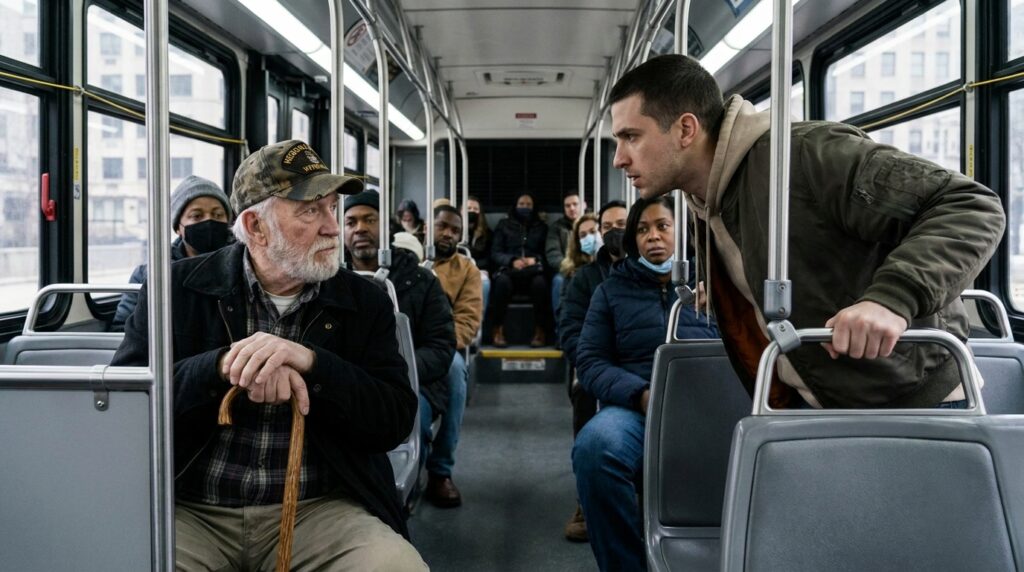
The low, rhythmic vibration of the municipal bus engine hummed directly through the worn soles of Thomas’s boots, a dull mechanical rattle that vibrated the brass collar of the oak cane resting between his knees. To his left, the scratched plexiglass window offered a desaturated view of the rainy American avenue—gray brick facades blurring into dark asphalt under the late afternoon downpour. Thomas did not look at the streets. His chin remained tucked into the collar of his utility jacket, his gaze fixed three feet ahead on the blue non-slip flooring of the aisle.

He calculated the environment out of a half-century habit that civilian life had never managed to erode. Fourteen passengers occupied the forward rows. Nine were staring down into the glowing screens of their mobile devices, their faces washed in a cold, artificial light that made them blind to the physical space around them. Two rows back, an exhausted woman in a damp grocery apron held a sleeping child, her shoulders slouched with a fatigue that slowed her reaction time to near zero. The bus was a closed container moving at forty-five miles per hour, its metal handrails polished smooth by thousands of transient hands, creating a precise grid of obstacles and leverage points.

Thomas adjusted his grip on the curved handle of the oak cane, feeling the deep grain of the wood press against the calluses of his palm. Beneath his low-brimmed brushed-cotton cap, his eyes remained steady, watching the front doors hiss open at the corner of 4th and Industrial.

A cold gust of wind swept into the cabin, carrying the smell of wet pavement and exhaust. A young man stepped up the metal stairs, his boots hitting the rubber treading with an intentional, heavy stomp. He was broad-shouldered, mid-20s, with short dark hair cut close to an aggressive jawline. A heavy leather bomber jacket bunched at his shoulders, a dark hoodie pulled up just far enough to shadow his brow. He didn’t drop a token into the slot; he merely stared at the driver until the older worker looked away, adjusting his mirrors with a sudden, tense focus.

The newcomer moved down the aisle with an unstable, top-heavy stride, his shoulder intentionally clipping the seatback of an office worker, who immediately shrunk back into the window panel. The young man was looking for friction. He was assessing the room for compliance, his chest pushed out to maximize the visual weight of his athletic build.

Thomas didn’t shift his position. He kept his slender frame centered in the aisle-adjacent seat, his hands resting loose but aligned over the top of his cane. He noticed the slight tremor in the young man’s right hand—not from fear, but from the raw adrenaline of a predator accustomed to unearned deference.

The heavy leather jacket stopped directly parallel to Thomas’s row. The shadow fell over the veteran’s lap, cutting off the dim overhead light. The young man didn’t look down at the cap or the service ribbons embroidered into the fabric; he only saw an obstacle with white hair and a thin, lined face. He planted a thick, calloused hand onto the vinyl seatback directly in front of Thomas, leaning inward until his breathing was audible over the engine’s drone.

Thomas felt the shift in air pressure. He did not blink. From the periphery of his vision, he saw three passengers across the aisle rigidly freeze, their eyes darting to their phones as they withdrew into a protective silence.

A dry flake of gray paint peeled from the handrail near Thomas’s left knuckle, exposing a bright, clean glint of raw iron beneath the surface.


CHAPTER 2: THE INTERSECTION OF APATHY

“You’re in the wrong seat, old man,” the voice rasped over the heavy thrum of the diesel engine, dropping down from a shadow that smelled of cheap tobacco and damp synthetic leather.

Thomas did not move his head. His eyes remained locked on the single bright fleck of raw iron where the blue paint had chipped away from the handrail. In his periphery, the broad chest of the young man shifted, the heavy bomber jacket pulling taut across his shoulders as he leaned deeper into the aisle-side clearance. Thomas could read the precise physics of the posture—the weight distributed entirely on the balls of the feet, the left hand gripping the vinyl seat cushion to anchor a sudden, downward lever. It was a stance built for sudden intimidation, an unrefined projection of civilian mass that relied entirely on the target flinching first.

“I’m talking to you,” the young man muttered. His breath carried the sharp, sour tang of artificial energy drinks and stale grease. He shifted his grip on the seatback, his knuckles turning a bloodless, sharp white against the dark blue vinyl. “The cap doesn’t buy you a pass today. Move down the bus. I need the room.”

The bus swerved slightly as it navigated the standing water near the industrial railway crossing, the sharp right angles of the metal window frames rattling against their rubber seals. A low, collective murmur passed through the cabin—the sudden rustle of synthetic winter coats, the rhythmic tapping of a damp umbrella tip against the floorboards—but no one raised their eyes. The silence of the fourteen commuters was a thick, palpable pressure, a calculation of self-preservation that Thomas recognized instantly. They were building a perimeter of apathy, ensuring that whatever occurred within the two-foot boundary of his row remained safely isolated from theirs.

Thomas slowly let his eyes slide upward, tracking the sharp edge of the young man’s zipper up to the aggressive line of his jaw. He did not look at the eyes yet; he looked at the throat, noting the rapid, shallow pulse just beneath the skin of the carotid artery. The boy was riding a wave of chemical confidence, his adrenaline spikes unregulated by discipline.

“There are empty rows in the back, son,” Thomas said. His voice was low, dry, and perfectly flat, carrying the mechanical cadence of a retired instructor who had spent thirty years projecting over the roar of helicopter rotors. He did not use an inflection of complaint; it was a baseline assessment of available space.

The young man let out a short, dry breath that was half-laugh, half-snarl. He leaned in further, his athletic frame blocking the dim yellow light from the overhead fixtures, throwing Thomas’s lap into absolute shadow. “I don’t go to the back. And don’t call me son.”

As the young man adjusted his stance, his right hand came up to rest on the polished silver stanchion bar running vertically from the floor to the ceiling. It was then that Thomas saw it—a small, jagged scar shaped like a precise crescent moon tucked directly into the meat of the lower thumb joint. The tissue was old, silvered by years of healing, but its clean, crescent shape was the distinct signature of a military-issue utility blade slip. Thomas’s left index finger twitched slightly against the smooth oak handle of his cane, a cold, long-buried filing system in the back of his mind clicking open with an audible internal snap. It was a minor discrepancy, a fraction of a detail that didn’t belong on a common street thug.

“You’ve got five seconds to take your hand off my seat,” the young man whispered, his jaw tightening until the muscle fibers bunched into hard, visible knots near his ears. He let his right hand drop from the stanchion bar, his fingers curling into a heavy, thick fist that hung loose but loaded near his hip. “Before I help you find another place to sit.”

Thomas looked at the fist. He evaluated the distance between the young man’s knuckles and the edge of his own collarbone—exactly twenty-two inches. The angle of attack would be descending, a clumsy, top-heavy right hook designed to rely on gravity and shock. Thomas’s fingers remained wrapped around the curved head of the oak cane, the brass collar beneath his palm cold and unyielding. He could feel the precise tension of the rubber tip where it met the ribbed floor matting. It was a perfect pivot point.

The bus hit a deep pothole, the suspension groaning as the frame listing hard to the right. The young man’s balance wavered for less than a quarter of a second, his weight shifting onto his left heel to compensate for the momentum of the vehicle.

Thomas didn’t look up to check if the driver was watching in the wide rearview mirror. He knew the driver wasn’t. He knew the woman with the sleeping child had already turned her shoulder completely away. The space had shrunk down to the two of them—an old man with an antique piece of timber and a broad-shouldered boy who believed that history began the day he turned eighteen.

Thomas lifted his chin just half an inch, the edge of his faded service cap catching the pale gray light from the scratched windowpane. “You’re making a very poor tactical decision, young man,” he said, his voice dropping an octave into a cold, transactional register that made the broad chest across from him suddenly freeze.

The young man’s eyes widened slightly, a momentary flicker of uncertainty crossing his face before the unchecked entitlement flooded back, his leather coat creaking as he pulled his right arm back to break the boundary.

CHAPTER 3: THE INTRUSION OF THE SHADOW

The leather of the bomber jacket creaked like a straining bulkhead as the young man pulled his right shoulder back. It was a macro-movement, clumsy and telegraphed, shifting his entire center of gravity away from his base of support. To a civilian eye, it looked like an impending explosion of physical force; to Thomas, it was a sequence of structural errors occurring in slow motion. The vectors of the aisle had narrowed to a critical choke point, the heavy silver stanchion bar acting as a rigid boundary behind the young man’s left heel.

Thomas did not flinch as the space between them vanished. Instead, his left hand slid two inches up the grain of his oak cane, his thumb resting firmly against the cold, angular edge of the brass collar. Every muscle in his slender frame remained completely loose, a state of calculated kinetic readiness that allowed him to absorb the mechanical vibrations of the bus without wasting structural energy.

“You talk too much for an old man who’s about to get broken,” the young man hissed, his fist rising to the level of Thomas’s jaw line. As his arm retracted, the heavy lining of his unzipped sleeve pulled open, exposing a small, sharp object caught loosely in the interior mesh pocket. It was a tarnished brass military insignia pin—a crossed-rifles infantry design with one bent clutch-back, deeply scratched and worn down to the base zinc. The sharp edge of the brass caught the pale yellow light from the ceiling, a silent, incongruous detail that matched the silver crescent scar on the kid’s thumb joint.

The discrepancy locked into place with a cold weight. Thomas’s mind processed the visual data with transactional speed. The insignia pin belonged to the 1971 domestic logistics command—the exact unit Thomas had structurally audited and disassembled four decades ago. The kid wasn’t just a random transit predator following a blind impulse; he carried a fragment of a specific, broken lineage. But there was no time to track the genealogy of the artifact. The fist was accelerating.

The young man didn’t deliver a clean, straight strike. He lunged forward, using his athletic bulk to crowd Thomas against the plexiglass window, his left hand reaching down aggressively to grab the collar of the utility jacket. He wanted a submission, a public display of dominance that would force the elderly passenger to cower in front of the silent perimeter of observers.

Across the aisle, the silver surface of a passenger’s smartphone rose by two inches, the dark glass lens reflecting the sharp angles of the confrontation. The witness layer was adjusting its tracking, their breathing suspended as the physical threshold was crossed. No one screamed. No one called out for the driver. The isolation of the row was absolute.

Thomas felt the cold air from the window pane press against the back of his neck as the young man’s fingers brushed the top fabric of his collar. The proximity was exactly six inches. The weight distribution was seventy percent forward on the aggressor’s left knee. It was the precise moment where momentum becomes an inescapable trap for the person who unleashes it.

Thomas didn’t pull back. He allowed his head to tilt slightly to the left, a micro-adjustment of three centimeters that caused the young man’s sweeping grasp to miss the solid zipper line and snatch instead at the loose, unyielding denim of the shoulder seam. The grip was tight, but it lacked a skeletal anchor.

“Go on then,” the young man snarled, his breath hitting Thomas’s cheek as he pulled his right fist down into the striking arc. “Let’s see what that attitude is worth.”

Thomas’s right hand stayed flat on his knee, his fingers relaxed. His entire focus was concentrated on his left palm, where the oak handle felt solid, heavy, and balanced. The mechanical rattle of the diesel engine seemed to fade into a background hum, replaced by the internal clarity of a combat theater where every surface is either a weapon or an anchor. He could feel the precise point where the rubber tip of his cane was wedged into the floor mat’s rubber ribbing. The structural geometry was complete. The kid had committed his weight entirely to the descent, his balance locked into a vector that offered no route for a recovery move.

Through the fabric of his jacket, Thomas felt the tension of the young man’s knuckles locking onto his shoulder. The leather of the bully’s jacket was cold, stiff, and smelling of old rain, its sharp edges pressing against the veteran’s chest as the space between them completely ran out.

Thomas’s chin lifted, his unblinking eyes meeting the bloodshot glare of the young man with a stillness that was entirely devoid of human malice or fear. It was the look of a machine calculating a tolerance limit.

“Your wrist alignment is off, son,” Thomas murmured, his voice cutting through the space between them like a cold steel wire just as the young man’s arm locked into the final downward plunge.

CHAPTER 4: THE THRESHOLD OF FORCE

The downward plunge of the young man’s fist didn’t meet the soft resistance of flesh. It met a sudden, geometric vacuum.

In the precise microsecond that the knuckles cleared the lip of Thomas’s utility collar, the veteran shifted his entire weight down into the iron seat frame. His left arm cut upward, an unbending lever of bone and sinew that intercepted the young man’s extended right forearm from the blind inside track. The collision was a sharp, flat crack—the friction of heavy leather slamming against dense utility canvas.

Thomas did not push against the strike; he redirected the momentum. His fingers, curved and hard from a lifetime of structural maintenance, snapped around the young man’s thick wrist with the precision of a high-tensile clamp. At the exact same instant, Thomas’s right hand came down on the brass collar of his oak cane, jamming the rubber tip deeply into the ribbed floor matting directly behind the young man’s leading left heel. The cane became a rigid, unyielding pivot point—an external skeleton anchoring the geometry of the aisle.

The young man’s eyes widened, the bloodshot veins expanding as his forward weight encountered an absolute wall. He tried to pull back, his massive shoulder muscles bunching under the leather of his bomber jacket, but his own forward velocity had already crossed the center line. Thomas simply twisted his torso five degrees to the left, using the kid’s tight grip on his shoulder seam to pull the larger body down into the exact trajectory it had initiated.

There was a wet, heavy slap as the young man’s knees hit the ribbed rubber floorboards. The impact shook the metal partition behind the driver’s seat, a dull vibration rattling through the silver handrails. The aggressor’s arm was pinned across Thomas’s lap, his wrist locked in a reverse flexion that kept his shoulder completely immobilized. He was frozen, brought to his knees in the center of the narrow aisle, his chest heaving as the raw physics of leverage held him in place without a single punch being thrown.

A sharp, collective intake of breath cut through the cabin. Across the aisle, the two teenagers with the glowing smartphones lowered their hands by three inches, their faces dropping their expressions of digital detachment as the reality of the physical reversal hit the space. The perimeter of apathy had fundamentally collapsed. The commuters leaned forward, their gazes locked on the broad-shouldered boy now trapped beneath the small, unmoving frame of the elderly passenger.

“Let go,” the young man wheezed, his voice losing its tight, mocking edge, replaced by a raw, breathless panic. He strained against the wrist-lock, his boots sliding against the wet floorboards, but every micro-movement only tightened the pressure of the brass cane collar against his leverage points. “Let go of me, you old bastard.”

“You’re shouting, son,” Thomas said. His voice was a calm, low-frequency hum that didn’t rise above the mechanical rattle of the idling engine. His expression remained entirely flat, his eyes fixed on the small crescent scar on the kid’s lower thumb joint. “And your center of gravity is completely unmanaged.”

As the young man made a desperate, violent surge to break the restraint, his left jacket sleeve caught the sharp edge of the seat rail. The sudden friction tore open the damp interior lining, and a folded, water-damaged square of heavy cardstock slipped from the hidden mesh pocket, fluttering onto the blue rubber matting between them.

Thomas’s eyes dropped to the paper. The document was an official Department of the Army service manifest from October 1971, its edges stained with dark grease and stamped with a faded red classification marking. Written in crisp, typewritten characters near the bottom of the roster was a name Thomas had not seen in forty-five years: Corporal Marcus Vance. Beneath it, a handwritten note in blue ink detailed a summary court-martial for the theft of logistical field supplies—a file Thomas himself had signed off on before closing the command log forever.

The young man noticed the document on the floor, his face draining of its remaining color until his skin matched the pale gray light filtering through the bus windows. He stopped struggling, his fingers going entirely slack against Thomas’s shoulder.

The bus began to decelerate, the air brakes hissing loudly as the vehicle pulled toward the rain-slicked concrete platform of the upcoming terminal. The timing was precise, a mechanical punctuation mark that signaled the evolution of the incident from a private clash into a public consequence. Thomas did not loosen his grip on the wrist. His mind was already moving down a darker, strategic corridor, realizing that the artifact on the floor had completely shattered the illusion of a random transit encounter. The decoy secret was out, but the ultimate reality behind why this specific boy was tracking this specific bus line remained locked behind a wall of cold, calculated silence.

CHAPTER 5: THE KINETIC REVERSAL

The pneumatic hiss of the bus’s air brakes rasped through the dark cabin like a heavy blade drawing across dry slate. Outside, the rain-slicked concrete of the industrial terminal platform blurred past the scratched glass windows, reflecting fractured neon greens and cold whites from the overhead stadium lights. Inside the central aisle, the spatial geometry remained completely rigid. Thomas maintained the downward vector of his leverage, his thumb pressing hard into the nerve cluster behind the young man’s right wrist joint while his left forearm remained an unbending structural brace across the kid’s pinned collarbone.

The boy did not struggle now. His athletic frame had gone completely hollow, his knees anchored to the wet rubber floor matting while his gaze remained glued to the water-damaged square of military cardstock resting between their feet. The name Corporal Marcus Vance stared up through a thin laminate of pooling condensation, the ink of Thomas’s own historic signature a clean, unyielding line of judgment that had survived forty-five years of storage.

“You’re his son,” Thomas stated. It was not an interrogation; it was the flat, clinical registration of a file tab dropping into its designated slot. He did not let his voice lift above the rhythmic, mechanical vibration of the idling diesel engine. “You have his wrist structure. You have the exact same lateral instability in your base stance when the ground shifts.”

The young man’s mouth opened slightly, his lower jaw trembling as the cold air from the front doors hit his damp skin. “He died three months ago,” the kid muttered, the tight, mocking bravado of his earlier urban cadence completely evaporating into a flat, regional rust-belt drawl. “In a county facility. He had nothing left but an old trunk and a box of logistics records with your name stamped on every page.”

Thomas felt a cold, familiar calculation spin through his chest. The strategic pursuit model required him to ignore the emotional bait of the boy’s confession and look strictly at the anomalies in the field. A common revenge grievance would dictate a targeted strike at Thomas’s home or a private approach—not a calculated piece of transit harassment designed to look like a spontaneous act of public entitlement on a municipal route. The kid had been tracking this specific transit run.

Thomas shifted his gaze by two inches, looking past the pinned shoulder of the leather jacket to the narrow space underneath the blue vinyl seat cushion. There, tucked securely into the right angle where the iron piping met the floor rail, a small, obsidian-faced electronic tracker widget hummed with a faint, periodic pulse of infrared light. It was an active, commercial-grade transponder, its magnetic housing coated in a fresh layer of grey industrial grease.

The realization hit Thomas with the sharp, geometric force of a tactical ambush. The boy wasn’t the architect of this trap; he was the component. He had been directed to this vehicle to force a highly visible public escalation, using his father’s old court-martial papers as a personal justification while someone else utilized the tracking signal to map Thomas’s precise operational movements through the urban transit grid. The decoy secret—the familial military grudge—was a perfect, functional mask designed to cover a far deeper, ongoing surveillance deployment. The ultimate reality was still locked down, but Thomas’s status as a passive retiree had just been structurally compromised.

Across the aisle, the witness layer began to move. The two teenagers lowered their smartphones entirely, their faces showing a sudden, sharp transition from amusement to visceral discomfort as the boy’s confession spilled into the public space. The perimeter of apathy was gone, replaced by a tense, nervous energy as the remaining commuters gathered their bags, their eyes darting toward the front doors as the bus came to a final, shuddering halt at the terminal bay.

“He told me you broke him,” the boy whispered, his left fist clenching against the rubber floorboards as he tried to find a sliver of leverage. “He said you signed the order that took his pension before he even hit twenty-four. I came to take something back.”

“Your father broke his own lineage when he removed three crates of field medicine from the logistics depot at Chu Lai,” Thomas said, his voice dropping into a razor-thin register that made the young man’s shoulders instantly stiffen. “He left thirty-two men in the third battalion without basic surgical prep before the monsoons hit. I didn’t break him, son. I merely recorded the precise depth of his failure.”

The boy’s eyes went wide, the historical reality of the record striking him with a physical force that left him completely paralyzed. The moral logic he had built to justify his entitlement collapsed beneath the weight of the veteran’s flat memory.

Thomas slowly released the tension in his left hand, sliding his fingers away from the kid’s wrist and returning his palm to the smooth, curved head of his oak cane. He did not jump or move quickly. He maintained his seated posture, his dark utility jacket straight, his brushed-cotton service cap tilted forward to keep his brow in absolute shadow.

“Stand up,” Thomas commanded, his voice carrying the quiet, absolute authority of a command room that had never known civilian compromise. “The doors are open. Get off my bus.”

The young man scrambled backward, his heavy leather boots slipping on the wet floor matting as he broke the physical proximity. He snatched the water-damaged manifest from the floor with a trembling hand, his eyes locked on Thomas with a mixture of terror and unmitigated confusion as he stood up into the full clearance of the aisle. He didn’t look at the passengers. He didn’t look back at the seat frame. He turned and lunged down the metal exit stairs, his athletic silhouette vanishing instantly into the grey, rain-swept concrete of the terminal platform.

Thomas did not watch him run. He reached down with his right index finger, his knuckles brushing the cold iron piping beneath his seat cushion until his skin made contact with the small, vibrating square of the obsidian tracker. He did not pull it off. He left it exactly where it was, his mind already calculating the cause-and-effect loop of the next three stops. They wanted to know where the old commander was going; Thomas was about to show them exactly how an old decoy operates when the field parameters turn hostile.

CHAPTER 6: THE ALTERED HORIZON

The heavy rubber-treaded boots of the young man vanished into the gray, rain-swept sheets of the terminal platform, leaving only a dark, slick trail of wet footprints slowly expanding across the blue non-slip floor. The front pneumatic doors stayed open for three additional seconds, their thick rubber seals vibrating as cold air rushed into the cabin, stripping away the lingering scent of damp leather and panic.

Thomas did not watch the kid run. His eyes remained fixed on the lower iron frame of the seat across the aisle, where the small, obsidian-faced transponder continued its quiet, silent transmission. The infrared signal flickered against the damp metal work with a machine regularity—an unblinking eye tracking the exact coordinates of an old commander who had supposed himself forgotten.

The remaining transit passengers moved past him in a silent, hurried line, their heads bowed into the collars of their winter coats as they emptied the vehicle. They kept their shoulders drawn inward, their movements quickened by a collective desire to separate their realities from the physical violence they had just witnessed. The two teenagers who had held the glowing smartphones slipped past without looking up, their devices already tucked away into deep pockets. The isolation of Thomas’s row was no longer an enforced perimeter of bystander apathy; it was an absolute clearance. The cabin had become an empty echo chamber, the low, rhythmic thrum of the diesel engine shaking the right-angled window frames against their frames.

Thomas slowly let his right hand settle over the smooth, carved head of his oak cane, the cold brass collar pressing firmly into the meat of his thumb joint. He felt the internal shift of his own respiration, his heartbeat perfectly baseline, unaffected by the chemical spikes that had destroyed the young man’s tactical composure. He had run an audit on the field parameters within forty seconds. The boy was gone, the family grudge exposed as a carefully staged provocation, but the underlying mechanism—the active surveillance array—remained entirely functional beneath his knees.

A short, dry cough broke the quiet from the front of the bus. The driver, an older American man with a faded transit patch on his short-sleeve shirt, leaned his shoulder heavily against the wide steering wheel, his eyes catching Thomas’s reflection in the long rearview mirror.

“You need me to call this in, Mac?” the driver asked, his voice gravelly from a long shift. He did not pull the lever to close the doors; his hand hovered near the control box, tracking the empty platform outside. “The kid looked like he was about to tear this whole rig apart before you sat him down.”

Thomas lifted his chin just enough to clear the low brim of his brushed-cotton service cap, the embroidered ribbons catching a single ray of harsh white light from the platform’s sodium lamps. “No,” Thomas said, his voice flat, dry, and holding the mechanical weight of an operational center. “The situation has resolved its primary friction. Maintain your schedule.”

The driver hesitated for a fraction of a second, his knuckles tightening against the black rubber of the steering wheel before he nodded in silent compliance. He pulled the hydraulic valve. The pneumatic doors closed with a heavy, pressurized slap, sealing the vehicle once more against the downpour as the wheels turned heavily away from the concrete terminal dock, transitioning back into the dark asphalt grid of the industrial sector.

Thomas reached down with his left hand, his fingers moving with unhurried precision into the dark space beneath his seat. His skin brushed the greasy, cold surface of the iron piping before making contact with the magnetic housing of the tracker. With a single, sharp twist of his wrist, he broke the magnetic bond. The obsidian device came away cleanly, its red micro-LED continuing to blink against his palm like a captured insect.

He did not crush it. He did not throw it into the waste receptacle near the door. He turned the device over, his thumb tracing the smooth molded edge until he located the micro-serial number etched into the casing. It wasn’t commercial surplus. The three-digit suffix belonged to an active domestic security contractor—the same intelligence branch that had inherited the records of the 1971 logistics command after the restructuring.

The final reality aligned with a cold, absolute clarity. This run through the rainy municipal sectors hadn’t been an aimless transit route for a lonely retiree. Thomas had known about the tracking cells for three weeks; he had chosen this specific bus line because its narrow aisles and high-backed seats created a predictable, defensible corridor where any approach would be forced into a single vector of movement. The boy had been a diagnostic test—a piece of historical bait sent by an unseen adversary to verify if the old commander still possessed the kinetic reflexes to defend a position.

Thomas slipped the tracker into the deep, dry pocket of his utility jacket, letting it drop against his old pocket watch. He adjusted his grip on the scarred oak cane, planting the rubber tip back into the center groove of the floor matting. The uniform had changed, the terrain was modern asphalt instead of monsoon mud, but the operational horizon remained exactly as it had been forty-five years ago. The first layer of defense had held; the next three stops would determine where the counter-offensive would initiate.

Similar Posts

Leave a Reply

Your email address will not be published. Required fields are marked *






