
The Weight of Salt and Iron: A Narrative of the Old Guard and the Rusted Machine
CHAPTER 1: THE TASTE OF COPPER
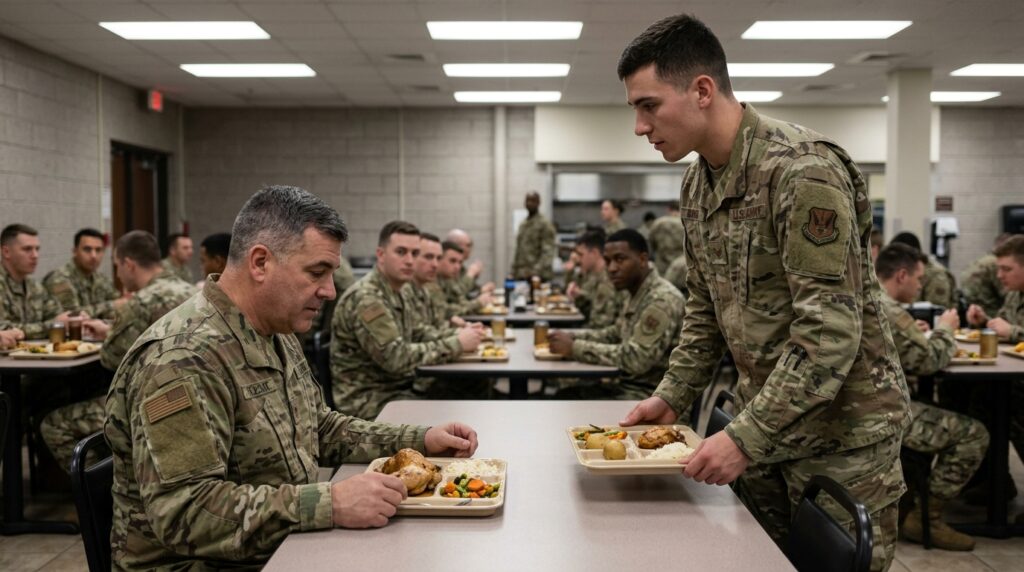
The yellow-tinted gravy didn’t splash; it slid down the stiff, starch-baked fabric of Master Sergeant Miller’s right thigh like grease on an engine block. The plastic tray hit the linoleum with a dull, hollow clack that didn’t belong to the vocabulary of an assembly line, yet every uniform within twenty feet stopped moving with mechanical precision.
“My bad, old man,” Miller didn’t look up at the words. He didn’t need to. He knew the voice—the thin, nasal drawl of Specialist Vance, a boy who smelled of cheap vape juice and the clean, unused oil of supply trucks that never crossed a state line. Vance stood with his boots wide, his shoulders rounded forward in a posture copied from internet videos, his hands hovering inches from his hips as if waiting for applause from the row of tables behind him.
Miller looked down at his plate. The salisbury steak was gray, turning cold where the skin had split. A single drop of grease clung to his thumb, heavy and yellow. For thirty-two years, the dining facility at Fort Meade had smelled exactly like this—scoured copper, industrial bleach, and the damp, sweet rot of cabbage from the loading docks. It was a rhythm. You took the tray, you found the corner where the fluorescent tube flickered at a low sixty hertz, and you chewed until the clock told you to stop.
“I said,” Vance leaned down, his face dipping into the stale perimeter of Miller’s air, “my hand slipped. Sir.”
The silence in the hall wasn’t the silence of respect; it was the heavy, passive quiet of a highway crowd watching a fender bender. No one moved to help. The kids at the center tables remained frozen with forks halfway to their mouths, their eyes bright with the small, cheap thrill of an unscheduled event.
Miller shifted his weight. His hip joint gave a dry, metallic pop—the legacy of an unvented drop in ninety-eight that the medical boards had categorized as a pre-existing degenerative condition. He turned his head slowly, his neck leathered and creased like an old boot left in the bed of a truck. Vance’s skin was smooth, a pale, digital white that had never seen grease-paint or the dry grit of a real ditch.
“Pick it up,” Miller said. His voice was too low for the room, a rough gravel drag that stayed low in the throat.
Vance laughed. It was a short, wet sound. “The floor’s got people for that, Sergeant. I think you’re past the expiration date for ordering me around.”
The boy’s fingers reached out, his thumb catching the edge of Miller’s water glass, a deliberate, slow-motion slide to push it over.
Miller didn’t think about his retirement packet. He didn’t think about the three months left until his pension cleared, or the clean, small house in Ocala with the rusted roof he needed to tin. The world simply narrowed to the gap between Vance’s chin and the stiff collar of his service uniform.
Miller’s right hand didn’t swing; it drove forward from the chest, short and heavy, the meat of his palm striking Vance squarely where the throat met the jawbone. It was the sound of a sack of grain dropping onto a flatbed.
Vance went backward, his heels catching the edge of the overturned tray. He didn’t fall clean—he folded, his spine hitting the edge of the adjacent table with a sharp, aluminum rattle that brought three metal pitchers down with him. The boy stayed down on one knee, his breath coming in ragged, high-pitched whistles as his hands clutched at his throat, his eyes wide and leaking water.
Miller stood up. The table shifted an inch under his grip. He looked down at his uniform, at the dark, irregular stain spreading toward his knee. His knuckles didn’t hurt, but the old iron heat in his chest was back, tasted like copper on the back of his tongue.
“Get up, Specialist,” Miller said, taking a step forward.
Vance didn’t move. He retreated a half-inch on his shin, his shoulders hunching into his ears, his fingers coming up in a flat, trembling gesture to keep the distance between them. But he wasn’t looking at Miller’s face anymore. He was staring at the small, black lens of a pocket camera sitting upright inside an empty ration tin on the table behind Miller’s shoulder, its blue indicator light pulsing in perfect, silent rhythm.

CHAPTER 2: THE PAPER CAGE
The fluorescent hum inside Major Vance-Taylor’s office didn’t vibrate at sixty hertz; it sat at a flat, dead frequency that made the enamel on Miller’s molars ache. The walls were painted that specific federal shade of desaturated seafoam—a color designed by committee to suppress adrenaline and replace it with a slow, gray fatigue.
Miller sat in the metal-framed chair, his thighs sticking slightly to the vinyl seat where the cafeteria gravy had begun to dry into a stiff, salt-rimmed crust. He didn’t look at his hands. If he looked at his knuckles, he’d see the gray smudge of Vance’s grease-paint foundation still ground into the grain of his skin. Instead, he kept his eyes on the desk. The surface was a laminate faux-wood, peeled back at the corners to reveal the pressed particleboard beneath—crumbly, dry, and gray, like old bones left in the sun.
“Thirty-two years, Master Sergeant,” Major Vance-Taylor didn’t look up from his tablet. He was thirty-six, maybe thirty-seven. His skin had the smooth, pristine finish of someone who spent his deployments in containerized housing units with dedicated air conditioning. His uniform was perfect, the creases on his sleeves razor-sharp, stiffened with commercial sizing rather than the heavy, manual starch Miller used. “A clean sheet. Not a single notation since a minor equipment discrepancy in Ninety-Nine. And then you break a specialist’s hyoid bone over an overturned tray.”
“The tray wasn’t an accident, sir,” Miller said. The words felt like gravel turning over in a dry pipe. His throat was parched; they hadn’t offered him water since the MPs brought him into the building two hours ago.
“The recording shows an accident,” the Major replied smoothly. He tapped the glass screen with a manicured index finger. “Specialist Vance tripped. The floor was wet near the dish-return line. A standard slip-and-fall under high-use conditions. You responded with an unauthorized, unprovoked vertical strike to a non-combatant peer.”
Miller shifted. His right hip gave that familiar, dry thud against the vinyl. He reached up, his fingers naturally seeking the lapel of his Class A jacket, where a small, non-regulation brass service pin from his first tour in Panama was tucked behind the seam of his pocket. His thumb traced the rough, notched edge of the metal. It was a habit from the trenches—checking the seal, checking the gear. But here, the metal felt cold, small, and entirely useless against the flat glare of the screen.
“The camera was in a ration tin, Major,” Miller said, his eyes drilling into the plastic bezel of the tablet. “The tin was dry. It was placed on the corner table three minutes before Vance entered the line. It wasn’t an MP unit. It was a consumer-grade proxy lens.”
Major Vance-Taylor finally looked up. His eyes were entirely unreadable—not angry, not malicious, just perfectly transactional. A professional assessing a line item that refused to balance. He slid the tablet across the laminate desk, the plastic casing scratching against the faux-grain with a sharp, dry hiss.
“The equipment on the floor is irrelevant to the specification of the charge, Master Sergeant. What matters is the metrics. Your platoon’s readiness index has dropped four percent this quarter. Your knees are certified at forty percent efficiency by the VA’s own preliminary discharge review. And now, we have a clear, documented instance of geriatric volatility on the commissary floor.” The Major leaned back, his chair giving a high-pitched, oiled whine. “The transition protocol for senior personnel is very specific. We can file the article fifteen, which strips your retention bonus and locks your pension at the twenty-five-year tier while the investigation runs its course. Or, you can sign the accelerated medical release today.”
The room grew very quiet. Through the single high window, Miller could hear the distant, heavy thrum of the motor pool—the familiar, low-register cough of a five-ton diesel engine struggling with cold fuel. It was a sound he knew better than his own brother’s voice. He knew the exact moment the injectors would clear, the exact rhythm of the pistons when the oil pressure normalized.
He looked at the digital document on the screen. The box for his signature was a bright, clean blue.
“Vance didn’t think of that camera,” Miller murmured, his hand dropping from his lapel back to his knee, his thumb pressing down hard into the dried grease stain on his trousers. “He’s too loud. Too stupid. He doesn’t know how to set a line-of-sight angle that accounts for the glare from the kitchen bays.”
The Major didn’t blink. He reached down, opened his top desk drawer, and pulled out a small, gray plastic thumb drive. He didn’t hand it to Miller; he just set it on the desk between them, right on top of a peeled seam in the laminate.
“The modern army doesn’t run on leather and shouting, Master Sergeant. It runs on efficiency logs. Some assets have a high maintenance cost with diminishing returns. Vance is cheap. He’s digital-native. He doesn’t require a five-figure orthopedic subsidy every twelve months just to stay behind a desk.” The Major stood up, pulling his tunic down with a single, sharp tug. “You have until sixteen-hundred to sign the portal file. The drive contains your transport manifest for the out-processing center at Lee. If you’re still in this building at sixteen-hundred-and-one, the compliance log goes to the regional magistrate.”
The door didn’t slam when the Major left; it clicked shut with a pneumatic sigh, leaving Miller alone with the dull hum of the ceiling lights and the gray, crumbly edges of the desk. He reached out, his thick, calloused fingers closing around the cold plastic of the gray thumb drive. He didn’t look at the screen. He looked at the window, where the sun was hitting the chain-link fence outside, turning the zinc coating into a bright, white line of salt.
CHAPTER 3: THE MOTOR POOL DRIVE
The rain had stopped by midnight, leaving the motor pool covered in a thin, iridescent skin of diesel runoff. The corrugated iron roofs of the maintenance bays sweated under the high-pressure sodium lights, casting a sickly orange glare over the rows of parked five-ton trucks. Everything here felt heavy, mechanical, and slightly decayed—the cold iron smell of old gearboxes blending with the damp, sour earth of the perimeter ditch.
Miller didn’t use his flashlight. He didn’t need to. He knew the layout of Bay 4 by the texture of the gravel under his boots and the specific, rhythmic drip of a faulty hydraulic seal on the third bay lift. He slid through the side door, the rusted hinges giving a short, dry scrape against the frame that sounded like a fingernail on a chalkboard.
Inside, the shadows were thick, smelling of grease-rags and stale coffee. He walked toward the diagnostics terminal—an ancient, grease-filmed rugged laptop bolted to a swinging steel arm near the parts cage. It was old ordnance tech, the kind the younger mechanics complained about because it didn’t have a touchscreen interface. It required command lines. It required patience.
Miller slotted the gray plastic drive into the lateral USB port. The connector was loose, worn down by hundreds of hasty transfers, requiring a slight upward tilt before the green indicator light flickered to life.
The screen didn’t open with a polished interface. It threw a series of low-level system logs in white text against a flat black field. Miller’s calloused fingers hovered over the keyboard, his thumb dropping to the spacebar with a heavy, deliberate thrum. He wasn’t a systems expert, but thirty-two years of maintenance logs taught you how to read the hidden history of an asset. You looked for the gaps. You looked for the anomalies.
He bypassed the out-processing manifests Major Vance-Taylor had mentioned. Those were just paper walls designed to keep him moving toward the gate. Instead, he pulled the metadata from the commissary security feed—the raw, unedited package that had captured the confrontation between his fist and Specialist Vance’s throat.
The time-stamp on the recording didn’t match the standard automated cycle of the facility. The file had been opened three minutes before Vance walked through the double doors.
“Looking for a way out, Master Sergeant?”
The voice came from the darkness behind the tool cage, flat and dry, accompanied by the dull, metallic thunk of a torque wrench being set down on a steel bench.
Miller didn’t jump. He didn’t pull his hand from the terminal. He turned his head slowly, his creased neck popping against his collar. Out of the shadow stepped Sergeant First Class Ramirez, the shop foreman. Ramirez was forty-eight, his hair shaved close to a skull that looked like it had been carved out of a hickory root. His coveralls were black with carbon oil, his fingers stained a deep, permanent slate gray.
“The log has a proxy tag, Hector,” Miller said, his gravelly voice staying low beneath the hum of the transformer box on the wall. “The camera in the commissary wasn’t Vance’s phone. It was routed through an unlisted MAC address on the local server.”
Ramirez walked to the edge of the light, his boots making a gritty sound on the concrete floor. He didn’t look at the screen; he looked at Miller’s right hand, where the skin over the knuckles was still slightly swollen, a dull purple bruise forming under the leathered gray.
“You should have signed the medical packet, John,” Ramirez said softly. He pulled a rag from his pocket, turning it over in his hands, wiping grease that wasn’t there. “The Major’s office doesn’t leave doors unlatched. If you found that routing tag, it’s because they didn’t care if you saw it after you were off the reservation.”
“Vance didn’t set this up,” Miller said, his thumb tapping the edge of the terminal casing, feeling the cold, vibrating metal of the hard drive inside. “The boy didn’t even know where to look. The file path originates from the third-floor compliance annex. Vance-Taylor’s personal terminal.”
Ramirez let out a short, dry breath through his nose—a sound that was half-laugh, half-sigh. He stepped closer, the smell of industrial solvent trailing off his clothes like an old perfume.
“Vance is a relative of the Major, John. A cousin’s kid from Ohio. He was brought in three months ago on a clean-slate transfer because his record at Carson was full of red ink. He wasn’t brought here to work. He was brought here to be an anvil.” Ramirez leaned against the steel arm of the terminal, his slate-gray fingers gripping the rusted pipe. “The Major needed a violent incident involving senior personnel to trigger the expedited attrition clause. The regional board requires a physical breach of decorum before they can void the twenty-year retention bonus. You gave it to him in real-time detail.”
Miller’s face didn’t change, but his fingers tightened on the edge of the keyboard until the metal casing creaked. The decoy secret was laid bare across the black screen—a simple, dirty case of institutional nepotism and rigged compliance to clear a troublesome file. It was a petty trap, an ugly piece of middle-management maneuvering.
But as Miller stared at the scrolling metadata lines, his eyes caught a deeper discrepancy. The file path from the compliance annex wasn’t just an internal memo. It was nested inside an administrative directive code named Gray Harvest—and the data footprint wasn’t just pulling his personnel file. It was indexing every service record on the base dated prior to two thousand and six.
“It’s not just me, Hector,” Miller murmured, his eyes reflecting the pale green light of the screen.
Ramirez didn’t answer right away. He turned back toward the dark bays, where the hulking shapes of the five-ton trucks sat like silent, dead beasts under the iron roof.
“The gate opens at sixteen-hundred tomorrow, John,” Ramirez said, his voice dropping into the lower register of the machinery around them. “If you’re still on the log, they’ll process the specification. You can’t fight a paper machine with an old fist.”
Miller reached out and pulled the gray drive from the port. The green light died instantly, leaving the terminal screen blank and cold. He slid the drive into his pocket, his fingers brushing against the sharp, notched edge of the Panama service pin hidden beneath his lapel.
“The machine has a lot of rust on the underside, Hector,” Miller said.
He turned away from the terminal, his boots crunching into the dark gravel as he stepped back out into the orange, sulfur-lit rain, the air smelling of old iron and things that had stayed in the dark for too long.
CHAPTER 4: THE GRAY GRAVEL YARD
The dawn came up cold, a flat smear of wet slate across the eastern perimeter fence. The rain had slowed to a greasy mist that didn’t wash the base clean; it just made the coal dust from the old rail spur stick to everything, coating the chain-link and the gravel underfoot in a dull, carbon glaze.
Miller stopped by the salvage pens at the edge of the supply yard. The ground here was littered with the discarded bones of old machinery—half-stripped humvee frames sinking into the mud, cracked engine blocks weeping brown oil, and stacks of corrugated zinc panels turning an orange, scale-flaked red. It was the scrap heap of three decades of continuous rotation, a graveyard of parts the system had worked until they seized, then left to rot.
A figure was already waiting by the rusted scales. Chief Warrant Officer Five Marcus Vance-Taylor—the Major’s older brother, though the resemblance had long since been hammered out by thirty years in the logistics corps. Marcus wore a frayed field jacket with no name tape, his hands buried deep in pockets lined with grease-stained wool. His skin was the color of wet river rock, creased deeply at the corners of his mouth from a lifetime of chewing tobacco he wasn’t supposed to have on base.
“You’re out early, John,” Marcus said. He didn’t look up from the gravel. His boot was slowly turning over a rusted iron bolt, grinding the orange flakes into the dirt. “The Major said you were back in your quarters packing your gear.”
“The Major is a clerk, Marcus. He only knows what the screen tells him to look at,” Miller said. He stepped up to the rusted railing of the scale, his old hip clicking in the damp air. He took the gray plastic thumb drive from his pocket, the hard edge cold against his palm, and held it out. “The data string on here isn’t an administrative transfer log. It’s a systemic filter.”
Marcus didn’t reach for the drive. He kept his hands buried in his coat, his jaw working slowly as he stared at the stack of old zinc roofing behind Miller. “I told you last winter to take the early retirement. I told you the machinery was changing out from under us.”
“This isn’t about Vance or an overturned tray,” Miller’s voice grated, dropping low into the silence of the yard. “The Gray Harvest directory isn’t pulling bad files. It’s pulling any file with a pension liability multiplier over twenty-four months. Every master sergeant, every shop chief, every line mechanic who remembers when this yard was built. Why did the compliance office flag Ramirez’s readiness logs last Tuesday?”
Marcus let out a long, wet breath that turned to white fog in the gray light. He finally pulled one hand from his pocket, not to take the drive, but to pull a small, notched brass tool from his vest—a thread gauge used for measuring the wear on heavy artillery bolts. He rolled it between his fingers, his thumb catching on the rusted serrations.
“Because the yard isn’t being re-staffed, John,” Marcus said smoothly, his voice devoid of anger, flat with the pragmatism of a man who had spent forty years reading financial balance sheets for the supply lines. “The whole sector is being scrubbed. The digital transition isn’t an upgrade; it’s a shutdown notice. By next fiscal year, Meade is dropping three tiers. The heavy armor maintenance is moving to a consolidated depot in Texas. The trucks are being sold to state contractors. The compliance office has a target dollar figure they need to clear off the payroll before the automation protocols drop the base profile.”
The gray mist seemed to grow heavier, smelling of wet rust and cold iron. Miller looked at the drive in his hand. The petty trap—the arrogant kid, the camera in the tin, the Major’s smooth ultimatum—shattered like cheap glass. It wasn’t a personal grudge. It wasn’t even standard military politics. It was an inventory adjustment. He wasn’t a soldier facing a disciplinary hearing; he was a line item being zeroed out to save on the maintenance costs of an outdated building.
“They’re clearing the ledger,” Miller said. It wasn’t a question.
“They’re clearing the room, John,” Marcus corrected him, his eyes finally lifted, small and hard like flint stones beneath his dark brow. “The Major gets his promotion code if the transition budget comes in fifteen percent under the projection. He’s just the broom. The directive came down from the regional transformation panel six months ago. If you fight that Article Fifteen, they won’t just take your bonus—they’ll tie up your medical benefits in litigation until your knees give out completely. The system doesn’t need old iron anymore. It wants carbon fiber.”
Miller looked down at his boots, at the gritted gray gravel that had been hauled into this yard by the truckload when he was still a private. Every inch of this ground had been maintained by hands like his—scoured, packed down, and cleared of weeds year after year.
“The scrap manifests,” Miller murmured, his mind hooking onto a detail he had seen in the terminal metadata—thousands of tons of functional machinery marked with red-inked serial numbers, cleared for immediate destruction rather than transfer. “They aren’t moving the depot. They’re liquidating it.”
“Sign the paper, John,” Marcus said, stepping past him toward the gate, his boots making a dry, crunching sound on the stone. He didn’t stop, his voice trailing back through the desaturated light. “Go to Ocala. Fix that roof. The grease here doesn’t belong to us anymore.”
Miller didn’t move. He stood by the rusted iron scale, his fingers tightening on the plastic drive until his swollen knuckles turned white. The gate was three hundred yards away, the clock on the administrative block already ticking toward the sixteen-hundred deadline, but the world had suddenly expanded into a dark, cold grid where every exit was a trap and every victory was a lie.
CHAPTER 5: THE FINAL AUDIT
“The clock on the bulkhead is accurate to the atomic standard at Boulder, Master Sergeant,” Major Vance-Taylor didn’t look up from the stylus he was turning between his fingers. The plastic tool made a small, dry tick every time it struck his wedding ring. “It is precisely fifteen-fifty-eight. You have two minutes before the automated file system logs your non-compliance with the medical release protocol.”
Miller stood in the center of the room. There was no chair for him this time. The hearing space was narrow, smelling of old carpet paste and the chemical musk of a laser printer that had been running diagnostics for six hours straight. The windowless gray walls offered no perspective, only the harsh, uniform glare of modern tubes that left no shadows for an old man to hide his anger in.
On the table sat the single sheet of paper—the physical duplicate of the portal file. The ink was fresh, carrying that faint, hot iron smell of a machine that had just spit it out. Beside it lay his gray plastic thumb drive, resting next to Major Vance-Taylor’s manicured hand like an spent casing on a concrete range.
“I found the Gray Harvest logs, Major,” Miller said. His voice was a flat, low rasp, the gravel in his throat dry from twelve hours without water. He didn’t drop his chin. He kept his eyes fixed on the silver insignia pinned to the Major’s collar—the bright, stamped aluminum that had never seen a field pack. “I found the retirement multiplier metrics. I know about the budget purges.”
The stylus stopped turning. The Major set it down on the desk with a clean, metallic snap. The smooth skin around his jaw tightened, just a fraction, the pale digital white of his cheeks flushing with a dull, sudden heat.
“You found an administrative directory, Master Sergeant. The Army reorganizes its assets quarterly. You aren’t a strategic analyst; you’re a mechanic with a degenerative hip who cannot complete a three-mile run under full load.” The Major leaned forward, his hands flat on the laminate. “The documentation is legal. The transition parameters are approved by the Department of the Army. Your signature on that release validates your forty-percent disability tier. If you don’t sign, the compliance board handles the separation under an unsuitability clause. The end result is identical, John. The only variable is how much your family receives from the treasury after you leave.”
“And the trucks?” Miller’s hand didn’t move toward the pen. He reached under his lapel, his thick, oil-blackened thumb feeling the jagged, notched edge of his Panama pin. “The twenty-eight five-ton platforms in Bay 4. The ones Ramirez and I rebuilt from the axle-trees up last winter. Their serial numbers are on the scrap manifest. They aren’t being moved to Texas, Major. They’re being chopped into forty-pound blocks at the Baltimore dockyard.”
“The maintenance cost on those frames exceeds their tactical value by twelve percent,” the Major said, his voice dropping into that chilling, uniform drone of a policy brief. “They are iron liabilities. The modern corps utilizes modular, lease-structured transport networks that don’t require thirty-year grease monkeys to keep them from throwing a rod.”
The silence that followed was heavy, filled only with the faint, digital hum of the printer cooling down behind the desk. In that space, time seemed to slow down for Miller, stretching until he could see the individual fibers of the paper on the table, the dry grit of the black toner, the small, red-inked authorization stamp at the bottom that bore the electronic signature of a regional transformation panel.
He could see the whole machine now. It wasn’t just Vance-Taylor. It wasn’t even the Major’s cousin or a cheap camera in a ration tin. It was a giant, rusted gear that had spent thirty years turning, consuming fuel, consuming flesh, consuming old men who had given their youth to the dirt. And now, the teeth of that gear were smooth, worn down by time, and the machine was simply dumping the ballast to keep the shaft spinning for another six months.
The clock on the wall gave a dull, electronic beep.
Sixteen-hundred.
“The file is locked, John,” Major Vance-Taylor said, his hand reaching out to pull the gray drive back into his pocket. He didn’t look triumphant; he looked tired, his fingers sliding over the plastic with the routine indifference of a clerk filing a closed ledger. “The Article Fifteen will be served to your quarters by the morning detail. You should have taken the gate.”
Miller looked at his own hand—the thick, stiff fingers that had turned wrenches in the freeze of Fort Drum and the swamp heat of Fort Clayton. The knuckles were purple, the skin cracked and stained with oil that would never wash out. He hadn’t signed. He hadn’t saved the bonus. He hadn’t even protected his name from the gray ink of the compliance sheet.
But as he looked at the Major’s smooth, unblemished face, he realized he had kept something else. He had kept his weight. He was still three hundred pounds of old iron sitting directly in the middle of their clean, digital floor.
“The morning detail will have to find me in Bay 4, Major,” Miller said. His voice wasn’t loud, but it had the solid, heavy ring of an anvil struck in an empty room. “The third lift has an oil leak. It’s been dripping since Ninety-Nine. Someone needs to turn the valve before the floor gets slick.”
He turned his back on the Major, his boots making a heavy, irregular thud-clack against the vinyl tiles as his bad hip dragged his right heel. He didn’t look back at the desk or the paper or the clock. He pushed the heavy steel door open, stepping out into the gray corridor where the desaturated lights hummed their eternal sixty-hertz song, his hand still clamped tight around the small brass pin hidden beneath his coat.
CHAPTER 6: THE BARRICADE LINE
The third bay lift didn’t drop; it died with a high, metallic shriek that echoed off the corrugated steel ceiling before settling into a low, hydraulic hiss. Ramirez pulled the three-phase breaker switch down, his oil-slicked forearm slick with carbon sweat under the yellow glow of the inspection lamps. The iron tracks groaned as they locked three inches off the concrete floor, pinning a dead five-ton axle-tree directly across the main roll-up door.
“That’s three pins down, John,” Ramirez said, spitting a dark stream of tobacco juice into an empty brake-fluid tin. He didn’t look at Miller. He was looking at the main entrance, where the heavy galvanized chain was wrapped four times around the steel handles, secured with an old Master Lock that had survived the deployment to Mogadishu. “The morning detail from the PMO just cleared the main gate. They’ve got three sedans and a utility van.”
Miller didn’t answer. He was sitting on a low wooden crate near the parts cage, a heavy-gauge steel grease gun across his lap. His fingers were slowly rotating the grease reservoir, feeling the friction of the coarse threads. The tool was older than the Major; it had an old hand-stenciled serial number on the barrel—US-04-88—that didn’t match any modern logistics inventory code. It was a phantom asset, kept in the bottom locker because the modern pneumatic pumps couldn’t handle the thick, graphite-heavy compound needed for the older gearboxes.
The air inside Bay 4 had grown cold, smelling of stale chicory coffee, old floor-dry compound, and the wet, pungent rot of the marshlands behind the fence line. It was the absolute silence of an engine that had been switched off after a twelve-hour haul—that small, clicking heat as the block cooled down and the metal contracted.
“They brought cameras, John,” a voice called out from the dark back-alley of the tool crib. It was Miller’s old supply sergeant, a retired contractor named Kowalski who still wore his faded nineteen-eighties field cap with the grease-line across the brim. He was sitting on a stack of tire casings, a portable shortwave radio balanced on his knee, its speaker crackling with static from the base security frequency. “The compliance unit is logging the serials on the external locks. They’re calling it an unauthorized conversion of government property.”
“Let them log it,” Miller said. His voice was lower than the machine hum, a dry stone drag that stayed close to the floor. He stood up, his hip joint giving that familiar, dry thump against his thigh. He walked over to the roll-up door, his boots making a crisp, gritted sound on the gray concrete. Through the three-inch gap where the door met the rubber seal, he could see the gray gravel yard.
The three white sedans were parked in a neat chevron thirty yards back, their blue and red roof lights pulsing in silent, desaturated rhythm through the early fog. Major Vance-Taylor stood by the front fender of the lead car, his hands tucked behind his back, his starch-stiff coat perfectly dry under a black regulation umbrella held by a junior specialist.
“Master Sergeant Miller,” the megaphone didn’t distort the Major’s voice; it just gave it a flat, metallic edge that made it sound even more like an automated recording. “You are in violation of Base Directive One-Zero-Four. You have cleared your sixteen-hundred window for out-processing. The facility is scheduled for structural inventory consolidation. Clear the tracking threshold and report to the provost marshal’s station.”
Miller didn’t take the megaphone Ramirez held out to him. He didn’t need it. He leaned his forehead against the cold, rusted zinc of the door frame, feeling the vibration of the idling police cruisers through the metal.
“Tell him the valve is stuck, Hector,” Miller murmured.
Ramirez walked to the small lateral window, his slate-gray fingers gripping the iron bars that had been welded into the frame during the seventies. He didn’t shout. He just let his voice hit the concrete yard like a dropped hammer. “The three-phase lift has a pressure lock, Major. If we move the axle before the pressure bleeds, the whole bay ceiling comes down on the inventory. We’re conducting a manual override.”
Outside, the Major didn’t move his hands from his back. He turned his head toward the junior specialist holding the umbrella, his mouth moving in a brief, clipped command. The specialist reached into the utility van behind them and pulled out a heavy, yellow-cased optical scanner—a system used for reading the digital chassis tags on modern aluminum trucks.
“They aren’t coming in with axes, John,” Kowalski said from the dark, his radio crackling as the base operator cleared the secondary channels. “They’re switching off the power grid to the sector. They’re going to freeze the lifts where they sit and list the bay as non-functional assets by noon.”
Miller looked up at the main transformer box on the back wall—a gray, iron cage with two heavy padlock latches turning red with scale. Inside that box was the manual bypass lever that kept the bay’s internal generators linked to the old coal-spur line, a circuit that didn’t run through the main administration block. It was a rogue wire, laid down by a construction crew in Ninety-One that had long since been dropped from the digital master map.
“Kowalski,” Miller said, his thumb pressing into the rough stencil on the grease gun. “Go find the iron pipe behind the battery rack. The three-inch one.”
“What are we doing, John?” Ramirez asked, his eyes shifting from the window to Miller’s face, where the pale gray light showed the deep, creased lines around his mouth like cracks in old river mud.
“We’re checking the friction, Hector,” Miller said, his boots turning back toward the dark center of the bay. “Let’s see how much pressure the machine needs to turn a cold gear.”
CHAPTER 7: THE BATTALION GRID
The administrative block didn’t go dark all at once; the secondary lines gave three quick, rhythmic clicks through the floorboards before the heavy fluorescent fixtures died. In the sudden dark, the ambient noise of the base shifted from a high-frequency digital whine to the raw, physical rattling of the wind coming off the storage yards.
Miller stood by the main terminal junction behind the battalion records vault. The walls here were unpainted concrete, sweating lime and gray dust where the foundation had settled into the marsh. His leathered skin felt cold, his fingers ground down by thirty years of graphite grease as he held the unencrypted copper routing tap against the bare logic board of the primary hub.
“The external gate loops just went to battery power, John,” Kowalski said, his shadow blocking what little gray light came from the basement slit window. He was holding an ancient analog multimeter, its needle jumping wildly across a scratched plastic gauge. “They didn’t just pull the breaker for Bay 4. They isolated the whole fourth sector network. They’re treating this block like a dead line on a field switch board.”
“They’re trying to clear the buffer,” Miller said. His gravelly voice was low, staying deep inside his chest. He didn’t look at the small brass service pin hidden under his lapel, but his palm stayed flat against the cold, zinc-plated casing of the distribution box. “The Major doesn’t want the regional log to show a live data stream coming from a decommissioned asset. If the station goes cold before the morning shift change, the system files the incident as a local hardware failure.”
“It’s not local anymore,” Ramirez’s voice came through the low-frequency radio on Miller’s belt, thin and scratched by the density of the reinforced concrete overhead. “John, we got a civilian transport line clearing the back spur. Two commercial car-haulers, no military markings. They’ve got work orders stamped by the regional logistics panel. They aren’t waiting for the Article Fifteen to clear the magistrate. They’re here for the iron.”
Miller turned the manual dial on the junction box. The copper contacts gave a short, blue spark that smelled immediately of scorched insulation—a sharp, ozone tang that tasted like copper on the back of his tongue. On the auxiliary screen, a new column of text began to crawl, desaturated and unformatted, bypassing the secure portal interface of the Major’s third-floor office.
It wasn’t a local purge. The metadata routing stamp showed an active, five-node link running through every major logistics hub from Meade down to the out-processing depot at Lee. The entries weren’t being deleted; they were being systematically reassigned to an unlisted corporate identifier registered out of Delaware three weeks prior. The Gray Harvest protocol wasn’t an attrition metric for personnel—it was the liquidation ledger for the entire physical framework of the third tier.
“They’re selling the serial numbers, John,” Kowalski muttered, squinting through his thick lenses at the rolling lines of hex code. “The trucks, the lifts, the storage bins. They aren’t scrapping them. They’re turning them into untracked private inventory before the decommission order hits the federal register.”
“The Major is a clerk,” Miller repeated, his hand dropping from the dial, leaving a smudged gray thumbprint on the clean zinc casing. “But the machine has an owner.”
A heavy, deliberate step sounded at the top of the concrete stairs. The metal fire door creaked open, throwing a long, yellow wedge of battery-operated emergency light down the stairwell.
“Master Sergeant Miller,” Major Vance-Taylor’s voice didn’t carry the megaphone rattle this time. It was tight, dry, and thin, muffled by the low clearance of the concrete ceiling as he descended. He didn’t have his specialist with the umbrella. He was alone, his service tunic slightly unaligned at the throat, his polished leather shoes clicking with an awkward, uneven rhythm on the grit-covered steps. “You’re out of your sector, John. The security detail from the provost marshal has already executed the administrative lock on your quarters.”
Miller didn’t move away from the junction box. He stood with his back to the concrete wall, his old hip joint giving a dry, deep ache that seemed to synchronize with the low thrum of the emergency generator down the hall.
“The Delaware registry went live on the fourteenth, Major,” Miller said, his voice level, devoid of the heat that had broken Specialist Vance’s jaw. “Before the incident in the commissary. Before the readiness index dropped four percent.”
The Major stopped three steps from the bottom. His shadow stretched long and thin across the concrete floor, his hands tucked into his belt loops in an attempt to maintain the posture of a command officer, but his fingers were twitching against the webbed nylon.
“The transformation panel operates on projected timelines, Master Sergeant,” Vance-Taylor said, his eyes shifting toward the flickering terminal screen behind Miller’s shoulder. “The efficiency allocation requires the liquidation of redundant assets. Your presence in this vault is an actionable breach of the internal security protocol. It doesn’t change the ledger.”
“The ledger is crooked,” Miller said smoothly. He didn’t reach for the gray drive in his pocket. He just stepped out into the yellow light of the stairwell, his massive, square frame filling the narrow space between the Major and the records rack. “You aren’t clearing space for a digital depot, Vance-Taylor. You’re clearing the yard so the trucks don’t have federal tags on them when the civilian haulers take them through the gate.”
The Major didn’t look away, but his jaw worked silently, a small muscle jumping beneath his pale, clean-shaven cheek. “You’ve spent thirty-two years turning bolts, Miller. You think that gives you a title to the iron? You think the state cares about the grease in your skin? By Monday morning, this entire sector is a dead line on a screen. If you stay inside the fence, you’re just an unlisted discrepancy on a balance sheet that’s already been balanced.”
“The fence has two sides, Major,” Miller said, his voice dropping into that low, gravelly register that sounded like an engine running on cold oil. “And the men outside have the keys to the trucks.”
Through the basement slit window, the first heavy air-brake hiss from the civilian haulers cut through the fog, a long, mechanical exhale that signaled the arrival of the contractors at the bay gates.
CHAPTER 8: THE LAST COLD GEAR
The hydraulic hiss of the civilian car-haulers outside Bay 4 didn’t rattle the glass in the high windows; it was too heavy, a low-register vibration that shook the rust flakes free from the structural iron beams. Miller didn’t look at Major Vance-Taylor as he stepped out of the basement stairwell. He walked past him, his old boots rhythmic and heavy against the concrete, carrying his weight like an ancient piece of ordnance rolling toward the line.
The Major followed him into the main bay floor, his pristine leather shoes sliding slightly on the film of cold oil that always coated the floor near the parts cage. “The transport company has a federal lien waiver, Miller. The gate security has already bypassed the local log. If your people touch those chains, it’s a civilian grand larceny specification.”
The bay was filled with shadows and the thick, sour smell of damp wool jackets. From behind the rows of stacked five-ton tires, figures began to materialize in the desaturated yellow light of the auxiliary lamps. It wasn’t just Ramirez and Kowalski anymore. There was Old Man Henderson from the fuel depot, his hands scarred white from a kerosene flash thirty years ago; there was Chief Miller’s old platoon mechanic from the Ninety-One deployment, his teeth grey with tobacco grit; and seven others, men whose names had been scrubbed from the active payroll before the Major’s division had even been given its digital code.
They stood with their hands buried deep in the pockets of their frayed field jackets, their shoulders rounded forward against the cold. They didn’t have weapons. They had three-foot iron cheater pipes, rusted torque wrenches, and the slow, immovable stillness of granite blocks left in an overgrown field.
“The civilian haulers aren’t clearing the gate, Major,” Miller said, his gravelly voice dropping low into the concrete vault. He stopped at the edge of the three-phase lift where the dead five-ton axle lay jammed against the galvanized rollers. He didn’t look at the external door. He looked down at the concrete floor plates near his heel, where a small, rusted iron ring was flush with the stone. “The yard belongs to the tracking register. But the sub-floor lines don’t.”
Miller bent his knees, his old hip joint giving a deep, metallic pop that sounded like an iron bolt breaking under high shear. His thick, grease-blackened fingers caught the rusted ring, his shoulders expanding beneath his tunic as he pulled upward. The concrete slab—four inches of wire-reinforced aggregate—shifted with a wet, grinding scrape, revealing the dark, oil-filmed pit where the old manual bypass valves for the base fuel lines sat turning red with rust.
The Major took a half-step back, his fingers twitching against his belt as the smell of stale, leaded JP-8 fuel rolled out of the dark hole, thick and sweet like old molasses. “Those lines were decommissioned in Two Thousand and Six, Miller. The master digital map shows them isolated and dry.”
“The master map was generated by a computer in Virginia, Major,” Ramirez said from the lateral window, his slate-gray fingers holding the bar lock tight against the iron frame. “The computer didn’t lay the pipe. We did. And the secondary cross-feed to the rail spur was never drained.”
Outside, the commercial hauler gave another heavy, three-second hiss of its air brakes, its steel ramp dropping against the gray gravel yard with a loud, ringing thud that shook the bay door. A man in gray civilian coveralls stepped out into the fog, a clipboard balanced on his knee as he approached the galvanized chains on the main handles.
Miller reached down into the dark pit, his hand closing around the notched, frozen wheel of the main bypass valve. The iron was scale-flaked, cold as ditch water, the rust biting into his palm through his skin. He didn’t turn it. He just held it, his thumb resting against the bare metal, feeling the distinct, heavy vibration of sixty thousands gallons of dead fuel sitting under five hundred pounds of hydrostatic pressure right beneath their boots.
“If those haulers pull one frame out of this yard before the regional board opens the audit,” Miller said, his eyes drilling into the Major’s pale, clean face, “the cross-feed valves open into the main drainage line under the administrative annex. The system won’t show a theft, Vance-Taylor. It’ll show a sixty-thousand-gallon environmental contamination event on the digital log. The automated safety protocol will drop the base profile to Tier Four before your shift change clears the gate.”
The Major froze. His shadow against the seafoam wall looked thin, his manicured fingers coming up to touch his collar as the full, heavy weight of the logic closed around him. It wasn’t a tactical maneuver he had a counter for in his manuals. It was a dirty, physical leverage point, paid for with forty years of forgotten infrastructure and unacknowledged sweat.
“You’ll lose the pension completely, John,” Vance-Taylor whispered, his voice thin, losing its uniform drone for the first time. “The board will classify it as sabotage. They’ll strip the medical tier before the week is out.”
Miller looked down at his hand on the rusted wheel, then up at the row of old men standing in the dark behind the tool cages—their creased faces, their scarred hands, their quiet, unmovable presence in the cold room. They had already been zeroed out. The system had already written their completion notices and marked their lives as redundant inventory. They had nothing left to pay with but the weight of their bones.
“The pension was gone when you printed the file, Major,” Miller said softly. He pulled his hand from the valve, his palm red and raw where the iron scale had ground into the lines of his skin. He didn’t sign the paper. He didn’t leave through the gate. He just stood there, a massive, rusted fixture in the middle of a dead sector, waiting for the clock to run out.
Outside, the civilian contractor struck the chain with his hammer, the metal ringing once through the fog before stopping, the sound dying instantly against the thick, heavy silence of the old guard.







