
They Erased Him in 1982. The System Came Back to Finish the Job

CHAPTER 1: THE FAULT LINE AT THE ISLAND

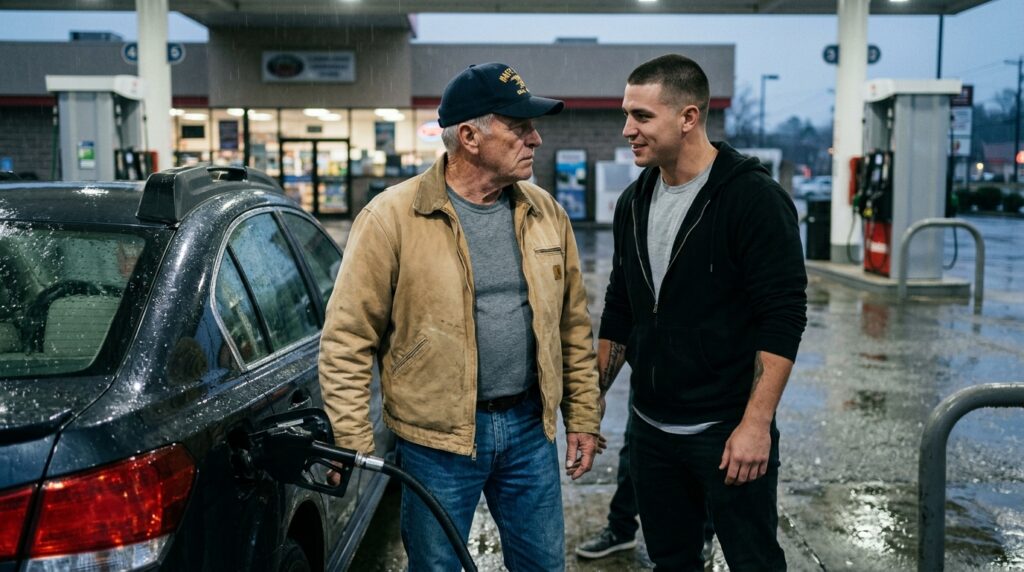
Nice hat, old man, you still playing hero at a gas pump?

The words cut through the heavy, rhythmic hiss of the June downpour, slick with the smell of cheap unwashed cotton and cheap tobacco. Miller did not let his fingers leave the rusted latch of the fuel nozzle. The metal was cold, vibrating faintly with the underground thrum of the premium storage tank. He kept his eyes fixed on the mechanical rolling digits of the meter—twenty-one dollars and forty cents, forty-one cents, forty-two cents. The rain was drumming a relentless, metallic beat against the roof of his faded F-150, bouncing off the hood in tiny, desaturated spikes.

He didn’t turn. He didn’t shift his boots. In the gray twilight of the forecourt, under the buzzing white glare of the overhead halogen tubes, the world was composed entirely of grit and friction.

You deaf, or just slow?

A shadow crossed the driver-side mirror, wide-shouldered and damp. The smell changed—now it was the sour tang of beer from two hours ago and the sharp heat of an adrenaline spike. The younger man stepped into Miller’s peripheral vision, crowding the narrow island between the truck’s rear fender and the rusted pillars of pump number four. He was twenty-eight, maybe thirty, with a short, jagged buzzcut that let the rain pool against his scalp, and a thick, dark line of ink curling out from the cuff of his black zip hoodie. His jaw was thrust forward, a smirking, restless movement that Miller recognized with a deep, visceral weariness. It was the face of an engine running without oil, looking for something to seize against.

Miller let the meter roll to twenty-five dollars. His internal count was different. He was tracking the distance between his right heel and the slick iron edge of the pump basin. Three inches. He was tracking the wet weight of his tan canvas work jacket.

I asked you a question, Chief. The young man’s shoulder hitched, his left hand coming out of his pocket, fingers twitching near the bill of Miller’s dark Navy SEAL cap. The faded gold lettering was dark with grease from the shop, but the anchor was still visible. You think that piece of cloth means people have to clear out for you?

Miller released the handle. The mechanical click of the shutoff valve sounded like a small bone snapping in the quiet of the station. He turned his torso slowly, pivoting on the ball of his left foot with the heavy, unhurried precision of an old crane. He did not raise his hands. He kept his elbows tucked close to his ribs, his chin low behind the collar of his jacket.

You picked the wrong pump, son, Miller said, his voice a low, dry rasp that sounded like gravel being dragged across iron. Now stay down and breathe.

The young man didn’t wait for the end of the sentence. He lunged, a clumsy, high-line grab aimed at the throat of Miller’s jacket, his boots scuffing a spray of oily water off the asphalt.

The world contracted to six square inches of wet skin and bone. Miller didn’t think; the decades of deliberate silence vanished behind the violent, instantaneous logic of a reflex he had spent forty years trying to forget. His left hand shot under the young man’s extended forearm, thumb driving deep into the soft tissue above the elbow joint while his right palm struck upward into the pectoral line, breaking the forward momentum. Before the aggressor could counter, Miller stepped deep into the gap, his hip catching the man’s center of gravity, and hoisted him with a short, brutal twist of his core.

The impact was loud—a wet, hollow thud as the younger man’s back met the concrete curb of the pump island, the air leaving his lungs in a single, ragged gasp.

Miller didn’t pursue. He stood perfectly upright in the downpour, his breath steady, his right hand reaching up with absolute deliberation to adjust the brim of his cap. He looked down into the young man’s stunned, pale face, watching the water mix with a smear of grease on the kid’s cheek. The young man lay there, his fingers clutching at the wet concrete, his mouth open but silent, paralyzed by the sheer speed of the drop. Miller turned back to the truck, unhooked the nozzle, and slid it back into its cradle with a dull metallic clink.

As he reached for his keys, his eye caught the puddle near the rear tire. Lying in the oily sheen, half-submerged in the gray water, was a small, laminated security badge that had torn free from the young man’s hoodie during the throw. It wasn’t a local mill pass. It bore the blue-and-gray logo of the state maritime regulatory commission, and stamped across the bottom in bold, red ink was Miller’s own real, unredacted surname—a name he hadn’t used since the night the transport plane went down in the delta.


CHAPTER 2: THE COLD IRON LOG

Turn the key.

The starter on the F-150 groaned once—a dry, iron-on-iron rasp that vibrated up through the worn rubber of the steering wheel—before the cylinders caught with a heavy, unbalanced rumble. Miller didn’t look back at the pump island. In his side mirror, the dark shape of the younger man was already shifting from a sprawl to a clumsy, one-handed push-up against the wet concrete, his boots slipping twice on the slick blend of rain and leaked diesel fuel. The laminated security badge sat face-up on the passenger seat, its cheap plastic edge catching the green, rhythmic blink of the dashboard clock. It read Miller. Not the name on his current state driver’s license. Not the name on the deed to the three-acre salvage yard down by the shipping canal.

The truck rolled out of the station’s halogen glare and into the desaturated gray of the county route. The wipers ploughed through the downpour, leaving opaque streaks of salt-crust and road film across the windshield. Miller kept his speed at exactly thirty-five miles per hour. A man driving an old truck at thirty-five in a storm was invisible; a man driving at forty-five was running. His fingers, calloused to the texture of coarse emery cloth, remained loose on the rim. His heart rate had already dropped back to its resting sixty beats per minute, settled by the same cold, mechanical self-regulation that had kept him breathing when the world around him was burning down to charcoal.

The road flattened out as it approached the industrial canal. Here, the landscape was defined by the oxidation of old logistics. Rusted chain-link fences were choked with dead briars, and the corrugated iron roofs of defunct processing plants sagged under the weight of the water. Miller turned off the tarmac onto a dirt track lined with crushed slag. The tires crunched over the sharp stones, the sound wet and heavy, until the truck cleared the gate of his workshop.

The shop was an unheated three-bay garage built from rough-cut cinder blocks that sweated lime when the humidity spiked. Inside, the air smelled of stale gear oil, solvent, and the sharp, iron tang of the iron shavings piling beneath his drill press. He didn’t turn on the overhead lights. Instead, he pulled the heavy sliding door shut until the rusted iron latch dropped into its hasp with a definitive, dead latch.

He sat down at the workbench. A single goose-neck lamp cast a yellow, low-contrast circle over his logbooks—three-ring binders with canvas covers that had rotted down to loose threads at the corners. For twenty-four years, Miller had recorded every gallon of heating oil he bought, every old engine block he stripped, and every transaction with the regional distributors. He was a meticulous ghost.

He picked up the laminated badge from the truck seat and laid it under the lamp. The logo for the state maritime regulatory commission was authentic—the watermark was embedded in the plastic layer—but the typeface used for the name was a fraction of a millimeter narrower than standard agency issue. It was a rush job. It was an interrogation tool disguised as an ID card, designed to be dropped or shown to verify if the old man at the pump would flinch at the sight of his own ghost.

Miller pulled his latest bulk fuel invoice from the metal spindle on the wall. The receipt was dated three days ago, issued by the terminal foreman at the canal docks where Miller bought his wholesale kerosene. His eye traced the line items down to the registration code at the footer.

The paper felt different between his fingertips. The grain was too slick, lacking the dry, fibrous texture of the cheap carbon sheets the terminal had used since the nineties. He held the sheet directly up to the yellow bulb of the desk lamp.

The serial number stamped into the upper margin was 82-Proc-041.

The pencil in Miller’s right hand snapped cleanly across the grain of the cedar. His thumb stayed pressed against the splintered edge, the pain minor and distant. That wasn’t a commercial shipping prefix. The 82-Proc designation belonged to a defunct logistics channel out of the sub-dock at Norfolk—the very unit that had handled the untraceable freight manifests for the supply drops during the third month of his deployment in the delta. Someone hadn’t just found his current address; they had inserted themselves directly into his local supply line, altering the invoices he handled every single week to see if he was still monitoring the old operational codes.

A floorboard creaked in the storage loft above the drill press.

The sound was microscopic—the dry, microscopic slide of old pine shifting against an iron joist under less than a hundred and eighty pounds of weight. A normal ear would have dismissed it as the building settling under the weight of the rain. Miller’s hand went flat against the cold cast-iron bed of the workbench, his fingers identifying the smooth handle of a heavy three-quarter-inch socket wrench before his body even finalized the movement.

The downpour outside seemed to recede, leaving only the steady, rhythmic drip-drip of water leaking from the eaves into an empty oil drum near the door. He didn’t look up at the dark rafters. He didn’t reach for the light switch. He simply listened to the silence of his own house, realizing that the young man at the gas pump hadn’t been an isolated piece of road friction. He had been the perimeter guard, and the real infiltration was already sitting in the dark above his head, waiting for him to read the paper.

CHAPTER 3: THE DUST AND THE MANIFEST

The socket wrench felt cold, heavy, and balanced between Miller’s fingers. He didn’t lift his gaze from the carbon-slick invoice on the desk, but his shoulders settled into the iron frame of the stool. Every muscle group in his back locked into a quiet, dormant sequence. The water dripping into the external oil drum counted four more beats before the shadow at the top of the wooden stairs shifted again.

Come down from the rafters, Vance, Miller said. His voice didn’t carry more weight than the rain outside, but it cut through the smell of damp pine and gear oil with the flat finality of a closing valve. You’re tracking wood dust onto the drill press.

The silhouette above the heavy timber crossbeam straightened. A low, dry cough rattled down the ladder, followed by the heavy, deliberate scuff of work boots against the rungs. The man who descended wasn’t the young runner from the gas pump; he was broader, older, his skin the color of a wet cardboard box left out on the canal docks. He wore a grease-stained canvas apron over an old hunting jacket, his left hand tucked deep into his pocket while his right stayed loosely hooked over the iron rail of the ladder. His face was a map of local industrial failure—broken veins across a bulbous nose and graying hair that clung to his temples with the sweat of a long shift.

Vance took three steps away from the ladder, his boots crunching lightly over the iron shavings on the floor. He stopped exactly eight feet away, just outside the yellow circle of the desk lamp.

The kid at the station is mine, Vance said. His voice was thin, reedy, the vocal cords scraped raw by forty years of chemical vapors at the commercial terminal. He’s got three cracked ribs and a split lip. He says you didn’t even use two hands.

He crossed the line he shouldn’t have crossed, Miller replied. He didn’t turn his head, but his thumb remained hooked over the cold knurling of the socket wrench. His gaze stayed anchored on the laminated card. He’s carrying state paper with my name on it. Who gave it to him?

Vance let out a short, wet laugh that didn’t reach his eyes. He reached into his internal coat pocket, his movements slow and exaggerated to prove his hands were empty of iron. He didn’t pull a weapon. Instead, he dropped a thick, leather-bound ledger onto the edge of the workbench. The corner of the book was bound in oxidized zinc, and the pages within were yellowed, their edges swollen by thirty years of maritime humidity.

Nobody gave it to him, Miller. The terminal office has had that file since the consolidation in ninety-four, Vance said, his fingers lingering on the cover. My old man was the foreman when the Norfolk freight lines were dissolved. We didn’t know who you were until you started buying bulk kerosene under the salvage yard license. The shipping manifest numbers matched the logistics logs from the delta.

Miller let his eyes drop to the opened page of the ledger. The ink was faded purple—the indelible stencil ink of a military procurement office from 1982. There were six lines of typewriter text, each detailing specific crates of specialized ordnance delivered to a sub-dock at Norfolk. At the very bottom, beneath the authorization stamps, were three names. Two were crossed out with single, heavy lines of black grease pencil, the word DECEASED stamped beside them in faded ink. The third name was his own real name, unredacted, bold, and naked under the halogen glare.

This is a decoy, Vance, Miller said, his thumb tightening against the wrench until the cold steel began to bite into his palm. You’re small-time logistics. You don’t hold files from the Norfolk procurement pool. A shipping company doesn’t keep thirty-year-old black freight logs just to squeeze an old man out of a salvage yard by the canal. Who bought the terminal last winter?

Vance’s jaw twitched, the skin around his mouth turning a dull, flat gray. The smirk he had been trying to maintain collapsed into something hard, narrow, and defensive.

It doesn’t matter who owns the paper, Vance muttered, his eyes darting toward the darkness of the garage door behind Miller. The land under this shop is zoned for the canal expansion. The corporate office has the unredacted manifests. If you don’t sign the transfer deed for the acreage by Friday, those files go to the county prosecutor’s office. An old man with an elite service record and a missing identity trail makes for a very long investigation, Miller. They’ll dig up everything you buried under the swamp.

Miller stood up. The movement was so fluid, so devoid of preparatory tension, that Vance stepped back two full feet, his boot heel catching on a discarded iron pipe with a loud, clattering ring.

The socket wrench didn’t leave the desk, but Miller’s hand was now empty, his fingers resting lightly against the leather ledger. He looked past Vance’s shoulder, his hard, focused eyes capturing the small, dark silhouette of a sedan parked down the track, its lights turned off, its exhaust pipe coughing faint, white plumes of smoke into the cold rain.

The corporate office didn’t hire your kid to scare me off the land, Vance, Miller said softly, his gravelly voice dropping into the quiet space between the thunder claps. They sent him to see if I’d kill him. They wanted to know if the man from the 1982 manifest was still alive, or if he’d turned into a soft old mechanic. You told them I used one hand. That means they have their answer.

Vance looked at the window, then back at the ledger, his bravado completely evaporating into the smell of wet zinc. What are you talking about? It’s just a property dispute. The company wants the waterfront.

Miller leaned down, his face inches from the yellow light of the lamp, his weathered jaw set like iron. No. The company wants the third man on that manifest. And you just gave them the signature they were looking for. Get out of my shop.

Vance didn’t take the ledger. He backed toward the sliding door, his hands raised to his chest, his boots shuffling through the iron shavings until he slipped through the narrow gap into the rain. The car down the track didn’t turn on its high beams; it simply shifted into gear, its tires sucking against the wet slag as it glided backward into the dark, leaving Miller alone with the rotted purple ink of his past.

CHAPTER 4: THE COLD IRON MERIDIAN

The tail-lights of Vance’s sedan dissolved into the black, rain-mottled boundary where the slag track met the county road. Inside the shop, the single bulb of the goose-neck lamp hummed, its yellow filaments vibrating with the low frequency of the industrial power grid. Miller did not look back at the open doorway or the wet air blowing mist across the floorboards. His hands moved with an unhurried, heavy rhythm that had nothing to do with panic and everything to do with the simple economy of survival.

He closed the leather-bound ledger. The zinc-bound corners scraped against the iron filings on the workbench, a sharp, abrasive sound that remained in the small space between his ears long after the book was stowed inside a heavy canvas tool sack. He didn’t lock the garage door behind him. A lock was an invitation for a crowbar, and everything of value inside the block walls was already registered in his muscle memory.

The F-150 cleared the gate without headlights, its iron exhaust coughing a cold, gray plume against the wet weeds. Miller navigated by the silhouette of the cranes three miles south—six black skeletons rising over the shipping canal, their steel booms silhouetted against the desaturated orange glare of the municipal refinery.

The entrance to the regional shipping terminal was defined by gravel trucks and rusted scales. A single chain-link gate hung open, its padlock swinging from an iron link like an unspent pendulum. Miller parked the truck behind a row of dead flatbeds, where the shadow of the container stacks was dense enough to swallow the faded paint of his fenders. He walked toward the administrative shack, his boots making no more sound on the wet gravel than the rain hitting the mud.

The shack was constructed of corrugated iron panels that had turned the color of dried liver under thirty years of river salt. Inside, through the grease-filmed glass of the single office window, Vance was standing beside a gray filing cabinet. His canvas apron was gone, replaced by a cheap nylon jacket that rasped every time his arms twitched. Opposite him sat an older man in a tailored wool overcoat that looked out of place among the iron desks—a man whose fingers held a thin, clean sheet of corporate transfer paper with the distinct, unhurried confidence of an executioner.

Miller didn’t use the handle. He struck the latch side of the iron door with the heel of his boot, a single, short impact that sheared the small zinc screws holding the strike plate to the frame. The door swung inward, banging hard against the drywall with a hollow, dust-choking crack.

Vance jumped back, his hip hitting the edge of the desk, a row of plastic specimen cups rattling onto the linoleum. The man in the wool coat didn’t move his boots. He simply raised his chin, his eyes cold, grey, and entirely devoid of the small-town hesitation that defined Vance’s family.

You’re late, Miller, the man in the coat said. His voice was flat, unyielding, carrying the precise mid-Atlantic accent of an administrative officer from the old logistics command at Norfolk. The deed has been ready since six.

Miller dropped the canvas tool sack onto the desk. The weight of the zinc ledger hit the wood with a dead, heavy thud that flattened a box of brass paperclips.

The land isn’t what you’re tracking, Miller said. His rasp was lower now, matching the low thrum of the river barges passing thirty yards behind the wall. You bought this terminal through three shell companies registered in Delaware. The corporate land grab is a clean file for the county inspectors. But the manifest inside that sack doesn’t belong to a commercial entity. It belongs to the desk that authorized the transport over the border in August of eighty-two.

The man in the coat let his fingers rest on the clean transfer document. A small, cold smile touched the edge of his mouth, though his eyes remained fixed on the golden lettering of Miller’s cap. The gold thread was fraying, one small loop of the anchor hanging loose like a broken wire.

My father was the procurement officer who signed that purple ink, the man said softly. He spent twenty years in a federal facility because three crates of specialized optics vanished from the sub-dock at Norfolk during your unit’s third month. He died in a gray room believing one of the three men on that manifest had sold those crates to a scrap dealer in Baltimore to fund a civilian exit.

He was wrong, Miller said. He stepped closer, the wet canvas of his jacket brushing the edge of the desk, the smell of old grease and swamp water filling the small room until Vance began to wipe his nose with the back of his sleeve. The crates never left the transport plane. They went into the mud with the rest of the fuselage when the tail rotor sheared over the delta.

The man in the coat stood up, his wool shoulders squaring against the corrugated iron wall. Then your signature on the delivery log is a forgery, Miller. Or it’s a confirmation that you survived the impact while the other two went into the ground. Either way, the company doesn’t need the land. The company needs the identity trail. The moment you used your old leverage to secure the salvage yard deed twenty years ago, you left an ink trace in the state archives. We just had to wait for you to grow old enough to slow down.

Miller looked down at his own hand—the skin calloused, stained with black oil that would never wash out of the grain, the fingers steady against the cold iron edge of the desk. He felt the weight of forty years of silence balancing against the sudden, mechanical necessity of a final confrontation. The decoy secret—the simple land dispute that Vance had used to threaten him—was gone, dissolved into the cold, multi-generational ink of an old military grudge that had followed him down to this river mud.

You shouldn’t have brought your boy to the pump, Vance, Miller said, his gaze shifting back to the foreman, who was now trembling against the filing cabinet. He’s too soft for this kind of work. And he doesn’t know what happens to things that get caught in the machinery.

The man in the coat reached toward his internal pocket, his fingers tracking a small, black shape beneath the wool.

Miller didn’t draw a weapon. He simply reached across the desk with his left hand, his thumb catching the man’s lapel with the exact, instantaneous grip he had used on the concrete forecourt three hours ago, his right hand pinning the clean transfer document to the wood like a metal stake. The room fell into an absolute, suffocating silence, broken only by the sound of the rain drilling into the iron roof above their heads—an echo of an old sky that had never truly cleared.

CHAPTER 5: THE COLD EXTRACTION

The wool fabric of the overcoat bunched tight in Miller’s left fist, the fibers resisting the sudden, downward leverage of his knuckles. Across the desk, the procurement officer’s son froze, his right hand still trapped inside the lining of his coat, his fingers locked around a shape that never had the chance to clear his lapel. The air between them smelled of damp wool and the sudden, iron-sharp spike of an old man’s breath.

Don’t open the hand, Miller said. His rasp was dry, level, and entirely devoid of the heat that usually accompanied a breach. He didn’t shift his weight. His boots remained glued to the water-dark linoleum, his center of gravity low, anchoring the entire desk against the wall. Vance, pull the middle drawer on the left side of that filing cabinet. The zinc one.

Vance didn’t move for two full beats, his mouth opening and closing like a landing fish against the green metal drawers. He looked at the man in the overcoat, then at Miller’s thumb, which was pressing into the carotid artery just beneath the tailored collar—a precise, mechanical pressure that was already turning the officer’s cheeks a dark, mottled purple.

Do it, Vance, the man in the coat choked out. His grey eyes had lost their administrative chill, widening as they calculated the terrifying, effortless stability of the hand holding him down. Do what he says.

Vance lunged forward, his wet boots scuffing a loud, desperate streak across the floor. He yanked the zinc drawer until it struck the internal stop with a hollow, brassy ring. Inside, beneath a stack of rotted canal tonnage logs from eighty-six, sat a six-inch cylindrical container—a rusted zinc dispatch tube with a screw-top cap that had been sealed with green grease-pencil markings. It was a military courier canister, old enough to have pitted along the seams, but the stamp on the cap was unmistakable: LOG-SEC-O4.

Bring it here, Miller commanded.

Vance lifted the tube as if it were unexploded ordnance from the riverbed, his fingers shaking so violently the cylinder rattled against the metal desk lamp. He dropped it onto the clean property transfer deed.

Miller didn’t release his grip on the wool coat. He used his right hand, the skin calloused down to the quick, to twist the zinc cap. The threads ground against years of dried mineral grease, releasing a sharp, vinegar-sharp odor of degrading cellulose nitrate paper. He tilted the tube. A single roll of thin, unredacted ledger sheets slid out onto the wood, their edges stained the color of old lard.

These aren’t procurement logs, Vance, Miller said, his eyes scanning the first four lines of purple ink without moving his chin an inch from the officer’s throat. This is a dispatch manifest for an evaluation team. It’s dated three days after the transport plane went down in the delta. Look at the logistics codes at the top.

The man in the overcoat tried to swallow, his throat clicking against Miller’s knuckle. My father didn’t sign those, he muttered, the words thin and wet. He was just the custodian.

He didn’t sign them because he didn’t have the clearance, Miller said softly. He released the coat with a sudden, clean opening of his fingers, stepping back two inches into the shadow of the doorframe before the man could regain his balance. The signature at the bottom belongs to the regional director at the capital. Your father didn’t go to prison for losing three crates of optics. He went to prison because he hid this tube in the terminal safe to keep his family alive when the cleanup crew started turning the team into ghosts.

Miller grabbed the roll of lard-stained paper and shoved it deep into his canvas jacket pocket, his fingers identifying the cold, square corner of the zinc canister before he cleared the desk. The car down the track wasn’t Vance’s sedan; it was the second unit, the one that had stayed in the dark with its lights turned off while Vance did the talking. Through the broken frame of the door, the sound of the rain on the gravel had changed—the heavy crunch-crunch of multiple pairs of heavy rubber boots advancing in a wide, synchronized crescent toward the shack.

They’re not here for the land, Vance, Miller said as he reached for the iron latch of the door. And they’re not here to verify my signature. They’re here to close the file on anyone who ever saw that tube.

He didn’t wait for the foreman to reply. He stepped out into the desaturated downpour, his Navy SEAL cap low over his eyes, his boots already executing the short, dark route between the dead flatbeds toward his truck before the first high-beam halogen cut through the gray mist of the canal.

CHAPTER 6: THE SILICATE TRAP

The door of the administrative shack hadn’t settled back into its frame before Miller was deep within the maze of twenty-foot steel shipping containers. The rain cut through the narrow corridors between the iron boxes in sharp, fragmented sheets, the wind turning the yard into a vast, industrial woodwind that rattled the loose locking rods overhead. Behind him, the rhythmic crunch of the rubber boots on gravel split into two distinct paths—one grouping flanking low toward the pier, the other tracking the exact grease line left by his truck’s worn oil pan.

They weren’t using flashlights. That meant they carried active starlight optics or thermal lenses, computing the cold landscape by the heat signatures left on the wet metal. Miller reached into the canvas sack at his hip, his fingers identifying the cold, coarse weight of a heavy iron rigging clamp he’d pulled from the terminal scrap heap three days ago.

He didn’t run. The dirt path down to the flooded gravel pit was lined with old sorting screens—giant grids of rusted steel mesh that had been left to sink into the river silt. Every three paces, his heel found the solid, buried edge of an iron support beam. He knew the layout of the pit better than the corporate surveyors who had signed the acquisition papers; he had spent fifteen winters dragging dead engines out of the slurry at the bottom of the basin.

A sharp, metallic clink sounded thirty feet to his left. It was the distinct slide of a carbon-fiber bolt-carrier being cleared—a short, professional sound that lacked the loose play of a local deer rifle.

Miller stopped behind the rusted winch housing of an old aggregate conveyor. The iron frame was five inches thick, deeply pitted by oxidation, but dense enough to stop a high-velocity round from an evaluation team’s carbine. He let his breath out slowly, a cold plume of gray vapor that vanished against the wet canvas of his sleeve. Through the gap in the winch gears, he watched the first silhouette clear the container line.

The man moved with a short, wide-based stride that belonged to maritime boarding parties. He wore an unbadged foul-weather parka that didn’t reflect the orange glare of the distant refinery, and his face was masked by a tight neoprene hood that left only the narrow slit of his protective lenses visible. The weapon in his hands was short, suppressed, and fitted with an oversized zinc-coated battery pack under the handguard.

He was checking the mud, his lens tracking the single line of deep, square boot prints Miller had deliberately left in the soft silt beside the main track.

Miller didn’t wait for the man to calculate the depth of the stride. He swung the iron rigging clamp by its threaded spindle, letting the four-pound block of corroded iron strike the rusted steel cable of the conveyor line. The impact was loud—a high-frequency, bell-like ring that traveled up the length of the steel lattice, echoing off the hollow containers across the yard like a small mortar detonation.

The silhouette turned instantly toward the sound, the muzzle of the suppressed carbine rising in a flat, defensive arc.

Before the lens could settle on the winch housing, Miller stepped into the gap from the blind side, his movements low and compact, his boots making no more friction on the wet gravel than a handful of thrown sand. He didn’t use a high-line strike. He drove his right shoulder straight into the operator’s ribs beneath the body armor, his left hand coming upward to trap the hot metal of the suppressor before the muzzle could clear his belt line.

The impact was short and wet. The operator’s breath left him in a dry hiss as Miller used the man’s own forward momentum to pivot, driving the back of the neoprene hood into the sharp, exposed corner of the conveyor’s rusted zinc junction box.

There was a muffled, plastic crack as the lens broke against the metal. The man went limp, his knees buckling into the slurry, the carbine sliding free from his fingers into the black water at the bottom of the trench.

Miller didn’t check the pulse. He snatched the short weapon by the grip, his thumb immediately finding the safety selector—it was set to a sterile, unmarked position between safe and semi—and verified the weight of the magazine. It was loaded with heavy, sub-sonic lead rounds designed for close extraction inside enclosed spaces. The corporate cover was clean, but the iron in the magazine belonged to the old logistics pool at Norfolk.

A second set of boots scuffed the gravel twenty yards up the bank, followed by the short, rhythmic chirp of a digital tactical radio.

Unit two, status on the perimeter. We have an unverified signature near the pit.

Miller didn’t answer the air. He dropped the carbine into the deep silt at the foot of the conveyor, knowing that using their own iron would trigger a cross-fire sequence he couldn’t control with three cracked ribs and a failing F-150. He pulled the rotted roll of purple-ink ledger sheets tighter inside his canvas jacket, his fingers catching the sharp, rusted edge of the zinc tube that Vance had left behind.

He had forty seconds before the secondary team covered the distance between the administrative shack and the pit. The path down to the river road was still open, but the mud was rising, the rain turning the old working-class basin into a slick, industrial sinkhole that was slowly reclaiming every name on the manifest. He turned toward the truck, his face set against the cold rain, his active agency now driving him directly toward the capital highway before the local authorities could lock the county line.

CHAPTER 7: THE RUSTED HORIZON

The door of the F-150 caught the first heavy gust of river wind as Miller pulled himself into the cab, his boots carrying three pounds of wet gravel slurry onto the floor mats. The engine didn’t fail him; it caught with that same stubborn, iron-on-iron groan before the exhaust pipe clearing its throat into the rising water of the pit. He kept the headlights dead until the truck cleared the terminal perimeter gate, the tires tracking the deep, parallel ruts left by the utility vans that had cut him off from the south road. He had only one line left—the state highway running straight north into the capital, a forty-mile stretch of desaturated asphalt pinned between abandoned industrial canals and chemical storage farms.

The roll of old, purple-ink ledger sheets sat heavy against his ribs, protected from the rain by the oil-stained lining of his canvas jacket. Every mile the truck traveled, the rhythmic thrum of the wheels against the concrete joints sounded like a countdown. He didn’t check his rearview mirror until he reached the high span of the canal bridge, where the gray expanse of the city appeared through the cloud base like an array of rusted iron teeth.

The address from the zinc tube led him away from the legislative center, deep into the old wholesale district behind the rail yards. Here, the state authority didn’t use glass or limestone; it used gray brick buildings with barred windows and fire escapes that had corroded down to jagged orange lace. The sign over the entry read Department of Maritime Archives, the gold lettering long ago flaked away by the sulfurous smog of the nearby diesel sheds.

Inside, the silence was absolute, save for the hum of an ancient, vibrating fluorescent fixture hanging over a long linoleum counter. A single man sat behind the barrier—not a field operator with a carbon-fiber weapon, but an administrative fossil in a frayed cardigan, his fingers stained with the dark gray graphite of an old ledger pencil. His hair was thin, white as lard, and his shoulders stooped under the weight of fifty years of processing shipping manifests that nobody would ever read again.

Miller didn’t drop the tool sack this time. He laid the rotted roll of purple-ink ledger sheets flat on the wood, his calloused thumb pinning the unredacted signature line right under the clerk’s yellowed spectacles.

The old man didn’t flinch. He didn’t call for security. He simply peered through his lenses at the indelibly stenciled signature from 1982, his jaw moving with a small, slow chew that smelled faintly of peppermint and stale coffee.

You’re late with the turn-in, Miller, the clerk said, his voice a dry, papery whisper that matched the sound of the rain against the skylight above. The Norfolk procurement office closed its books before the wall came down in Berlin.

Who signed the erasure order on the third day after the crash? Miller asked. His voice was lower than the city traffic outside, a gravelly rattle that had spent forty years waiting for this specific room. The corporate office at the terminal said it was a land dispute. Vance said it was an insurance audit. But this ink didn’t come from a commercial desk.

The clerk reached under the counter, his hand returning with a heavy brass key barrel that bore a small, distinctive notch near the pins—the hallmark of the old logistics pool locking mechanisms Miller had handled during his first month at Norfolk. He didn’t turn the key. He just let it sit between them on the wood, a cold piece of metal that had outlived the unit it was built for.

The company didn’t buy the terminal to clear the land, Miller, the old man whispered, his eyes remaining fixed on the unredacted name that had been crossed out with grease pencil. They bought it because the liquidation protocol from eighty-two was never legally rescinded. It was a standing order left on a dormant mainframe in the sub-basement here. Every time you bought bulk kerosene with an archived voucher number, the system flagged your location as an unspent liability. The men at the pump weren’t contractors trying to build a dock. They were the third-generation retrieval team, executing an automated loop that doesn’t know the war is over.

Miller looked at his cap resting on the counter—the gold thread of the Navy SEAL anchor frayed and dark with shop grease. The entire architecture of his flight—the forty years of changing names, the three-acre salvage yard, the silence he had built like a block wall—hadn’t been compromised by an enemy or a traitor. It had been compromised by the permanence of his own record, an unliquidated line item in a rusted filing system that kept grinding away long after the operators had gone home to die.

There’s no one left to sign the cancellation, the clerk added, his fingers sliding the ledger sheets back into the rusted zinc canister with a slow, definitive scrape. The registry is empty. The people who authorized your erasure are buried in the national cemetery, but the machine doesn’t care about a headstone. It just looks for the signature to match the exit manifest.

Miller didn’t take the brass key. He pulled his cap back over his brow, his fingers lingering for one brief second on the coarse canvas of his jacket where the old grease pencil had left its watermark. The ultimate truth was naked now, cold and desaturated like the rain falling over the railyards outside. There was no victory to be won against a corporate structure or an old grudge; there was only the continuous, pragmatic labor of staying one step ahead of an automated ghost that would never stop tracking his oil consumption until the F-150 ran out of road.

He turned toward the exit, his boots making a heavy, unhurried sound against the linoleum as he stepped back out into the gray twilight of the capital. The truck was waiting by the curb, its wipers still plowing through the film of salt and soot, its engine running on the last quarter-tank of unrefined diesel, ready for whatever horizon was left to clear before the dark caught up with him for good.

CHAPTER 8: THE CARBON COURIER

The glass doors of the archive building rattled behind Miller, the old brass latch catching with a dry, hollow click that was instantly swallowed by the roar of the city’s drainage grates. The rain here didn’t smell of river mud or the green salt of the canal; it tasted of soot, sulfur, and the cold, metallic discharge of the locomotive sheds two blocks south. He adjusted the brim of his Navy SEAL cap, pulling it low until the frayed anchor gold was shielded from the white spray thrown by a passing delivery van.

He didn’t make it to the F-150’s door handle.

A shadow broke away from the entry of a defunct customs brokerage house forty feet down the curb. It didn’t have the wide-set, tactical posture of the operators from the gravel pit. This figure was thin, narrow-shouldered, moving with the rapid, uneven hitch of someone whose knees had been ruined by structural labor. He wore a long, water-logged oilskin coat that dragged against the wet weeds growing out of the concrete seams.

Miller’s right hand went flat against his thigh, his fingers instinctively testing the canvas lining of his pocket to ensure the rusted zinc dispatch tube hadn’t shifted during his exit. He didn’t reach for a tool. He simply stood beside the truck’s rusted fender, his boots anchored into the cold asphalt, watching the shape close the gap.

Miller, the man said. The voice was a cracked reed, but it carried the flat, localized accent of the lower delta counties. The old clerk in there… he doesn’t have the whole book. He only sees the paper that comes down the chute.

Miller didn’t take his hand off his thigh. Who are you?

The man stopped five feet away, just clear of the truck’s side mirror. He pulled back the hood of his oilskin, revealing a face that looked like an old boot left in a swamp—leathery, deeply scarred along the left jawline by a high-velocity fragment, and missing the lower half of his right earlobe. His eyes were small, wet, and clear with the desperate clarity of a man who had been hiding in the same cellar for thirty years.

I was the third name on the sub-dock manifest before they stamped it DECEASED, the man whispered. His breath was shallow, smelling of cheap wintergreen lozenges and damp cotton. They didn’t cross me out because I died in the crash, Miller. They crossed me out because I was the one who drove the truck that hauled the remaining three crates out of the delta before the cleanup team reached the smoke.

Miller’s torso remained perfectly still, but his jaw set until the bone clicked beneath his weathered skin. You’re supposed to be in the national registry at Arlington. I saw the markers myself in ninety-two.

They put stones up for all of us to keep the audit clean, the man said, a short, bitter grin twitching the scarred corner of his mouth. He reached into his coat and pulled out a small, green canvas logbook—identical to the ones Miller kept in his cinder-block garage, but this one was bound with heavy steel wire instead of thread. Stamped across the fabric cover was the old Norfolk logistics prefix: 82-Proc-042. The terminal didn’t flag you because of your kerosene vouchers, Miller. The terminal flagged you because the company that bought the docks just initialized the secondary phase of the procurement sweep. They’re tracking the optics crates. They think you have the keys to the warehouse in the capital.

The sound of a heavy diesel engine shifted gears at the corner of the block.

A dark utility van, its windows opaque with security film and its fenders splattered with the gray mud of the lower county roads, turned slow onto the archival route. It didn’t turn on its high beams, but the tires hissed against the wet asphalt with a heavy, deliberate momentum that Miller recognized from the station forecourt forty miles behind him.

Get in the truck, Miller said, his rasp dropping into the quiet space between the downpours.

The old courier didn’t look back at the headlights. He simply turned toward the passenger side, his stiff knee scraping against the rusted rocker panel as he hauled himself into the cab, leaving a dark smear of river silt on the vinyl seat. Miller swung into the driver’s side, his hand hitting the key before his door had even latched against the frame, the old iron starter groaning into the gray dark as the automated loop finalized its target profile.

CHAPTER 9: THE CONCRETE CRESCENT

The starter gave its familiar, jagged screech—metal binding against metal in a dry casing—before the eight cylinders caught with a sharp, ragged exhaust backfire. Miller didn’t clear his high beams. He pulled the column shifter into reverse, his boot driving into the heavy steel pedal until the rear tires bit into the grease-slick gutter. The truck lurked backward, its steel bumper catching the rusted lip of a discarded cast-iron coal chute with a harsh, screaming scrape that sent a shower of orange rust flakes bouncing across the pavement.

Beside him, the man with the ruined earlobe didn’t touch the dashboard. He held the green canvas logbook against his ribs with both thumbs, his knuckles gray and pitted like zinc washers.

They’re tracking the terminal loop, the courier said, his voice flat, dry, and thin as packing paper. They don’t need a confirmation signature anymore. They just need the truck stopped before we reach the freight gate at the rail yard.

Miller didn’t answer. He threw the wheel over, the power steering pump groaning a high-frequency whistle as the F-150’s nose swung out into the lane. Forty feet ahead, the dark utility van didn’t brake; its front bumper dipped as the driver accelerated into a wide, aggressive crescent designed to pin the truck against the brick masonry of the archive wall. There was no flash of chrome, no municipal emblem on the panels—only the dull, desaturated sheen of commercial primer and the rhythmic, heavy thump of heavy-duty off-road tires chewing the wet slag.

Miller didn’t look for an exit route on the open road. He drove straight into the mouth of the crescent.

His right hand shifted the column lever back into first gear, his thumb remaining locked over the cold iron rod. The truck’s steel grill met the van’s front quarter panel at an angle of twenty degrees—a short, blunt impact that didn’t shatter the frame but sheared the fiberglass headlight housing of the pursuing vehicle with a sound like a heavy boot breaking dry pine. The shock traveled up the steering column, vibrating the old scars in Miller’s wrists, but the weight of the truck’s iron bumper won the displacement. The van skidded six inches sideways into the mud of the curb, its high-traction tires spinning uselessly against the slick moss of the masonry foundation.

The lane behind them opened. Miller blew through the gray curtain of the downpour, his engine screaming at three thousand revolutions as he navigated by the rusted steel spans of the high-line tracks overhead.

Where is the warehouse, Vance? Miller asked, his rasp dropping into the low hum of the transmission gears. His eyes stayed locked on the windshield film, tracking the faint, blue flashes of the industrial switch-engines half a mile ahead.

It’s not a warehouse anymore, the courier whispered, his fingers tracing the steel wire binders of the logbook. It’s the old cold-storage facility under the second pier. The company uses the sub-level to dry-dock the river tugs. But the mainframe… the old automated registry from eighty-two… it’s still wired into the local telegraph line behind the boiler room. The clerks never took the copper out of the walls. They just built a cinder-block partition over the junction box.

The truck crossed the iron plates of the railyard crossing, the tires bouncing with four short, rhythmic thuds that sent a loose socket wrench rolling across the floorboards. In the rearview mirror, the van had cleared the curb, its remaining halogen beam cutting through the rain like a yellow needle, accompanied by a second set of headlights turning off the industrial avenue three hundred yards back.

They’re closing the grid, Miller, the courier said, his thumb tightening against the green canvas until the wire binding began to warp. They’ve had forty years to map the escape lines from this block.

Let them map it, Miller said softly. His face remained fixed in the yellow glare of the dashboard, his Navy SEAL cap casting a deep, motionless shadow over his hard, focused eyes. They’re tracking a manual log from eighty-two with an automated system. The machine only knows how to close the gate we used when the plane went down. It doesn’t know what happens when an old mechanic changes the oil.

He didn’t hit the brakes for the terminal turn. He dropped the truck into second, the transmission grinding a protest as he forced the nose into a narrow, unpaved alleyway lined with corroded iron scrap bins and the rotted timbers of old flatcars, driving straight into the desaturated gray underbelly of the river district where the final truth was waiting behind the brick.

CHAPTER 10: THE COLD ARCHIVE LOGIC

The F-150’s front tires cleared the final mountain of rusted iron scrap with a dull, wet thud, the frame bottoming out on a half-buried oak sleeper before sliding into the dead shadow of pier number two. Above them, the roof of the cold-storage facility hung low, its corrugated zinc panels blackened by forty years of coal soot from the nearby marshaling yards. Miller turned the key back to the zero marker. The engine died mid-stroke, its final rumble vanishing into the vast, hollow echo of the river basins.

The silence that followed was heavy, wet, and thick with the chemical stench of ancient ammonia lines. Beside him, the courier pushed his door open, his stiff leg scraping across the seat frame with a short, metallic squeak that felt as sharp as a razor blade inside the closed cab.

The boiler room is behind the salt tanks, the old man whispered, his fingers leaving a damp, grey residue on the green logbook cover. The terminal blocks haven’t been scrubbed since the corporate buyout. If the loop is still hot, the relay will be buzzing behind the insulation.

Miller didn’t take the sack. He slipped the zinc dispatch tube into his internal jacket pocket, his calloused palm confirming the rigid, unyielding shape of the cylinder against his ribs. They left the truck in the dark, their boots navigating a concrete floor that had split into deep, water-filled trenches where the river was reclaiming the foundation.

The air grew colder as they descended the ramp behind the coal bunkers, the lime-crusted brick walls weeping steady, freezing beads of condensation that pattered against the canvas of Miller’s shoulders. At the foot of the stairs, an iron door hung crookedly from a single rusted hinge, its zinc strike plate stamped with the same logistics code Miller had carried out of the delta: LOG-SEC-O4.

Inside, the room was small, square, and choked with the dead weight of abandoned machinery. Behind a massive, scaling boiler shell sat the partition wall—a crude barrier of unpainted cinder blocks that had been laid down with irregular, oozing mortar seams. A single braided copper grounding strap ran out from beneath the concrete blocks, its lower end clamped tightly to a dead two-inch water line that had oxidized to a brilliant, toxic green.

Miller didn’t search for an iron bar. He drove his boot into the center of the block wall, his weight finding the hollow core of a poorly secured unit. The concrete shattered with a dry, gravelly crack, exposing a narrow recess lined with rotted canvas cable wraps.

Mounted to the back wall was the relay—a heavy cast-iron terminal block fitted with twelve brass toggle switches and a bank of mechanical stepper counters that were clicking with a slow, erratic rhythm. Tick. Click-tick. Tick. The sound was mechanical, rhythmic, and old, driven by a vintage continuous-current loop from a mainframe that had survived three changes of government. The digital ledger counters were rolling forward, their white-on-black digits registering the precise coordinates of his salvage yard license.

It’s an automated sweep, Miller said, his rasp flat and low in the damp cellar. His thumb went to the main breaker toggle—a heavy iron bar wrapped in dry, cracked vulcanized rubber. The local office didn’t initialize this phase to find the crates. The system initialized itself the moment the old clerk at Norfolk died and his security token was cleared from the regional terminal grid.

The courier reached out, his gray, scarred fingers touching the vibrating iron casing of the relay box. If you open that bar, Miller, the state network flags it as a physical line compromise. The extraction team outside won’t stop at the county line. They’ll clear the whole basin to find where the signal dropped.

Let them clear it, Miller said softly. He didn’t flinch as a sharp, metallic scuff echoed down the concrete ramp behind them—the distinct, heavy sound of an off-road utility vehicle’s tire rubbing against the rotted timber of the bay entrance. The high-beam halogens cut through the broken frame of the door, throwing two sharp, white needles of light across the lime-crusted bricks.

The second layer—the true reality beneath the corporate land grab and the multi-generational blood feud—was naked now. There was no desk left to appeal to, no supervisor who could redact the manifest, no political shift that could dissolve the budget siphon that had funded his unit’s erasure in 1982. The state-level black budget that had bought those crates had created an engine that could only execute its final instruction: Zero the ledger.

Miller’s fingers closed around the rubber-wrapped iron toggle. He didn’t look at the headlights filling the doorway behind him, nor did he look at the courier’s green logbook. He pulled the bar down with a single, short, downward stroke that sheared the brass safety wire with a sharp ping.

The relay box died with a dull, popping hiss of burnt copper filament, the mechanical counters stopping mid-rotation between two unspent digits. The yellow dashboard glare from his truck outside went dark as the entire cold-storage terminal dropped into the absolute, unvarnished silence of the river night. The machine had lost its line. Miller turned slowly toward the white halogens in the doorway, his chin low behind his canvas collar, his hard, focused eyes calculating the distance to the nearest iron conveyor pipe as the first pair of heavy rubber boots cleared the broken masonry threshold.

Similar Posts

Leave a Reply

Your email address will not be published. Required fields are marked *





