
The Cold Geometry of Duty and the Weight of Unacknowledged Soil

CHAPTER 1: THE SALUTE IN THE GRAVEL

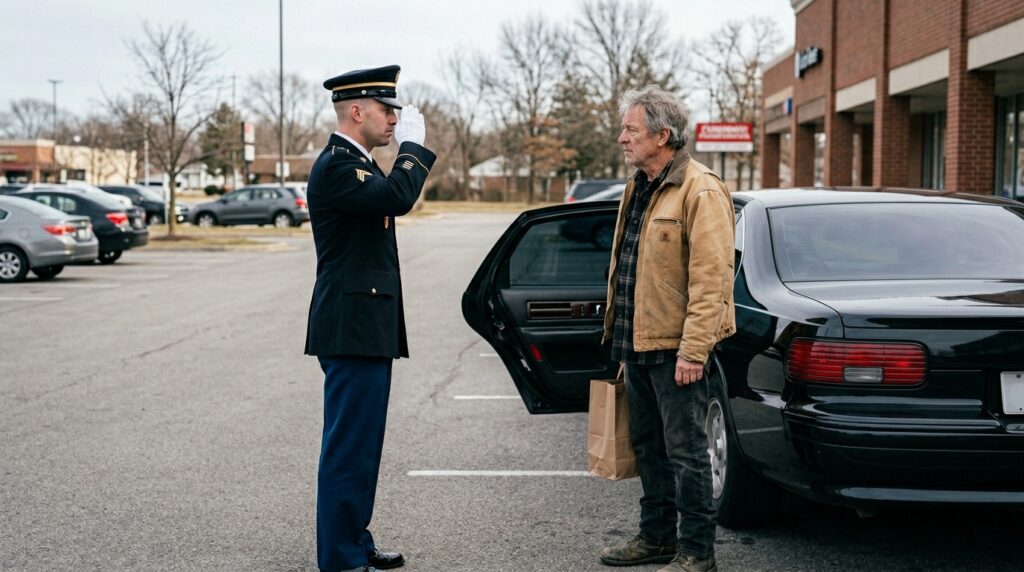
“You shouldn’t have worn the dress blues, Arthur,” the old man said. His voice was like two gravel bags rubbing together in the bed of a truck.

Captain Arthur Vance did not lower his arm. His white-gloved fingers were locked in a perfect forty-five-degree angle, the edge of his hand pointing precisely toward the corner of his eyebrow. The blue stripe running down his trousers felt stiff against the bite of the December wind cutting across the asphalt. Every institutional instinct he possessed demanded he maintain the posture until the salute was returned or acknowledged. This wasn’t a parking lot behind a defunct department store; it was a matter of structural survival.

“The notification required an officer of rank, Dad,” Arthur said, his lips barely moving behind his clean-shaven jaw. “I happened to be the one holding the file.”

Between them stood the black sedan, its rear passenger door flung wide like a broken wing. Inside, the gray fabric seats were immaculate, smelling of industrial ozone and the chemical vanilla of military pool vehicles.

His father, Thomas, didn’t move. He looked small in the dirty tan work jacket, his shoulders hunched as if expecting a low-skipping stone from the tree line. In his left hand, he held a brown paper bag, the top twisted into a tight, greasy rope. The smell of cheap onions and lard drifted from it, a heavy, domestic scent that fouled the clean air of the state line.

“An officer of rank,” Thomas muttered. He looked at the white cloth of Arthur’s glove. A tiny speck of black grease from the sedan’s door hinge had already transferred to the fabric near Arthur’s wrist. “You look like a mannequin in a PX window.”

“Return the salute, Senior Airman Vance.” Arthur’s voice dropped an octave, deploying the flat, rhythmic cadence of the barracks. It was a shield, thick and cold. “Do it by the book, or let it go. But don’t look at me like that.”

The old man’s right shoulder twitched. The movement was ugly, burdened by forty years of shifting crates on the dry-docks and a rotator cuff that had clicked like a dry socket since 1991. Slowly, his hand rose. The fingers didn’t straighten; they curled like dried leaves, the knuckles thick and gray with embedded oil that no pumice could ever reach. He brought his hand to his temple, his eyes remaining fixed on the second button of Arthur’s tunic.

For three seconds, the parking lot was entirely silent except for the rhythmic ticking of the sedan’s cooling manifold. The iron under the hood was hot; the ground beneath their boots was freezing.

Arthur dropped his hand first, his arm snapping down to his seam with a dull thwack against the wool. Thomas let his arm fall more slowly, a heavy drop that ended with his hand slapping against the worn denim of his thigh.

“The state is terminating the medical variance on the house,” Arthur said, stepping forward. He didn’t ask permission. He closed the three feet of gray gravel between them, his pristine boots crunching into the grit. He reached out, his white-gloved hands wrapping around the rough canvas of his father’s coat shoulders, pulling the old man into a brief, three-second frame.

Thomas felt like iron wrap-around pipe—cold, unyielding, and smelling of damp wool. He didn’t hug back; his arms stayed pinned by his sides, the paper bag crinkling between their hips.

Arthur pulled away, his face resetting instantly into the stiff discipline of the regiment. He took two steps backward, his hand rising again into a final salute, inches from Thomas’s lined forehead. “The car stays here. The keys are in the ignition. I will be at the county records office until dark.”

He turned on his heel before the old man could drop his hand, his eyes tracking back toward the highway. But as his glove caught the edge of the driver’s side door, his fingers brushed the interior pocket where he’d tucked his father’s old service summary. A single piece of red carbon paper, sticking out from the top of the envelope, bore a name that wasn’t Thomas’s—it was the name of the officer who had signed Arthur’s own commission choice ten years ago, marked with a military penal code for fraud.


CHAPTER 2: THE AUDIT OF SHADOWS

The basement of the county records office smelled of subterranean damp and decaying pulp, a heavy, dead air that hung over rows of olive-drab surplus filing cabinets. Arthur didn’t take off his white dress gloves, even as the cold iron handles bit through the cloth. The grease smudge on his right wrist had dried into a stiff, black crescent, a small notch of the shipyard brought into the silent geometry of the archives.

He pulled the drawer for Vance, T. — 1994. The metal tracks shrieked, a sharp, unlubricated scrape that echoed off the bare cinderblock walls. Inside, the hanging folders were thick with dust, the tops of the tabs yellowed to the color of old teeth.

His fingers, stiff from the parking lot chill, sorted through the parchment until they caught on the texture of a legal-sized manila sleeve. He pulled it free and laid it across the top of the cabinet. The iron surface was pitted with rust, tiny orange flakes transferring onto the clean manila paper like dried blood.

Arthur flicked the steel clasp open. Inside lay the administrative skeleton of his father’s exit from the service. Three decades of official silence reduced to six ounces of processed timber.

He flipped past the standard enlistment records, the deployment logs from the Mediterranean, the marksmanship commendations that ended abruptly in the late eighties. Then he found it—the red carbon copy of the DD-214 discharge summary, the exact twin to the fragment currently tucked against his ribs.

He traced his thumb over the line marked Reason for Separation. The typed letters were faint, produced by an old mechanical ribbon, but the ink was clear enough: Conduct Unbecoming — Administrative Separation under Chapter 14. Below it, the section detail cited property damage and the unauthorized operation of heavy logistics equipment during a midnight shift at the naval supply depot.

Arthur leaned closer, the starched collar of his dress tunic pinching the skin beneath his ear. The signature on the authorization line belonged to Colonel Richard Vance—his father’s brother, Arthur’s uncle, and the man whose recommendation letter had cleared Arthur’s path through West Point.

But it was the amendment form attached to the back that made Arthur’s hand go rigid.

A standard Form 215, used for correcting administrative errors, was stapled to the carbon copy with a rusted wire heavy with corrosion. The amendment shifted the blame entirely. It stated that the incident at the depot had been the result of personal negligence by the operator, Thomas Vance, completely deleting a secondary line that mentioned a systemic mechanical failure in the hydraulic brakes of the crane.

Arthur used his gloved index finger to scrape at the edge of the signature on the amendment. The ink was different. The original document used a faded blue ballpoint, but the amendment signature for the commanding officer had a slight, oily sheen under the basement’s fluorescent bulb. It wasn’t ink from 1994. It was modern synthetic polymer gel, the kind used in standard issue government pens issued within the last ten years.

The date stamped next to the correction read October 12, 1994. The ink told a completely different story.

“Looking for something specific, Captain?”

The voice came from the bottom of the basement stairs. Arthur didn’t start; his shoulder blades simply locked into a rigid plane. He closed the manila folder with a deliberate, unhurried motion of his palms, his white gloves smoothing down the paper until the rusted staples were hidden from view.

The archivist, an elderly woman named Mrs. Gable whose husband had served three tours in the delta, stood by the water cooler with a stack of property deeds. Her eyes didn’t fix on the file; they fixed on the immaculate blue stripe running down Arthur’s trousers, then on the dried grease mark on his sleeve.

“Just verifying some historical family data, Mrs. Gable,” Arthur said, his tone flattened to the neutral frequency he used when addressing civilian staff on base. “My father’s service records had some discrepancies regarding his medical pension eligibility.”

“Thomas always was quiet about his time,” she said, her shoes clicking softly against the concrete as she walked toward her desk. “Most of the men from that unit don’t talk. The ones that are left just show up at the VFW on Thursdays, drink their draft, and leave before the lights get bright. Your uncle Richard used to come by here before he moved up to the district command. He was very particular about the family files.”

“Particular how?” Arthur asked. His hand remained flat on top of the folder, his fingers pressing into the manila cover until the cardboard bowed under the weight of his grip.

“Just checking on things. Ensuring the legacy was clean, he called it. He said a family in the service needs to keep its ledger balanced.” She adjusted her glasses, her gaze drifting back to her paperwork. “He came down here about six months ago, right before your promotion went through the senate committee. Spend about two hours in that very aisle.”

Arthur felt a cold drop of sweat trace a slow line down his spine, disappearing into the stiff wool of his waistband. Six months ago was exactly when his background check for the major’s list had been initiated.

He reached into the folder, his gloved fingers sliding beneath the red carbon copy until they brushed a third piece of paper that hadn’t been listed on the file’s index. It was an internal memo from the logistics command, dated two weeks before his father’s discharge. The top corner had been clipped with scissors, removing the classification routing slip, but the remaining text was a list of serial numbers for defective brake lines assigned to the 4th Supply Battalion.

One of those serial numbers matched the crane his father had allegedly crashed while intoxicated.

Arthur didn’t read further. He slid the file back into its hanging folder and pushed the drawer shut until the latch clicked with a heavy, metallic finality that sounded like a rifle bolt locking home. He walked toward the stairs, his boots hitting the concrete with a rhythmic, measured cadence that gave no hint of the fracture widening inside his head.

As he reached the exit, the glare of the gray December afternoon hit the glass door, turning his reflection into a sharp, dark silhouette. On his right hand, the black smudge from his father’s sedan seemed darker now, bleeding into the white weave of the cloth, a permanent blemish on a uniform that had never failed an inspection.

He stepped out into the cold air, his eyes tracking the distance toward the highway where his father’s truck was parked. The truth wasn’t just old grease and rusted iron; it was a currency that had been traded to buy the very rank he was currently wearing.

CHAPTER 3: THE PRICE OF GREASE

The salt shaker on the Formica table had a rusted zinc cap that left a granular orange ring on the gray laminate. Arthur sat perfectly vertical, his spine detached from the vinyl booth’s cracked backrest. He had removed his white dress gloves, folding them into a precise square next to his untouched saucer, but the phantom restriction of the fabric still lingered around his knuckles. Across from him, Thomas was scraping a cold wedge of home fries through a pool of congealed lard.

The diner smelled of old fat and scorched chicory, a heavy, unventilated air that clung to the wool of Arthur’s service dress. Outside the grease-filmed window, the shipyard cranes loomed like skeletal mantises against the desaturated sky.

“The sedan is registered to the base pool,” Arthur said, keeping his volume locked below the hum of the nearby refrigerator unit. “The paperwork is processed. It’s a clean lease, covered under the family hardship extension. No one is coming for the keys, Dad.”

Thomas didn’t look up from his plate. His thick, gray-ingrained thumb pressed against the base of a brass lighter on the table—an old piece of trench art with a clumsy line of lead solder repairing a split along its hinge. “I don’t drive black cars,” the old man muttered. “Looks like a funeral detail. Or a marshal’s escort.”

“It’s transit,” Arthur replied, his voice transactional, sharp. “You can’t keep walking four miles along the bypass with that shoulder. The shipyard union reps filed the precarity report. If the state pulls your variance, you won’t have a kitchen to cook in, let alone a driveway.”

“The union reps are boys who write with plastic pens,” Thomas said, finally dropping his fork with a dull clatter that rattled the rusted salt shaker. He looked straight at Arthur, his wounded eyes narrowing under the messy thatch of his gray hair. “And you’re a boy with silver pins in your collar. You think because you can move numbers from a ledger to a checkbook, you’ve bought the right to clean up my porch?”

Arthur leaned forward, his elbows framing his folded white gloves. The contrast between his pristine blue-striped trousers and the sticky floor beneath his boots felt like an physical weight. “This isn’t about the porch. I went to the county archives.”

Thomas’s hand went still on the brass lighter. The greasy tan fabric of his work jacket bunched around his hunched shoulders as he leaned back, the vinyl of the booth groaning in protest. “You always were a parasite for paper, Arthur. Just like your uncle Dick.”

“Uncle Richard signed the correction form on your Chapter 14,” Arthur said, the subtext dropping between them like a lead weight. “He signed it six months ago. With a polymer ink pen that didn’t exist in 1994. He changed the record to omit the hydraulic failure on the crane.”

Thomas picked up the brass lighter, his rough fingers tracing the clumsy line of lead solder over and over. The texture of his skin was like bark, hardened by decades of chemical solvents and brine. He didn’t deny it. He didn’t blink. He simply pocketed the lighter with a slow, deliberate sweep of his wrist.

“Your uncle Richard is a three-star legacy,” Thomas said, his voice dropping into a raspy, territorial growl. “He knows how to maintain an engine. If there’s oil on the deck, you wipe it up before the admiral walks the line. You don’t track it back into the command tent.”

“He forged a federal record to clear his own battalion’s logistics audit,” Arthur pressed, his internal calculation ticking over the risks. He was probing, looking for the weakness in his father’s stubborn resistance. “He used your signature from thirty years ago to cover a modern compliance review. It kept his seat on the senate selection committee clean—the same committee that certified my promotion last quarter.”

“Then it sounds like the ledger is balanced,” Thomas said. He reached down, grasping his simple brown paper bag by its twisted rope handle. He hadn’t touched the coffee. “You got your wool suit. Dick gets his retirement villa in Virginia. And I get to be left the hell alone in the gravel.”

“It’s fraud, Dad,” Arthur said, his hand instinctively reaching toward his gloves, his fingers seeking the familiar shield of protocol. “If the inspector general pulls the logistics ledger from the 4th Supply Battalion, the timeline doesn’t hold. The ink on that Form 215 is fresh. Why are you protecting his transition?”

Thomas stood up, his hunched frame casting a long, irregular shadow across the faded laminate table. He looked down at Arthur, his lined face showing neither anger nor regret—only a vast, industrial exhaustion.

“I’m not protecting his transition, Captain,” Thomas whispered, his gaze lingering on the grease smudge on Arthur’s right sleeve. “I’m protecting mine.”

He turned and walked toward the cash register, his heavy boots leaving faint, damp prints of gray silt on the diner’s tile floor. He didn’t leave money; he had an account on a plastic tab behind the counter, a small circle of blue-collar survival that Arthur’s white gloves couldn’t touch.

Arthur remained in the booth, his eyes fixed on the salt shaker’s orange ring. The micro-mystery of the solder-repaired lighter remained in his mind—the lead was fresh, too bright to be thirty years old, matching the precise metallic composition of the maintenance equipment his deceased older brother had collected before his accident. His active agency demanded he follow the thread, but as he reached for his dress cap, his phone buzzed inside his tunic pocket.

It was a secure text alert from Colonel Richard Vance’s adjutant. Audit team scheduled for morning inspection at regional depot. Your presence required at 0600.

The door to the diner clicked shut, the cold air rushing in to replace the smell of burned lard, leaving Arthur alone with the realization that the trap had already closed around his rank.

CHAPTER 4: THE ALTERED LEDGER

“The numbers don’t lie, Captain. People do. But the steel usually stays right where we leave it.”

General Richard Vance didn’t turn around from the high-density storage rack. He was in his utility uniform, the sleeves rolled with geometric precision, revealing forearms like cured hickory. The depot around them was a cathedral of corrugated iron and yellowing zinc yellow primers, smelling heavily of cosmoline and wet concrete. Above them, a three-ton overhead gantry crane sat silent, its heavy steel cables grease-blackened and thick with dust.

Arthur stood at strict attention, his dress cap tucked under his left arm. The white gloves were back on, but the grease stain on his right cuff had bled deeper, a dark, star-shaped blemish against the pristine fabric. “The inspector general’s team is already checking the parts ledger at the border gate, sir. They aren’t looking at the steel. They’re looking at the signatures.”

Richard finally turned. His face was a mirror of Arthur’s own, thirty years down the line—the same razor-straight nose, the same thin lips that looked like an incision. But his eyes were clear, pale, and entirely devoid of the exhaustion that weighed down Thomas Vance. He reached into his pocket and pulled out a heavy steel micrometer, setting it on the scuffed edge of an open parts bin.

“You’ve been spending time in the county cellar, Arthur,” Richard said softly. The sound of his boots on the concrete was light, intentional. “A man who looks down into old holes usually gets dirt on his shirt. I expected more situational awareness from my premier selection candidate.”

“The Form 215 in my father’s file was amended six months ago,” Arthur said, his voice level, refusing to allow the slight tremor in his chest to break his military bearing. “The signature bears your authentication stamp, but the ink is a contemporary synthetic gel. The document deletes the record of a cracked brake manifold on the yard crane—the exact crane that caused the 1994 logistics default.”

Richard took two steps forward, entering the narrow aisle between the steel lockers. The scent of gun oil and old canvas moved with him. “Your father was an operator who couldn’t keep his hands off the bottle, Captain. The service gave him every opportunity to clean his bench. When a machine breaks, you look at the man holding the levers.”

“The serial number on the failed manifold matches a safety recall notice from the logistics branch dated two weeks prior to the incident,” Arthur countered, his active agency pushing him into the teeth of the command structure. He drew the folded red carbon copy from his tunic pocket and laid it flat on the nearest metal workspace. “You suppressed the recall notice to protect the division’s readiness rating during the procurement hearings. And you altered the ledger last year because the major’s list required my family record to be entirely free of systemic liability.”

The General looked down at the red paper. His mouth twitched into something resembling a smile, though his eyes remained frozen. “You think this is about my seat on the committee? You think I altered that scrap to save myself from an administrative footnote?”

“It’s a federal forgery, sir. It directly ties my current rank to a fraudulent transaction.”

“Then tear it up,” Richard said, his voice dropping into a flat, venomous whisper that cut through the low rumble of the depot’s ventilation units. “Go ahead. Take those pretty white gloves and tear that copy into confetti. Walk out to the gate, hand your commission back to the gate guard, and go sit in the mud with Thomas. See how long your sense of institutional purity keeps the roof over his kitchen.”

Arthur froze. The predator-prey logic he had learned from this very man told him he was being funneled into a kill zone, but the boundaries of the terrain were changing. “Why did he sign it? If the brake line failed, he had the union behind him. He could have fought the separation.”

Richard stepped close enough that Arthur could see the tiny network of red veins in the older man’s eyes. “Because Thomas knew what it cost to build a replacement. He looked at what he had left—a house with a rotted sill and a broken back—and he looked at you. He knew the legacy didn’t have room for two broken names. He took the Chapter 14 because it was the only way to clear the path for the academy allotment.”

“That allotment was funded by the veteran survival fund,” Arthur said, his jaw tightening until his teeth ached. “My brother’s death benefits.”

“Look at the ledger again, Arthur,” Richard said, his finger tapping the cold steel of the workspace next to the paper. “Your brother didn’t die in a training accident. He was the unlisted private who was riding the platform when that crane went down. Thomas was at the wheel because your brother asked him to cover his shift after he’d been drinking. The brake line failed, yes—but the boy shouldn’t have been on the hook. Thomas took the fall to ensure your brother’s file stayed clean enough for the insurance line to clear. If the truth came out, there would be no pension. No academy. No Captain Vance.”

The words hit Arthur like a physical blow, the clean geometry of his world fracturing into an ugly, unaligned mess of grease and old blood. The decoy secret—his uncle’s ambition—shattered to reveal a deeper, darker soil beneath.

Before he could speak, the metal door at the end of the depot hangar creaked open with a harsh, unlubricated groan. A young lieutenant with a clip-board stepped into the light, his boots clicking sharply on the floor.

“General Vance, sir? The inspector general’s representative is in the main office. They’re requesting the historical logs for the 4th Battalion’s maintenance cycles. They specifically asked for the 1994 logs.”

Richard didn’t look back at the lieutenant. He kept his eyes locked on Arthur’s face, watching the realization settle into his nephew’s eyes like gray silt. “Tell them Captain Vance is assembling the file now, Lieutenant. He has the ledger right in front of him.”

The lieutenant saluted and exited, the heavy door slamming shut behind him with an echo that sounded exactly like the closing of a cell. Arthur looked down at his white gloves. The black grease smudge on his wrist seemed to have spread, the ink of the forged file waiting on the metal table, a heavy, silent choice that had to be paid for before the morning light could break.

CHAPTER 5: THE THRESHOLD OF THE GRAY

The radiator in the corner of the county clinic room leaked steam with a sharp, metallic hiss that smelled of rusted iron and hard water. From the second-story window, Arthur watched the gray December rain dimple the puddles in the gravel yard below. He had not removed his dress uniform. The white gloves were tucked beneath his left shoulder strap, exposing long, pale fingers that were stained gray at the tips from the carbon paper he had spent the last three hours destroying.

On the narrow cot behind him, Thomas sat with his hands resting flat on his knees. His work jacket was unzipped, the dark shirt beneath stiffened by old shipyard grease. Between his boots sat the simple brown paper bag, its top still twisted into that grease-softened rope.

“The inspector general signed the closing memorandum at noon,” Arthur said, his voice flat, devoid of the cadence he had used in the depot. “The 1994 ledger is filed under historical exemptions. My promotion remains on the slate.”

Thomas did not move his head. His eyes remained fixed on a patch of peeling paint near the radiator baseboard where the drywall had rotted down to the lath. “You kept the uniform clean.”

“No,” Arthur said. He turned from the window, the blue stripe on his trousers appearing desaturated under the room’s flickering fluorescent tube. He reached into his pocket and pulled out the brass lighter—the one with the line of clumsy lead solder sealing its cracked hinge—and laid it on the bedside table next to a plastic cup of cold water. “I found the original manifest tucked behind the logbook casing. The one containing the mechanical maintenance records from the midnight shift. It had my brother’s initial stamp on the tool clearance line.”

The silence that followed was heavy, filled only with the rhythmic clicking of the old radiator cooling down. Outside, a delivery truck shifted gears on the bypass, its engine a low, vibrating growl that shook the thin glass of the windowpane.

Thomas reached out, his thick, scarred thumb covering the bright lead solder on the lighter. “The boy didn’t know the line was dry, Arthur. He thought he was just helping the battalion move the final five crates before the audit team arrived. He wanted to look good for the selection board.”

“And you let Richard write the Chapter 14,” Arthur said. He walked to the foot of the cot, his pristine leather shoes silent on the linoleum. “You let him turn you into a drunkard who crashed a crane because you knew if the division log showed a mechanical fault during an unauthorized operation, the survival pension would be voided for systemic negligence.”

“A boy who dies while violating base transit protocols doesn’t leave a legacy,” Thomas muttered. He finally looked up, his wounded eyes locked onto his son’s immaculate silver pins. “A father who takes the fall for a broken brake line leaves a younger brother with a chance to get his boots out of the silt. It was a trade, Arthur. It wasn’t a crime.”

“The trade was built on a forgery,” Arthur said. He looked down at his bare hands, noticing the tiny grain of carbon dust embedded under his fingernail. “Richard didn’t change the file last year to protect my promotion. He changed it because the new digital auditing system flags any manual amendment that doesn’t have an authentication stamp. He was covering his own signature from thirty years ago.”

“The machine doesn’t care about the reason, Captain,” Thomas said, his voice dropping into that low, gravelly rasp. “It only cares that the bolt fits the thread. You’re in the machine now. You can’t turn the gears backward without breaking your own wrist.”

Arthur walked back to the window. In the courtyard below, the black sedan sat parked with its driver’s side door slightly unlatched, its interior light casting a dim, yellow square onto the wet asphalt. The keys were still in the ignition, just where he had left them. He could walk out the door, take the highway back to the base, and report for the morning command briefing with his ledger balanced and his record unblemished. He would be a major before the spring thaw.

But as he looked at the reflection of his own stern countenance in the dark glass, he saw the faint silhouette of his father behind him—hunched, broken, and completely discarded by the very structure that had polished Arthur’s silver pins. The ultimate reality was locked in the red carbon paper currently burning in the clinic’s industrial incinerator downstairs, but the weight of that unacknowledged soil would remain under his feet every time he stepped onto a parade deck.

“The lease on the sedan is permanent, Dad,” Arthur said, his hand reaching for the white gloves on his shoulder. He did not put them on; he simply gripped them in his right fist, the stiff canvas wrinkling under his knuckles. “I’ve requested a transfer to the regional logistics bureau. I won’t be taking the seat in Washington.”

Thomas’s hand tightened around the brass lighter until his knuckles turned the color of dry clay. “You’re throwing away the slate, Arthur. Richard will have your commission before the month is out.”

“Let him try,” Arthur said, his jaw tightening into a hard, defensive ridge. “He has to find the original manifest first. And that paper is already ash.”

He turned and walked toward the door, his heavy boots striking the floor with a slow, pragmatic rhythm. He didn’t ask for a salute, and Thomas didn’t offer one. As his hand caught the cold brass knob of the clinic door, he looked back one final time. The old man had picked up his simple brown paper bag, holding it low against his side as he watched the rain hit the gravel outside, two men left on the periphery of a system that had taken everything they had and left them with nothing but the rusted truth between them.

CHAPTER 6: THE TRANSFER AUDIT

“The slot is gone, Vance. It was closed by a departmental memo at 0400.”

Major Halloway didn’t look up from his desk. His utility uniform was faded at the seams, the collar pinned with brass that had lost its lacquer to years of desk work. The regional logistics bureau office was a converted brick warehouse near the rail spur, smelling of damp cardboard, stale tobacco, and the ozone of aging computer towers. Outside, the rain continued its heavy, rhythmic drumming against the corrugated steel roof.

Arthur stood at the boundary of the gray linoleum floor, his dress cap tucked firmly under his left arm. He had replaced his soiled white gloves with a fresh pair from his kit, but the heavy wool of his dress blues felt absurdly out of place among the scuffed green lockers and stacked plastic crates of the regional office. “The transfer was authorized by the district commander’s adjutant last Tuesday, Major. The routing number was locked.”

Halloway finally stopped typing. He reached for a heavy ceramic mug—its base chipped and stained with oil-slicked coffee—and took a slow swallow before sliding a single sheet of paper across the desk. It wasn’t an official order. It was a printout of an electronic ledger entry, marked with a bright red, manual ink stamp across the top: FLAGGED – PENDING DISCIPLINARY REVIEW.

“Your uncle Richard has a very long reach, Captain,” Halloway said, his voice flat, matching the desaturated gray of the office walls. “He didn’t pull the slot. He just moved the prerequisite qualifications line three inches to the left. As of this morning, any officer seeking a transfer to this bureau must have twenty-four months of continuous field logistics command. You’ve been sitting in a staff car in Washington for eighteen.”

Arthur stepped forward, his leather soles squeaking against the wet linoleum. He didn’t pick up the paper. He could see the electronic signature at the bottom of the restriction block—the same alphanumeric code that had authenticated his own promotion file. “It’s a punitive quarantine, Major. He’s freezing my movement until the senate committee slate closes next week.”

“I don’t judge the plumbing, Vance. I just watch the water leak,” Halloway said, leaning back until his surplus chair squeaked in protest. He pointed a thick finger at the red stamp. “The problem isn’t the slate. The problem is that once a file gets flagged for a qualification mismatch, the automated system runs an retroactive audit on every transaction you’ve signed for the last three quarters. That includes the family hardship vehicle lease for the black sedan currently parked at the county clinic.”

Arthur’s fingers tightened against the rim of his dress cap. The predator-prey logic of the command structure was shifting from a legal battle to a war of attrition. Richard wasn’t trying to court-martial him; he was simply turning the administrative valves until the pressure starved Arthur out of the service. “The lease was fully compliant with the regional variance rules.”

“It was compliant because your uncle’s office was carrying the balance as a discretionary allocation,” Halloway countered. He stood up, revealing a heavy, thickened waist and shoulders that had long since surrendered their military posture to the weight of desk work. He walked to the window, looking out at the switching yard where two diesel engines were idling, their exhaust pipes belching thick, blue-gray smoke into the drizzle. “The moment he drops that allocation, the cost of that car reverts back to the primary beneficiary’s account. In this case, that’s Senior Airman Thomas Vance.”

“They’ll garnish his retirement variance,” Arthur said, the subtext dropping between them like an iron plate.

“They won’t just garnish it, Arthur. They’ll terminate it for administrative overpayment. The state collection bureau doesn’t care about thirty-year-old brake lines. They see an unhedged debt, and they take the house.” Halloway turned back around, his eyes narrowing under his graying brows. “You wanted to play the sovereign protector in the gravel, Captain. But you forgot that the machine owns the gravel too.”

Arthur felt the cold, familiar rigidity of his upbringing reset behind his eyes. His active agency—flawed but relentless—demanded an immediate counter-move. If the bureau was locked, he would have to find the leverage where the paper trail started, down in the silt where his father worked.

He snapped a precise, formal salute toward Halloway—a gesture that felt like a weaponized silence in the cramped, dingy office. “Thank you for the briefing, Major.”

“Don’t go down to the shipyard, Arthur,” Halloway said before Arthur could turn on his heel. The major’s voice lost its administrative neutrality for a split second, revealing the rough, tired edge of an old field soldier. “Richard has the harbor police checking the gate manifests. If you show up there in your dress blues, you’re giving him the exact insubordination line he needs to strip your commission before the senate committee even sits.”

Arthur didn’t answer. He turned and exited the office, his boots striking the concrete stairs with a rapid, accelerating cadence. He didn’t stop to put on his raincoat. As he hit the gravel parking lot, the rain immediate pelted the stiff wool of his shoulders, turning the deep blue fabric to the color of wet slate.

He climbed into his personal truck, his hands gripping the wheel until the white fabric of his fresh gloves stretched to the point of tearing. The red ink stamp on the receipt was still burned into his mind—a physical blemish that matched the black grease stain on his cuff. The trap wasn’t just closing around his rank anymore; it was moving down the line toward the only piece of rotted ground his father had left.

Similar Posts

Leave a Reply

Your email address will not be published. Required fields are marked *






